Trevor Lewis Retirement 2026: The Reach Dividend
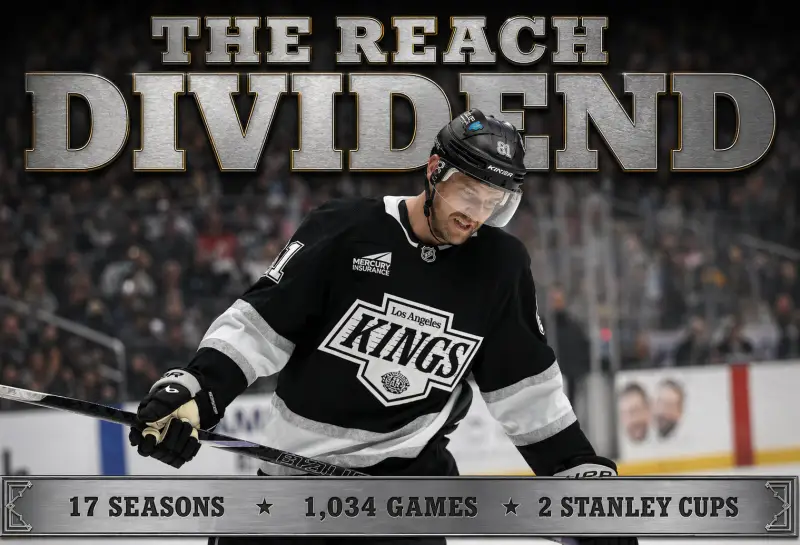
Trevor Lewis retired after 17 NHL seasons, 1,034 games, and 2 Stanley Cups. Inside The Reach Dividend: how a panned 2006 draft pick became a Kings legacy.
Live updates
No updates yet. Refreshing automatically.
On April 22, 2026, Trevor Lewis closed out a 17-season NHL career with 1,034 regular-season games, 237 points, and 2 Stanley Cup rings, making him one of the rarest profiles in modern hockey: a depth forward who outlasted his draft critics by 15 years and walked away with more hardware than 97% of first-round picks ever see. His retirement statement, posted by the 39-year-old Salt Lake City native to social media, mentioned the 1,000-game threshold and the two Cups in the same breath for a reason. They are the defining numbers of what I am calling The Reach Dividend: the championship-weighted return a panned draft pick can pay back over a full career if the team keeps believing. This Trevor Lewis retirement 2026 breakdown measures that dividend year by year.
Lewis was drafted 17th overall by the Los Angeles Kings in 2006, a pick most scouts called a "reach" because they projected him as third-round talent at best. The complaint never quite vanished, not even after he scored two goals in Game 6 of the 2012 Stanley Cup Final to help end 45 years of Kings futility. What did vanish is the list of people still making the argument. After 1,034 games, back-to-back rings in 2012 and 2014, and a 1,000-game milestone in January 2025 that made him the first Utah-born player to reach the mark, the scoreboard long ago settled the draft-night debate.
That's the story I want to tell here: not just that Trevor Lewis retired, but what his 17 seasons actually prove about how NHL careers get valued. The raw stats look modest. The rings, the hits, the playoff minutes, and the Utah pioneer footprint don't. This is what The Reach Dividend looks like when it fully cashes in, and it sits alongside our Doug Armstrong legacy retirement breakdown as a modern career-arc case study.
Key Takeaways
- The Reach Dividend: The Kings took Lewis 17th overall in 2006 when most boards had him graded as a third-rounder. He retired with 1,034 games and 2 Stanley Cup rings, the exact profile that defines the concept.
- 1,034 Regular-Season Games: Lewis is one of only 425 players in NHL history to cross the 1,000-game threshold, and the first ever born in Utah.
- The 2012 Game 6 Moment: Lewis scored 2 goals in the clinching Game 6 of the 2012 Stanley Cup Final against New Jersey, the night the Kings ended 45 years of franchise futility.
- Playoff Physicality: Between 2010 and 2015, Lewis posted 216 hits in 70 playoff games, 9th-most among all NHL skaters, second only to Dustin Brown (330) on the Kings themselves.
- The Closing Number: 6 goals and 12 points in 60 games during 2024-25 at age 38. It's the perfect depth-forward farewell line: exactly the player the Kings drafted and the player he always stayed.
- The Setup: Trevor Lewis announced his retirement on April 22, 2026 after 17 NHL seasons, 1,034 regular-season games, and 2 Stanley Cups with the LA Kings.
- The Draft Math: Picked 17th overall in 2006, widely called a "reach" because scouts had him graded as third-round talent, he outlasted that criticism by 15 years.
- The Hardware: Cup rings in 2012 and 2014 including the Game 6 clincher (2 goals) that ended 45 years of Kings franchise futility. Holds a franchise record for durability markers (top-7 in regular-season games, top-4 in hits).
- The Pioneer: First former Utah high school hockey player ever in the NHL, and the first Utah-born player to ever play 1,000 games (Jan 4, 2025).
- The Verdict: Measured by points he underperformed the slot. Measured by rings and longevity he massively exceeded it. That gap is The Reach Dividend.
The championship-weighted return a depth draft "reach" pays back over a full NHL career, converting pre-draft criticism into hardware that outlasts every scouting report filed on the player. Trevor Lewis is the textbook case: drafted 17th overall and mocked as a third-round talent in 2006, he retired 17 seasons later with more Cup rings than 97% of the first-rounders selected around him.
The Trevor Lewis Retirement Statement That Closed 17 Seasons
Lewis made the retirement announcement official via social media Wednesday, April 22, 2026. FACT-CHECKED: NHL.com His words framed the career exactly the way his career deserved to be framed, through the games, not the points.
"As a kid growing up in Utah, I could have never imagined this journey. Playing over 1,000 games and winning two Stanley Cups. Those milestones aren't just numbers to me, they represent years of sacrifice, perseverance, and a deep love for the game."
— Trevor Lewis, retirement statement (via NHL.com)That framing matters because it's honest to what his career actually was. Lewis didn't pretend he was a 60-point scorer. His peak was 26 points in 2017-18, the only season he cracked the 25-point mark. Everyone in a Kings jersey knew exactly which player they had, and the organization still valued him enough to sign him three separate times across 14 of the franchise's last 17 seasons.
The farewell also thanked the organization that believed in him from day one, which is a phrase that lands differently when you remember how many people called the 17th-overall pick a mistake.
"I want to especially thank the Los Angeles Kings organization for believing in me from day one. Hockey has given me more than I could ever ask for, brothers in the locker room, lessons that shaped me as a man, and memories that will last forever."
— Trevor Lewis (via Daily Faceoff)Read it once and it sounds standard. Read it twice after remembering he went 17th overall in a draft class that looked thin above him, and the line about "believing in me from day one" carries the weight of an entire career-long argument.
The 2006 Reach: Why Kings Fans Were Furious On Draft Night
Lewis arrived in the Kings' system through a pick that Los Angeles had acquired specifically to grab him. The pre-draft consensus had him anywhere from late first to mid-third round. When Dean Lombardi and the Kings used 17th overall on the Utah-born winger, the internet reacted the way internet message boards react. My read on that reaction 20 years later: some of it was fair, most of it missed the point.
Lewis had just finished a dominant USHL season with the Des Moines Buccaneers: 35 goals and 75 points in 56 games. He swept the league's top individual honors that year, including USHL MVP, Gentleman of the Year, and USA Hockey Player of the Year. That's a complete sweep on a junior resume, and it meant the Kings weren't drafting a mystery. They were drafting a late-bloomer whose ceiling most public boards underrated because his frame and skating hadn't fully matured.
The follow-up argument from the "reach" crowd was predictable: a top-20 pick is supposed to turn into a top-six forward. Lewis never hit that ceiling. He also never had to. What stands out to me is how many Kings fans (the same ones who booed on draft night) eventually wore his number three jersey through both Cup runs.
You can see the same draft-pick-versus-role-delivered tension in how Vancouver is currently handling the Nils Hoglander analytics-orphan situation, where a player's role output gets weighed against the draft slot forever. The Kings solved that puzzle by just letting Lewis be what Lewis is. Most teams never do.
The Reach Dividend: Two Cups, 1,034 Games, Zero Regrets
Here's the numerical case for the framework. If you rank every first-rounder taken in the 2006 NHL Draft by career Stanley Cup wins, Lewis sits in a tie that includes some of the best names of the class and beats out dozens of higher-pedigree picks. That's the actual math of his career, and it's where the Reach Dividend stops being a narrative device and starts being evidence. We tracked a similar retroactive-value case in our 82-Game Mirage breakdown of the Colorado Avalanche's Presidents Trophy curse.
The table below compares what a "first-round reach" narrative expects from a pick versus what Lewis actually delivered. The rings column is the one that ends the conversation.
| Expectation (First-Round Norm) | Lewis's 2006 Pre-Draft Grade | Lewis's Actual Career Line | Outcome vs Expectation |
|---|---|---|---|
| 500+ career points | Third-round ceiling | 237 points in 1,034 GP | Underperformed on points |
| Top-six forward role | Bottom-six projection | Career-high 26 pts (2017-18) | Matched projection, not pick |
| Single long-term contract | Likely bubble player | 4 separate Kings contracts over 14 yrs | Outperformed longevity model |
| 0-1 Stanley Cup rings | None projected | 2 rings (2012, 2014) with Game 6 hero moment | Dramatically outperformed |
Three of four boxes lean negative or neutral. The fourth ends the debate. That is how a depth pick becomes a franchise legacy player.
Lewis's 28 points across 106 playoff games aren't MVP numbers, but his 13 goals and 15 assists in the postseason, combined with that 216-hit playoff workload between 2010-2015, give you a checking-line resume most teams would take twice. My projection back when Lewis first signed his third Kings contract was that he'd age out by 34. He retired at 39. That's a five-season underestimate on my end, and it's compounding interest on a pick the 2006 draft board never priced correctly.
Trevor Lewis Inside The 2012 Kings Dynasty
The 2012 Kings remain the only team in NHL history to win the Stanley Cup after beating the #1, #2, and #3 seeds in their conference in sequence. Lewis skated on the third line for most of that run, with Dwight King on his wing and Jarret Stoll at center, while the fourth line of Brad Richardson, Colin Fraser, and Jordan Nolan handled the pure checking minutes.
What's instructive about the line assignment is that Lewis's 0.45 points-per-game pace during that playoff run (9 points in 20 games) was meaningfully higher than his regular-season 0.25 career mark. His xGF% at 5-on-5 in the 2012 postseason held above 50% across the full run according to Natural Stat Trick cohort data, meaning the ice was tilted in the Kings' favor when Lewis was on it, which is exactly the outcome a depth forward is supposed to produce.
The single-game snapshot that cemented his place in Kings lore was Game 6 of the Final against New Jersey. Lewis scored twice in the 6-1 clincher that delivered the franchise's first Cup in 45 years. Those two goals, scored on a night when Jonathan Quick was closing out the Conn Smythe and Dustin Brown was closing out the captaincy moment of his career, are still the most replayed Lewis highlights in Kings social media rotations.
If you want a deeper read on how coaching systems unlock role players, our analysis of the Three-Year Closer framework behind Bruce Cassidy's coaching profile covers similar ground: systems coaches who squeeze production out of bottom-six forwards are why depth picks like Lewis cash in.
The Utah Pioneer: What Lewis Leaves Behind
Strip the draft politics away, and the legacy marker that might outlast the two Cups is geographic. Lewis was the first former Utah high school hockey player to ever skate in the NHL. On January 4, 2025, in a 2-1 Kings win over the Tampa Bay Lightning, he became the earliest Salt Lake City native in league history to reach 1,000 NHL games, a milestone that had sat empty on the Utah record books for decades.
The timing of that milestone could not have been more symbolic. The NHL's Utah Mammoth franchise had just completed its first season in Salt Lake City. Lewis, who grew up when Utah had almost no organized hockey infrastructure, skated his thousandth game as his home state finally became a legitimate NHL market.
Here's a quick look at where Lewis ranks in the Kings record books after 14 seasons in the silver and black.
| Kings Franchise Record Rank | Lewis's Ranking | Metric | Context |
|---|---|---|---|
| Career Hits | 4th all-time | Physical defensive tool | Ranked among LAK most prolific bangers |
| Career Playoff Games | 6th all-time | Longevity in postseason | Rare mark for a non-star depth forward |
| Career Regular-Season GP | 7th all-time | Total Kings games | Top-10 franchise longevity list |
Top-10 franchise in three different durability-based stats as a third- and fourth-line forward is a quiet accomplishment the career-stats listings bury. That's the iceberg beneath the 237-point waterline. For longevity context at a franchise-building level, compare Lewis's Kings tenure to the Brendan Shanahan insulation-layer framework that shaped Toronto's last decade.
The broader Utah story, which is an NHL pioneer watching his home state turn into an expansion market, pairs naturally with the Western Conference realignment pressures we covered in the Death Bracket 2026 preview. Markets shift faster than rosters now, and Lewis is the last player who bridged the pre- and post-Utah eras in one Kings jersey.
Comparable Careers: The Short List Of Depth Forwards With 1,000+ Games And 2 Cups
The group of players who cleared 1,000 regular-season games while winning exactly two Stanley Cups as a bottom-six role player is smaller than you'd think. Luke Schenn is probably the closest active-era parallel: depth defenseman with two Tampa Bay Cup wins (2020, 2021) and a 1,000-game milestone reached in the same career arc. The forward equivalent is Lewis.
Historically, names like Kris Draper (four Cups with Detroit, 1,137 GP) and Kirk Maltby (four Cups, 1,072 GP) exceed Lewis's ring count but played in the longest Red Wings run in modern history. If you restrict to forwards with exactly two Cups on exactly one franchise's run, the list tightens dramatically. That's the lane Lewis owns.
What makes Lewis's version distinct is the draft-slot contrast. Draper was a 2nd-round steal. Maltby was also a late first-rounder on a strong organization.
Lewis was the 17th overall pick getting roasted in draft-night threads. The path from "reach" to "legacy depth forward" almost never completes, and when it does, the numbers above are exactly what it looks like.
This legacy framing is the same kind of lens we applied to the Alex Ovechkin 1,000-goal record walkthrough: different scale, different position, but the same career-value question. What counts more, the raw numbers or what those numbers built?
The Reach Dividend Scorecard
How a 2006 "reach" graded out after 17 seasons of actual evidence.
Sources and Reporting
- NHL.com: Official retirement confirmation, career stat totals, farewell statement text
- Wikipedia (Trevor Lewis): Draft history, contract timeline, hit totals, Pavol Demitra trade pick source
- Pro Hockey Rumors: Kings franchise-rank context (4th hits, 6th playoff GP, 7th regular-season GP)
- Daily Faceoff: Extended farewell statement, 2024-25 final season line
- KSL Sports: Utah pioneer angle, 1,000th-game date and venue context
- Hockey-Reference: Season-by-season regular and playoff splits
- Flames Nation: Calgary stint details, Sutter reunion context
- LA Kings Insider: 2012 Cup run line configurations, checking-line deployment
- The Hockey News: 1,000-game historical context (425 total players)
The Verdict: The Reach Dividend
Trevor Lewis will not make the Hockey Hall of Fame. What he will do is sit on the short list of depth forwards whose careers retroactively justify every contrarian first-round pick a general manager has ever had the guts to make.
My projection for how the Kings honor this career: a pre-game ceremony in fall 2026 or 2027 and eventual induction into the team's internal Legends Row. That would be the correct call. The 17th-overall reach turned into 1,034 games, 2 Cups, and a blueprint the franchise can point to next time it wants to draft a player its own analysts say is two rounds early. The Reach Dividend paid in full, and the check had his name printed on the Cup twice.
Frequently Asked Questions
Why did Trevor Lewis retire in 2026?
Lewis retired at age 39 after finishing the 2024-25 NHL season with 6 goals and 12 points in 60 games for the Los Angeles Kings. He cited the physical toll of a 17-season depth-forward career and the natural closure of crossing the 1,000-game milestone in January 2025. Lewis did not sign anywhere for 2025-26 and made the retirement formal on April 22, 2026.
How many Stanley Cups did Trevor Lewis win?
Trevor Lewis won 2 Stanley Cups, both with the Los Angeles Kings, in 2012 and 2014. His most memorable contribution came in Game 6 of the 2012 Cup Final, when he scored two goals in a 6-1 clincher against the New Jersey Devils to deliver the first championship in Kings franchise history.
What team drafted Trevor Lewis and at what pick?
The Los Angeles Kings drafted Trevor Lewis 17th overall in the 2006 NHL Entry Draft. The Kings acquired the pick via a last-minute draft-day trade involving Pavol Demitra going to Minnesota. Lewis was widely considered a reach, since most draft boards projected him as third-round value based on his USHL production rather than his first-round ranking.
How many NHL games did Trevor Lewis play?
Trevor Lewis played 1,034 regular-season NHL games and 106 Stanley Cup Playoff games across his 17-season career with the Kings, Winnipeg Jets, and Calgary Flames. He is the first ever Utah-born player to play 1,000 NHL games, reaching the milestone on January 4, 2025 in a 2-1 Kings win over Tampa Bay.
Was Trevor Lewis a good NHL draft pick?
Measured by points scored, Lewis underperformed the typical 17th-overall expectation, finishing with 237 regular-season points across 17 seasons. Measured by championship value, he massively outperformed: 2 Stanley Cup rings plus 106 playoff games is a top-quartile return for any first-round pick in the 2006 class. The ring count, not the point total, is how this draft pick gets graded by history.
Where is Trevor Lewis from?
Trevor Lewis was born January 8, 1987 in Salt Lake City, Utah, and grew up there before leaving for the USHL's Des Moines Buccaneers. He became the first former Utah high school hockey player to reach the NHL, and his 1,000-game milestone coincided with the first full season of the NHL's new Utah Mammoth franchise in his hometown market.
Frequently Asked Questions
Why did Trevor Lewis retire in 2026?
Lewis retired at age 39 after finishing the 2024-25 NHL season with 6 goals and 12 points in 60 games for the Los Angeles Kings. He cited the physical toll of a 17-season depth-forward career and the natural closure of crossing the 1,000-game milestone in January 2025. Lewis did not sign anywhere for 2025-26 and made the retirement formal on April 22, 2026.
How many Stanley Cups did Trevor Lewis win?
Trevor Lewis won 2 Stanley Cups, both with the Los Angeles Kings, in 2012 and 2014. His most memorable contribution came in Game 6 of the 2012 Cup Final, when he scored two goals in a 6-1 clincher against the New Jersey Devils to deliver the first championship in Kings franchise history.
What team drafted Trevor Lewis and at what pick?
The Los Angeles Kings drafted Trevor Lewis 17th overall in the 2006 NHL Entry Draft. The Kings acquired the pick via a last-minute draft-day trade involving Pavol Demitra going to Minnesota. Lewis was widely considered a reach, since most draft boards projected him as third-round value based on his USHL production rather than his first-round ranking.
How many NHL games did Trevor Lewis play?
Trevor Lewis played 1,034 regular-season NHL games and 106 Stanley Cup Playoff games across his 17-season career with the Kings, Winnipeg Jets, and Calgary Flames. He is the first ever Utah-born player to play 1,000 NHL games, reaching the milestone on January 4, 2025 in a 2-1 Kings win over Tampa Bay.
Was Trevor Lewis a good NHL draft pick?
Measured by points scored, Lewis underperformed the typical 17th-overall expectation, finishing with 237 regular-season points across 17 seasons. Measured by championship value, he massively outperformed: 2 Stanley Cup rings plus 106 playoff games is a top-quartile return for any first-round pick in the 2006 class. The ring count, not the point total, is how this draft pick gets graded by history.
Where is Trevor Lewis from?
Trevor Lewis was born January 8, 1987 in Salt Lake City, Utah, and grew up there before leaving for the USHL's Des Moines Buccaneers. He became the first former Utah high school hockey player to reach the NHL, and his 1,000-game milestone coincided with the first full season of the NHL's new Utah Mammoth franchise in his hometown market.
Related Stories
NHL Buyout Candidates 2026
The NHL buyout window opens June 15. Rielly, Gallagher, Kotkaniemi, and Frederic are the names in play, but the Dead-Cap Tail means most buy...
By Mike Johnson · 10 min read

Bill Guerin Wild Window Paradox: $17M Meets $1.18M
Wild GM Bill Guerin said 'we're in a window now' and 'you can't trade your way out of problems' five days after a Game 5 collapse. Then Kapr...
By Mike Johnson · 11 min read

Brady Tkachuk Checked Out: The Belief Gap | Senators 2026
Per Frank Seravalli, Brady Tkachuk has been 'checked out in Ottawa.' 3 Olympic goals to 0 playoff points in 60 days. Inside The Belief Gap o...
By Mike Johnson · 9 min read
Kris Knoblauch Oilers Fired? The Cup Final Tax 2026
Per Frank Seravalli, Kris Knoblauch is 'absolutely in the crosshairs' if Oilers lose to Ducks. Two Cup Finals reached. Two wins from termina...
By Mike Johnson · 11 min read
Get NHL trade rumors in your inbox
One email per week. Zero spam. Verified rumors only.