Nils Hoglander Trade: The Analytics Orphan Vancouver Should Have Kept
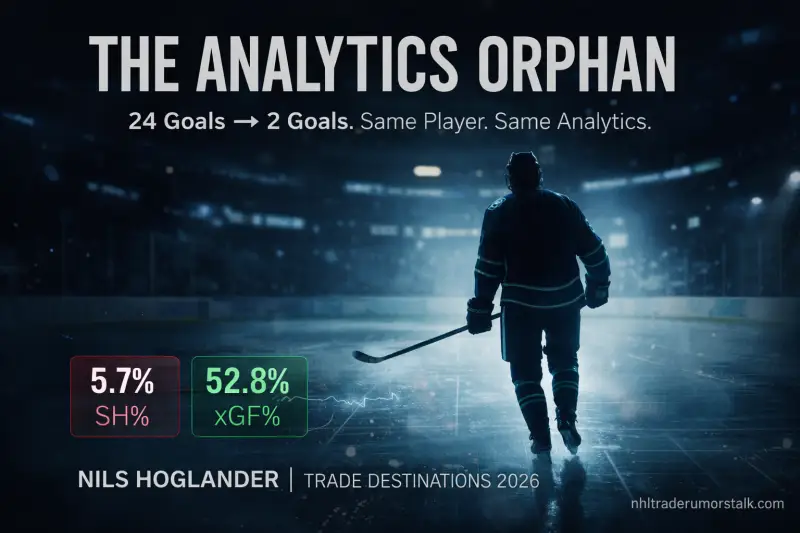
Nils Hoglander scored 24 goals in 2023-24, then two in 2025-26. His 5.7% shooting hides a 52.80% expected goals percentage that says he still drives play. Three teams can unlock the Analytics Orphan at $3M AAV with zero trade restrictions.
Live updates
No updates yet. Refreshing automatically.
24 goals in 80 games. Then two in 37. Same hands, same motor, same willingness to drive the net at 5-foot-9 — and a 14.3-percentage-point collapse in shooting luck that turned a breakout winger into the most expendable forward on the worst team in hockey.
Nils Hoglander is what I'm calling an Analytics Orphan — a player whose underlying process metrics consistently confirm his value while his results have collapsed so completely that his own organization has moved on. Vancouver's front office traded Quinn Hughes to Minnesota, shipped Conor Garland to Columbus, and dumped Tyler Myers to Dallas at the deadline. Hoglander sat through all of it. Unwanted by buyers. Unplayed by his own coaching staff. Stuck at the intersection of a franchise teardown and a career-worst shooting slump.
I've watched enough of these collapses to know what it looks like when a player is done versus when a player is buried. Hoglander's advanced metrics — a 52.80% expected goals percentage, a 53.54% high-danger chance share, both among Vancouver's best in 2024-25 — say this is a forward who still drives play at 5-on-5. The $3 million cap hit with two years of team control and zero trade clauses makes him the cheapest analytics-backed reclamation bet on the summer trade market.
Key Takeaways
- The Analytics Orphan: Hoglander's 5.7% shooting in 2025-26 is a career worst, but his expected goals percentage (52.80%) and high-danger chance share (53.54%) from 2024-25 prove he still drives play at 5-on-5. His value is real — his results are buried under puck luck.
- The 20-to-5.7 Swing: His 20.0% shooting in 2023-24 was unsustainably high. His 5.7% in 2025-26 is unsustainably low. His career average of 11.6% is the true talent level — translating to roughly 15-18 goals with proper deployment.
- $3M for Two Years, No NTC: The cleanest contract structure on the trade market for a player with this analytics profile. Any team can acquire him without negotiating a no-trade clause.
- Three Reported Suitors: Washington, Pittsburgh, and Columbus all called Vancouver during the season, per ESPN's Kevin Weekes. Each offers a different deployment path that could unlock his 5-on-5 finishing.
- The Canucks' Fire Sale Continues: Vancouver traded Hughes, Garland, and Myers. Elias Pettersson and Jake DeBrusk are next. Hoglander is a smaller piece in a franchise-wide teardown heading toward the 2026 draft lottery.
The Numbers Behind the Collapse
Start with the shooting percentage, because that's where the entire narrative lives. Hoglander shot 20.0% in 2023-24 — roughly double his career average of 11.6%. That breakout season produced 24 goals, all at 5-on-5, which ranked him tied 10th in the entire NHL in even-strength goals alongside Mikko Rantanen. It was a legitimate production spike. It was also mathematically certain to regress.
The regression arrived in 2024-25 (9.6% shooting, 8 goals in 72 games) and then cratered in 2025-26 (5.7% shooting, 2 goals in 37 games). An ankle sprain in September 2025 required surgery and cost him the first 29 games of the season. When he returned, coach Adam Foote immediately made him a healthy scratch.
"He's been out a long, long time, and three games in four nights is hard for a guy coming in with that much time out, in my opinion. We've got to still get him up to speed."
— Adam Foote, Canucks head coach (via Canucks Army)The deployment never recovered. Hoglander averaged 11:28 of ice time per game — fourth-line territory for a player whose 2023-24 underlying numbers screamed top-nine usage. Here's the three-year trajectory:
| Season | GP | G | PTS | SH% | xGF% | HDCF% | TOI/G |
|---|---|---|---|---|---|---|---|
| 2023-24 | 80 | 24 | 36 | 20.0% | — | — | 13:30 |
| 2024-25 | 72 | 8 | 25 | 9.6% | 52.80% | 53.54% | 14:12 |
| 2025-26 | 37 | 2 | 5 | 5.7% | — | — | 11:28 |
| Career | 330 | 60 | 120 | 11.6% | — | — | — |
The critical number isn't the 5.7% or the 20.0%. It's the 52.80% expected goals percentage from 2024-25 — a full-season sample across 72 games showing Hoglander on the right side of puck possession more often than not. His 53.54% high-danger chance share ranked first among all Canucks forwards with 20-plus games played. The process was sound. The results just stopped showing up.
Shooting percentage at 5.7% is 5.9 points below his career average — a gap large enough that positive regression is virtually guaranteed with adequate deployment and sample size. The analytical case for buying low on Hoglander is as clean as the trade market offers this summer.
Three Destinations for the Analytics Orphan
ESPN's Kevin Weekes reported three teams actively calling Vancouver on Hoglander during the season: Washington, Pittsburgh, and Columbus. All three make structural sense — though the fit is slightly different for each.
1. Washington Capitals
Washington's forward depth was stretched thin through much of 2025-26, particularly on the left side. Hoglander's $3 million cap hit slots cleanly beneath the Capitals' core contracts, and his 5-on-5 play-driving ability addresses a gap the Capitals haven't been able to fill internally. At 25, he's young enough to complement Washington's competitive window while Alex Ovechkin chases Wayne Gretzky's goal record.
My read: Washington is the best stylistic fit. The Capitals play a heavy, north-south game that rewards exactly the type of net-front tenacity Hoglander showed when he scored 24 goals. His willingness to absorb contact at 5-foot-9, 185 pounds is rare, and it translates directly to a team built around power forwards and physical presence. The Capitals would likely slot him into a middle-six role with consistent linemates — something he hasn't had in Vancouver since 2023-24.
Projected cost: 2027 third-round pick, possibly with a low-end prospect swap.
2. Pittsburgh Penguins
Pittsburgh's need for affordable, controllable wingers is well-documented. With Sidney Crosby entering his final contracted season in 2026-27 and the franchise needing every dollar of cap space allocated efficiently, a $3 million winger who drives possession fits the same template that made the Yegor Chinakhov acquisition work. Chinakhov was producing at a similar floor (3 goals in 29 games with Columbus) before Pittsburgh's system unlocked him.
The risk: Pittsburgh already took one reclamation swing this year. Taking another on a player with a worse 2025-26 stat line than Chinakhov had in Columbus feels like pushing the model. But Kyle Dubas has explicitly said acquiring young, controllable forwards for draft capital is the Penguins' template — and Hoglander's profile fits that description exactly.
Projected cost: 2026 fourth-round pick plus a depth forward (Marcus Pettersson has been mentioned as a trade chip going the other direction in separate Pittsburgh trade talks).
3. Columbus Blue Jackets
Columbus is building around a young core and has the cap space to absorb Hoglander's full $3 million without restructuring. The Blue Jackets acquired Conor Garland from Vancouver at the deadline — a similar profile of a skilled, undersized winger — suggesting their front office specifically values this archetype. Adding Hoglander to a forward group that includes Garland, Adam Fantilli, and Kent Johnson gives Columbus multiple puck-possession drivers at manageable cap hits.
Projected cost: 2027 third-round pick. Columbus could also include David Jiricek as part of a larger package involving multiple Canucks assets, per Weekes' original reporting.
"Nils Hoglander is a name out there right now. Teams are calling on him. No points in 13 games, fourth line... It's time to move him."
— Rick Dhaliwal, Canucks insider (via Sportskeeda)Why the Return Will Sting
I'll be honest about the counter-argument, because it's significant: two goals in 37 games is historically awful for a player making $3 million. Vancouver's front office isn't delusional for wanting to move on. There are real reasons to believe the 2023-24 breakout was the outlier, not the 2025-26 collapse.
Hoglander has only two career power-play goals across 330 NHL games. He doesn't kill penalties consistently. His career playoff sample — one game-winning goal, two points in 11 postseason games — offers nothing for a contender banking on October-to-June production. At 5-foot-9, he doesn't project as a physical mismatch in the way that larger reclamation targets do. And the ankle surgery that wiped out September through November may have affected his push-off mechanics in ways that don't show up in expected-goals models.
The realistic return reflects all of this. Heavy.com described his trade value bluntly: a mid-round pick at best, possibly a prospect-for-prospect swap. That's the market for a rebuilding team offloading a forward whose box-score numbers look replacement-level. The acquiring team is buying the analytics, the age curve, and the contract — not the 2025-26 stat line.
Here's where most Hoglander takes get it wrong, though. They treat his 24-goal season as a shooting-percentage mirage and stop the analysis there. What they miss is that his play-driving metrics were strong before that breakout and stayed strong after the goals disappeared. His rookie-year Corsi was the best on the Canucks. His 2024-25 expected-goals percentage was fourth on the team. The process has been consistent across four seasons — only the results have fluctuated with shooting luck.
The Chinakhov Precedent
The most instructive comparable isn't a historical trade from 2018 or a lockout-era reclamation project. It happened four months ago in Pittsburgh.
Yegor Chinakhov was producing at a 3-goals-in-29-games pace with the Columbus Blue Jackets when Kyle Dubas acquired him in late December for Danton Heinen, a 2026 second-round pick, and a 2027 third. The analytics community flagged Chinakhov as an underperforming asset whose deployment in Columbus suppressed his output. Pittsburgh changed his linemates, bumped his ice time from 10 minutes to 15, and watched him produce at a 20-goal pace the rest of the way.
The parallel is almost eerie. Both Hoglander and pre-trade Chinakhov are young, controllable wingers with underlying metrics that outperformed their point totals. Both were buried on rebuilding teams that couldn't or wouldn't deploy them in top-nine roles. Both carried cap hits under $3.5 million with multiple years of team control remaining. The structural profile is identical — only the trade hasn't happened yet.
The lesson of the Subtraction Spiral applies in reverse here. Where Toronto learned that removing a connector destroys a system, the acquiring team learns that adding an analytics-verified driver to a competent system creates compounding returns. Hoglander doesn't need to be Mitch Marner. He needs to be the guy who generates an extra three high-danger chances per game on a team that can convert them.
Andre Burakovsky offers the longer-term precedent. Washington traded him to Colorado for a second-round pick in 2019 after he underperformed in their system. Burakovsky put up 45 points in his first season with the Avalanche and won a Stanley Cup three years later. Western Conference teams that identify these mismatches between player capability and team deployment have historically been rewarded.
What $3 Million Actually Buys
Strip away the 2025-26 stat line and focus on what an acquiring team is structurally purchasing:
- Age 25 with 330 NHL games: Not a prospect, not a project — a player with a defined NHL game who has already shown a 24-goal ceiling and whose floor (even at career-worst shooting) still drove positive expected-goals rates.
- salary cap hit calculations through 2027-28: Under a salary cap projected to hit $104 million in 2026-27 and $113.5 million in 2027-28, that cap hit shrinks from 3.1% to 2.6% of the ceiling. It's a rounding error on a contender's cap sheet.
- No NTC, no NMC: Any of 32 teams can acquire him. No agent-managed 10-team list suppressing the market, no modified clause restricting destinations. The cleanest trade mechanics available.
- 5-on-5 net-front game: All 24 of his 2023-24 goals were scored at even strength. He doesn't need power-play deployment to produce — he needs consistent linemates and a system that plays through the middle of the ice.
The 2026 UFA class is deep enough that teams chasing winger upgrades have multiple paths. But the free-agent market charges market-rate AAV for players with Hoglander's upside — $5 million or more, with term commitments that carry real risk. The trade market charges a third-round pick. That's the gap the Analytics Orphan creates: a player priced at his floor by a team that has stopped investing in his development, available to any organization willing to bet that 52.80% expected-goals rates don't lie.
Sources and Reporting
- ESPN — complete career stats, 2025-26 season totals, and game log data
- CapWages — contract verification: 3yr/$9M ($3M AAV), no NTC, UFA 2028
- Canucks Army — 2024-25 advanced metrics: 52.80% xGF%, 53.54% HDCF%, 49.97% CF%
- Canucks Army — Adam Foote healthy-scratch comments, deployment timeline
- Sportskeeda / Rick Dhaliwal — Canucks insider confirming trade interest, agent involvement
- Yardbarker / Kevin Weekes — Washington, Pittsburgh, Columbus identified as active suitors
- Heavy.com — offseason trade candidate ranking, return expectations
- Hockey Reference — career splits, 5v5 goal breakdown, historical comparables
- Natural Stat Trick — shooting percentage regression models, on-ice event rates
The Verdict: The Analytics Orphan
Nils Hoglander's trade market this summer will be defined by which version of the player you believe is real. If you trust the 2 goals in 37 games, he's a replacement-level winger on an expiring opportunity. If you trust the 52.80% expected-goals rate and the 53.54% high-danger chance share — metrics that have been consistently above average across multiple seasons regardless of his shooting luck — he's a $3 million steal with a 15-to-20-goal ceiling that a competent system can unlock.
My projection: Washington acquires Hoglander before the 2026 draft for a third-round pick and a B-level prospect swap. He scores 16 goals in his first full season as a Capital. And the Canucks, three years from now, will add him to the list of assets this rebuild gave away for less than they were worth — because the box score orphaned him before the analytics could make the case.
Frequently Asked Questions
What is Nils Hoglander's current contract?
Hoglander signed a three-year, $9 million extension ($3 million AAV) in October 2024. He has two years remaining through 2027-28 with no trade clauses of any kind, making him one of the easiest players to move on the summer trade market. He becomes an unrestricted free agent in 2028.
Why are the Canucks trading Nils Hoglander?
Vancouver is in a full franchise rebuild after finishing last in the NHL in 2025-26. The Canucks have already traded Quinn Hughes, Conor Garland, and Tyler Myers. Hoglander's diminished role under coach Adam Foote — 11:28 average ice time, multiple healthy scratches — signals the organization views his roster spot as better used for younger prospects entering the pipeline.
What happened to Hoglander in 2025-26?
An ankle sprain during September preseason required surgery, costing him the first 29 games. He returned in December but was immediately healthy scratched, then deployed on the fourth line. He finished with 2 goals and 5 points in 37 games at a career-worst 5.7% shooting percentage — well below his 11.6% career average.
Could Hoglander realistically score 20 goals again?
Twenty is a stretch, but 15-18 is analytically supported. His 2023-24 shooting percentage of 20.0% was unsustainably high, but his career average of 11.6% applied to proper top-nine deployment and 150-plus shots projects 17-18 goals. His underlying metrics at 5-on-5 consistently rank above average regardless of goal output.
What is Hoglander's realistic trade value?
A mid-round draft pick — likely a third-rounder — plus potentially a low-end prospect swap. His 2025-26 production (2 goals in 37 games) has cratered his market value, but two years of team control at $3 million AAV with no trade restrictions provides enough structural value to command more than a late-round flier.
Frequently Asked Questions
What is Nils Hoglander's current contract?
Hoglander signed a three-year, $9 million extension ($3 million AAV) in October 2024. He has two years remaining through 2027-28 with no trade clauses of any kind, making him one of the easiest players to move on the summer trade market. He becomes an unrestricted free agent in 2028.
Why are the Canucks trading Nils Hoglander?
Vancouver is in a full franchise rebuild after finishing last in the NHL in 2025-26. The Canucks have already traded Quinn Hughes, Conor Garland, and Tyler Myers. Hoglander's diminished role under coach Adam Foote signals the organization views his roster spot as better used for younger prospects.
What happened to Hoglander in 2025-26?
An ankle sprain during September preseason required surgery, costing him the first 29 games. He returned in December but was immediately healthy scratched, then deployed on the fourth line. He finished with 2 goals and 5 points in 37 games at a career-worst 5.7% shooting percentage.
Could Hoglander realistically score 20 goals again?
Twenty is a stretch, but 15-18 is analytically supported. His career average shooting percentage of 11.6% applied to proper top-nine deployment and 150-plus shots projects 17-18 goals. His underlying metrics at 5-on-5 consistently rank above average regardless of goal output.
What is Hoglander's realistic trade value?
A mid-round draft pick, likely a third-rounder, plus potentially a low-end prospect swap. His 2025-26 production has cratered his market value, but two years of team control at $3 million AAV with no trade restrictions provides enough structural value to command more than a late-round flier.
Related Stories
NHL Buyout Candidates 2026
The NHL buyout window opens June 15. Rielly, Gallagher, Kotkaniemi, and Frederic are the names in play, but the Dead-Cap Tail means most buy...
By Mike Johnson · 10 min read

Bill Guerin Wild Window Paradox: $17M Meets $1.18M
Wild GM Bill Guerin said 'we're in a window now' and 'you can't trade your way out of problems' five days after a Game 5 collapse. Then Kapr...
By Mike Johnson · 11 min read

Brady Tkachuk Checked Out: The Belief Gap | Senators 2026
Per Frank Seravalli, Brady Tkachuk has been 'checked out in Ottawa.' 3 Olympic goals to 0 playoff points in 60 days. Inside The Belief Gap o...
By Mike Johnson · 9 min read
Kris Knoblauch Oilers Fired? The Cup Final Tax 2026
Per Frank Seravalli, Kris Knoblauch is 'absolutely in the crosshairs' if Oilers lose to Ducks. Two Cup Finals reached. Two wins from termina...
By Mike Johnson · 11 min read
Get NHL trade rumors in your inbox
One email per week. Zero spam. Verified rumors only.