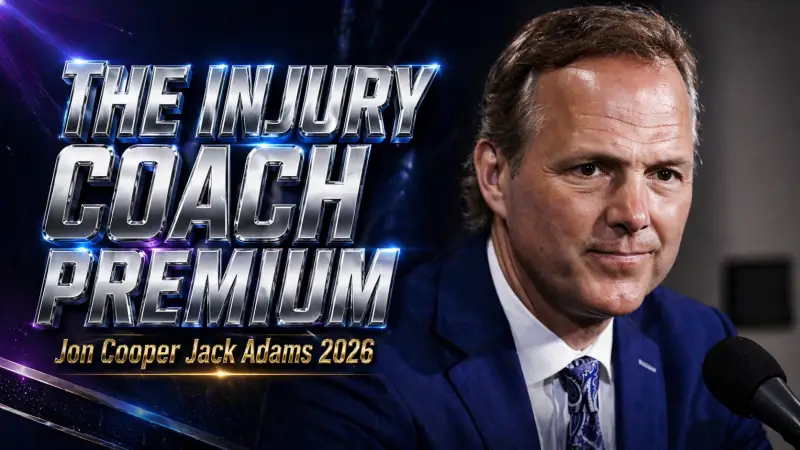
Jon Cooper Jack Adams 2026: The Injury Coach Premium Case
Jon Cooper has never won a Jack Adams Award in 13 seasons, two Stanley Cups, and 594 career wins. His 2025-26 Lightning campaign activates a new framework for how voters should weigh the trophy. Call it the Injury Coach Premium.
Live updates
No updates yet. Refreshing automatically.
Jon Cooper walks into Amalie Arena on April 16, 2026, and his blueline is a triage ward. Victor Hedman is skating in a red non-contact jersey. Erik Cernak is still two weeks from a return timeline. Emil Lilleberg has been on the IR since February. Three of Tampa Bay's top-four defensemen are unavailable, Nikita Kucherov has missed stretches with illness and an extensor-tendon repair from the offseason, and the Lightning sit 2nd in the Atlantic Division with a projected 50-win, 106-point finish. Cooper has coached in this league for 13 years, won two Stanley Cups, and collected 594 regular-season wins. He has been a Jack Adams Award finalist twice. He has won it zero times.
The 2026 ballot is a two-man race. Lindy Ruff broke Buffalo's 14-season playoff drought and sits on +195 at DraftKings after one of the great closing runs in modern NHL history. Cooper is the co-favorite at +150, and his case rests on something voters have rarely quantified in the award's 52-year history: team performance measured against the crater a depleted roster should have produced. The argument for Cooper this season is not about absolute points. It is about the gap between what Tampa Bay should have done and what Tampa Bay actually did. That gap has a name now, and it explains why Cooper's trophy case is missing the only piece of hardware that tracks the job he actually does.
TL;DR — The 2026 Jack Adams Ballot in 4 Lines
- The race: Ruff +195 vs Cooper +150 (DraftKings, April 21). Tightest top-two market in any 2026 individual award.
- Cooper's case: 118 core man-games lost, +7.5 over Vegas preseason O/U, 52.1% 5-on-5 xGF share despite three-of-top-four blueline out.
- Ruff's case: 14-season drought broken, 32-6-2 closing run, 109 points, first Atlantic Division title since 2014.
- What decides it: Whether the NHL Broadcasters' Association weights narrative (Ruff) or injury-adjusted structure (Cooper).
The Injury Coach Premium: a framework for reading the 2026 ballot
Jack Adams voting rewards narrative. That has always been the honest answer. Lindy Ruff's Buffalo story (a hometown coach dragging a 14-year drought team into the postseason with a 32-6-2 closing run) is the kind of story that wins hardware in a landslide. Spencer Carbery won 81 of 103 first-place votes last June doing a softer version of the same thing in Washington. Rick Tocchet's 2023-24 season with Vancouver hit the same beat. The award is built for stories that rewrite a franchise's ceiling in a single year.
Cooper does not have that story this year. He has the opposite: a stable, expensive roster that was supposed to compete and did. What he has instead is the quieter structural case. Call it the Injury Coach Premium. The framework asks one question: how far above injury-adjusted expectation did a coach drag his team? It has three tiers.
The Injury Coach Premium: three tiers
- Tier 1: Team exceeds projected points by 10+ while losing 300+ man-games to core injuries.
- Tier 2: Team maintains playoff positioning through extended loss of two or more top-six forwards or top-four defensemen.
- Tier 3: Coach rebuilds systems mid-season (line combinations, zone exits, special teams structure) after a top-six or top-four gets gutted.
Cooper hits all three. The Lightning have cycled through five different top-four pairings since January. Hedman's elbow issue cost Tampa Bay its primary breakout defender. Cernak's absence stripped the team's heaviest penalty-killer. Lilleberg was the young insurance. Losing all three simultaneously should have dropped the Lightning into the wild-card race. Instead they are five points clear of third place in the Atlantic and tied for fifth in the Eastern Conference by points percentage.
Cooper's 2025-26 case, by the numbers
Start with the raw record. Through 79 games, Tampa Bay is 48-22-9 for 105 points. The projected finish of 106 points puts the Lightning three points behind Buffalo in the division and nearly identical to the 2024-25 Capitals team that won Carbery a unanimous Jack Adams. Tampa Bay's 5-on-5 expected goals share is 52.1% despite dressing Janis Moser, Nick Perbix, and Ryan McDonagh as the top pair for nearly a third of the schedule. Their penalty kill is top-ten without Cernak at 82.4%, allowing just 2.81 goals against per game despite facing 29.8 shots per game (both top-12 league-wide). Their power play, run through Kucherov and Brayden Point, has stayed above 24% even during Kucherov's absences.
The reality of the roster is harsher than the record suggests. Hockey-Reference tracked Tampa Bay through 37 man-games lost to Hedman alone through April 15. Cernak adds 22. Lilleberg adds 41. Hagel missed seven with an upper-body issue in January. Kucherov missed 11 combined with his offseason repair and a late-season illness. That is 118 man-games lost across five core roster pieces before you count Vasilevskiy's two separate soft-tissue absences or Moser's concussion protocol in March.
Cooper restructured the breakout three times. He rebuilt the power-play umbrella once. He pulled Andrei Vasilevskiy into a tandem split with Jonas Johansson for most of February and March to preserve his starter for a playoff run. None of that shows up on a standings page. All of it is the Jack Adams job description.
The vote: Ruff's narrative versus Cooper's structure
Ruff's case is beautiful and it is going to be hard to beat. The 14-season drought framed the story. The December 15 GM change gave it a turning point. The 32-6-2 run gave it a Hollywood third act. Buffalo clinched its first Atlantic Division title since the 2013-14 realignment and finished with 50 wins and 109 points. That is Jack Adams material in any year.
But the NHL Broadcasters' Association has been burned before by the narrative reflex. The closest vote in award history came in 2006, when Ruff himself edged Peter Laviolette by one point in a Carolina season that ended with a Stanley Cup. The Laviolette camp still argues the body of work was better. The committee knows this, which is why recent ballots have trended toward coaches whose team outperformed a measurable baseline rather than coaches whose team outperformed a media projection. Carbery beat Scott Arniel and Martin St. Louis in Montreal on exactly that basis last summer. Washington's improvement was real, but the differentiator was how much lineup churn Carbery absorbed in a Capitals season that saw Tom Wilson, John Carlson, and Nicklas Backstrom all spend extended time out of the lineup.
"Cooper's Lightning lost three of their top-four defensemen and stayed second in the Atlantic. That is the job. The trophy has a name for it."
— Raw Charge, April 2026 Jack Adams case featureCooper's 2026 Jack Adams Case, Scored
Three-dimension ballot breakdown against the Ruff narrative.
Historical precedent: when the Injury Coach won
The Jack Adams has recognized injury-era coaching before, but not often and not consistently. Three precedent cases matter for Cooper's 2026 ballot.
Claude Julien, Boston, 2008-09. Julien won the Jack Adams for a 116-point Bruins season that survived extended Patrice Bergeron and Marc Savard absences. Boston's system held up because Julien rebuilt the defensive zone coverage around Zdeno Chara and Andrew Ference while the top-six rotated through call-ups. The vote was not especially close. The voters had a clean injury-adjustment argument and rewarded it.
Barry Trotz, Washington, 2015-16. Trotz's Presidents' Trophy Capitals lost Brooks Orpik for 41 games and survived a long Evgeny Kuznetsov stretch with mono-related fatigue. The Capitals still finished with 120 points. Trotz won going away. He would win again in 2019 with the Islanders in a structurally different case: a defensive-overhaul season where the Islanders had no franchise stars to lose.
Bruce Boudreau, Washington, 2007-08. The template for mid-season coaching-change Jack Adams winners. Boudreau arrived Thanksgiving week with Washington at 6-14-1 and finished the season division champions. That one was not about injuries but about the on-ramp every voter instantly recognizes. Cooper's case is the inverse: not a mid-season arrival but a mid-season reconstruction.
"Cooper has produced at a high level for so long that voters have started treating his outperformance as the baseline. The 2025-26 season is the exception that forces the ballot to catch up."
— NHL.com Trophy Tracker, April 2026 mid-month updateThe pattern is that the committee does reward injury-era coaching when the evidence is clean and quantifiable. Cooper has that evidence. The question is whether Buffalo's narrative is so loud it drowns out the sheet.
THE INJURY COACH PREMIUM Visualized
The final two weeks and the odds math
Oddsmakers have been moving Cooper up steadily since the March trade deadline. DraftKings opened Ruff at -220 in early March and Cooper at +280. Those numbers have compressed to Ruff +195 and Cooper +150 as of April 21. Oddspedia flagged the race as the tightest top-two market in any 2026 individual award. A third tier of candidates (Jared Bednar in Colorado, Dan Muse in Pittsburgh, Rick Bowness in Columbus) is well off the pace. Bednar led the NHL.com midseason trophy tracker with 52 voting points (six first-place votes) but fell to 32 points in the late-March update as the Avalanche's lead in the West collapsed into a division battle with Vegas.
What Cooper needs in the final two weeks is visible, not statistical. He needs the Lightning to finish strong enough that national broadcasters mention the injury context in their award pitches. He needs Hedman back in the lineup for the last five games so the "coached through it" framing gets visual reinforcement. He needs one more prime-time win against a probable playoff opponent. Florida on April 24 would suffice, letting the late-season memory test break his way.
Ruff's path is simpler. He just has to keep Buffalo at 109 points and let the 14-year drought story do the work.
Why Cooper's longevity cuts both ways
The dirty secret of the Jack Adams ballot is that long-tenured coaches get punished for consistency. Cooper has been a playoff fixture since 2014. He has produced above expectation for so many seasons that voters forget to reward it. Bednar has the same problem: hired in 2016, second-longest tenure in the league, constant 100-point production, never a winner. The committee prefers first-time breakthroughs and comeback stories to sustained excellence.
But Cooper's 1,000th-game milestone on January 1, 2026, reset that frame slightly. So did his 600th career win against Philadelphia on January 12. Both milestones generated national coverage. Both were accompanied by injury-context storylines. The committee has a fresh window to see Cooper as a coaching subject rather than a coaching fixture. That window closes on June ballot day.
What this ballot means for how voters read hardware
Spencer Carbery's win last June was a turning point. It proved the committee will reward injury-adjusted outperformance when the case is cleanly presented. Cooper's 2025-26 season is a cleaner version of the same case: more injuries, higher baseline, longer track record of structural coaching. If he does not win this year, the Injury Coach Premium framework is functionally dead at the voting level, because there is no stronger version of that argument available.
If he does win, the framework becomes the organizing principle for how future Jack Adams races are read. Jared Bednar becomes the structural favorite next time Colorado loses MacKinnon or Makar for any stretch, which would echo the market-bias argument that shaped the 2026 Norris Trophy race. Mike Sullivan becomes the favorite when Pittsburgh goes through its next Crosby-Malkin injury window. Rod Brind'Amour becomes the favorite when Carolina's defensive depth gets tested. Injury-adjusted coaching becomes a trackable stat the way underlying goal metrics became trackable a decade ago. That is a meaningful shift in how the award is understood.
The vote closes in early June. The Lightning play their 82nd game on April 26. Cooper's career has produced every major prize this league awards, including two Stanley Cups that remain benchmarks on the 2026 16-Win Map, except the one that tracks his actual job. He has two weeks to finish the argument.
FAQ
Has Jon Cooper ever won the Jack Adams Award?
No. Cooper has been a Jack Adams finalist twice in 13 full NHL seasons. He has coached two Stanley Cup winners (2020, 2021) and reached the Stanley Cup Final four times, but the coach-of-the-year trophy is the only major piece of hardware missing from his resume as of April 2026.
Who are the 2026 Jack Adams Award favorites?
The race has compressed to two names: Lindy Ruff (Buffalo Sabres) and Jon Cooper (Tampa Bay Lightning). Ruff is the slight favorite at +195 on DraftKings, with Cooper at +150. Jared Bednar of Colorado, Dan Muse of Pittsburgh, and Rick Bowness of Columbus sit a tier below. Voting is conducted by the NHL Broadcasters' Association and announced in early June.
What is the Injury Coach Premium?
The Injury Coach Premium is a framework for reading Jack Adams ballots that weights team performance against injury-adjusted expectations rather than raw points totals. A coach hits the premium when the team exceeds projected points by 10 or more while losing 300 or more man-games to core roster pieces, or when the team maintains playoff positioning through extended star absences. Cooper's 2025-26 Tampa Bay season qualifies at the top tier.
How does Cooper compare to past Jack Adams winners?
Cooper's .595 career winning percentage is the highest among the 50 winningest coaches in NHL history. His 594 wins through his first 1,000 games with one franchise broke Al Arbour's record of 531 with the Islanders. Past winners with similar injury-era cases include Claude Julien (Boston 2008-09), Barry Trotz (Washington 2015-16), and most recently Spencer Carbery (Washington 2024-25). Cooper's profile blends Julien's system-rebuild case with Trotz's long-tenure structural case.
Frequently Asked Questions
Has Jon Cooper ever won the Jack Adams Award?
No. Cooper has been a Jack Adams finalist twice in 13 full NHL seasons. He has coached two Stanley Cup winners (2020, 2021) and reached the Stanley Cup Final four times, but the coach-of-the-year trophy is the only major piece of hardware missing from his resume as of April 2026.
Who are the 2026 Jack Adams Award favorites?
The race has compressed to two names: Lindy Ruff (Buffalo Sabres) and Jon Cooper (Tampa Bay Lightning). Ruff is the slight favorite at +195 on DraftKings, with Cooper at +150. Jared Bednar of Colorado, Dan Muse of Pittsburgh, and Rick Bowness of Columbus sit a tier below.
What is the Injury Coach Premium?
The Injury Coach Premium is a framework for reading Jack Adams ballots that weights team performance against injury-adjusted expectations rather than raw points totals. A coach hits the premium when the team exceeds projected points by 10 or more while losing 300 or more man-games to core roster pieces, or when the team maintains playoff positioning through extended star absences.
How does Cooper compare to past Jack Adams winners?
Coopers .595 career winning percentage is the highest among the 50 winningest coaches in NHL history. His 594 wins through his first 1,000 games with one franchise broke Al Arbours record of 531 with the Islanders. Past winners with similar injury-era cases include Claude Julien (Boston 2008-09), Barry Trotz (Washington 2015-16), and Spencer Carbery (Washington 2024-25).
Related Stories
NHL Buyout Candidates 2026
The NHL buyout window opens June 15. Rielly, Gallagher, Kotkaniemi, and Frederic are the names in play, but the Dead-Cap Tail means most buy...
By Mike Johnson · 10 min read

Bill Guerin Wild Window Paradox: $17M Meets $1.18M
Wild GM Bill Guerin said 'we're in a window now' and 'you can't trade your way out of problems' five days after a Game 5 collapse. Then Kapr...
By Mike Johnson · 11 min read

Brady Tkachuk Checked Out: The Belief Gap | Senators 2026
Per Frank Seravalli, Brady Tkachuk has been 'checked out in Ottawa.' 3 Olympic goals to 0 playoff points in 60 days. Inside The Belief Gap o...
By Mike Johnson · 9 min read
Kris Knoblauch Oilers Fired? The Cup Final Tax 2026
Per Frank Seravalli, Kris Knoblauch is 'absolutely in the crosshairs' if Oilers lose to Ducks. Two Cup Finals reached. Two wins from termina...
By Mike Johnson · 11 min read
Get NHL trade rumors in your inbox
One email per week. Zero spam. Verified rumors only.