Vincent Trocheck Rangers Trade 2026: Offseason Market
Five contenders are lining up for Vincent Trocheck this offseason, but his 10-team NTL quietly prices the trade. Why the Rangers' ask won't hold — plus destination rankings and a return projection.
Live updates
No updates yet. Refreshing automatically.
Vincent Trocheck has three years and $16.875 million left on his deal, and the New York Rangers are now the last team in line before his no-trade clause shrinks from a 10-team list to the six-team version that starts in 2027-28. That window (this summer, before the draft floor opens in Los Angeles) is why Elliotte Friedman's April 17 update on the 32-year-old center landed harder than a standard offseason rumor. The usual offseason trade candidate list doesn't typically come with this much bargaining power for the player.
"Teams know what the Rangers want, and I always assume after the playoffs are over, someone who's gonna lose early is gonna say you know what...we could use Vinny Trocheck," Friedman wrote in his 32 Thoughts column. That single sentence is the shape of the market. Five contenders are positioned to circle back once their postseason ends early: Washington, Toronto, Carolina, San Jose, and Los Angeles. New York is betting they will.
My read: the ask is big (a first-round draft pick, a top-six-projection prospect, a roster-ready body), but the pricing weight isn't where the Rangers think it is. Trocheck's 10-team NTL filters the market down to a small pool of Stanley Cup teams he'd approve, and those teams know exactly how narrow the approved zone is. That's The Contender's Veto: the structural imbalance nobody talks about when they list destinations.
Key Takeaways
- Contender's Veto: Trocheck's 10-team NTL filters the Rangers' market down to a small pool of playoff teams he'd approve, and those teams know their bargaining power.
- The Ask: New York wants a first-round draft pick, a top-six-projection prospect, and an NHL-ready piece. Three trade-deadline suitors (per Friedman) balked at that price.
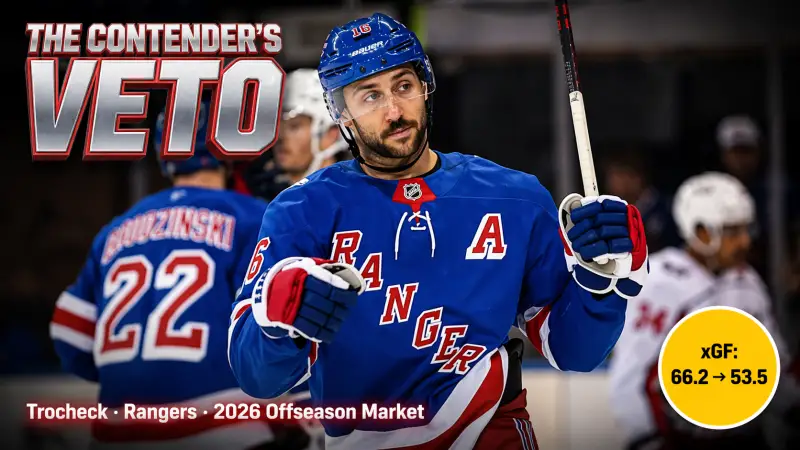
- Analytics pressure: Trocheck's xGF dropped from 66.2 (2024-25) to 53.5 (2025-26), a decline that weakens the premium ask.
- Money left: $5.625M AAV over three more years ($16.875M total). No buy-out clause, no escape hatches. The acquiring team owns the contract into Trocheck's age-35 season.
- My projection: Return lands at a conditional first plus a mid-tier prospect (not top-tier), with Rangers salary retention of 25-30% of AAV to extract value from the contender pool.
What Friedman's Report Actually Confirmed
There have been center rumors out of Madison Square Garden for five months. This one is different. Friedman's April 17 column named the five approved contenders and framed the market in a way that suggests the Rangers' front office expects multiple offers after the first round of playoffs. That's a structural signal, not noise.
Two of those teams (Carolina and Los Angeles) were already in advanced talks before the March trade deadline, according to multiple deadline reports. The Hurricanes reportedly balked at the Rangers' ask (a first-round pick, a top prospect, and a roster-ready body) and pivoted to Nicolas Deslauriers instead. That's a revealing "no." When Carolina, a team with genuine Cup-window urgency and plenty of cap flexibility, won't pay the Rangers' price, every other team noticed.
The Contender's Veto
The structural imbalance created when a player with a restrictive no-trade list is traded by a rebuilding team. Because the rebuild team has only one window to move the asset (before the clause shrinks further), and because the player will only approve a narrow set of Cup contenders, those contenders collectively set the price, not the seller. In Trocheck's case, his 10-team NTL in 2026-27 means the Rangers need buy-in from both the trade partner AND Trocheck himself. The vetoing party isn't the GM. It's the player's agent and the player's contender filter.
The Rangers' Rebuild Math: Why This Trade Has to Happen
New York traded Artemi Panarin and Carson Soucy earlier in the cycle. They hold nine picks in the 2026 draft, including five in the first three rounds. They are projecting for a top-five overall selection. The rebuild isn't theoretical anymore: it's committed. A parallel retention-based market analysis appears in the Dougie Hamilton retention-ladder breakdown, which tracks the same seller-retention dynamic the Rangers now face.
Here's the cap math that forces the Trocheck move:
| Season | NHL Cap Ceiling | Rangers Cap Space | Trocheck Cap Hit |
|---|---|---|---|
| 2025-26 (current) | $95.5M | ~$5.9M | $5.625M |
| 2026-27 | $104.0M (+$8.5M) | Flexible if Trocheck moves | $5.625M |
| 2027-28 | ~$110M projected | Rebuild cycle mid-point | $5.625M (NTL drops to 6-team) |
| 2028-29 | TBD | Extension year for young core | $5.625M (final year) |
The 2026-27 cap jump of $8.5 million, the largest single-year increase in league history, creates cover for New York. They can afford to eat money as part of a retention trade, use that retention to upgrade the return, and still clear enough space to onboard the Class of 2026 top-five pick plus a prospect promotion or two. Trocheck at $5.625M is not unmovable, but he is ineffective if he stays through the next three rebuild years as a top-line veteran eating development minutes from the team's younger centers.
Cost-efficiency aside, there's a locker-room argument. When you sit a two-way top-line center out of the lineup leading into a deadline that had real interest on both sides, you're signaling to the room that the relationship is effectively over. Friedman's reporting makes it clear this time around, he's played his last game in the Big Apple. The MSG chapter closes the moment a draft-weekend deal is finalized.
Ranking the Five Destinations: Who Actually Pays the Ask
Not every rumored team is an equal fit. Some are analytics pretenders. Some have cap bodies already. And one team on Friedman's list has the wrong cap structure and the wrong depth chart to make it work, which is the destination rejection most competitors don't flag.
Washington Capitals: The Best Fit
GM Chris Patrick said the quiet part loud on April 9: "We had to have as many different pieces that we can use to get somebody," per Russian Machine Never Breaks. Washington has $33.97 million in projected offseason cap space (per PuckPedia), no true second-line center after the McMichael speculation, and draft capital from the John Carlson and Nic Dowd trades to package.
"Making the case for what you are is really important. We had to have as many different pieces that we can use to get somebody."
— Chris Patrick, Capitals GM, April 9, 2026 (via Russian Machine Never Breaks)Patrick's framing maps directly onto what the Rangers are asking for. He has the pieces, he has the cap space, and he has a stated plan to turn them into "somebody." Trocheck slots directly behind Ovechkin's line (Ovechkin led the team with 31 goals and 61 points in 2025-26) and gives Spencer Carbery a right-shot center who can drive play in the middle six. The fit is clean. The question is whether Patrick wants to pay retail for a 32-year-old with three more years on the deal, or wait and see if the Rangers' price softens in July.
Toronto Maple Leafs: The Strongest Buyer, the Worst Fit
Toronto's interest has been reported for months and is expected to intensify in the summer. But the depth chart tells a different story. Bo Groulx has quietly earned second-line center minutes between Matthew Knies and Matias Maccelli, and Brad Treliving's public preference has been internal development over veteran top-six additions.
What stands out to me: the Leafs' current rebuild-adjacent reality doesn't match Trocheck's profile. He's a playoff-experience bet for a team at 32, not a contender-window asset for an organization still sorting its core. If Toronto pays New York's full ask, it will be a statement about not trading the young assets they've been protecting, but the analytical fit is weak at best.
Carolina Hurricanes: The Re-opening Talk
Carolina's interest at the deadline was the realest of the reported five. They had the cap, the need at 2C behind Sebastian Aho, and the Cup-window urgency. They pivoted to Deslauriers because, per multiple sources, the Rangers wanted a first plus top prospect plus rostered player, and Carolina's front office valued the Kochetkov, Jarvis, and Kotkaniemi pieces more than New York's asking price allowed. The retention question mirrors the four-first-round-pick problem the Blues built around Robert Thomas, where seller retention became the structural unlock.
The Hurricanes will be back at the table. The question is whether a lower July price (or Rangers salary retention) makes the math work on their terms.
San Jose Sharks: Why This Is Wrong
This is the destination that deserves active skepticism. The Sharks are in a rebuild, not a Cup push. Macklin Celebrini is their 1C of the present and future. Will Smith and William Eklund project as 2C/top-six scorers. Adding a 32-year-old with three years and $16.875 million left, from the same part of a rebuild curve the Sharks just exited, is rebuild malpractice.
Would Trocheck even waive for San Jose? He has a 10-team NTL (no-trade clause / NTC variant) in 2026-27, and given his stated preference for Stanley Cup contention, I can't see the Sharks making his approved list. This rumor is likely front-office smoke designed to create the appearance of competing offers. Ignore it.
Los Angeles Kings: The Dark Horse
The Kings had advanced trade talks at the deadline per the original Rangers report. Their need at 2C is real (Phillip Danault is 33, Pierre-Luc Dubois is a polarizing fit), their cap math works with minor salary retention, and geographic distance doesn't hurt Trocheck's approval list because the Kings are on his likely-approved side. The playoff bracket's first-round exits are the pool Friedman expects to drive the aggressive post-series offers, and LA's window is exactly that shape.
If Washington and Carolina both soften their offers, LA is where the Rangers' price survives intact.
Trocheck Trade Market Scorecard
Five approved destinations scored across fit, cap math, and return value.
The Asking Price: Why It Won't Hold
Let me connect the xG data to the pricing argument. Trocheck's expected goals for (xGF) at 5-on-5 dropped from 66.2 in 2024-25 to 53.5 in 2025-26, a 19% decline. His expected goals against (xGA) rose from 55 to 57. The combined -4 xG differential is his worst since 2017-18 with Florida, per Blue Line Station's analysis.
"With the cap going up and the free-agent class shrinking, teams believe term will become even more valuable for trade targets. That's one of the reasons the Rangers didn't move Vincent Trocheck."
— Elliotte Friedman, Sportsnet (via 32 Thoughts)Friedman's logic is sound on the cap-and-term premise. But it treats every center with term equally. Trocheck in 2025-26 is not Trocheck in 2024-25. His raw production (16G-37A-53P in 67 games) is a .79 points per game pace, which is fine for a 2C role but below the 1.08 PPG he carried in 2022-23. A smart front office, and Patrick, Dubas, and Tulsky all qualify, will factor that decline into their offer. The thin free agent class of 2026 pushes some contenders toward trade-over-UFA spending, which adds demand, but it doesn't raise the ceiling on what Trocheck specifically is worth.
What I'd bet: the Rangers' opening ask (first-round draft pick plus top prospect plus NHL piece) gets met with counteroffers of a conditional first, a mid-tier prospect, and Rangers retaining 25% to 30% of AAV. That's a $1.4M to $1.7M cap hit commitment carrying through 2028-29. Not insignificant, but manageable given the $8.5M ceiling jump.
Historical Parallel: The Filip Forsberg Nashville Model
The 2022 Nashville-Philadelphia framework for Filip Forsberg (a veteran center on an expensive contract, sought by multiple contenders, with the seller retaining salary to extract premium return) is the closest modern parallel. Nashville kept Forsberg and extended him instead, but the template of a rebuilding team using salary retention as a negotiating tool is the same principle that applies here.
The difference: Trocheck's age and xG trajectory don't support the Rangers playing Nashville's "extend instead" card. He isn't 27 years old anymore, and the Rangers aren't a playoff bubble team hoping to re-enter contention in 18 months. The retention-trade path is the only one that captures anything close to the full ask.
What Happens Next: My Timeline
Watch for three triggers. First: whichever of Washington, Carolina, or Los Angeles loses in the first round of the 2026 playoffs becomes the most aggressive bidder within 72 hours. Friedman's read on that post-elimination dynamic is the exact signal to track. Second: the Rangers' willingness to retain salary will be the price point. If they budge from "no retention" to "25% retention," a trade happens within two weeks of the draft. Third: the NHL Draft floor in Los Angeles is the natural venue for a finalized deal. If Trocheck isn't moved by Day 2 of the draft, July free agent frenzy begins and the urgency drops.
My projection: conditional 2026 first-round draft pick (top-10 protected, converts to 2027 unprotected) plus a B-level prospect, plus Rangers salary retention of 25% of AAV. Final destination: Washington. Timeline: draft weekend. That outcome satisfies Patrick's "pieces" strategy, gives the Rangers a top-10 pick if the Capitals miss the second round, and preserves most of the return New York is targeting.
Sources and Reporting
- NHL Trade Rumors, original April 21 report with five-team list and Friedman quote
- PuckPedia, Trocheck contract terms, NTL structure, AAV breakdown
- CBS Sports, 2025-26 season stat line (16G-37A-53P in 67 GP)
- Blue Line Station, xGF decline analysis and Rangers cap context
- Russian Machine Never Breaks — Chris Patrick's April 9 offseason trade-market comments
- CapWages, 2025 CBA retention and cap ceiling rules
- NHL.com, official 2026-27 cap ceiling confirmation ($104M)
- Wikipedia, career context and Panthers tenure reference
The Verdict: The Contender's Veto
The Rangers are selling in a market where the buyer controls approval. Trocheck's 10-team NTL and his declared Stanley Cup preferences mean any deal flows through a pool of five contenders, and those contenders know it. The asking price (first, top prospect, NHL-ready piece) was ambitious before the xG curve cracked. Now it's a negotiating position, not a price. My final read: Trocheck leaves New York at the 2026 Draft floor, headed to Washington, on a deal with Rangers salary retention that closes the gap between ambition and reality. That's The Contender's Veto in its purest form: the player's list of approved destinations quietly priced the trade.
Frequently Asked Questions
Where will Vincent Trocheck be traded in 2026?
Per Elliotte Friedman's April 17 reporting, five teams are expected to pursue Trocheck in the offseason: Washington Capitals, Toronto Maple Leafs, Carolina Hurricanes, San Jose Sharks, and Los Angeles Kings. Washington is the cleanest fit given their $33.97 million in projected cap space and GM Chris Patrick's publicly stated trade-market strategy. Trocheck's 10-team no-trade clause filters the final list down to approved Stanley Cup contenders only.
What are the Rangers asking for Vincent Trocheck?
Multiple reports indicate New York's ask is a first-round draft pick, a top-six-projection prospect, and a roster-ready NHL piece. The Hurricanes balked at this price at the March trade deadline and pivoted to Nicolas Deslauriers instead. The realistic settled price likely involves Rangers salary retention of 25-30% of AAV to upgrade the return, rather than a straight swap at full AAV.
Does Vincent Trocheck have a no-trade clause?
Yes. Trocheck holds a 12-team no-trade list for 2025-26, which drops to a 10-team NTL (also called an NTC variant) for 2026-27, then shrinks further to a 6-team NTL for his final two contract years (2027-28 and 2028-29). He signed a seven-year, $39.375 million deal on July 13, 2022.
Why didn't the Rangers trade Trocheck at the deadline?
Per Friedman, "With the cap going up and the free-agent class shrinking, teams believe term will become even more valuable for trade targets. That's one of the reasons the Rangers didn't move Vincent Trocheck." The Rangers also sat Trocheck in the lineup immediately before the March trade deadline, a signal that preserved his asset value for a summer free agent-adjacent market rather than forcing a rushed deadline deal.
How much money is left on Trocheck's contract?
Trocheck has three years and $16.875 million remaining on his seven-year deal (2026-27 through 2028-29), at a $5.625 million cap hit. That includes the full remaining salary-plus-bonuses structure. Because the 2025 CBA eliminated double-retention trades and caps salary retention at 50% of remaining cap hit, any retention by the Rangers is locked to a single retention partner.
What are Trocheck's advanced stats in 2025-26?
Through 67 games, Trocheck posted 16 goals, 37 assists, and 53 points with a 50.6% Corsi-For at MSG. His expected goals for (xGF) at 5-on-5 dropped from 66.2 in 2024-25 to 53.5 in 2025-26, while xGA rose from 55 to 57. The resulting -4 xG differential is his worst since the 2017-18 season with Florida, which is the analytics concern that weakens the Rangers' premium asking price.
Frequently Asked Questions
Where will Vincent Trocheck be traded in 2026?
Per Elliotte Friedman's April 17 reporting, five teams are expected to pursue Trocheck in the offseason: Washington Capitals, Toronto Maple Leafs, Carolina Hurricanes, San Jose Sharks, and Los Angeles Kings. Washington is the cleanest fit given their $33.97 million in projected cap space and GM Chris Patrick's publicly stated trade-market strategy. Trocheck's 10-team no-trade clause filters the final list down to approved contenders only.
What are the Rangers asking for Vincent Trocheck?
Multiple reports indicate New York's ask is a first-round pick, a top-six-projection prospect, and a roster-ready NHL piece. The Hurricanes balked at this price at the March deadline and pivoted to Nicolas Deslauriers instead. The realistic settled price likely involves Rangers retention of 25-30% of AAV to upgrade the return, rather than a straight swap at full AAV.
Does Vincent Trocheck have a no-trade clause?
Yes. Trocheck holds a 12-team no-trade list for 2025-26, which drops to a 10-team NTL for 2026-27 (the relevant summer trade window), then shrinks further to a 6-team NTL for his final two contract years (2027-28 and 2028-29). He signed a seven-year, $39.375 million deal on July 13, 2022.
Why didn't the Rangers trade Trocheck at the deadline?
Per Friedman: 'With the cap going up and the free-agent class shrinking, teams believe term will become even more valuable for trade targets. That's one of the reasons the Rangers didn't move Vincent Trocheck.' The Rangers also sat Trocheck in the lineup immediately before the March deadline, a signal that preserved his asset value for a summer market rather than forcing a rushed deadline deal.
How much money is left on Trocheck's contract?
Trocheck has three years and $16.875 million remaining on his seven-year deal (2026-27 through 2028-29), at a $5.625 million cap hit. That includes the full remaining salary-plus-bonuses structure. Because the 2025 CBA eliminated double-retention trades and caps retention at 50% of remaining cap hit, any retention by the Rangers is locked to a single retention partner.
What are Trocheck's advanced stats in 2025-26?
Through 67 games, Trocheck posted 16 goals, 37 assists, and 53 points with a 50.6% Corsi-For. His expected goals for (xGF) at 5-on-5 dropped from 66.2 in 2024-25 to 53.5 in 2025-26, while xGA rose from 55 to 57. The resulting -4 xG differential is his worst since the 2017-18 season with Florida, which is the analytics concern that weakens the Rangers' premium asking price.
Related Stories

Darnell Nurse Trade: 4 Suitors
Edmonton wants Darnell Nurse's $9.25M off the books, but a buyout saves barely $1.53M and his no-move clause hands him the pen. The Bonus Sh...
By Mike Johnson · 12 min read
Darren Raddysh Free Agent 2026: 4 Teams
Darren Raddysh's 70-point breakout turned his $975K cap hit into a four-team bidding war. The Athletic linked him to Philadelphia, San Jose,...
By Mike Johnson · 13 min read
Bobby McMann Free Agent 2026 Destinations: 4 Teams Linked
Bobby McMann's career-high 29 goals just turned a $1.35M cap hit into Sharangovich-tier money. The Athletic locked him to 4 teams (Detroit,...
By Mike Johnson · 10 min read
Hellebuyck Trade Rumors 2026: The Vulture Watch Begins
David Pagnotta says vultures circle Hellebuyck after a .902 save percentage and exit-interview frustration. Three destinations make cap sens...
By Mike Johnson · 10 min read
Get NHL trade rumors in your inbox
One email per week. Zero spam. Verified rumors only.