Calgary Flames Offseason Trade Candidates: The Saddledome
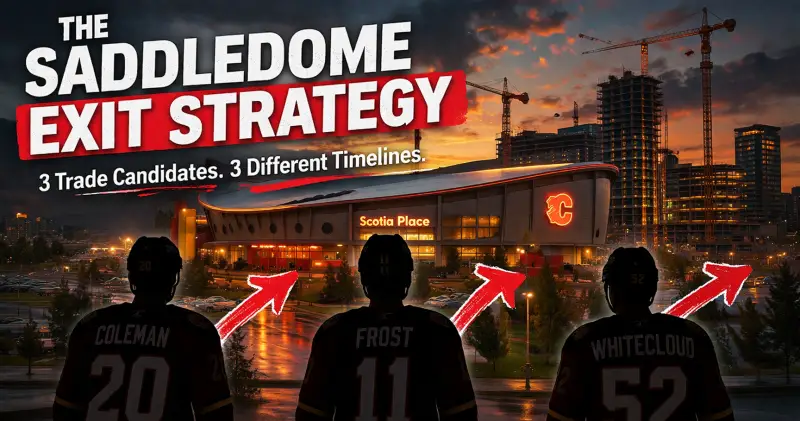
Conroy sold Andersson, Weegar, and Kadri for 26 draft picks. Now Coleman, Frost, and Whitecloud are next — but the Saddledome Exit Strategy says timing each trade to the new arena window matters more than whether they’re moved at all.
Live updates
No updates yet. Refreshing automatically.
Craig Conroy didn't just sell at the 2026 trade deadline. He liquidated. Rasmus Andersson went to Vegas for Zach Whitecloud, prospect Abram Wiebe, a conditional 2027 first-round pick, and a conditional 2028 second-rounder. MacKenzie Weegar went to the Utah Mammoth for three 2026 second-rounders, prospect Jonathan Castagna, and defenseman Olli Maatta. Nazem Kadri went back to the Colorado Avalanche for Victor Olofsson, prospect Max Curran, a conditional 2028 first-round pick, and a 2027 second-rounder. In a span of 47 days, Conroy dismantled Calgary's defensive foundation and shipped out their top-six center — and the return was staggering.
The Flames now control eight picks in the first three rounds of the 2026 draft. Two first-rounders — including their own lottery pick, currently projected at 4th overall with a 13.5 percent chance of going first — and six selections across rounds two and three. Across the next three drafts, Calgary holds 26 picks total. That's not a retool. That's a teardown with a plan.
But the deadline was Phase 1. Phase 2 is this offseason. And the three names nobody is analyzing properly are Blake Coleman, Morgan Frost, and Zach Whitecloud — three very different players requiring three very different strategies, all operating on the same countdown clock.
The Saddledome Exit Strategy — Why the Arena Timeline Changes Everything
Here's the part that every trade candidate article misses: Craig Conroy isn't just rebuilding a roster. He's timing a rebuild to a building.
Scotia Place — Calgary's $1.22 billion, 18,400-seat new arena — opens in the fall of 2027 for the 2027-28 season. When Conroy visited the construction site, he didn't talk about patience. He talked about urgency. "When I was over in the new building the other day, thinking it won't be next year, but the year after, we're gonna be there, I want to be on that upswing going where we're pushing to make the playoffs," Conroy said. Then came the qualifier that reveals the entire strategy: "We're gonna do it the right way."
"When I was over in the new building the other day … I want to be on that upswing going where we're pushing to make the playoffs. We're gonna do it the right way."
— Craig Conroy, Calgary Flames GM (NHL.com)
That's the Saddledome Exit Strategy in one sentence. Every roster decision Conroy makes from this point forward is tethered to opening night at Scotia Place. He doesn't need a competitive team tomorrow. He needs a competitive team in October 2027. That 18-month window determines who gets traded this summer, who gets held through 2026-27, and who stays as part of the core. The Saddledome Exit Strategy isn't about leaving a building. It's about leaving behind the era that produced zero playoff appearances in the last four seasons and no postseason run since their 2022 second-round exit. Compare that to Steve Yzerman's open-ended rebuild in Detroit — no arena deadline, no hard timeline, and seven years later the Red Wings are still waiting. Conroy has a clock on the wall. And the clock says 18 months.
The foundation is already locked in. Dustin Wolf signed a seven-year, $52.5 million extension that kicks in next season at a $7.5 million salary cap mechanics through 2032-33. The franchise goalie of the Scotia Place era is secured. Zayne Parekh just set an all-time Canadian record for points by a defenseman at the World Juniors with 13 points in seven games. Matvei Gridin has 14 points in 28 NHL games this season and is already on Calgary's first power-play unit. The core exists. What Conroy needs now is to squeeze maximum value from three veterans who don't fit the timeline — and the order in which he sells them matters more than whether he sells them at all.
Blake Coleman — The Deadline Hold That Could Pay Double
Let's start with the most obvious question: why didn't Conroy trade Coleman at the deadline?
The answer, according to multiple reports, was simple. The offers weren't good enough. Conroy wanted to be blown away. He wasn't. So Coleman stayed — and that restraint might end up being the best move Conroy makes all year.
Coleman is 34 years old. He's on a $4.9 million cap hit that expires at the end of 2026-27, making him a pending unrestricted free agent. His 2025-26 numbers were quietly excellent: 17 goals and 30 points in 60 games, a plus-10 rating, 151 shots on net, and 139 hits. He's a physical, two-way left winger with two Stanley Cup rings from Tampa Bay's back-to-back championships in 2020 and 2021. That playoff pedigree is the asset nobody is properly pricing.
| Category | Deadline Returns (Jan–Mar 2026) | Remaining Offseason Assets |
|---|---|---|
| Players Moved | Andersson, Weegar, Kadri | Coleman, Frost, Whitecloud (potential) |
| 1st-Round Picks Acquired | 2 (conditional 2027 + conditional 2028) | TBD |
| 2nd-Round Picks Acquired | 4 (3 from Utah + 1 from Colorado) | TBD |
| Prospects Acquired | Wiebe, Castagna, Curran | TBD |
| Combined AAV Cleared | $18.65M (Andersson $4.55M + Weegar $6.5M + Kadri $7.0M + Battaglia $0.6M) | $12.025M possible (Coleman $4.9M + Frost $4.375M + Whitecloud $2.75M) |
Here's the Saddledome Exit Strategy case for Coleman: hold him through 2026-27 and sell him at the 2027 trade deadline. The math is straightforward. An offseason trade for a 34-year-old with one year left probably returns a second-round pick and a mid-tier prospect. A deadline trade for a healthy, productive, two-time Cup champion with two months of rental value to a contender? That's a first-round pick conversation. Maybe more. Tampa traded a first for Blake Coleman once already. History repeats when the stakes are high enough.
Coleman himself has acknowledged the situation with remarkable candor. "I'd be lying if I said I wasn't aware of everything and keeping up with it," he said before the deadline. "It's a lot of moving pieces at this stage of my life with family and kids. It's not just me anymore." Then he added the line that tells you everything about his trade value: "From Day 1, I'm a Flame until I'm told I'm not and I'm going to bring my best every day here."
"I'd be lying if I said I wasn't aware of everything and keeping up with it. It's a lot of moving pieces at this stage of my life with family and kids."
— Blake Coleman (ClutchPoints)
That's not a player who's mailing it in. That's a professional who will produce at a high level whether he's in Calgary or on a Cup contender's second line in March 2027. Conroy's best play is patience — let Coleman play a full 2026-27 season, keep his value hot, and cash him in when contenders are paying the premium that only the deadline creates. Potential suitors: Montreal, Tampa Bay (reunion), New Jersey (his original team), and any contender that needs a physical, reliable winger with a ring.
Morgan Frost — The Offseason Sell Window Is NOW
Morgan Frost is the opposite case. If Coleman's value appreciates by waiting, Frost's value depreciates.
The Flames acquired Frost from Philadelphia midway through the 2024-25 season in a significant trade that also brought Joel Farabee to Calgary in exchange for Jakob Pelletier, Andrei Kuzmenko, and a 2025 second-round pick. Then Calgary signed him to a two-year, $8.75 million deal ($4.375 million AAV) with a modified no-trade clause featuring an eight-team list. The investment was clear: Conroy saw a reclamation project in a 25-year-old center who never found his ceiling in Philadelphia.
The numbers this season? Fine. Not transformative. Frost posted 18 goals and 38 points in 73 games — comfortably his best NHL season, but not the kind of breakout that turns a question mark into a cornerstone. He's 26 now, entering his final contract year next season, and he'll be an unrestricted free agent in the summer of 2027. That timeline is the entire argument for selling now.
A team that acquires Frost this offseason gets a full year of a 26-year-old center on a reasonable $4.375 million cap hit with upside. A team that acquires him at the 2027 deadline gets two months of a rental center whose best season was 38 points. The value gap is enormous. Frost's trade ceiling is right now — this summer, before he plays a single game in 2026-27, while the narrative is "career-best season with more room to grow" rather than "pending UFA on an expiring deal."
FlamesnNation called Frost "another mystery for Flames' brass to solve this summer," and that framing is exactly right. He's productive enough to attract interest from teams that need a second-line center — Seattle, whose forward group could use a proven center to complement their extensions, or Ottawa, or Nashville — but not productive enough to justify keeping through a rebuild. The Saddledome Exit Strategy says: convert Frost into a draft pick and a prospect this offseason while his stock is highest. Waiting is the wrong play for this particular asset.
| Team | Seasons | GP | G | A | P | P/GP | Context |
|---|---|---|---|---|---|---|---|
| Philadelphia Flyers | 2020–2025 | 241 | 41 | 72 | 113 | 0.47 | Never exceeded 27 points in a full season |
| Calgary Flames | 2024–2026 | ~105 | 28 | 42 | ~70 | 0.67 | Career-best 38P in 73GP this season |
The table tells the story. Frost is a different player in Calgary — his per-game production jumped 42 percent after leaving Philadelphia. That improvement is the selling point Conroy should be shopping to every GM in the league this summer.
Zach Whitecloud — The Wildcard With Two Years of Leverage
Whitecloud is the most interesting piece on this board, and it's not close.
When Conroy traded Andersson to Vegas on January 18th, Whitecloud came back as the centerpiece player in the deal. A right-shot defenseman. A Stanley Cup champion from Vegas's 2023 run. And a contract that might be the single best value deal on Calgary's roster: $2.75 million annually through 2027-28. That's two full years of a proven, physical, defensively responsible blueliner at a cap hit that wouldn't crack the top 15 highest-paid defensemen on most rosters.
His 2025-26 offensive numbers are modest — two goals and 11 points in 59 games across Vegas and Calgary. But that's not what you're buying when you acquire Whitecloud. You're buying a right-shot shutdown defender who logged heavy minutes against top lines in a Cup Final and lived to tell about it. You're buying leadership and a Cup ring for less than $3 million. Before the deadline, 15 or more teams were circling Whitecloud, but Conroy held firm. The offers weren't enough to justify moving him.
The Saddledome Exit Strategy creates an interesting dilemma with Whitecloud because, unlike Coleman and Frost, he actually fits the timeline. His contract runs through the first season at Scotia Place. He's 29 — he'll be 31 when his deal expires. And with Zayne Parekh transitioning to the NHL as a young offensive defenseman, Whitecloud provides exactly the kind of veteran defensive mentorship that accelerates prospect development. Teams that rebuild through the draft need veterans who can shelter young talent while the kids learn to play at the NHL level. Whitecloud is that player.
So the question becomes: is Whitecloud more valuable as a trade chip or as a bridge veteran? My read: Conroy should hold him through 2026-27 and reassess at the 2027 deadline. If the rebuild is ahead of schedule and the prospects are pushing for roster spots, trade him for a premium return when contenders come calling. If the development needs another year of insulation, keep him for the Scotia Place opener and let him walk as a UFA in 2028. Two years of control means Conroy doesn't have to decide this summer. That flexibility is worth more than whatever second-round pick someone offers in July.
The Saddledome Exit Strategy Scorecard — Conroy's Rebuild Ledger
Key Takeaways
- Sell Frost this offseason — his value is highest now with a full year of control at $4.375M. Waiting until the 2027 deadline turns a 2nd-round pick into a 3rd.
- Hold Coleman through 2026-27 — his playoff pedigree and production will command a 1st-round pick from a contender at the 2027 deadline. Selling now leaves value on the table.
- Keep Whitecloud flexible — two years of cost-controlled RHD at $2.75M gives Conroy the option to trade OR keep depending on how fast the prospects develop.
- The arena timeline is the strategy — Scotia Place opens fall 2027. Every trade decision is calibrated to that date.
Here's what the optimal Saddledome Exit Strategy looks like on paper. Summer 2026: trade Frost for a second-round pick, a prospect, and cap flexibility. Let Coleman play a full productive season in 2026-27 while mentoring the young forwards. March 2027: trade Coleman to a contender for a first-round pick. Assess Whitecloud's value against the development needs of Parekh and the incoming draft class. If the kids are ready, sell Whitecloud at the 2027 deadline. If they need one more year, keep him for Scotia Place's opening night.
If Conroy executes this sequencing correctly, the total offseason-plus-deadline haul from Coleman, Frost, and Whitecloud could add another first-round pick, two to three second-rounders, and multiple prospects on top of the 26 picks he already controls. Combined with the deadline returns from Andersson, Weegar, and Kadri, you're looking at a franchise that will have made eight to ten significant asset acquisitions in the span of 12 months. That's not a rebuild. That's a detonation followed by a blueprint.
The Saddledome Exit Strategy only works if Conroy sells the right player at the right time. Sell Coleman too early and you lose the deadline premium. Hold Frost too long and his value erodes to rental status. Rush the Whitecloud decision and you either lose a mentor the prospects need or miss the market window entirely. Conroy has shown the discipline to wait at the deadline when the offers weren't right. Now he needs to show the opposite skill: knowing exactly when to pull the trigger this offseason.
Calgary hasn't won a playoff series since 2022, and they've missed the postseason entirely in three of the last four seasons. They've made the postseason once in the last four years. The Saddledome has been a museum of mediocrity for the better part of a decade. But for the first time since Jarome Iginla left town, there's a plan that makes structural sense — a franchise goalie locked up for seven years, blue-chip prospects knocking on the door, 26 draft picks loaded across three years, and a new arena that demands a new era. Craig Conroy said he'd do it the right way. The next 18 months will tell us whether the Saddledome Exit Strategy was a masterclass in asset management or just a fancy name for another Canadian team that took too long to rebuild.
Frequently Asked Questions
Who are the Calgary Flames' offseason trade candidates for 2026?
The three primary offseason trade candidates are left winger Blake Coleman ($4.9M AAV, pending UFA after 2026-27), center Morgan Frost ($4.375M AAV, pending UFA after 2026-27), and right-shot defenseman Zach Whitecloud ($2.75M AAV, signed through 2027-28). All three could be moved during the 2026 offseason, though the optimal timing differs for each player.
What did the Calgary Flames get at the 2026 trade deadline?
The Flames traded Rasmus Andersson (to Vegas), MacKenzie Weegar (to Utah), and Nazem Kadri (to Colorado) in exchange for defensemen Zach Whitecloud and Olli Maatta, forward Victor Olofsson, prospects Abram Wiebe, Jonathan Castagna, and Max Curran, plus multiple draft picks including two conditional first-rounders and four second-rounders. Calgary now controls eight picks in the first three rounds of the 2026 draft.
When does Blake Coleman's contract expire?
Blake Coleman's six-year, $29.4 million contract ($4.9M AAV) expires at the end of the 2026-27 season, making him an unrestricted free agent in the summer of 2027. The Flames held him through the 2026 trade deadline because offers weren't sufficient, and he could be traded either during the 2026 offseason or at the 2027 deadline for maximum value.
Should the Flames trade Morgan Frost this offseason or wait?
The case for trading Frost this offseason is strong. At 26, coming off a career-best 38-point season, Frost's value is highest now with a full year of control remaining on his $4.375M contract. Waiting until the 2027 trade deadline turns him into a rental, significantly reducing his return. Teams needing a second-line center — like Seattle, Ottawa, or Nashville — would likely offer more for a full season of Frost than two months of him.
How many draft picks do the Calgary Flames have?
The Calgary Flames control 26 draft picks across the next three drafts (2026, 2027, 2028). In 2026 alone, they hold eight picks in the first three rounds, including two first-rounders — their own pick (projected 4th overall with 13.5% lottery odds at #1) and the Vegas Golden Knights' pick (projected 17th overall). They also hold two first-round picks in 2027 and first-round picks in 2028.
Sources
- Craig Conroy post-deadline press conference — NHL.com / Calgary Flames
- Blake Coleman trade deadline quotes — ClutchPoints
- Flames deadline haul analysis — FlamesnNation
- Draft capital and lottery odds — The Win Column
- Conroy rebuild strategy — Daily Faceoff
- Contract data — PuckPedia
- Morgan Frost offseason outlook — FlamesnNation
Frequently Asked Questions
What does the Calgary Flames offseason trade candidates 2026 mean for the 2026 NHL season?
Conroy sold Andersson, Weegar, and Kadri for 26 draft picks. Now Coleman, Frost, and Whitecloud are next — but the Saddledome Exit Strategy says timing each trade to the new arena window matters more than whether they’re moved at all.
What is The Saddledome Exit Strategy — Why the Arena Timeline Changes Everything?
Here's the part that every trade candidate article misses: Craig Conroy isn't just rebuilding a roster. He's timing a rebuild to a building.
How does Blake Coleman — The Deadline Hold That Could Pay Double affect the outcome?
Let's start with the most obvious question: why didn't Conroy trade Coleman at the deadline?
Related Stories

How Do Line Changes Work in Hockey?
A line change is hockey's strangest routine: you swap players while the puck is live, but only inside a five-foot pocket beside your own ben...
By Mike Johnson · 10 min read
What Is the Long Change in Hockey?
The long change is not jargon, it is bench geography. Teams switch ends each period but keep the same bench, so in the second period a tired...
By Mike Johnson · 9 min read
What Is a Delayed Penalty in Hockey?
A delayed penalty is not a penalty yet. It is the referee holding the whistle after a foul until the penalized team touches the puck, which...
By Mike Johnson · 9 min read
What Is a One-Timer in Hockey?
A one-timer reaches the net just 42% of the time, the worst of any shot, yet it is the most dangerous weapon in hockey and the shot Ovechkin...
By Mike Johnson · 11 min read
Comments
Be the first to share your take.
Get NHL trade rumors in your inbox
One email per week, zero spam, verified rumors only.