Yzerman's "Better Players" Confession: 3 Red Wings Trade
Steve Yzerman publicly admitted Detroit needs better players after a tenth straight missed playoff. J.T. Compher's 10-team no-trade list, Albert Johansson's expiring RFA window, and one top-10 prospect are the Red Wings' trade currency this summer .
Live updates
No updates yet. Refreshing automatically.
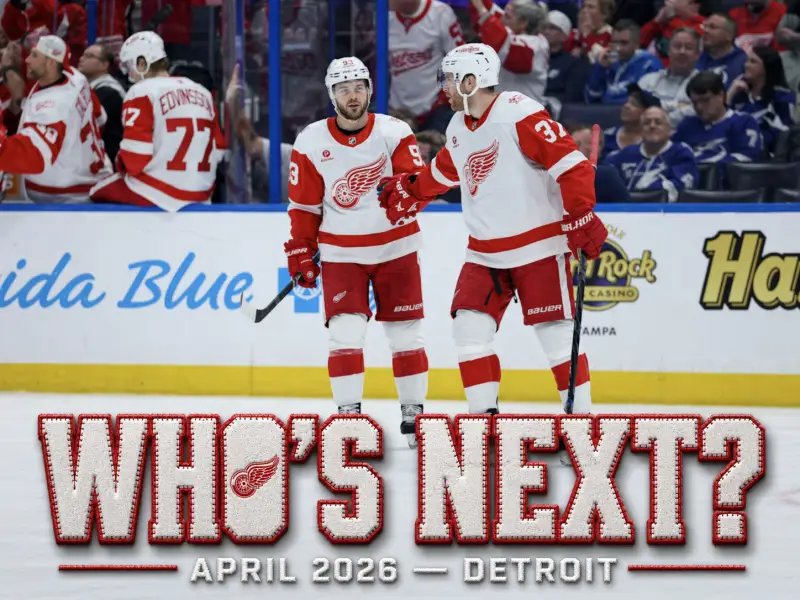
On April 23, 2026, two weeks after the Red Wings were mathematically eliminated for a tenth straight spring, Steve Yzerman stood at a podium in Little Caesars Arena and said the quiet part out loud: "The most obvious would be need better players. We need to improve in particular areas, goal scoring, particularly five-on-five." That sentence, from a general manager who rarely gives reporters an inch, is the single most consequential admission of the Yzerplan era. It means players are leaving. Buffalo broke its 14-year drought the same week, so Detroit now owns the NHL's longest active postseason absence, the backdrop for every trade this front office makes between now and October. This is The Yzerplan Tollbooth: the structural fee Detroit must now pay for ten years of patience. Every rental Yzerman buys is funded by prospects and picks the pipeline can no longer absorb. Every bottom-six veteran he keeps is a roster slot the "better players" Yzerman publicly asked for can never occupy. The 2026 summer is the first time the plan's math has to balance in a single offseason. Below: the three Red Wings most likely to pay that toll, with verified contracts, real trade leverage, and the honest reason each one is moving.
Key Takeaways
- Yzerman said it publicly: "we need better players" ended the polite-patience era in Detroit.
- J.T. Compher's 10-team no-trade list (2 yrs × $5.1M) makes him the summer's most-discussed chip.
- Albert Johansson ($1.125M, 1 year left) is a clean tradable asset because Sandin-Pellikka is NHL-ready.
- The pipeline, not the pick bank, is the trade currency, since Detroit already spent its 2026 first and 2027 second.
- Detroit holds the league's longest active playoff drought now that Buffalo clinched after 14 years.
The Yzerplan Tollbooth: Why This Summer's Math Is Different
For most of the last decade, Yzerman's rebuild ran on one principle: hoard picks, hoard prospects, hoard cap. That worked. The Athletic's Scott Wheeler ranked Detroit's pipeline fourth-best in the NHL entering this spring. The Red Wings walked into the 2026 offseason with roughly $20-31 million in projected cap space against a $104M upper limit, per CapWages. On paper, this looks like flexibility against the rising cap ceiling reshaping every team's math.
It isn't. The Justin Faulk trade at the March 6 trade deadline cost Detroit its 2026 first-round pick, San Jose's 2026 third-rounder, Justin Holl, and Dmitri Buchelnikov, a second-round pick from 2022 who was producing 23 points in 39 KHL games at the time. The NHL.com press release confirms the return. Eight months earlier, the John Gibson acquisition from Anaheim had already burned the 2027 second-round pick. Detroit kept the 2027 first, but the point stands: the draft bank is thinner than the public cap sheet suggests, and the 2026 draft lottery on May 5 won't return any of those picks to Detroit's column.
That is the Tollbooth. Every "better player" Yzerman brings in through trade will have to be funded with pipeline assets, not picks he no longer owns. The forwards are the leverage point, because that is where the pipeline is least deep. Wheeler's own breakdown this spring noted "the Red Wings don't have a game-breaking forward prospect in the pool." Meaning: the defense prospects and the goaltenders are more tradable than the skaters Detroit actually needs to keep.
"We need to surround them with more talent." — Steve Yzerman, end-of-season press conference, April 23, 2026
J.T. Compher: The 10-Team List That Will Define Detroit's Summer
Compher is the name every Red Wings reporter will type most often between now and July. The reasons start with usage and end with math.
| J.T. Compher, 2025-26 | Value | Context |
|---|---|---|
| Games played | 78 | Middle-six rotation |
| Goals / Assists / Points | 11 / 15 / 26 | Per PuckPedia |
| Faceoff win % | 43.62% | Larkin: 62.28% for contrast |
| Cap hit | $5.1M AAV | 2 yrs left, UFA 2028 |
| Trade protection | 10-team no-trade list | Full list, not modified clause |
The numbers tell one story, but the quiet one is more damning. The Hockey Writers' penalty kill breakdown of Detroit's 2025-26 collapse names Compher directly: when Dylan Larkin is unavailable on a shorthanded draw, Compher steps in, and his 43.62% rate has left the Red Wings chasing clears all season. For a team that finished dead last in the NHL in 5v5 goals since January 24, that specific inefficiency compounds.
The trade math is simple. Compher is two years from unrestricted free agency, his production has slipped below the 30-point floor he set in his first season in Detroit, and his $5.1M AAV is precisely the kind of middle-layer money contenders trim in August to open a hole for a deadline rental. The 10-team no-trade list is not a wall, it is a negotiating tool. Yzerman's job is to find the teams not on that list who happen to need a third-line center with penalty kill history. If a suitor's cap sheet is tight, Detroit can retain up to 50% of Compher's salary, a retained salary move that Yzerman has already used twice in his tenure to widen markets. That is not a small pool in a league with a rising cap.
Albert Johansson: The 25-Year-Old Priced to Move
If Compher is the dramatic move, Johansson is the logical one. The 25-year-old Swedish defenseman dressed for all 82 games, posting 3 goals, 8 assists, and 11 points while earning $1.125M on a two-year deal that expires in July 2027. He is tradable money, plain and simple.
| Albert Johansson, 2025-26 | Value | Implication |
|---|---|---|
| Games played | 82 | Zero availability issues |
| Goals / Assists / Points | 3 / 8 / 11 | Bottom-pair output |
| Cap hit | $1.125M AAV | Near-minimum friendly contract |
| Contract status | 1 yr left, then RFA | Acquiring team gets a qualifying offer window |
The real driver behind a Johansson move: Axel Sandin-Pellikka is ready. Wheeler's prospect rankings place the Swede at No. 3 in the entire Detroit system, projecting him as a high-end offensive defenseman capable of driving shot creation in all three zones. William Wallinder, Antti Tuomisto, and Shai Buium are also rising in Grand Rapids. With Simon Edvinsson's next contract expected to land in the $8M-plus AAV range per The Hockey Writers, Moritz Seider entrenched on the right side, and Faulk now occupying a top-four slot, Detroit's defense is already full. Johansson's path to protected ice time is mathematically gone.
What he is worth on the market is a bottom-six NHL-ready forward who can play 200 feet, exactly what Yzerman said the Red Wings must acquire. A Johansson-for-center swap with a rebuilder like Chicago, San Jose, or Anaheim is the quietest plausible deal Detroit makes this summer, and probably the first. Johansson is also not an offer sheet risk given his production, so Detroit's RFA control next July stays intact until the moment they decide to trade him.
"Outside of Sandin-Pellikka, the Red Wings have William Wallinder, Antti Tuomisto and Shai Buium in Grand Rapids, and any of them could be of interest to the right organization." — The Hockey Writers, April 2026
The Prospect Everyone's Ignoring: Why a Top-Ten Name Will Leave
The third name isn't a name yet. It is a category. With Detroit missing a 2026 first-round pick and a 2027 second, and with no "game-breaking forward prospect" in the pipeline per Wheeler, Yzerman cannot do what he has done every previous summer: trade for an impact player using draft capital as the lead asset. He has to give up a roster-adjacent prospect, and the pool to choose from is exactly the one the fourth-ranked prospect pipeline made famous.
The math forces the issue. The Red Wings have two NHL-ready goaltending prospects in Sebastian Cossa and Trey Augustine. Cam Talbot and John Gibson are the NHL tandem. Ville Husso is still on the books until July. That is a four-goalie traffic jam that cannot survive 2026-27, and Cossa is at the front of it because he has played a full AHL season ready for the call. Meanwhile, Nate Danielson is 20, posted only 7 points in his first NHL look, and projects as a Hintz-archetype middle-six center, precisely the archetype a playoff team desperate for a second-line pivot would pay for. Michael Brandsegg-Nygard (Wheeler's No. 6) is a heavy winger with a specific, marketable profile.
One of those four, most likely Cossa or Danielson, is the "better player" currency. Yzerman publicly admitting the need without having either the picks or the cap runway for an external splash forces that outcome. The only open question is whether the return is a rental or a term contract, and that answer will tell Red Wings fans everything about how this front office reads the next three years.
Who Leaves Detroit First?
Scored across 4 vectors: Contract Leverage, Trade Market, Replacement Cost, Probability of Move. Higher = more likely gone.
The Suitor Math: Which Teams Fit Each Chip
A trade market only exists when the right need meets the right asset. Here is the plausible fit list for each of the three chips, using publicly reported team needs as of April 2026:
| Red Wings Asset | Best-Fit Suitors | Why It Fits |
|---|---|---|
| J.T. Compher | Utah, Columbus, Seattle | All three need third-line centers, none are on a typical no-trade list, cap sheets clear |
| Albert Johansson | Chicago, San Jose, Anaheim | Rebuilders with extra forwards and thin left-side D depth |
| Pipeline asset (G or F) | Vancouver, Calgary, New Jersey | Contenders with 2C/goalie holes and draft capital to return |
The Utah-Compher match is the most cleanly fit of these. The franchise relocated to Salt Lake needs penalty kill depth and has the cap to absorb the entire $5.1M for two years, and per PuckPedia tracking, Utah has not appeared on any reported Compher protection list. A Compher-to-Utah deal for a 2027 second-round pick and a roster depth piece is the kind of honest middle-ground trade Yzerman builds his career on.
What Happens If Yzerman Keeps Them All
There is a version of this offseason where none of the above happens. Yzerman re-signs Edvinsson at $8M, Mazur at a bridge deal, adds one energy-role UFA forward for $5-6M, and runs the same roster back with Faulk now on it for a full year, echoing the veteran-discount logic that let him re-up Patrick Kane in-season. That path protects the pipeline and keeps the longer-term cap projection clean. The 2027-28 upper limit is projected to jump to $113.5M, opening real room for a major swing next summer.
The argument against that restraint is the four-word sentence Yzerman actually said: "we need better players." A general manager who publicly admits that after ten consecutive missed playoffs does not then stand still. The quote itself is the signal. The only thing left is identifying which assets leave first, and in what order.
Sources
- Detroit News, Yzerman press conference transcript, April 23, 2026
- NHL.com, Red Wings elimination coverage and Faulk trade press release
- PuckPedia, J.T. Compher and Albert Johansson contract and stat pages
- The Hockey Writers, 2025-26 player grades and penalty kill breakdown
- ESPN, "Red Wings lose, extend NHL's longest current playoff drought"
- The Hockey News, Scott Wheeler prospect pipeline ranking
- Daily Faceoff, "We need better players" coverage and Faulk trade analysis
- CapWages, 2026-27 cap projections and Detroit team page
- Yardbarker, Red Wings 2025-26 deep dive
- Pro Hockey Rumors, Albert Johansson two-year extension coverage
Verdict
The Yzerplan Tollbooth is real, and it comes due this summer. The smart money says Compher is gone by July 15 to clear the 5-on-5 scoring gap and the faceoff liability, Johansson is gone within the same window to make room for Sandin-Pellikka, and one of Cossa or Danielson exits in the trade that finally brings in a top-six forward. Detroit's playoff drought is no longer the longest in NHL history, but it is now the longest active, and that distinction alone guarantees this offseason won't be a quiet one.
Frequently Asked Questions
Why did Yzerman publicly say the Red Wings need better players?
Yzerman made the comment at his end-of-season press conference on April 23, 2026, after Detroit missed the playoffs for a tenth consecutive season. He specifically cited goal scoring, "particularly five-on-five," as the area needing the most improvement. The statement is considered the clearest signal yet that significant roster changes are coming.
Does J.T. Compher have a no-trade clause?
Compher owns a 10-team no-trade list, not a full no-movement clause. That means 21 NHL teams are freely available as trade partners, and Detroit's front office can engage them without requiring Compher's approval. The list itself is not publicly disclosed, but it gives him meaningful, not total, control over his destination.
Why is Albert Johansson considered tradable despite being only 25?
Detroit's defensive depth chart is full: Moritz Seider, Simon Edvinsson, and Justin Faulk occupy the top four, and elite prospect Axel Sandin-Pellikka is ready for an NHL role. Johansson's $1.125M cap hit and RFA status after 2026-27 also make him an attractive asset for a rebuilding team that wants a controllable young defenseman at a low salary.
Do the Red Wings have their 2026 first-round pick?
No. Detroit sent its 2026 first-round pick to St. Louis on March 6, 2026, as part of the Justin Faulk trade, along with a 2026 third-round pick (originally San Jose's), Justin Holl, and forward prospect Dmitri Buchelnikov. Detroit does retain its 2027 first-round pick.
How does Detroit's playoff drought compare now that Buffalo made the playoffs?
With the Sabres clinching a playoff spot for the first time since 2011 and ending a 14-season drought, the Red Wings now own the NHL's longest active postseason absence at 10 consecutive seasons. Their last playoff appearance was 2015-16.
Frequently Asked Questions
Why did Yzerman publicly say the Red Wings need better players?
Yzerman made the comment at his end-of-season press conference on April 23, 2026, after Detroit missed the playoffs for a tenth consecutive season. He specifically cited goal scoring, particularly five-on-five, as the area needing the most improvement. The statement is considered the clearest signal yet that significant roster changes are coming.
Does J.T. Compher have a no-trade clause?
Compher owns a 10-team no-trade list, not a full no-movement clause. That means 21 NHL teams are freely available as trade partners, and Detroit's front office can engage them without requiring Compher's approval. The list itself is not publicly disclosed, but it gives him meaningful — not total — control over his destination.
Why is Albert Johansson considered tradable despite being only 25?
Detroit's defensive depth chart is full: Moritz Seider, Simon Edvinsson, and Justin Faulk occupy the top four, and elite prospect Axel Sandin-Pellikka is ready for an NHL role. Johansson's $1.125M cap hit and RFA status after 2026-27 also make him an attractive asset for a rebuilding team that wants a controllable young defenseman at a low salary.
Do the Red Wings have their 2026 first-round pick?
No. Detroit sent its 2026 first-round pick to St. Louis on March 6, 2026, as part of the Justin Faulk trade, along with a 2026 third-round pick (originally San Jose's), Justin Holl, and forward prospect Dmitri Buchelnikov. Detroit does retain its 2027 first-round pick.
How does Detroit's playoff drought compare now that Buffalo made the playoffs?
With the Sabres clinching a playoff spot for the first time since 2011 and ending a 14-season drought, the Red Wings now own the NHL's longest active postseason absence at 10 consecutive seasons. Their last playoff appearance was 2015-16.
Related Stories
NHL Buyout Candidates 2026
The NHL buyout window opens June 15. Rielly, Gallagher, Kotkaniemi, and Frederic are the names in play, but the Dead-Cap Tail means most buy...
By Mike Johnson · 10 min read

Darnell Nurse Trade: 4 Suitors
Edmonton wants Darnell Nurse's $9.25M off the books, but a buyout saves barely $1.53M and his no-move clause hands him the pen. The Bonus Sh...
By Mike Johnson · 12 min read

Bill Guerin Wild Window Paradox: $17M Meets $1.18M
Wild GM Bill Guerin said 'we're in a window now' and 'you can't trade your way out of problems' five days after a Game 5 collapse. Then Kapr...
By Mike Johnson · 11 min read
Darren Raddysh Free Agent 2026: 4 Teams
Darren Raddysh's 70-point breakout turned his $975K cap hit into a four-team bidding war. The Athletic linked him to Philadelphia, San Jose,...
By Mike Johnson · 13 min read
Get NHL trade rumors in your inbox
One email per week. Zero spam. Verified rumors only.