Sharks-Leafs Trade Partners: Rielly, Robertson Fit Explained
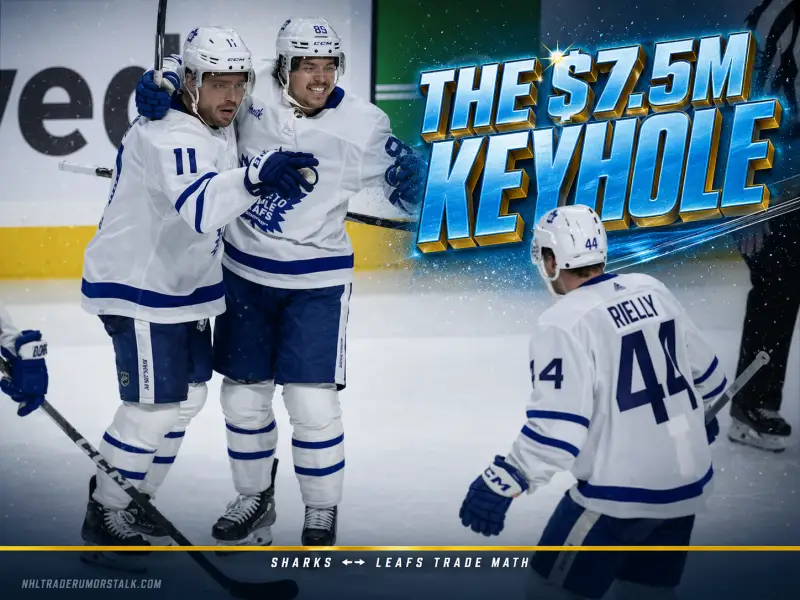
San Jose has three defensemen signed for next season. Toronto has a $7.5M franchise D with a full no-move clause and a 24-year-old RFA whose preferred-destination list starts with California. The structural case for a Sharks-Leafs summer deal, and the one wall it still has to clear.
Live updates
No updates yet. Refreshing automatically.
The San Jose Sharks and Toronto Maple Leafs entered late April 2026 from opposite sides of the same empty arena. San Jose missed the playoffs for a seventh straight year. Toronto broke a nine-year postseason streak and fired GM Brad Treliving inside of a week. But the paperwork in both buildings points to the same late-summer window. Sharks GM Mike Grier has three defensemen signed beyond this season. The Leafs have a 31-year-old franchise blue-liner on a $7.5 million cap hit with a full no-movement clause, and a 24-year-old RFA winger whose preferred-destination list starts with California. That overlap is why David Pagnotta and the Toronto trade rumor ecosystem keep circling the same two teams.
Orlov, Mukhamadullin and Dickinson are the only Sharks defensemen under contract next season. Rielly is signed through 2029-30 with a full no-move clause. The structural fit is the story; the consent is the gate.
Key Takeaways
- The cap arithmetic works: Sharks are one of a handful of teams that can absorb Rielly’s full $7.5M without asking Toronto to retain salary.
- Robertson is an RFA, not a UFA: Toronto controls his rights. His California preference only matters if the Leafs choose to qualify and then trade him.
- The real gate is Rielly’s full NMC: Pagnotta reported that San Jose was asked to wait until Toronto decides to move the file.
- Handedness mismatch: All three Sharks defensemen signed for 2026-27 are left-shot. Adding Rielly (left) does not solve San Jose’s right-side problem.
- Coined concept: We call the narrow team-by-team fit The $7.5M Keyhole, the point where open cap, open roster slots and willingness to absorb four years of term all line up.
Why the Sharks-Leafs Offseason Trade Talk Has Real Teeth
Most late-April rumor cycles are empty calories. This one has structure. Toronto’s nine-year playoff streak ended with a 4-1 home loss at Scotiabank Arena to the same San Jose team that keeps surfacing in the gossip columns. Treliving was fired days later, and Frank Seravalli has since reported Boston assistant GM Evan Gold and Rangers assistant GM Ryan Martin as finalists for the vacancy. That is a front office in transition with a mandate to retool, the leadership environment in which franchise veterans on long cap hits first become movable.
On the other side of the call, Grier told reporters at his exit interview that the Sharks need to “regroup that D-core” and add offensive depth around Macklin Celebrini. A conversation that produces a top-four defenseman and a cheap bottom-six scorer on the same call is one a seventh-straight-lottery team has to take.
The $7.5M Keyhole: A Cap Fit Only a Handful of Teams Have
Rielly’s contract is the single hardest number to swallow in any deal. He is signed through 2029-30 at a flat $7.5 million per year, which the NHL’s 2026-27 cap increase to $104 million makes slightly more palatable but not trivial for buyers already carrying long-term commitments on the back end. San Jose is one of the few destinations where that math collapses cleanly, because its blue-line ledger is essentially empty beyond next fall. We call this narrow window, where open cap space, roster need and four-year term tolerance all line up at once, The $7.5M Keyhole.
| Player | Age / Pos | Cap Hit | Years Left | Status | Clause |
|---|---|---|---|---|---|
| Morgan Rielly | 31 / LD | $7.5M | 4 (through 2029-30) | Signed | Full NMC |
| Nick Robertson | 24 / LW | $1.825M | 0 (expiring) | RFA | None |
The wrinkle is that the keyhole is not purely an open door. San Jose carries a $918,694 cap overage into 2026-27 from entry-level bonuses earned by Celebrini, Will Smith, William Eklund, Collin Graf and Sam Dickinson. The rising cap clears that overage, but it signals large extension bills coming for the young core. Adding Rielly at full freight for four years locks in a major long-term commitment right as the Celebrini-Smith double-extension window opens in July.
Nick Robertson’s California Pull Meets Toronto’s RFA Leverage
Robertson’s 2025-26 is the quietly loudest data point in this whole conversation. Playing 12:40 a night in third-line minutes at best, he posted a career-high 16 goals and 32 points across 78 games. His minus-13 rating reads worse than it is given Toronto’s season, and his 127 shots on goal represent a healthy 5v5 rate for a player rarely deployed on the power play. For a Sharks team hunting a cheap, scorable bottom-six forward who can ride shotgun on Celebrini’s back-fill line, Robertson is a structural match.
The California angle is real. His brother Jason plays in Dallas, and reporting at The Hockey Writers, The Leafs Nation and Hockey Patrol all place the Stars, Kings and Sharks atop Robertson’s preferred-destination list. But preference is not leverage. As a restricted free agent (RFA) with arbitration rights, Robertson cannot force a move; Toronto’s new GM holds every card except one. If the Leafs decline to qualify him at his $919K tender, he walks free to whichever California suitor wants him. That is the single scenario in which Robertson actually chooses. Our Committee Mirage breakdown covers the rest of Toronto’s post-Marner sequencing.
San Jose’s Blue-Line Arithmetic: 3 Signed, 5 Slots to Fill
If the Keyhole concept has a skeleton key, it is Grier’s defensive depth chart. Only Dmitry Orlov, Shakir Mukhamadullin and Sam Dickinson are signed for next season. Every other defenseman from the 2025-26 opening-night back end (Mario Ferraro, Nick Leddy, John Klingberg, Vincent Desharnais, plus Timothy Liljegren before his March trade to Washington) is either a pending UFA or already gone. That leaves five NHL roster slots to fill by Game 1 of 2026-27, and it is the reason Pagnotta’s reporting puts San Jose in a different buyer category than Chicago or Seattle.
| Defenseman | Shot | 2026-27 Status |
|---|---|---|
| Dmitry Orlov | L | Signed |
| Shakir Mukhamadullin | L | Signed |
| Sam Dickinson | L | Signed (ELC) |
| Mario Ferraro | L | UFA |
| Nick Leddy | L | UFA |
| John Klingberg | R | UFA |
| Vincent Desharnais | R | UFA |
The handedness chart flags the one big tension in any Rielly-to-San Jose scenario. Fear the Fin and NBC Sports Bay Area have spent the back half of the season arguing that San Jose’s largest long-term need is a right-shot top-four defenseman. Rielly is a left shot. Acquiring him solves term and pedigree, but does not unlock the right side, and pushes Mukhamadullin further down the depth chart. That is an important editorial correction to the “Rielly makes the Sharks a playoff team” framing floating through the aggregation layer. Our 2026 trade deadline tracker captured how thin the supply of true right-shot top-pair D is around the league, and our look at San Jose’s Celebrini-era rebuild plan lays out what positional priorities should actually come first.
The Full No-Move Clause Is the Real Gate
Every Sharks-Rielly conversation eventually runs into the same wall. Rielly’s contract carries the strongest possible protection: a full NMC that blocks trades and waivers alike, and he reinforced it at his exit interview by stating clearly he has no interest in leaving Toronto. That detail was missing from the source rumor that kicked off the latest aggregation cycle, and it is the most important editorial filter here. Joe Thornton and Patrick Marleau work inside the Sharks front office and could pitch Rielly as former teammates, but no agent waives an NMC on a recruiting call alone. The player has to want the move.
That is why Pagnotta’s phrasing matters. Asking San Jose to wait is not a rejection; it is a read on where the leverage lives. The new Leafs GM has to commit to moving Rielly first, then Rielly has to agree, and only then does the Sharks conversation become a real negotiation. Skipping any step turns the whole thing into fan fiction. Our archive on the nine-year streak ending covers the political math Gold or Martin will inherit on day one.
What Toronto Realistically Gets Back
The source rumor floated “a top prospect or a first-round pick” as Toronto’s return on Rielly. That is almost certainly the floor, not the ceiling, and it understates how much the incoming Leafs front office will need for taking four-year-contract exposure off the books on a 31-year-old defenseman. A realistic ask starts at a conditional first-round pick plus a top-10 organizational prospect, with Toronto willing to offer limited salary retention only if a second asset is added. San Jose has the draft capital for that price: they pick high in 2026, own multiple 2027 selections, and have one of the league’s deepest prospect pipelines.
The Robertson piece works as a standalone transaction, either stitched to the Rielly deal for cleanup or executed separately with Toronto simply declining to qualify. The return on Robertson is lower, with a mid-round pick as the realistic expectation for a 24-year-old RFA coming off career-high bottom-six usage. Toronto’s priority in that file is flexibility, not volume. The parallel negotiation can happen; it just should not be conflated with Rielly’s much higher-stakes file. See our full board on the Leafs’ 2026 offseason priorities, and our read on Robertson’s career year for production context.
Sharks-Leafs Trade Fit Scorecard
Data Journalism · 5 Categories · 50 Points
Editorial scoring of the structural trade fit, weighted against PuckPedia contracts and Pagnotta reporting (April 2026).
San Jose has the room to take on all $7.5M at full sticker and still come out cap-compliant, a rare spot league-wide.
Three defensemen signed for 2026-27, five NHL slots to fill, plus a bottom-six winger hole on the Celebrini flank.
A conditional first-rounder plus a high-end pipeline piece is the realistic opening ask. Sharks have the draft capital for it.
Toronto’s GM seat is still open. No transaction this size closes before the Gold-or-Martin decision lands.
Full NMC plus exit-interview comments. The single hinge the whole deal swings on.
Editorial Verdict · 32 / 50
Structural case grades an eight-out-of-ten. The consent hinge drags it to conditional yellow. Green on everything except the hinge.
Sources
- The Fourth Period: David Pagnotta on Sharks, Blackhawks and Kraken interest in Rielly
- PuckPedia: Morgan Rielly contract ($7.5M AAV through 2029-30, full NMC)
- PuckPedia: Nick Robertson contract and RFA status
- ESPN: Robertson 2025-26 game-by-game log
- Sharks Hockey Digest: $918,694 cap overage for 2026-27
- NHL.com: Leafs eliminated from 2026 postseason
- CBS Sports: Maple Leafs fire GM Brad Treliving
Frequently Asked Questions
Are the Sharks and Maple Leafs actually close to a trade?
No. Pagnotta confirms San Jose has expressed interest in Rielly and been asked to wait until Toronto is ready to move him. The Leafs are still hiring a new general manager, and no trade of this magnitude closes before that seat is filled.
Could Morgan Rielly really be traded given his full no-move clause?
Only if he agrees to waive it. His postseason comments made clear he does not want out. The Sharks have a soft recruiting angle through former teammates employed in the San Jose front office, but the player controls the switch. No waiver means no trade, full stop.
Why do the Sharks make sense as a landing spot for Nick Robertson?
Three reasons. His destination preferences cluster around California and his brother Jason in Dallas, shrinking the buyer pool to a handful of teams. The Sharks need cheap bottom-six scoring behind the Celebrini-Smith-Eklund core. And a 16-goal RFA on third-line minutes is the exact contract profile San Jose can absorb at minimal cost despite the $918,694 cap overage already on the books.
What would the Maple Leafs realistically get back in a Rielly trade?
The floor is a first-round pick or a top prospect. A realistic Toronto ask is a conditional first alongside a high-end prospect, with retention triggering another asset from San Jose. The Sharks have the capital; the open question is whether they value four years of Rielly at that price given their own upcoming extension bills.
Is Rielly’s handedness a problem for the Sharks’ blue line?
Yes, and it is the most under-discussed wrinkle here. Orlov, Mukhamadullin and Dickinson all shoot left, and so does Rielly. Every serious analysis of San Jose’s back end has prioritized a right-shot top-four. Adding Rielly addresses term and pedigree but deepens the left-side logjam.
The Verdict
The Sharks-Leafs pairing is real because the cap fit is real. Toronto has a franchise defenseman on a contract and a fourth-liner with a qualifying offer; San Jose has three defensemen signed beyond next summer and a young core that needs a bottom-six winger. The $7.5M Keyhole is where this deal lives or dies, a narrow alignment that only opens from the inside. Until Rielly waives his clause, San Jose’s interest is a bookmark, not a transaction. Expect movement only after Gold or Martin is hired and has one private conversation with Rielly’s agent. Everything until then is groundwork.
Frequently Asked Questions
Are the Sharks and Maple Leafs actually close to a trade?
No. Pagnotta confirms San Jose has expressed interest in Rielly and been asked to wait until Toronto is ready to move him. The Leafs are still hiring a new general manager, and no trade of this magnitude closes before that seat is filled.
Could Morgan Rielly really be traded given his full no-move clause?
Only if he agrees to waive it. His postseason comments made clear he does not want out. The Sharks have a soft recruiting angle through former teammates employed in the San Jose front office, but the player controls the switch. No waiver means no trade, full stop.
Why do the Sharks make sense as a landing spot for Nick Robertson?
Three reasons. His destination preferences cluster around California and his brother Jason in Dallas, shrinking the buyer pool to a handful of teams. The Sharks need cheap bottom-six scoring behind the Celebrini-Smith-Eklund core. And a 16-goal RFA on third-line minutes is the exact contract profile San Jose can absorb at minimal cost despite the $918,694 cap overage already on the books.
What would the Maple Leafs realistically get back in a Rielly trade?
The floor is a first-round pick or a top prospect. A realistic Toronto ask is a conditional first alongside a high-end prospect, with retention triggering another asset from San Jose. The Sharks have the capital; the open question is whether they value four years of Rielly at that price given their own upcoming extension bills.
Is Rielly's handedness a problem for the Sharks' blue line?
Yes, and it is the most under-discussed wrinkle here. Orlov, Mukhamadullin and Dickinson all shoot left, and so does Rielly. Every serious analysis of San Jose's back end has prioritized a right-shot top-four. Adding Rielly addresses term and pedigree but deepens the left-side logjam.
Related Stories

Darnell Nurse Trade: 4 Suitors
Edmonton wants Darnell Nurse's $9.25M off the books, but a buyout saves barely $1.53M and his no-move clause hands him the pen. The Bonus Sh...
By Mike Johnson · 12 min read
Darren Raddysh Free Agent 2026: 4 Teams
Darren Raddysh's 70-point breakout turned his $975K cap hit into a four-team bidding war. The Athletic linked him to Philadelphia, San Jose,...
By Mike Johnson · 13 min read
Bobby McMann Free Agent 2026 Destinations: 4 Teams Linked
Bobby McMann's career-high 29 goals just turned a $1.35M cap hit into Sharangovich-tier money. The Athletic locked him to 4 teams (Detroit,...
By Mike Johnson · 10 min read

Hellebuyck Trade Rumors 2026: The Vulture Watch Begins
David Pagnotta says vultures circle Hellebuyck after a .902 save percentage and exit-interview frustration. Three destinations make cap sens...
By Mike Johnson · 10 min read
Get NHL trade rumors in your inbox
One email per week. Zero spam. Verified rumors only.