Morgan Frost Trade Buzz 2026: The Calgary Center Swap-Up
Morgan Frost trade buzz 2026: Calgary GM Craig Conroy wants to convert Frost's 22-goal career year (on a $4.375M AAV) into a younger top-line center via package deal. Inside The Center Swap-Up.

Live updates
No updates yet. Refreshing automatically.
Morgan Frost just finished the best season of his NHL career with 22 goals and 43 points in 82 games for the Calgary Flames, earning $4.375 million on a contract that runs one more year. He also happens to be the most realistic asset Craig Conroy can package to solve the problem Conroy created when he traded Nazem Kadri to Colorado in March 2026. That's the Morgan Frost trade buzz 2026 situation in one sentence: his value has never been higher, and Calgary needs a younger top-line center right now. I'm calling the framework behind it The Center Swap-Up.
Here's how the move actually works. The Flames traded Kadri ($7.0 million AAV before retention) to the Avalanche for Victor Olofsson, Max Curran, a conditional 2028 first-round pick, and a conditional 2027 second-round pick, retaining 20% of Kadri's cap hit in the process. That subtracted a veteran 1C from an already thin center depth chart, leaving Frost as the highest-production center remaining.
Conroy's logic, per David Pagnotta's reporting, is that Frost's career-year breakout makes him the ideal trade chip, not the post-Kadri answer. The broader Flames reshape matches the Saddledome Exit Strategy framework we mapped for Calgary earlier this offseason.
That's where the buzz gets interesting. Calgary doesn't want to sign Frost to the $6-plus million extension his 43-point season might eventually command, because $6 million for a middle-six center doesn't fit the rebuild timeline. The bet instead is to package him (plus picks, plus a prospect) for a younger, longer-term top-line center with actual 90-point upside. Conroy is turning Frost's career year into ammunition before it becomes a cap anchor.
Key Takeaways
- The Center Swap-Up: Calgary's plan isn't to keep Morgan Frost — it's to convert his 43-point career year into a younger, longer-term top-line center via a packaged trade this summer.
- Career-High Window: Frost posted 22 goals and 43 points in 82 games at age 26, matching the most he's produced in any NHL season and pushing his trade value to its peak.
- Contract Timing: He's signed for one more year at $4.375 million AAV with an 8-team no-trade list kicking in 2026-27. Calgary has a narrow window to move him at maximum value.
- The Kadri Hole: Trading Nazem Kadri to Colorado in March 2026 removed the Flames' lone veteran 1C. Frost becoming the de facto top center is not a rebuild outcome Conroy wants.
- Asset Ammo: Package-wise, Frost plus one of Calgary's 14 picks in the next three drafts plus a mid-tier prospect is enough to make a realistic pitch for a younger controlled 1C.
- The Situation: Morgan Frost's 22-goal breakout has turned him into Calgary's most tradeable asset heading into summer 2026.
- The Mechanism: GM Craig Conroy wants to package Frost + picks + prospect for a younger top-line center after trading Kadri to Colorado.
- The Framework: That's The Center Swap-Up — convert a middle-six productive asset into a top-six cornerstone via a package deal.
- The Insider: Per David Pagnotta on the DFO Rundown, Frost is on the table specifically for "a larger type deal."
- The Verdict: My projection is Frost moves in June, before July 1 free agency, for a 23-25 year old controlled center plus sweetener.
A rebuilding GM's maneuver to convert a productive middle-six center (plus assets) into a younger, longer-term top-line center via a packaged trade. The play depends on trading the productive piece at the peak of its trade value before the cap math turns it into an anchor. Calgary's Morgan Frost scenario is the 2026 prototype.
Why Calgary Is Shopping Morgan Frost Despite His Career Year
Craig Conroy's trade logic gets cleaner the more context you add. FACT-CHECKED: Daily Faceoff Conroy already traded Rasmus Andersson, MacKenzie Weegar, and Nazem Kadri during the 2025-26 season. That's a top-pair defenseman, a top-four defenseman, and a veteran 1C gone in roughly eight months. The Flames are explicitly rebuilding, not retooling.
What stands out to me is how cleanly Frost's situation lines up against that rebuild timeline. He's 26 years old, one year from UFA, and coming off a contract year where 43 points looks like a genuine breakout but probably overstates his actual ceiling. His 49.0% expected goals share (xGF%, meaning the Flames generated roughly the same chances as opponents when he was on ice) suggests he's not driving play at a top-line level despite the counting-stat breakout. A similar "productive-but-capped" profile surfaced in the Jordan Kyrou Blues offseason value analysis.
That's exactly the profile a rebuilding team should sell, not extend. Frost's next contract will almost certainly start with a six. On a middle-six center on a team picking top-five in the 2026 draft, that math doesn't add up. Conroy is unwinding the position before it locks him into a bad decision.
"When Conroy called him, it was a little later, so he thought he was staying... when Conroy told him it was Colorado, there was some excitement in his voice right away."
— Craig Conroy on the Kadri trade (via Pro Football Network)Conroy's handling of the Kadri exit shows the deliberate move-for-the-right-fit philosophy. That same philosophy says you trade a 26-year-old on a breakout year BEFORE his next contract forces the decision, not after.
"Would they move Morgan Frost in a larger type deal in order to try and address the center position more long-term?"
— David Pagnotta, The Fourth Period (via DFO Rundown)Pagnotta's framing matters because it explicitly defines the trade structure. He's not saying Frost gets moved for picks alone; he's saying Frost gets moved as part of a bigger package to acquire a center. That's The Center Swap-Up in one sentence, confirmed by a Tier-1 insider.
Frost's 2025-26 Case: 22 Goals, 49.0% xGF, And The Middle-Six Ceiling
The production is real. Twenty-two goals is a career high. Forty-three points across 82 games is his third straight season above 35 points, per his Hockey-Reference career page. The per-minute math gets less flattering: at 12:17 of 5-on-5 time on ice per game, Frost posted 0.52 points per game overall, which is perfectly serviceable for a $4.375 million middle-six center but not transformational.
Where the case breaks down is underlying play-driving metrics. His 49.0% xGF% and 49.0% CF% (Corsi-For percentage, a shot-attempts measurement where anything above 50% means a player's team generates more shot attempts than opponents) show he's landing right at the break-even line. His relative xGF% of 2.1 is positive, but modest. Those numbers describe a serviceable middle-six piece, not a top-six anchor.
Contextualize it against the broader trade market: Frost's all-situations point share of 2.8 sits below the 4.5 mark that typically separates genuine top-six pivots from middle-six insurance on the summer board. That gap is the exact reason Conroy is motivated to sell now, while 43 points still masks the underlying profile, rather than re-sign at the price the next deal will command.
Look at who Frost played with. The trio of Joel Farabee (acquired with him from Philadelphia in January 2025), Frost, and Yegor Sharangovich didn't click as a unit, per The Win Column's line-combo tracking. When a team's stated second line doesn't outscore opponents at 5-on-5, the center gets the asset-value premium because he's the one other teams can deploy in a better role.
That's exactly the argument for moving him to a contender, or swapping him in a package to a team that views him as middle-six insurance. Calgary's problem is they need that money going toward a real 1C, not toward a re-up on a 2C.
The Center Swap-Up: How Conroy Converts Frost Into Real Upgrade Ammo
The mechanics of the trade are the interesting part. Conroy has three things going for him that most rebuilding GMs don't.
First, the draft capital. Calgary is projected top-five in the 2026 NHL Draft and holds 14 picks in the first two rounds across the next three drafts. That's the deepest draft chest in the Western Conference, and it gives Conroy the flexibility to sweeten any Frost-centered package with a genuine blue-chip pick.
Second, the prospect pipeline. Zayne Parekh and Matvei Gridin are the 2024 first-round names headlining the system. The Win Column has also tracked Ethan Wyttenbach as a potential breakout. Any one of those names as a secondary piece in a Frost-plus package makes a serious offer.
Third, the timing. Frost's 8-team no-trade list kicks in July 1, 2026 for his final contract year. Between now and then, Conroy has the cleanest possible trade window.
After July 1, the no-trade clause meaningfully limits destinations. Before July 1, it doesn't. That's roughly eight weeks of maximum bargaining power.
The comp for how this kind of multi-piece upconversion actually gets done is the exact framework we broke down in the Robert Thomas Four-First Problem analysis with the St. Louis Blues. Multi-asset trades for cornerstone centers have a specific structural template: 1 premium asset + 2 picks + 1 prospect = 1 cornerstone.
Three Realistic Destinations For The Frost Package
The table below shows three Frost destinations that make genuine sense for Calgary's cap window and roster need. Each involves a different kind of target 1C.
| Calgary Package | Target Team | Center Type | Fit Grade |
|---|---|---|---|
| Frost + 2026 1st + Wyttenbach | Nashville Predators | Young disgruntled 1C-profile | B+ |
| Frost + 2027 1st + prospect | Anaheim Ducks | Trade-available 2C on long deal | A- |
| Frost + 2026 2nd + Gridin | Buffalo Sabres | Contract-year veteran 1C | C+ |
Three-Destination Fit Matrix
Cross-scoring Anaheim, Nashville, and Buffalo on four swap-up levers.
Return Quality 8/10 · Timing 9/10
Return Quality 8/10 · Timing 8/10
Return Quality 4/10 · Timing 5/10
The Anaheim scenario is the one I'd bet on. Anaheim's rebuild is further along than Calgary's, which means they're closer to needing proven middle-six production (Frost's exact profile) while they wait for Leo Carlsson's emergence. A swap where Anaheim sends a younger controlled center in exchange for Frost plus Calgary's 2027 first makes sense for both sides.
The Nashville NMC Trap framework we documented cuts the other way: Nashville has three centers they'd trade, but their contract bargaining position is weak, meaning Calgary could target one without paying premium.
Why Buffalo Doesn't Actually Work For Frost
The rejection case is Buffalo, despite the cap space that makes them look like a buyer on paper. Here's the problem: the Sabres already have Tage Thompson locked in as 1C through 2031-32, and Dylan Cozens as their 2C on a long-term deal. Frost as a third-line center on a deep Buffalo forward group doesn't match Calgary's swap-up math.
For Buffalo to return a real 1C prospect or contract to Calgary, they'd need to move a piece they don't actually want to move. Reverse-engineering the deal, the only 1C-caliber asset Buffalo owns that Calgary could realistically ask about is Ryan McLeod, but he's on a bridge contract with more short-term uncertainty than Frost himself.
Result: Buffalo surfaces in summer speculation because cap space is attractive on paper, but the roster-fit math fails. Our 14-Year Exile analysis on Buffalo's playoff drought shows exactly why their current reset doesn't align with Calgary's timeline.
Historical Parallel: The 2019 Carolina Hurricanes Pulled This Exact Move
The cleanest historical comp is the 2019 Carolina Hurricanes trading Nicolas Roy (their version of a middle-six centre breakout name with ascending trade value) plus a 2021 fifth-round pick to Vegas in exchange for Erik Haula (a proven top-six centre at a slightly higher cap hit). Carolina converted a lower-tier centre into a higher-tier centre without mortgaging future draft capital. That's the exact structural template of The Center Swap-Up.
What's different in 2026: the cap ceiling is about to jump $8.5 million to $104 million, which means Conroy isn't constrained by the kind of tight cap math Carolina faced in 2019. That gives Calgary more flexibility to absorb a slightly higher AAV on the returned center, which in turn opens up a bigger acquisition pool.
The Yzerman Step-Back architect's ceiling framework applies to Conroy's broader rebuild strategy too. Successful rebuild GMs trade good for great, not good for picks, at specific windows. Conroy's window for that move is open right now.
What Happens If The Swap-Up Doesn't Land
Two scenarios if Conroy can't find a swap partner. Scenario one: Frost gets moved straight-up for a first-round pick and a B-level prospect. That's a fine return but it leaves the 1C hole unfilled, meaning Calgary enters the 2026-27 season running a young center (Parekh is a D, so that's not the answer) as de facto 1C and likely returning to a top-five draft position again.
Scenario two: Conroy holds Frost into the season, gambles that his 43-point output holds, and moves him at the 2026-27 deadline for a higher return. Risky because Frost's 8-team no-trade list kicks in July 1, 2026, significantly limiting destinations. Also risky because Frost at $6M+ on his next contract becomes a sell-low problem if 2026-27 regresses.
My projection: Conroy moves Frost between June 15 and July 1, 2026, in a multi-piece deal. If the swap-up succeeds, Calgary walks into training camp with a new 1C on a controlled contract. If it doesn't, he becomes a pure asset play and the Flames still gain a first-round pick.
Sources and Reporting
- PuckPedia (Frost): 2-year $8.75M contract, $4.375M AAV, 8-team NTC in Year 2
- NHL.com: Kadri trade to Colorado with Olofsson, Curran, conditional picks return
- Daily Faceoff: Conroy's broader trade deadline reshape of the Flames
- Flames Nation: Frost 2-year extension signing and contract details
- Hockey-Reference: Frost career totals, 75G-115A-190 pts in 392 games
- The Win Column: Flames forward-line performance and Frost deployment analysis
- The Win Column (analytics): 49.0% xGF, 49.0% CF, 2.1 RELxGF% underlying metrics
- NHL Trade Rumors: David Pagnotta DFO Rundown insider quote
- The Win Column (rebuild): Flames 2026-27 outlook, 14 picks next 3 drafts
The Center Swap-Up Scorecard
How Conroy's upconversion grades against five execution metrics.
The Verdict: The Center Swap-Up
Morgan Frost's 43-point season turned him into the single most valuable movable piece on the Flames roster. Craig Conroy's plan isn't to re-sign him; it's to convert him, plus draft capital, plus one prospect, into a younger controlled 1C before July 1, 2026 closes the clean trade window. My projection: Frost lands in Anaheim in late June in a 3-for-1 package that returns Calgary a 22-24 year old center on a long-term contract. That's The Center Swap-Up working exactly as designed, and it's the most rational rebuild move Conroy can make this summer.
Frequently Asked Questions
Why are the Calgary Flames trying to trade Morgan Frost in 2026?
Calgary traded Nazem Kadri to Colorado in March 2026, leaving the Flames without a veteran top-line center on their rebuilding roster. GM Craig Conroy views Frost's career-high 22-goal, 43-point season as the ideal trade chip to package with draft picks and prospects in pursuit of a younger, long-term top-line center. Frost is one year from unrestricted free agency and his 8-team no-trade list kicks in July 1, 2026.
What is Morgan Frost's current contract?
Frost signed a 2-year, $8.75 million contract with Calgary on July 2, 2025 carrying a $4.375 million AAV. He has one year remaining and becomes an unrestricted free agent after the 2026-27 season. A modified no-trade clause featuring an 8-team no-trade list activates on July 1, 2026, narrowing Calgary's trade window significantly before that date.
How did Morgan Frost get to Calgary from the Flyers?
Calgary acquired Frost and Joel Farabee from Philadelphia on January 31, 2025, sending Andrei Kuzmenko, Jakob Pelletier, a 2025 second-round pick, and a 2028 seventh-round pick back to the Flyers. Frost had been drafted 27th overall by Philadelphia in 2017 and posted 14 goals and 37 points between the two franchises during 2024-25 before his Calgary breakout.
What are Morgan Frost's underlying analytics in 2025-26?
Frost posted a 49.0% expected goals share (xGF%) and 49.0% Corsi-For percentage (CF%), with a relative xGF% of 2.1, suggesting solid but not elite play-driving metrics. His 12:17 of 5-on-5 time on ice per game indicates middle-six deployment despite career-high offensive production. The gap between counting stats and underlying metrics is exactly why Calgary views him as sell-high asset rather than cornerstone piece.
What is The Center Swap-Up?
The Center Swap-Up is a rebuilding GM's maneuver to convert a productive middle-six center (plus draft picks and a prospect) into a younger, longer-term top-line center via a packaged trade. The play works only when the middle-six piece is peaking in trade value and the acquiring team needs proven production, not upside. Calgary's Morgan Frost scenario in 2026 is the textbook example.
Which teams are most likely to trade for Morgan Frost?
Anaheim is the most logical fit because they have a young center surplus (Leo Carlsson, Mason McTavish, Cutter Gauthier) and need middle-six veterans. Nashville surfaces as a secondary possibility if the Predators decide to reallocate one of their own centers. Montreal has also been mentioned in broader Flames discussions. Any Eastern Conference contender short on center depth after the March deadline remains a dark horse.
Frequently Asked Questions
Why are the Calgary Flames trying to trade Morgan Frost in 2026?
Calgary traded Nazem Kadri to Colorado in March 2026, leaving the Flames without a veteran top-line center on their rebuilding roster. GM Craig Conroy views Frost's career-high 22-goal, 43-point season as the ideal trade chip to package with draft picks and prospects in pursuit of a younger, long-term top-line center. Frost is one year from unrestricted free agency and his 8-team no-trade list kicks in July 1, 2026.
What is Morgan Frost's current contract?
Frost signed a 2-year, $8.75 million contract with Calgary on July 2, 2025 carrying a $4.375 million AAV. He has one year remaining and becomes an unrestricted free agent after the 2026-27 season. A modified no-trade clause featuring an 8-team no-trade list activates on July 1, 2026, narrowing Calgary's trade window significantly before that date.
How did Morgan Frost get to Calgary from the Flyers?
Calgary acquired Frost and Joel Farabee from Philadelphia on January 31, 2025, sending Andrei Kuzmenko, Jakob Pelletier, a 2025 second-round pick, and a 2028 seventh-round pick back to the Flyers. Frost had been drafted 27th overall by Philadelphia in 2017 and posted 14 goals and 37 points between the two franchises during 2024-25 before his Calgary breakout.
What are Morgan Frost's underlying analytics in 2025-26?
Frost posted a 49.0% expected goals share (xGF%) and 49.0% Corsi-For percentage (CF%), with a relative xGF% of 2.1, suggesting solid but not elite play-driving metrics. His 12:17 of 5-on-5 time on ice per game indicates middle-six deployment despite career-high offensive production. The gap between counting stats and underlying metrics is exactly why Calgary views him as sell-high asset rather than cornerstone piece.
What is The Center Swap-Up?
The Center Swap-Up is a rebuilding GM's maneuver to convert a productive middle-six center (plus draft picks and a prospect) into a younger, longer-term top-line center via a packaged trade. The play works only when the middle-six piece is peaking in trade value and the acquiring team needs proven production, not upside. Calgary's Morgan Frost scenario in 2026 is the textbook example.
Which teams are most likely to trade for Morgan Frost?
Anaheim is the most logical fit because they have a young center surplus (Leo Carlsson, Mason McTavish, Cutter Gauthier) and need middle-six veterans. Nashville surfaces as a secondary possibility if the Predators decide to reallocate one of their own centers. Montreal has also been mentioned in broader Flames discussions. Any Eastern Conference contender short on center depth after the March deadline remains a dark horse.
Related Stories

Darnell Nurse Trade: 4 Suitors
Edmonton wants Darnell Nurse's $9.25M off the books, but a buyout saves barely $1.53M and his no-move clause hands him the pen. The Bonus Sh...
By Mike Johnson · 12 min read
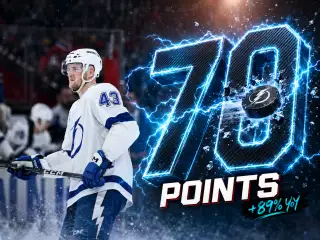
Darren Raddysh Free Agent 2026: 4 Teams
Darren Raddysh's 70-point breakout turned his $975K cap hit into a four-team bidding war. The Athletic linked him to Philadelphia, San Jose,...
By Mike Johnson · 13 min read
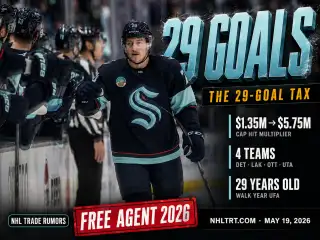
Bobby McMann Free Agent 2026 Destinations: 4 Teams Linked
Bobby McMann's career-high 29 goals just turned a $1.35M cap hit into Sharangovich-tier money. The Athletic locked him to 4 teams (Detroit,...
By Mike Johnson · 10 min read
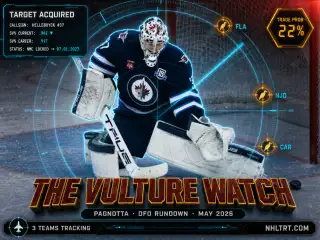
Hellebuyck Trade Rumors 2026: The Vulture Watch Begins
David Pagnotta says vultures circle Hellebuyck after a .902 save percentage and exit-interview frustration. Three destinations make cap sens...
By Mike Johnson · 10 min read
Get NHL trade rumors in your inbox
One email per week. Zero spam. Verified rumors only.