Canucks Trade Candidates 2026: The Peak-Valley Pivot
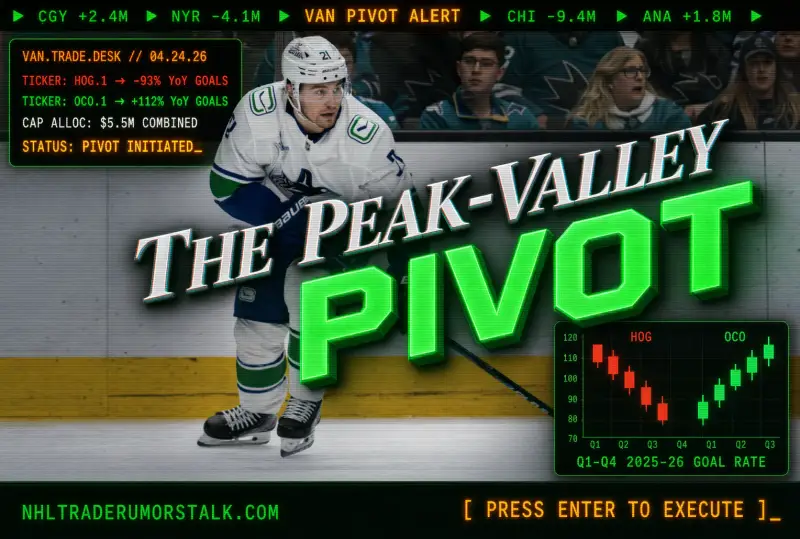
Canucks trade candidates 2026: Patrik Allvin's The Peak-Valley Pivot. Hoglander ($3M, 2 goals, valley) and O'Connor ($2.5M, 17 goals, peaking UFA) on opposite arcs.
Live updates
No updates yet. Refreshing automatically.
Patrik Allvin is carrying two Vancouver forwards on opposite value arcs right now, and the math on both contracts tells the whole Canucks trade candidates 2026 story in one sentence. Nils Hoglander has 2 goals in 38 games at a $3 million cap hit. Drew O'Connor has 17 goals in 81 games at a $2.5 million cap hit.
That's a 15-goal swing in favor of the cheaper contract, and it's why Allvin has to move both pieces before July 1 with opposite sales pitches. I'm calling the framework behind it The Peak-Valley Pivot.
Here's how the actual mechanics work. O'Connor is one year from unrestricted free agency after a career-high 17-goal season on a shooting percentage that just held around league-average, which makes him the classic sell-high rental asset on this roster. Hoglander is three years removed from a 24-goal breakout, now coming off preseason lower-body surgery and sporting an expiring contract with two years of term beyond this one (no NMC, no NTC, making him fully moveable). Allvin's pitch to rival GMs is opposite-day: hit me up for the high-value rental, and also come take this bounce-back project off my hands.
The broader context matters. Vancouver traded Quinn Hughes to Minnesota on December 13, 2025 for Marco Rossi, Liam Ohgren, Zeev Buium, and a 2026 first-round pick, a move that reshaped the roster mid-season and accelerated Allvin's rebuild timeline. The Peak-Valley Pivot is what happens next: cleaning up the two middle-six contracts that don't fit the new architecture, as the Rutherford-Allvin GM philosophy transition we documented earlier now forces into a coherent offseason plan.
- The Situation: Allvin has to move both Hoglander ($3M, valley) and O'Connor ($2.5M, peak UFA) this offseason for different reasons.
- The Mechanism: O'Connor's career-high 17 goals create a rental sell-high window before July 1; Hoglander's contract cannot sit on the depth chart through 2027-28.
- The Framework: That's The Peak-Valley Pivot, two forwards, opposite arcs, same GM, one offseason to unwind both.
- The Insider: Per nhltraderumors.me reporting, three teams are on each player, including Toronto, Chicago, and Boston on Hoglander.
- The Verdict: My projection is O'Connor moves by June 30 for a 2027 2nd, Hoglander moves by late July at 50% retention for a mid-round pick.
Key Takeaways
- The Peak-Valley Pivot: Vancouver is holding two forwards (Hoglander + O'Connor) at a combined $5.5M AAV whose value arcs are moving in opposite directions at the same time.
- Drew O'Connor's Peak: Career-high 17 goals and 29 points in 81 games at $2.5M AAV, with one year left before unrestricted free agency, meaning maximum trade value is right now.
- Nils Hoglander's Valley: 2 goals and 5 points in 38 games at $3M AAV after preseason lower-body surgery, with two years of term remaining beyond this summer.
- Post-Hughes Rebuild: Vancouver traded captain Quinn Hughes to Minnesota on December 13, 2025. Every veteran contract on the roster is now evaluated through the rebuild-pivot lens.
- Three-Team Market: Toronto, Chicago, and Boston are the reported Hoglander suitors; Eastern Conference contenders needing bottom-six playoff help are the O'Connor market.
A rebuilding-pivot team's maneuver where two forwards on the same roster require simultaneous exits but from opposite ends of the value curve. One is peaking into impending unrestricted free agency (sell-high rental window closing fast), the other is deep in a negative value arc with term remaining (sell-low or retain). Vancouver's 2026 Hoglander-O'Connor pairing is the prototype.
Why Allvin Is Shopping Both Forwards After the Hughes Trade
Patrik Allvin's offseason logic changed the moment Quinn Hughes walked out of Rogers Arena for the last time. FACT-CHECKED: NHL.com + TSN The December 13, 2025 Hughes trade to Minnesota returned Marco Rossi, Liam Ohgren, and Zeev Buium plus a 2026 first-round pick, a full rebuild package for a captain who would not have re-signed anyway. That's the framework the rest of the roster gets evaluated against now.
What stands out to me is how cleanly Hoglander and O'Connor fit the cleanup phase. Neither is going to be on the next Canucks core. Neither fits the Rossi-Ohgren-Buium development timeline. Both carry cap hits that look fine in isolation and wasteful once you see the depth chart Vancouver is actually building toward.
The specifics separate them. O'Connor is a 27-year-old winger coming off a career year whose contract expires in July 2027. Hoglander is a 25-year-old winger coming off an injury-shortened bounce-back attempt that failed, with two years of term beyond this season.
One is a quick-exit asset, the other is a reclamation project. Both have to go.
The broader Canucks reshape matches the Saddledome Exit Strategy framework we mapped for Calgary's rebuild pivot. Once a GM commits to the next core, every veteran contract becomes a conversation, and the expiring deals move first because the market pays for expiring deals.
Drew O'Connor's Peak: The UFA Rental Window
O'Connor is the cleaner trade story of the pair. His 2025-26 line reads 17 goals, 12 assists, 29 points across 81 games, a career-high output at every level. He won the 2025-26 Fred J. Hume Award, the Canucks' unsung hero trophy voted by fans, per The Hockey News.
That award matters for context. He's the kind of depth piece a fan base bonds with precisely because his production exceeds his contract.
The advanced metrics complicate the picture without wrecking it. O'Connor posted a 47.0% expected goals share (xGF%, meaning his team generated 47% of quality chances when he was on ice) and a 48.0% Corsi-For percentage (CF%, a shot-attempts metric), per CanucksArmy's tracking.
His relative xGF% of +3.5, however, tells the real story. Vancouver generated three and a half percentage points more scoring chances with him deployed than without. On a team that finished near the bottom of the Western Conference, that's a meaningful possession contribution.
His line-combination data makes the case even stronger. Per CanucksArmy's Statsies column, when paired with Aatu Raty and Jake DeBrusk, O'Connor's line controlled 70% of Corsi and 98.18% expected goals for. When deployed with Kampf and Sherwood, the trio posted a 76.22% xGF% with a team-high 0.95 xGF. That's elite play-driving for a fourth-line unit at $2.5M AAV.
The context I keep coming back to is his acquisition price. O'Connor arrived February 1, 2025 from Pittsburgh as part of the Marcus Pettersson deal. Canucks sent Danton Heinen, Vincent Desharnais, prospect Melvin Fernstrom, and a conditional 2025 first-round pick (top-13 protected, rolls to 2026 if unused).
O'Connor was effectively the secondary piece in that deal. Eighteen months later, he's graduated into a first-class sell-high rental.
"The 27-year-old winger enters the final contract year before becoming an unrestricted free agent, making him an attractive deadline candidate."
— Michael DeRosa, NHL Trade Rumors (via NHL Trade Rumors)DeRosa's framing is the market read. UFA-in-one-year wingers who just posted career bests are the exact player-type that contenders overpay for in June. Allvin's job is to make sure the offers actually arrive before Canucks get stuck eating a rental-window year.
Nils Hoglander's Valley: $3M With No Bounce-Back Runway
Hoglander is the harder trade. His 2025-26 line is 2 goals, 3 assists, and 5 points in 38 games, a catastrophic drop from the 24-goal campaign in 2023-24 that earned him the three-year, $3 million AAV extension. The contract has two years of term beyond this summer, which transforms any buyer's calculus.
Context matters for the production drop. Hoglander underwent lower-body surgery in preseason and missed roughly eight to ten weeks of the schedule, with his 2025-26 debut finally arriving December 8 against Detroit. He came back into a Canucks lineup that was already compressing minutes toward Rossi, Ohgren, and the rest of the Hughes-trade return pieces. His top-six runway disappeared while he was still recovering.
The underlying story the counting stats miss: this is now his second consecutive underwhelming year. He posted just 11 goals in 2024-25 after the 24-goal breakout, and then the injury-shortened 2 goals this season. A 3-year rolling sample paints a winger whose peak was the 2023-24 outlier, not the baseline. That's the profile we broke down in the Hoglander Analytics Orphan framework last offseason, where a player's on-ice metrics suggest tradeability but counting-stat collapse makes any deal structurally awkward.
Per nhltraderumors.me reporting, three teams surface as the rumored Hoglander market: Toronto (retooling with top-line left-wing needs behind Matthews), Chicago (rebuilding, young Blackhawks team that could absorb a bounce-back project), and Boston (left-wing boost). None of those destinations pays a premium for Hoglander's current form. That's what makes the $3M cap hit and the signing-bonus structure look heavier by the week.
"Trading away a player of this calibre is never an easy decision to make, but it was one we had to do to make our team better."
— Patrik Allvin, Canucks GM on the Hughes trade (via NHL.com)Allvin's framing around the Hughes trade reveals the same mindset that governs the Hoglander decision. Once the rebuild pivot is committed, even difficult contract moves get evaluated through the "better team in 2027" lens, not the "keep everyone happy this summer" lens.
The Peak-Valley Pivot: Allvin's Dual-Speed Playbook
The mechanics of moving both players require opposite strategies. O'Connor is a seller's market play: you push him into the June rental window, collect picks plus a conditional sweetener, and exit before free agency. Hoglander is a buyer's market play: you offer retention, cover 50% of the cap, and accept a 4th-round pick or B-level prospect as return.
The cap math supports both moves. Per CanucksArmy's 2026-27 skeleton projection, Vancouver enters next summer with roughly $19 million in cap space under the projected $104 million ceiling, not counting any draft capital returns from the two deals. That room is earmarked for Rossi's next deal, internal depth contracts, and optionality on the free-agent market. Neither Hoglander nor O'Connor's money belongs in that next architecture.
There's a timing wrinkle nobody's talking about. O'Connor has to move in June because the rental-window value peaks there, not at the March 2027 deadline. Contenders pay a premium for UFA-rental wingers they can sign through the playoffs AND re-sign into next season.
Wait until February, and Vancouver gets a pure rental price. That's the "sell-high" logic, compressed.
The comp for how this dual-speed offload actually gets done is the Matthew Knies deadline-valuation framework we mapped for Toronto. Knies is the same player-type as O'Connor: young, peaking, expiring-eligible, sold at maximum market value before the contract's weight shifts against the selling team.
The Peak-Valley Pivot Audit
Graded across return value, cap relief, timing, and roster fit.
Cap Recovery Audit
Four dimensions of value recovery graded after both trades clear the books.
Three Teams Circling Each Player
The table below shows the reported destination market for each player, drawn from insider rumor aggregation and analytical fit. Note the asymmetric buyer pools: contenders chase O'Connor, retooling teams chase Hoglander.
| Player | Destination | Return Estimate | Fit Grade |
|---|---|---|---|
| O'Connor | Florida Panthers | 2027 2nd + conditional 4th | A |
| O'Connor | Carolina Hurricanes | 2026 3rd + B-level prospect | A- |
| Hoglander | Toronto Maple Leafs | 2026 5th (retained 50%) | B+ |
| Hoglander | Chicago Blackhawks | 2027 4th (retained 25%) | B |
| Hoglander | Boston Bruins | B-level prospect (no retention) | C+ |
Florida is my top O'Connor fit. The defending Cup champion always adds cheap veteran forward depth before free agency, and O'Connor's defensive reliability (+3.5 relative xGF%) slots in behind Barkov or alongside the third line. The 2027 second-round pick is the kind of return Allvin should accept without blinking.
Carolina's interest fits the same profile. Rod Brind'Amour's system absorbs responsible middle-six wingers well, and their cap position supports a rental-year rental. Either deal would validate the sell-high half of The Peak-Valley Pivot.
Why Montreal Doesn't Work For Either Player
The rejection case is Montreal. The Canadiens surface in every offseason rumor cycle because Kent Hughes has cap space and a middle-six need, but the analytical fit fails for both Vancouver assets. Hoglander's negative-value contract is not something a fellow rebuilder should absorb, even with retention. Montreal has its own Logan Mailloux-tier depth pieces that deserve those minutes.
O'Connor to Montreal fails for the opposite reason. A rental-year winger on a contending team is worth a 2nd or 3rd; a rental-year winger on a non-playoff team re-signs as a UFA or gets re-flipped at the next deadline. Montreal is close to the playoff bubble but not over it, which means the rental math doesn't clear for them. That's why the Jordan Kyrou Blues offseason framework applies here, since buyer-team positioning matters as much as asset price.
Result: Montreal is a rumor participant, not a buyer. Allvin's phones ring, but neither player ships to the Canadiens this summer.
Historical Parallel: The 2023 Josh Morrissey Template
The cleanest recent precedent is not a trade but a market pattern. In 2022-23, Winnipeg's Josh Morrissey emerged as a breakout candidate at a sub-market $6.25M cap hit, and the Jets had to make the peak-value decision: extend now or trade at peak. They chose extension.
Vancouver's 2026 version of the question cuts the other way, because Hoglander and O'Connor are not franchise-altering pieces. They're productive depth with expiring optionality.
What's different in 2026: the cap ceiling jumps $8.5 million to roughly $104 million next July, which expands the buyer pool for both players. Rising-cap summers historically produce more aggressive retained-salary deals, because buyer teams with fresh room are happy to absorb a bit of dead cap in exchange for a cheap rental. That tailwind helps Allvin close the Hoglander half.
The framework also rhymes with the Bobby McMann extension projection work we did for Seattle. Young mid-production wingers on team-friendly deals are the asset class most affected by the cap ceiling jump, which is exactly what O'Connor represents this June.
The Verdict: The Peak-Valley Pivot
Vancouver's offseason isn't about Elias Pettersson or Brock Boeser this time. Those headlines arrive later. The cleaner story is Allvin clearing two mid-tier wingers whose contracts and value arcs have split in opposite directions.
My projection is O'Connor moves to Florida or Carolina by June 30 for a 2027 second-round pick plus a conditional sweetener, and Hoglander moves to Toronto or Chicago by late July at 50% retention for a mid-round selection. That's The Peak-Valley Pivot closing the way it has to, through two separate phone calls on two different timelines to two different kinds of buyer.
Sources and Reporting
- PuckPedia (O'Connor): 2-year $5M extension, $2.5M AAV, expires 2027
- PuckPedia (Hoglander): 3-year $9M extension, $3M AAV, 2 years term after 2025-26
- ESPN (O'Connor): 2025-26 stats, 17G-12A-29 pts career-high season
- The Hockey News: Fred J. Hume Award recognition
- CanucksArmy Statsies: O'Connor advanced metrics (47.0% xGF, 48.0% CF, +3.5% REL xGF)
- Canucks Daily: Hoglander trade speculation + agent involvement
- NHL.com: Quinn Hughes trade to Minnesota (December 13, 2025)
- CanucksArmy (Cap): 2026-27 projection, ~$19M under projected $104M ceiling
- NHL Trade Rumors (DeRosa): Original pair-focused rumor aggregation
Frequently Asked Questions
Which Canucks forwards are trade candidates in 2026?
Beyond the headline names (Elias Pettersson, Brock Boeser, Jake DeBrusk), the two under-the-radar trade candidates are Nils Hoglander (25, LW, $3M AAV, 2 years left) and Drew O'Connor (27, LW, $2.5M AAV, one year to UFA). Both fit Patrik Allvin's post-Hughes rebuild pivot and carry contracts that don't align with the Rossi-Ohgren-Buium timeline. Each has a distinct buyer pool.
Why did the Canucks trade Quinn Hughes to Minnesota?
Vancouver traded captain Quinn Hughes to the Minnesota Wild on December 13, 2025 in exchange for Marco Rossi, Liam Ohgren, Zeev Buium, and a 2026 first-round pick. The organization had accepted that Hughes would not re-sign beyond his current deal (expires 2027), so they converted him into a full rebuild package while his trade value peaked. The deal accelerated the Canucks' multi-year reset.
What is Drew O'Connor's contract?
O'Connor is on a 2-year, $5 million extension signed with Vancouver after his February 2025 acquisition from Pittsburgh, carrying a $2.5 million AAV through the 2026-27 season. He becomes an unrestricted free agent on July 1, 2027. His career-high 17-goal 2025-26 season peaked his value heading into what is structurally his sell-high offseason.
How did Drew O'Connor come to Vancouver?
Vancouver acquired O'Connor and Marcus Pettersson from Pittsburgh on February 1, 2025 in exchange for Danton Heinen, Vincent Desharnais, prospect Melvin Fernstrom, and a top-13 protected 2025 first-round pick (conditions rolled it to 2026). O'Connor was considered the secondary piece in the deal at the time but has since become arguably the cleaner asset given his production-to-salary ratio.
What is The Peak-Valley Pivot?
The Peak-Valley Pivot is a rebuilding-pivot team's situation where two forwards on the same roster require simultaneous exits but from opposite ends of the value curve. One is peaking into impending unrestricted free agency, the other is at a deep negative value with contract term remaining. Vancouver's Hoglander-O'Connor pairing in 2026 is the template instance.
How much cap space do the Canucks have for the 2026 offseason?
Vancouver projects to carry approximately $19 million in cap space for 2026-27 against the projected $104 million league ceiling, per CanucksArmy's early skeleton projection. That space is effectively earmarked for Marco Rossi's next contract, internal entry-level commitments, and one major free-agent or trade addition. Clearing Hoglander and O'Connor slots widens the effective budget meaningfully.
Frequently Asked Questions
Which Canucks forwards are trade candidates in 2026?
Beyond the headline names (Elias Pettersson, Brock Boeser, Jake DeBrusk), the two under-the-radar trade candidates are Nils Hoglander (25, LW, $3M AAV, 2 years left) and Drew O'Connor (27, LW, $2.5M AAV, one year to UFA). Both fit Patrik Allvin's post-Hughes rebuild pivot and carry contracts that don't align with the Rossi-Ohgren-Buium timeline. Each has a distinct buyer pool.
Why did the Canucks trade Quinn Hughes to Minnesota?
Vancouver traded captain Quinn Hughes to the Minnesota Wild on December 13, 2025 in exchange for Marco Rossi, Liam Ohgren, Zeev Buium, and a 2026 first-round pick. The organization had accepted that Hughes would not re-sign beyond his current deal (expires 2027), so they converted him into a full rebuild package while his trade value peaked. The deal accelerated the Canucks' multi-year reset.
What is Drew O'Connor's contract?
O'Connor is on a 2-year, $5 million extension signed with Vancouver after his February 2025 acquisition from Pittsburgh, carrying a $2.5 million AAV through the 2026-27 season. He becomes an unrestricted free agent on July 1, 2027. His career-high 17-goal 2025-26 season peaked his value heading into what is structurally his sell-high offseason.
How did Drew O'Connor come to Vancouver?
Vancouver acquired O'Connor and Marcus Pettersson from Pittsburgh on February 1, 2025 in exchange for Danton Heinen, Vincent Desharnais, prospect Melvin Fernstrom, and a top-13 protected 2025 first-round pick (conditions rolled it to 2026). O'Connor was considered the secondary piece in the deal at the time but has since become arguably the cleaner asset given his production-to-salary ratio.
What is The Peak-Valley Pivot?
The Peak-Valley Pivot is a rebuilding-pivot team's situation where two forwards on the same roster require simultaneous exits but from opposite ends of the value curve. One is peaking into impending unrestricted free agency, the other is at a deep negative value with contract term remaining. Vancouver's Hoglander-O'Connor pairing in 2026 is the template instance.
How much cap space do the Canucks have for the 2026 offseason?
Vancouver projects to carry approximately $19 million in cap space for 2026-27 against the projected $104 million league ceiling, per CanucksArmy's early skeleton projection. That space is effectively earmarked for Marco Rossi's next contract, internal entry-level commitments, and one major free-agent or trade addition. Clearing Hoglander and O'Connor slots widens the effective budget meaningfully.
Related Stories

Darnell Nurse Trade: 4 Suitors
Edmonton wants Darnell Nurse's $9.25M off the books, but a buyout saves barely $1.53M and his no-move clause hands him the pen. The Bonus Sh...
By Mike Johnson · 12 min read
Darren Raddysh Free Agent 2026: 4 Teams
Darren Raddysh's 70-point breakout turned his $975K cap hit into a four-team bidding war. The Athletic linked him to Philadelphia, San Jose,...
By Mike Johnson · 13 min read
Bobby McMann Free Agent 2026 Destinations: 4 Teams Linked
Bobby McMann's career-high 29 goals just turned a $1.35M cap hit into Sharangovich-tier money. The Athletic locked him to 4 teams (Detroit,...
By Mike Johnson · 10 min read
Hellebuyck Trade Rumors 2026: The Vulture Watch Begins
David Pagnotta says vultures circle Hellebuyck after a .902 save percentage and exit-interview frustration. Three destinations make cap sens...
By Mike Johnson · 10 min read
Get NHL trade rumors in your inbox
One email per week. Zero spam. Verified rumors only.