Blackhawks Trade Candidates 2026: The Bedard Buffer Trap
Blackhawks trade candidates 2026: Kyle Davidson paid $9.4M combined AAV for Teravainen + Donato, and 12 months later both regressed. Inside The Bedard Buffer Trap.
Live updates
No updates yet. Refreshing automatically.
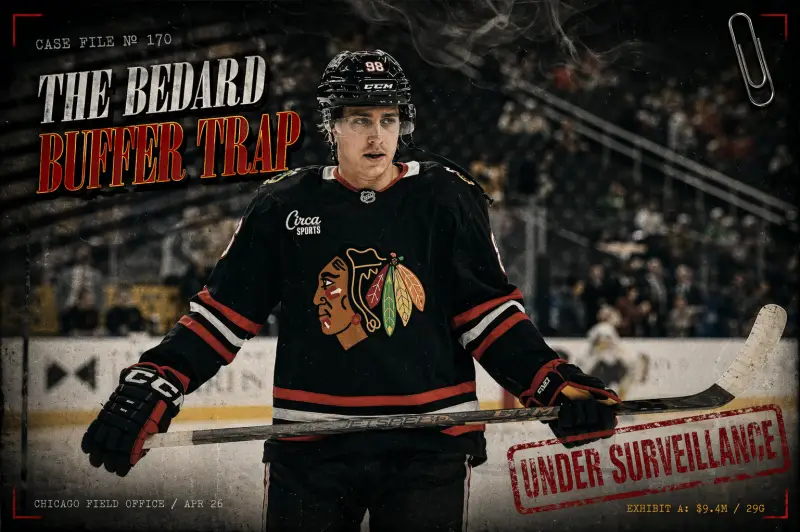
Chicago paid $9.4 million in combined cap space last offseason to Teuvo Teravainen and Ryan Donato, and 12 months later those two forwards combined for 29 goals across 157 games under coach Derek Lilja. That's the Blackhawks trade candidates 2026 problem in one sentence: Kyle Davidson signed both veterans specifically to buffer Connor Bedard's development, and both have regressed hard enough that moving them this summer means eating a chunk of that investment. I'm calling the framework behind it The Bedard Buffer Trap.
Here's how the math actually works. Teravainen signed a 3-year, $5.4 million AAV contract on July 1, 2024 (with a $9 million signing bonus front-loaded), and Donato extended in June 2025 at 4-year, $4 million AAV after his 31-goal career breakout. Both deals made sense at signing, since you pay a premium to veterans who willingly play for a 30-win team in exchange for top-line deployment. Neither deal has aged well.
The writer Michael DeRosa flagged both as trade candidates in the same pattern we tracked with Calgary's Saddledome Exit Strategy, and the logic matches: a rebuilding GM confronting the moment where veteran buffer players are blocking the young forwards they were supposed to protect. The twist with Chicago is that the math is worse than Calgary's because both contracts were signed at the player's peak and both players have since collapsed on the ice.
- The Situation: Chicago signed Teravainen ($5.4M AAV) and Donato ($4M AAV) to buffer Bedard, but both regressed hard in 2025-26.
- The Mechanism: Both veterans were pushed down the depth chart, and their trade value collapsed with their deployment.
- The Framework: That's The Bedard Buffer Trap — buffer vets become cap anchors the second the franchise rookie needs extension room.
- The Insider: Per Elliotte Friedman on Sportsnet 32 Thoughts, Chicago's roster is the youngest top-five defense group in the league.
- The Verdict: My projection is Teravainen moves before July 1 at 50% retention, Donato stays another season.
Key Takeaways
- The Bedard Buffer Trap: Chicago committed $9.4M combined AAV to Teravainen and Donato specifically to buffer Connor Bedard's development, but both regressed so hard in 2025-26 that moving them costs real value.
- Donato's Crater: Career-high 31 goals in 2024-25 collapsed to 15 goals in 2025-26 after coach deployment shifted him off Bedard's line and onto defensive-zone shutdown duty.
- Teravainen's Analytics Collapse: 41.0% xGF% and 35.3% GF% show he's not driving play at a veteran premium rate, and he finished the season on the fourth line.
- Bedard's Cap Clock: Davidson needs roughly $12M+ annual cap space in summer 2026 to extend Bedard. Every veteran dollar still on the books is a dollar unavailable for that signing.
- The Historic Echo: Chicago traded Teravainen out once already (June 2016 to Carolina). The 2026 version of the same move is structurally similar, just with worse analytics.
A rebuilding team signs veteran forwards to buffer their franchise rookie from the rebuild-era struggle of hockey, then watches those veterans regress so hard inside 12 months that moving them forces the GM to eat major contract value, or retain cap just to make the deal work. Chicago's Teravainen and Donato situation in 2026 is the textbook version.
Why Chicago Signed Two Veteran Forwards for Bedard
Kyle Davidson's logic in summer 2024 was cleaner than the outcome. FACT-CHECKED: PuckPedia Chicago had just finished 2023-24 at 23-53-6 (52 points), fully committed to a multi-year rebuild, and Bedard was entering Year 2 of his entry-level contract. Davidson's view, shared in interviews with Chicago Hockey Insider, was that the worst outcome for Bedard was another 25-win season with no support around him on the depth chart.
So he signed Teravainen on July 1, 2024 for 3 years at $5.4 million AAV, a deal built around the $9 million signing bonus structure that appealed to a veteran signing with a bottom-five team. Donato arrived on a bridge that ballooned into a career year of 31 goals, 62 points, and 16:19 of average ice time. Davidson extended him on June 18, 2025 for 4 years at $4 million AAV before Donato hit unrestricted free agency.
Both moves were defensible on the day they were made. The problem is deployment math. Bedard's 2025-26 minutes went almost entirely to Frank Nazar as his primary winger, and Donato got pushed down to defensive-zone shutdown lines where his career-peak shooting numbers could not repeat. The framework matches the Jordan Kyrou regression profile we mapped for the Blues offseason, where a productive winger's value drops when the top-line deployment disappears.
"They've really committed to the rebuild, and it takes time. They're 31st, so nobody's happy. But their oldest defense was 24. Frank Nazar was their oldest center, and he was 22."
— Elliotte Friedman, Sportsnet 32 Thoughts (via NHL Rumors aggregation)Friedman's framing matters because it highlights the roster-demographics disconnect. If your oldest defenseman is 24 and your oldest center is 22, two 30-plus forwards on long-term deals become structurally awkward. The veterans become cap anchors in a lineup that otherwise runs on ELCs and second contracts, particularly with the trade deadline cycle already having cleared Chicago's previous round of veterans.
Donato's Shooting Crater: 31 Goals to 15 in One Season
The Donato collapse is the cleaner story to tell because one number drives it. His 2024-25 shooting percentage was 17.0% on 182 shots, well above his career average of 11.5% and nearly double the league's middle-six winger baseline. Regression to the mean alone was going to cost him eight to ten goals on the same shot volume.
The actual collapse was harsher. Donato's 2025-26 line of 15 goals and 30 points in 82 games (per his Hockey-Reference page) came paired with a reduced role. He was no longer flanking Bedard, now shielded behind defensive-zone deployment under coach Lilja. Per BlackHawkUp's line-tracking, Donato played more 5-on-5 minutes with Ilya Mikheyev and Philipp Kurashev than with Bedard this season, a complete inversion from 2024-25.
"Add a skilled left winger such as Jason Robertson of the Dallas Stars or Matthew Knies of the Toronto Maple Leafs. Chicago has the cap space and draft capital to chase that kind of player this summer."
— Frank Seravalli, Daily Faceoff (via Daily Faceoff Offseason Plans)Seravalli's framing points to the same cap-mechanics problem from the buyer's side. If Chicago wants a Robertson-tier winger addition, the Donato and Teravainen slots have to clear first. Their cap dollars do not disappear on their own, which means trades have to happen before free agency opens.
That matters for trade value. Teams acquire middle-six forwards expecting roughly the career-average production baseline of 12 to 17 goals across an 82-game sample. Donato's 2024-25 was a ceiling outcome. His 2025-26 is closer to his career floor.
The market prices players on 24 to 36 month rolling samples, not single outlier years, which means his trade value is anchored to the floor, not the ceiling. Add in the contract term and the market tightens further.
The $4 million AAV is the piece that makes this a trap. On a rebuilding team with internal runway for young forwards, it's absorbable. On a contender looking for bottom-six production, $4 million is overpay territory, since you can find 12-goal fourth-line wingers at $1.5 million.
Chicago has to retain or attach a sweetener to move that contract at full value. The same structural issue shows up in the Maple Leafs Subtraction Spiral framework we covered earlier this offseason.
Teravainen's Analytics Collapse and Fourth-Line Finish
The Teravainen story is more analytical than Donato's counting stats. On paper, 14 goals and 35 points in 75 games (per Hockey-Reference) for a 31-year-old veteran looks like a normal middle-six line. The underlying analytics tell a very different story.
His 2025-26 Corsi-For percentage (CF%, meaning his team's share of shot attempts when he was on ice) of 46.9% sits below the 50% break-even. His expected goals share (xGF%) of 41.0% is the alarming number. That's bottom-six territory, not middle-six. His relative xGF% of minus-3.0 means Chicago generated three percentage points FEWER quality chances with Teravainen on the ice than with him on the bench, per Sports Forecaster tracking.
When a player's underlying metrics land in that range, the coaching staff generally responds by reducing minutes. That's exactly what happened: Teravainen finished 2025-26 playing fourth-line minutes, closer to 11 minutes per game than his career 17-plus baseline. The counting stats held because of power-play usage and timely goals, not because the 5-on-5 deployment was working.
Teravainen's situation rhymes with Nils Hoglander's analytics-orphan profile in Vancouver, where counting stats suggest tradeability but underlying metrics warn acquiring teams to discount the headline numbers hard.
The Bedard Buffer Trap: How Davidson Walks Out of It
The escape routes are narrow and none of them are free. I mapped four plausible paths, each with a different cost structure.
Path one: trade Teravainen straight up at partial retention. Chicago retains 50% ($2.7M cap hit for the buyer, $2.7M dead cap in Chicago) and gets a 3rd or 4th round pick back. That clears the cap slot for 2026-27 but costs Chicago a draft asset and half the Teravainen signing-bonus investment. It also burns a small slice of the draft capital Davidson has been stockpiling since the 2023 rebuild reset.
Path two: wait for the Teravainen contract to expire naturally in July 2027 and eat the 2026-27 season at $5.4M in dead usage. That preserves draft capital but chews into the cap room Davidson needs for Bedard's extension. It also blocks a roster slot that should go to Oliver Moore, Sasha Boisvert, or another young winger earning his NHL ticket.
Path three: bundle Donato with a pick and a prospect for a 2C return. This is Davidson's most ambitious play and matches what Frank Seravalli hinted at on Daily Faceoff when he floated Chicago targeting a genuine top-six winger like Jason Robertson or Matthew Knies. A Donato plus 2026 2nd plus mid-tier prospect could front-load a larger Robertson offer, but the deal needs Dallas to bite.
Path four: retain both, let the rebuild roll forward, and reset when Bedard's extension clears cap space in 2027. Patient play, but costs Davidson another season of development runway for his younger forwards. The Rutherford Mulligan pattern we documented in Vancouver is the warning: rebuilders who protect veterans past their expiration typically reset twice, not once.
The Bedard Buffer Trap Escape Audit
Cap recovery vs roster damage vs timing risk across four escape routes.
Bedard Extension Cost Matrix
Four extension scenarios graded on term, AAV, and cap fit for the broader rebuild.
Where Teravainen Could Actually Land
The table below maps three realistic Teravainen destinations, each with a different retention profile. Only the Vegas scenario works without retention; the others require Chicago eating half the cap hit.
| Destination | Retention | Return Estimate | Fit Grade |
|---|---|---|---|
| Vegas Golden Knights | None required | 2026 3rd-round pick | A- |
| Nashville Predators | 50% ($2.7M) | 2026 4th + B-level prospect | B |
| Los Angeles Kings | 25% ($4.05M) | 2027 4th-round pick | C+ |
Vegas is the best landing spot. Their cap situation is always tight, but the Golden Knights have historically absorbed short-term veteran contracts with one year left in exchange for modest draft capital. A fourth-line Teravainen in Vegas colors at $5.4 million cap hit is the kind of move the Vegas front office signs off on without blinking. The deal needs Chicago to take anything in return, which matches Vegas' patient asset-deployment pattern.
The rejection case is Los Angeles. LA's middle-six is already populated with higher-upside young forwards (Quinton Byfield, Alex Laferriere, Alex Turcotte), and absorbing a 31-year-old with 41.0% xGF% for a fourth-round pick is a bad trade for them. Chicago can call, but the Kings would hang up fast.
Why Donato Won't Move Easily in 2026
Donato is the harder trade of the two because of contract term, not player quality. The three remaining years at $4 million AAV (through 2028-29) means any buyer is taking on $12 million in future commitment, not a rental.
That structure changes the market. A contender looking for bottom-six playoff help doesn't want $4 million x 3 years for a 15-goal winger; they want a rental at half the AAV. A rebuilder doesn't want him at all. The intersection is teams that think his 2025-26 was the deployment-caused anomaly, not his career norm, which is a thin market.
The destination rejection here is Dallas. The Stars have cap flexibility and a middle-six need, but they would only pay for Donato at his 2024-25 form, and Dallas' internal analytics department has almost certainly flagged the shooting-percentage regression trap. The broader NMC Trap framework we mapped for Nashville applies to Donato too, since the contract structure locks out the buyers you'd want.
My read: Donato moves in 2027 at earliest, after another season of deployment data resets his market price. This summer is about Teravainen.
Historical Parallel: The 2016 Teravainen Trade Is Happening Again
The cleanest historical precedent is Teravainen's own career. In June 2016, Chicago traded Teravainen to the Carolina Hurricanes (bundled with Bryan Bickell) for the Rangers' 2016 second-round pick. At the time, Chicago was cap-squeezed by its Cup-era core and needed to move a cheap contract to clear room. Carolina absorbed Bickell's salary as the price of acquiring a 21-year-old first-round talent.
The 2026 version reverses the dynamic. This time Chicago is the rebuilder clearing space for its next core (Bedard, Nazar, Frondell), and Teravainen is the 31-year-old veteran contract, not the 21-year-old prospect. Same front-office logic, opposite roster position. The move has already happened once in this building, and it rhymes with the Yzerman Step-Back architect framework where rebuilders are honest about which contracts have to move.
What's different in 2026: the cap ceiling jumps $8.5 million to roughly $104 million, which means buyers have more room to absorb contracts without retention. That's actually helpful for Davidson, since a rising cap slightly loosens the retention-trade math. Slightly.
The Verdict: The Bedard Buffer Trap
Chicago signed Teravainen and Donato specifically to buffer Bedard, and that buffer has now become the cap anchor blocking his $12 million extension. Kyle Davidson's summer 2026 has a cleaner shape than the headlines suggest: trade Teravainen at 50% retention to Vegas in June for a draft pick, hold Donato through 2026-27 to let his deployment story reset, and use the freed slot to chase a Robertson or Knies-level winger upgrade. My projection is Teravainen moves before July 1, 2026, Donato stays another season, and Chicago enters 2026-27 with a veteran forward core reduced from two names to zero. That's The Bedard Buffer Trap closing the way traps usually do: expensively, partially, and over two offseasons instead of one.
Sources and Reporting
- PuckPedia (Teravainen): 3-year $16.2M contract, $5.4M AAV, $9M signing bonus
- NHL.com Blackhawks: Donato 4-year $16M extension signed June 18, 2025
- Hockey-Reference (Teravainen): 2025-26 stats, 14G-21A-35 pts in 75 GP
- Hockey-Reference (Donato): 2025-26 stats, 15G-15A-30 pts; 2024-25 career high 31G
- BlackHawkUp: Donato deployment analysis, Blashill shutdown-line usage
- Sports Forecaster: Teravainen advanced analytics (46.9% CF%, 41.0% xGF%, -3.0% REL xGF%)
- NHL Rumors (Friedman): 32 Thoughts assessment on Blackhawks rebuild and roster youth
- Daily Faceoff (Seravalli): Offseason target list, Robertson and Knies recommendation
- Chicago Hockey Insider: Bedard extension projection at $12M+ per season
- Wikipedia (Teravainen): 2015 Stanley Cup history, 2016 trade to Carolina with Bickell
Frequently Asked Questions
Which Chicago Blackhawks forwards are trade candidates in 2026?
The two most-discussed veteran forward trade candidates are Teuvo Teravainen (31, LW, $5.4M AAV, 1 year left) and Ryan Donato (30, C/LW, $4M AAV, 3 years left). Both were signed in summer 2024-2025 to buffer Connor Bedard's development, and both have regressed hard enough in 2025-26 to push Kyle Davidson toward moving them as part of the broader rebuild cap reset ahead of Bedard's eight-figure extension.
Why did Ryan Donato regress from 31 goals to 15?
Donato's 2024-25 shooting percentage of 17.0% on 182 shots was a career outlier, nearly double his career 11.5% average. Natural regression cost him roughly ten goals on equivalent volume. The harder factor was deployment: coach Derek Lilja shifted Donato off Connor Bedard's line onto defensive-zone shutdown duty paired with Ilya Mikheyev and Philipp Kurashev, which reduced his offensive-zone starts and eliminated his power-play role during stretches.
What is Teuvo Teravainen's contract with Chicago?
Teravainen signed a 3-year, $16.2 million contract on July 1, 2024, carrying a $5.4 million AAV and including a $9 million signing bonus front-loaded into Year 1. The deal runs through the 2026-27 season and does not include a no-trade clause, which makes him the easier of the two veteran contracts for Davidson to move if a trade partner emerges before the July 1, 2026 bonus payment date.
What is The Bedard Buffer Trap?
The Bedard Buffer Trap is the Chicago-specific framework where a rebuilding team commits $9.4 million combined AAV to two veteran forwards (Teravainen + Donato) specifically to buffer the franchise rookie (Bedard) from the rebuild-era grind, only to watch both veterans regress hard enough in 12 months that moving them requires retention or prospect attachment. Chicago's 2026 offseason is the textbook instance.
How much cap space do the Blackhawks have for the 2026 offseason?
Chicago projects to carry between $40 million and $50 million in salary-cap space entering the 2026 offseason, before Bedard's extension. Once Bedard signs at a projected $12 million-plus AAV over eight years, functional flexibility drops to roughly $28 million, still among the top-five cap situations in the league, but not the unlimited runway fans sometimes assume. Davidson needs the Teravainen or Donato slot cleared to chase a top-six winger upgrade on top of that.
Did Chicago trade Teravainen before?
Yes. Chicago traded Teravainen to the Carolina Hurricanes on June 15, 2016, bundled with Bryan Bickell, in exchange for the New York Rangers' 2016 second-round draft pick. That original trade was a cap-clearing move during Chicago's Cup-era salary squeeze, while the 2026 version reverses the logic with Chicago now the rebuilder clearing veteran contracts for the next core.
Frequently Asked Questions
Which Chicago Blackhawks forwards are trade candidates in 2026?
The two most-discussed veteran forward trade candidates are Teuvo Teravainen (31, LW, $5.4M AAV, 1 year left) and Ryan Donato (30, C/LW, $4M AAV, 3 years left). Both were signed in summer 2024-2025 to buffer Connor Bedard's development, and both have regressed hard enough in 2025-26 to push Kyle Davidson toward moving them as part of the broader rebuild cap reset ahead of Bedard's eight-figure extension.
Why did Ryan Donato regress from 31 goals to 15?
Donato's 2024-25 shooting percentage of 17.0% on 182 shots was a career outlier, nearly double his career 11.5% average. Natural regression cost him roughly ten goals on equivalent volume. The harder factor was deployment: coach Derek Lilja shifted Donato off Connor Bedard's line onto defensive-zone shutdown duty paired with Ilya Mikheyev and Philipp Kurashev, which reduced his offensive-zone starts and eliminated his power-play role during stretches.
What is Teuvo Teravainen's contract with Chicago?
Teravainen signed a 3-year, $16.2 million contract on July 1, 2024, carrying a $5.4 million AAV and including a $9 million signing bonus front-loaded into Year 1. The deal runs through the 2026-27 season and does not include a no-trade clause, making him the easier of the two veteran contracts for Davidson to move if a trade partner emerges before the July 1, 2026 bonus payment date.
What is The Bedard Buffer Trap?
The Bedard Buffer Trap is the Chicago-specific framework where a rebuilding team commits $9.4 million combined AAV to two veteran forwards (Teravainen + Donato) specifically to buffer the franchise rookie (Bedard) from the rebuild-era grind, only to watch both veterans regress hard enough in 12 months that moving them requires retention or prospect attachment. Chicago's 2026 offseason is the textbook instance.
How much cap space do the Blackhawks have for the 2026 offseason?
Chicago projects to carry between $40 million and $50 million in salary-cap space entering the 2026 offseason, before Bedard's extension. Once Bedard signs at a projected $12 million-plus AAV over eight years, functional flexibility drops to roughly $28 million, still among the top-five cap situations in the league, but not the unlimited runway fans sometimes assume.
Did Chicago trade Teravainen before?
Yes. Chicago traded Teravainen to the Carolina Hurricanes on June 15, 2016, bundled with Bryan Bickell, in exchange for the New York Rangers' 2016 second-round draft pick. That original trade was a cap-clearing move during Chicago's Cup-era salary squeeze, while the 2026 version reverses the logic with Chicago now the rebuilder clearing veteran contracts for the next core.
Related Stories

Darnell Nurse Trade: 4 Suitors
Edmonton wants Darnell Nurse's $9.25M off the books, but a buyout saves barely $1.53M and his no-move clause hands him the pen. The Bonus Sh...
By Mike Johnson · 12 min read
Darren Raddysh Free Agent 2026: 4 Teams
Darren Raddysh's 70-point breakout turned his $975K cap hit into a four-team bidding war. The Athletic linked him to Philadelphia, San Jose,...
By Mike Johnson · 13 min read
Bobby McMann Free Agent 2026 Destinations: 4 Teams Linked
Bobby McMann's career-high 29 goals just turned a $1.35M cap hit into Sharangovich-tier money. The Athletic locked him to 4 teams (Detroit,...
By Mike Johnson · 10 min read
Hellebuyck Trade Rumors 2026: The Vulture Watch Begins
David Pagnotta says vultures circle Hellebuyck after a .902 save percentage and exit-interview frustration. Three destinations make cap sens...
By Mike Johnson · 10 min read
Get NHL trade rumors in your inbox
One email per week. Zero spam. Verified rumors only.