Yzerman Step Back Red Wings: The Architect's Ceiling
Friedman proposed moving Yzerman to president and promoting Draper or Horcoff to GM. But the Sakic Model worked because Sakic won first — Yzerman hasn't. The Architect's Ceiling explains why Detroit's rebuild genius may be the obstacle to finishing it.
Live updates
No updates yet. Refreshing automatically.
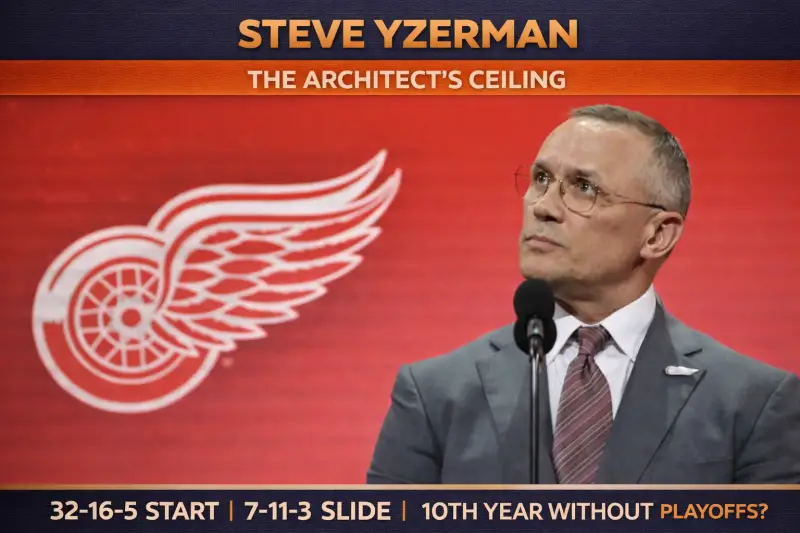
Detroit was 32-16-5 on January 25. Best start of Steve Yzerman's seven-year tenure as general manager. Then the floor disappeared. A 7-11-3 slide through February and March dragged the Red Wings from a comfortable playoff position to the wrong side of the wild-card bubble, and Yzerman was forced into something he'd never done as Detroit's GM: buy at the trade deadline. He spent a first-round pick, a third-rounder, defenseman Justin Holl, and prospect Dmitri Buchelnikov to acquire Justin Faulk from St. Louis. He re-acquired David Perron from Ottawa for a conditional fourth.
It still might not be enough. The Red Wings are sitting at 86 points through 73 games, battling Boston and Columbus for wild-card positioning with a 60% chance of making the playoffs. If they miss for a 10th consecutive season, the conversation won't be about coaching or depth scoring. It'll be about whether Yzerman should step back from the Red Wings' daily operations — and what that actually means. Elliotte Friedman floated the answer on the 32 Thoughts podcast: move Yzerman to president of hockey operations and promote either Kris Draper or Shawn Horcoff to general manager. It's the Joe Sakic model from Colorado. It sounds clean. I don't think it works here.
Key Takeaways
- Friedman's proposal: Move Yzerman to president of hockey operations, promote Kris Draper or Shawn Horcoff to GM — following the Sakic-MacFarland structure in Colorado.
- The Sakic Model flaw: Sakic moved upstairs after winning the 2022 Stanley Cup. Yzerman would move upstairs after nine consecutive playoff misses. Same org chart, opposite context.
- First-time buyer: Yzerman bought at a deadline for the first time in his tenure — trading a 1st, 3rd, Holl, and Buchelnikov for Faulk and Perron.
- Detroit's collapse: 32-16-5 start fell apart into a 7-11-3 slide. Currently 86 points with 60% playoff probability.
- The DeBrincat clock: Alex DeBrincat ($7.875M) becomes a UFA after 2026-27 with a career-high 37 goals — the next GM's first major decision.
What Friedman Actually Proposed — and What Everyone Got Wrong
The speculation didn't come from an anonymous source. It came from Elliotte Friedman — the most connected insider in hockey — on the 32 Thoughts podcast, a show NHL front offices actually listen to. His exact words deserve more attention than the clickbait headlines that followed.
"My alternate theory is Yzerman goes up to president of hockey operations and they promote Kris Draper or Shawn Horcoff to be the new general manager."
— Elliotte Friedman, 32 Thoughts Podcast (via HockeyFeed)Then came the qualifier that most outlets skipped entirely: "It doesn't necessarily change who has final say, but I think what it could do is, it empowers somebody else. Yzerman can scale back a little bit, and I think as that happens whoever that GM is starts to have more hands on." That second sentence is the one nobody's debating. Friedman isn't proposing that Yzerman loses power. He's proposing Yzerman keeps power but delegates presence — fewer league meetings, fewer daily cap negotiations, someone else as the public face of the front office while Yzerman operates from a strategic altitude.
The issue is binary. If Yzerman keeps final say, the title change is cosmetic. If he doesn't keep final say, the Ilitch family is effectively demoting a franchise icon who captained this team for 19 seasons. There's no middle ground that actually changes how Detroit makes decisions unless Yzerman genuinely wants to disengage — and nothing in his seven-year track record suggests a man who's comfortable with less control.
Sunday Overreactions for @Sportsnet The Red Wings squandered a big opportunity Saturday to make up ground in the playoff race. If they miss again after seemingly being a lock to end their postseason drought, how hot should Steve Yzerman's seat be? #LGRW
— Michael Amato (@amato_mike) March 29, 2026
What got buried under the April 1 firing hoax — a social media fabrication with zero connection to Friedman's reporting — is that this conversation is happening at all. In January, Yzerman was getting credit for a rebuild finally showing results. By late March, Sportsnet analysts were openly questioning his future. That swing happened in eight weeks. And it happened because the Red Wings did what Yzerman-era Red Wings always do: start hot, collapse in the second half, and leave fans wondering if anything has actually changed. For a franchise that hasn't seen a playoff game since April 2016, the patience has an expiration date — and it might be this summer.
The Sakic Model Has a Fatal Flaw Nobody's Examining
Friedman's comparison to Colorado isn't random. Joe Sakic served as the Avalanche's GM from 2013 to 2022, built a championship roster from scratch — drafting Cale Makar, extending Nathan MacKinnon, assembling the pieces that won the 2022 Cup — and then moved to president of hockey operations that July, handing the GM title to Chris MacFarland. It worked. MacFarland has kept the Avalanche among the league's best. Sakic provides oversight without micromanaging. Everybody wins.
The problem nobody is addressing: Sakic moved up after winning. Yzerman would be moving up after a decade of losing.
| Factor | Sakic (Colorado) | Yzerman (Detroit) |
|---|---|---|
| GM tenure before move | 9 years (2013-2022) | 7 years (2019-2026) |
| Trigger for change | Won Stanley Cup | Potential 10th playoff miss |
| Successor | MacFarland (rival teams poaching) | Draper or Horcoff (untested) |
| Motivation | Retain MacFarland + earned rest | Deflect pressure + show change |
That table is the entire argument. Sakic's promotion was a victory lap — rival teams were actively trying to hire MacFarland, and Colorado promoted him to prevent losing him. Nobody is poaching Kris Draper. No franchise has offered Shawn Horcoff a GM interview. The urgency to promote one of them doesn't come from external demand. It comes from the need to show Detroit's fanbase that something is different — even if the man making the decisions stays exactly the same.
Detroit actually has its own historical precedent for this kind of restructuring, and it's one nobody is invoking. Jimmy Devellano, who built the Red Wings dynasty as GM from 1982 to 1990, moved to senior vice president and eventually ceded day-to-day control to Bryan Murray and later Ken Holland. That transition worked because Devellano genuinely stepped back. He wasn't hovering over draft boards. He wasn't overruling trade proposals. My read on Yzerman: he's not wired to be a figurehead. He relocated his family back to Detroit specifically to run this rebuild hands-on. Giving him a bigger title and a smaller office doesn't solve the problem Friedman identified. It just rearranges the furniture.
Draper vs. Horcoff — The Two GMs Nobody's Comparing
Every article about Yzerman's future names Draper and Horcoff as potential replacements. None of them analyze who these men actually are or what they'd do differently. That's a significant gap, because these are two very different hockey executives with two very different philosophies.
| Category | Kris Draper | Shawn Horcoff |
|---|---|---|
| Current role | AGM / Dir. of Amateur Scouting | AGM / GM, Grand Rapids (AHL) |
| With Detroit since | 2011 (player: 1993-2011) | 2019 |
| Core strength | Draft pipeline architect | Player development specialist |
| Signature win | Emmitt Finnie (201st pick → NHL) | Built competitive Griffins roster |
Draper is the scouting-first candidate. He's overseen every Red Wings draft since Yzerman took over, including Lucas Raymond (4th overall, 2020), Simon Edvinsson (6th, 2021), Marco Kasper (8th, 2022), and the late-round steal of Emmitt Finnie — a 201st-overall pick in 2023 who's now playing on Detroit's top line. Five of six first-rounders from 2020 to 2023 are either in the NHL or on the doorstep. That's Draper's fingerprint. His value is in identifying talent before anyone else does, and his hit rate at the top of the draft has been genuinely elite.
Horcoff is the development candidate. As GM of the Grand Rapids Griffins, he's built an AHL roster that consistently produces NHL-ready players. His focus is the space between draft day and the big league — the coaching, the conditioning, the judgment call about when a prospect is ready. Where Draper finds talent, Horcoff finishes it.
Here's the part that bugs me. If Yzerman moves to president and one of these men becomes GM but Yzerman retains final say, what incentive does either man have to push back on a trade? The entire point of a new GM is a new perspective. I'd argue that Pittsburgh's approach to empowering Kyle Dubas — giving him full operational autonomy rather than installing a shadow power structure — produced faster results than any title-change-without-power-change ever will. A GM who has to check with the president before every move isn't a GM. He's a messenger with a nicer business card.
The Architect's Ceiling — What Yzerman Built and Where He Stalled
This is where I split from both camps — the "fire Yzerman" crowd and the "leave him alone" crowd. Both positions miss the actual tension. Yzerman has been an exceptional talent evaluator and a below-average closer. The skills that rebuilt Detroit's pipeline are the same skills that left the team unable to capitalize when the pipeline started producing.
"The players that we acquired, for what it cost us to acquire them, I feel, and we as a staff felt, it was justified to try to improve our team and give us a better chance of making the playoffs."
— Steve Yzerman, on 2026 deadline acquisitions (via NHL.com)The drafting has been outstanding. Moritz Seider — 8th overall in 2019, a pick most scouts called a reach — is a legitimate top-pairing defenseman earning $8.55 million through 2031. Raymond has 71 points through 71 games this season. Alex DeBrincat is shooting 14.2% on 261 shots with a career-high 37 goals through 73 games, production that appears sustainable based on his shooting rate. Dylan Larkin ($8.7M), Seider, and Raymond are all locked up long-term. The core is real.
The problem is everything around the core. Yzerman was a seller or a bystander at every trade deadline from 2019 to 2025 — six consecutive years of standing pat while the team languished in the bottom half of the standings. He was historically passive in free agency. The one time he finally bought, at the 2026 deadline, the haul was Justin Faulk (a solid second-pair defenseman but not a needle-mover) and David Perron (a 37-year-old recovering from hernia surgery). He gave up a first-round pick for Faulk — his most aggressive move in seven years — and the Blues happily accepted because they were selling a pending UFA to the highest bidder. Meanwhile, Detroit failed to land a top-six scoring upgrade. They pursued Elias Pettersson — Vancouver wouldn't retain salary. They offered for Michael Bunting — Dallas outbid them.
That pattern — patience when the team needs urgency — is The Architect's Ceiling. Yzerman built this house from the foundation. The blueprints are brilliant. But the team needed a roof two years ago, and he kept pouring concrete. DeBrincat is the clearest proof of the ticking clock. He's on a $7.875M deal that expires after next season, and he'll become an unrestricted free agent at 29 with career-best numbers. His next contract will push past $10 million on the open market. The window to extend him at a reasonable price is this summer — and whether Detroit's front office can shift from patience to aggression will determine if the core Yzerman assembled stays intact or starts to scatter.
Update May 12, 2026: The franchise-legend-as-executive model continues across the league. See Vancouver's Sedin twins front office offer per Friedman May 11.
Sources and Reporting
- HockeyFeed — Friedman's 32 Thoughts quotes on Yzerman succession, Draper and Horcoff as candidates
- Octopus Thrower — Amato's defense of Yzerman, Draper scouting credits, Horcoff Griffins role
- NHL.com (Red Wings) — Yzerman quotes on Faulk and Perron acquisitions, deadline rationale
- House of Hockey — April 1 firing rumor debunked, team record context
- Detroit Hockey Now — NHL source stating ownership won't fire Yzerman
- PuckPedia — Contract and salary cap mechanics data for Larkin, Seider, Raymond, DeBrincat, Faulk
I keep hearing the same reassurance from people close to the organization: ownership will never fire Yzerman. I believe that. What I don't believe is that "not firing" and "not changing" are the same thing. The Architect's Ceiling is real — Yzerman's conservative instincts built a pipeline that any franchise would envy, but those same instincts cost Detroit at the 2026 deadline when they needed a top-six forward and settled for a second-pair defenseman and a depth forward coming off surgery. My projection: Yzerman stays as GM through the 2026-27 season regardless of whether Detroit makes the playoffs this April. But Draper gets quietly expanded authority over roster construction and deadline strategy — the soft version of the Sakic Model without the title change and without the press conference. The real succession happens gradually, not in a single announcement. And if DeBrincat walks as a UFA next July because the front office couldn't shift from building mode to winning mode fast enough, The Architect's Ceiling becomes the defining failure of Yzerman's second act in Detroit.
Will Steve Yzerman be fired as Red Wings GM?
Almost certainly not. A prominent NHL source told Detroit Hockey Now he "couldn't envision" ownership ever firing Yzerman. The more likely outcome is expanded authority for Kris Draper or Shawn Horcoff while Yzerman retains his title and final say — a quiet internal power shift without a formal announcement. The Ilitch family views Yzerman as untouchable given his 19-year captaincy and the rebuild progress he's delivered.
Who would replace Yzerman as Detroit's general manager?
Kris Draper and Shawn Horcoff are the two internal candidates Friedman named. Draper runs amateur scouting and is credited with draft steals like Emmitt Finnie, a 201st-overall pick in 2023 now playing on Detroit's top line. Horcoff manages the Grand Rapids Griffins and specializes in prospect development. No external candidates have been publicly linked to the role.
What is the Sakic Model that Friedman referenced?
Joe Sakic moved from Avalanche GM to president of hockey operations in July 2022, promoting assistant Chris MacFarland to GM. The critical distinction: Sakic made that move after winning the Stanley Cup and because rival teams were trying to hire MacFarland. Yzerman's version would be triggered by a playoff miss, not a championship — fundamentally different context that changes whether the move signals strength or damage control.
How long have the Detroit Red Wings missed the playoffs?
Nine consecutive seasons since their last appearance in 2016, when Tampa Bay eliminated them in the first round. That ended a legendary 25-year playoff streak from 1991 to 2016. If Detroit misses again in 2026, it becomes a full decade without postseason hockey — the franchise's longest drought since the Dead Wings era of the 1970s and 1980s.
What did the Red Wings do at the 2026 trade deadline?
Yzerman bought for the first time in his seven-year tenure. He acquired defenseman Justin Faulk from St. Louis for a 2026 first-round pick, third-round pick, Justin Holl, and Dmitri Buchelnikov. He also re-acquired David Perron from Ottawa for a conditional fourth-rounder. The only active-roster loss was Elmer Soderblom, traded to Pittsburgh for a third-round pick. Detroit failed to land a top-six scoring upgrade despite pursuing Elias Pettersson and Michael Bunting.
Frequently Asked Questions
Key Takeaways Friedman's proposal: Move Yzerman to president of hockey operations, promote Kris Draper or Shawn Horcoff to GM — following the Sakic-MacFarland structure in Colorado. The Sakic Model flaw: Sakic moved upstairs after winning the 2022 Stanley Cup. Yzerman would move upstairs after nine consecutive playoff misses. Same org chart, opposite context. First-time buyer: Yzerman bought at a deadline for the first time in his tenure — trading a 1st, 3rd, Holl, and Buchelnikov for Faulk and Perron. Detroit's collapse: 32-16-5 start fell apart into a 7-11-3 slide. Currently 86 points with 60% playoff probability. The DeBrincat clock: Alex DeBrincat ($7.875M) becomes a UFA after 2026-27 with a career-high 37 goals — the next GM's first major decision. What Friedman Actually Proposed — and What Everyone Got Wrong The speculation didn't come from an anonymous source. It came from Elliotte Friedman — the most connected insider in hockey — on the 32 Thoughts podcast, a show NHL front offices actually listen to. His exact words deserve more attention than the clickbait headlines that followed. "My alternate theory is Yzerman goes up to president of hockey operations and they promote Kris Draper or Shawn Horcoff to be the new general manager." — Elliotte Friedman, 32 Thoughts Podcast (via HockeyFeed) Then came the qualifier that most outlets skipped entirely: "It doesn't necessarily change who has final say, but I think what it could do is, it empowers somebody else. Yzerman can scale back a little bit, and I think as that happens whoever that GM is starts to have more hands on." That second sentence is the one nobody's debating. Friedman isn't proposing that Yzerman loses power. He's proposing Yzerman keeps power but delegates presence — fewer league meetings, fewer daily cap negotiations, someone else as the public face of the front office while Yzerman operates from a strategic altitude. The issue is binary. If Yzerman keeps final say, the title change is cosmetic. If he doesn't keep final say, the Ilitch family is effectively demoting a franchise icon who captained this team for 19 seasons. There's no middle ground that actually changes how Detroit makes decisions unless Yzerman genuinely wants to disengage — and nothing in his seven-year track record suggests a man who's comfortable with less control. Sunday Overreactions for @Sportsnet The Red Wings squandered a big opportunity Saturday to make up ground in the playoff race. If they miss again after seemingly being a lock to end their postseason drought, how hot should Steve Yzerman's seat be? #LGRW— Michael Amato (@amato_mike) March 29, 2026 Sportsnet's Amato frames the question Detroit is avoiding — via X (formerly Twitter) What got buried under the April 1 firing hoax — a social media fabrication with zero connection to Friedman's reporting — is that this conversation is happening at all. In January, Yzerman was getting credit for a rebuild finally showing results. By late March, Sportsnet analysts were openly questioning his future. That swing happened in eight weeks. And it happened because the Red Wings did what Yzerman-era Red Wings always do: start hot, collapse in the second half, and leave fans wondering if anything has actually changed. For a franchise that hasn't seen a playoff game since April 2016, the patience has an expiration date — and it might be this summer. The Sakic Model Has a Fatal Flaw Nobody's Examining Friedman's comparison to Colorado isn't random. Joe Sakic served as the Avalanche's GM from 2013 to 2022, built a championship roster from scratch — drafting Cale Makar, extending Nathan MacKinnon, assembling the pieces that won the 2022 Cup — and then moved to president of hockey operations that July, handing the GM title to Chris MacFarland. It worked. MacFarland has kept the Avalanche among the league's best. Sakic provides oversight without micromanaging. Everybody wins. The problem nobody is addressing: Sakic moved up after winning. Yzerman would be moving up after a decade of losing. FactorSakic (Colorado)Yzerman (Detroit) GM tenure before move9 years (2013-2022)7 years (2019-2026) Trigger for changeWon Stanley CupPotential 10th playoff miss SuccessorMacFarland (rival teams poaching)Draper or Horcoff (untested) MotivationRetain MacFarland + earned restDeflect pressure + show change That table is the entire argument. Sakic's promotion was a victory lap — rival teams were actively trying to hire MacFarland, and Colorado promoted him to prevent losing him. Nobody is poaching Kris Draper. No franchise has offered Shawn Horcoff a GM interview. The urgency to promote one of them doesn't come from external demand. It comes from the need to show Detroit's fanbase that something is different — even if the man making the decisions stays exactly the same. Detroit actually has its own historical precedent for this kind of restructuring, and it's one nobody is invoking. Jimmy Devellano, who built the Red Wings dynasty as GM from 1982 to 1990, moved to senior vice president and eventually ceded day-to-day control to Bryan Murray and later Ken Holland. That transition worked because Devellano genuinely stepped back. He wasn't hovering over draft boards. He wasn't overruling trade proposals. My read on Yzerman: he's not wired to be a figurehead. He relocated his family back to Detroit specifically to run this rebuild hands-on. Giving him a bigger title and a smaller office doesn't solve the problem Friedman identified. It just rearranges the furniture. Draper vs. Horcoff — The Two GMs Nobody's Comparing Every article about Yzerman's future names Draper and Horcoff as potential replacements. None of them analyze who these men actually are or what they'd do differently. That's a significant gap, because these are two very different hockey executives with two very different philosophies. CategoryKris DraperShawn Horcoff Current roleAGM / Dir. of Amateur ScoutingAGM / GM, Grand Rapids (AHL) With Detroit since2011 (player: 1993-2011)2019 Core strengthDraft pipeline architectPlayer development specialist Signature winEmmitt Finnie (201st pick → NHL)Built competitive Griffins roster Draper is the scouting-first candidate. He's overseen every Red Wings draft since Yzerman took over, including Lucas Raymond (4th overall, 2020), Simon Edvinsson (6th, 2021), Marco Kasper (8th, 2022), and the late-round steal of Emmitt Finnie — a 201st-overall pick in 2023 who's now playing on Detroit's top line. Five of six first-rounders from 2020 to 2023 are either in the NHL or on the doorstep. That's Draper's fingerprint. His value is in identifying talent before anyone else does, and his hit rate at the top of the draft has been genuinely elite. Horcoff is the development candidate. As GM of the Grand Rapids Griffins, he's built an AHL roster that consistently produces NHL-ready players. His focus is the space between draft day and the big league — the coaching, the conditioning, the judgment call about when a prospect is ready. Where Draper finds talent, Horcoff finishes it. Here's the part that bugs me. If Yzerman moves to president and one of these men becomes GM but Yzerman retains final say, what incentive does either man have to push back on a trade? The entire point of a new GM is a new perspective. I'd argue that Pittsburgh's approach to empowering Kyle Dubas — giving him full operational autonomy rather than installing a shadow power structure — produced faster results than any title-change-without-power-change ever will. A GM who has to check with the president before every move isn't a GM. He's a messenger with a nicer business card. The Architect's Ceiling — What Yzerman Built and Where He Stalled This is where I split from both camps — the "fire Yzerman" crowd and the "leave him alone" crowd. Both positions miss the actual tension. Yzerman has been an exceptional talent evaluator and a below-average closer. The skills that rebuilt Detroit's pipeline are the same skills that left the team unable to capitalize when the pipeline started producing. "The players that we acquired, for what it cost us to acquire them, I feel, and we as a staff felt, it was justified to try to improve our team and give us a better chance of making the playoffs." — Steve Yzerman, on 2026 deadline acquisitions (via NHL.com) The drafting has been outstanding. Moritz Seider — 8th overall in 2019, a pick most scouts called a reach — is a legitimate top-pairing defenseman earning $8.55 million through 2031. Raymond has 71 points through 71 games this season. Alex DeBrincat is shooting 14.2% on 261 shots with a career-high 37 goals through 73 games, production that appears sustainable based on his shooting rate. Dylan Larkin ($8.7M), Seider, and Raymond are all locked up long-term. The core is real. The problem is everything around the core. Yzerman was a seller or a bystander at every trade deadline from 2019 to 2025 — six consecutive years of standing pat while the team languished in the bottom half of the standings. He was historically passive in free agency. The one time he finally bought, at the 2026 deadline, the haul was Justin Faulk (a solid second-pair defenseman but not a needle-mover) and David Perron (a 37-year-old recovering from hernia surgery). He gave up a first-round pick for Faulk — his most aggressive move in seven years — and the Blues happily accepted because they were selling a pending UFA to the highest bidder. Meanwhile, Detroit failed to land a top-six scoring upgrade. They pursued Elias Pettersson — Vancouver wouldn't retain salary. They offered for Michael Bunting — Dallas outbid them. That pattern — patience when the team needs urgency — is The Architect's Ceiling. Yzerman built this house from the foundation. The blueprints are brilliant. But the team needed a roof two years ago, and he kept pouring concrete. DeBrincat is the clearest proof of the ticking clock. He's on a $7.875M deal that expires after next season, and he'll become an unrestricted free agent at 29 with career-best numbers. His next contract will push past $10 million on the open market. The window to extend him at a reasonable price is this summer — and whether Detroit's front office can shift from patience to aggression will determine if the core Yzerman assembled stays intact or starts to scatter. Sources and Reporting HockeyFeed — Friedman's 32 Thoughts quotes on Yzerman succession, Draper and Horcoff as candidates Octopus Thrower — Amato's defense of Yzerman, Draper scouting credits, Horcoff Griffins role NHL.com (Red Wings) — Yzerman quotes on Faulk and Perron acquisitions, deadline rationale House of Hockey — April 1 firing rumor debunked, team record context Detroit Hockey Now — NHL source stating ownership won't fire Yzerman PuckPedia — Contract and salary cap mechanics data for Larkin, Seider, Raymond, DeBrincat, Faulk I keep hearing the same reassurance from people close to the organization: ownership will never fire Yzerman. I believe that. What I don't believe is that "not firing" and "not changing" are the same thing. The Architect's Ceiling is real — Yzerman's conservative instincts built a pipeline that any franchise would envy, but those same instincts cost Detroit at the 2026 deadline when they needed a top-six forward and settled for a second-pair defenseman and a depth forward coming off surgery. My projection: Yzerman stays as GM through the 2026-27 season regardless of whether Detroit makes the playoffs this April. But Draper gets quietly expanded authority over roster construction and deadline strategy — the soft version of the Sakic Model without the title change and without the press conference. The real succession happens gradually, not in a single announcement. And if DeBrincat walks as a UFA next July because the front office couldn't shift from building mode to winning mode fast enough, The Architect's Ceiling becomes the defining failure of Yzerman's second act in Detroit. Will Steve Yzerman be fired as Red Wings GM?
Almost certainly not. A prominent NHL source told Detroit Hockey Now he "couldn't envision" ownership ever firing Yzerman. The more likely outcome is expanded authority for Kris Draper or Shawn Horcoff while Yzerman retains his title and final say — a quiet internal power shift without a formal announcement. The Ilitch family views Yzerman as untouchable given his 19-year captaincy and the rebuild progress he's delivered.
Who would replace Yzerman as Detroit's general manager?
Kris Draper and Shawn Horcoff are the two internal candidates Friedman named. Draper runs amateur scouting and is credited with draft steals like Emmitt Finnie, a 201st-overall pick in 2023 now playing on Detroit's top line. Horcoff manages the Grand Rapids Griffins and specializes in prospect development. No external candidates have been publicly linked to the role.
What is the Sakic Model that Friedman referenced?
Joe Sakic moved from Avalanche GM to president of hockey operations in July 2022, promoting assistant Chris MacFarland to GM. The critical distinction: Sakic made that move after winning the Stanley Cup and because rival teams were trying to hire MacFarland. Yzerman's version would be triggered by a playoff miss, not a championship — fundamentally different context that changes whether the move signals strength or damage control.
How long have the Detroit Red Wings missed the playoffs?
Nine consecutive seasons since their last appearance in 2016, when Tampa Bay eliminated them in the first round. That ended a legendary 25-year playoff streak from 1991 to 2016. If Detroit misses again in 2026, it becomes a full decade without postseason hockey — the franchise's longest drought since the Dead Wings era of the 1970s and 1980s.
What did the Red Wings do at the 2026 trade deadline?
Yzerman bought for the first time in his seven-year tenure. He acquired defenseman Justin Faulk from St. Louis for a 2026 first-round pick, third-round pick, Justin Holl, and Dmitri Buchelnikov. He also re-acquired David Perron from Ottawa for a conditional fourth-rounder. The only active-roster loss was Elmer Soderblom, traded to Pittsburgh for a third-round pick. Detroit failed to land a top-six scoring upgrade despite pursuing Elias Pettersson and Michael Bunting.
Related Stories
How Do Line Changes Work in Hockey?
A line change is hockey's strangest routine: you swap players while the puck is live, but only inside a five-foot pocket beside your own ben...
By Mike Johnson · 10 min read
What Is the Long Change in Hockey?
The long change is not jargon, it is bench geography. Teams switch ends each period but keep the same bench, so in the second period a tired...
By Mike Johnson · 9 min read
What Is a Delayed Penalty in Hockey?
A delayed penalty is not a penalty yet. It is the referee holding the whistle after a foul until the penalized team touches the puck, which...
By Mike Johnson · 9 min read
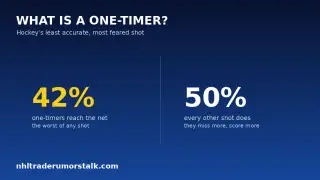
What Is a One-Timer in Hockey?
A one-timer reaches the net just 42% of the time, the worst of any shot, yet it is the most dangerous weapon in hockey and the shot Ovechkin...
By Mike Johnson · 11 min read
Comments
Be the first to share your take.
Get NHL trade rumors in your inbox
One email per week, zero spam, verified rumors only.