Ottawa After Brady Tkachuk: The Four-Pick Reset
For seven years Ottawa was Brady Tkachuk's team. After trading him to Florida for four picks, the Senators must define themselves without their captain. The return, the cap room, the empty C, and why Ottawa insists it isn't a teardown.
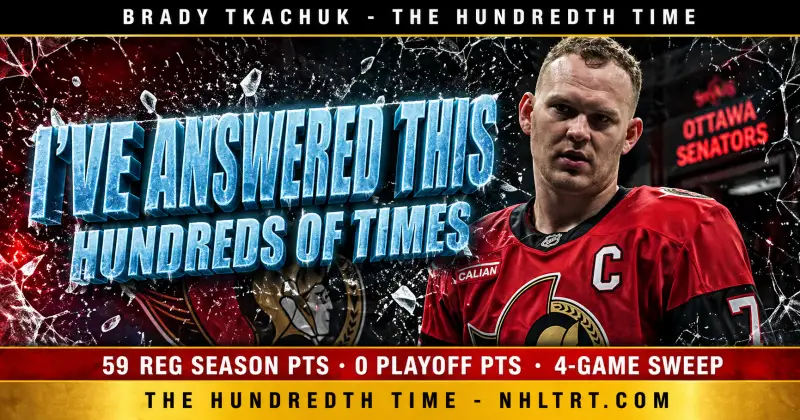
For seven years the Ottawa Senators had an easy answer to the question of who they were: they were Brady Tkachuk's team. The captain, the face, the heartbeat. On June 22 that answer disappeared in a trade to Florida, and Ottawa woke up the next morning as something it had not been in a long time, a team that has to define itself by something other than its captain. This is the Senators after Brady Tkachuk, and the rebuild starts with what they got back: the Four-Pick Reset.
Losing a franchise player is rarely a clean win. But Ottawa did not give him away, and the return reshapes the next three drafts. Here is what changed, what it costs, and what the Senators do now.
- The haul: four draft picks, including two first-rounders in 2026.
- The relief: an $8.214 million cap hit comes off the books.
- The hole: no captain has been named to replace him.
- The message: Ottawa says it is not rebuilding from scratch.
The Four-Pick Reset
The price of a captain, it turns out, is four picks. Ottawa received the No. 9 and No. 25 selections in the 2026 draft, a 2027 second-rounder, and a top-10-protected first in 2029. Two first-round picks in a single draft is the kind of ammunition a team uses to either restock a pipeline or package into a swing at a younger core piece. The No. 25 selection arrived by a winding route, originally Tampa Bay's, sent to Seattle and then to Florida in the Samoskevich trade hours before it landed in Ottawa. For the full structure of the deal and the four-team list that made it possible, our Brady Tkachuk-to-Florida breakdown has the terms.
| Asset | Detail |
|---|---|
| 2026 first (No. 9) | A high lottery-adjacent pick in a deep draft |
| 2026 first (No. 25) | Originally Tampa Bay's, via Seattle and Florida |
| 2027 second | Mid-round capital for the pipeline |
| 2029 first | Top-10 protected (conditional) |
What Ottawa does with this matters more than the count. Two first-round picks in a single draft can become two prospects, or the currency for one younger top-six forward who fits the contention window better than a 25-year-old captain who wanted out. That optionality is the real prize of the Four-Pick Reset: the Senators swapped a known, expensive certainty for a fistful of unknowns they get to shape. A rebuild lives or dies on how those swings are used, and Ottawa now holds more of them than any team that just lost its franchise player has a right to. The Four-Pick Reset is not a consolation prize so much as a blank canvas, which is exactly how a front office is supposed to frame the worst day of its offseason.
The cap room nobody expected
The quieter half of the trade is the money. Tkachuk's $8.214 million cap hit, with two years remaining, comes off Ottawa's books at the exact moment the league's spending ceiling is rising. Reporting around the deal suggested the Senators could open well over $20 million in space and even look at a top-tier scorer to redirect it, though those targets are speculation rather than confirmed plans. What is certain is that Ottawa traded a fixed, expensive commitment for flexibility, the currency every rebuilding team craves. How that space gets deployed depends on the rules of trade protection and term that our no-trade versus no-movement explainer walks through, and on the timing of the July 1 free-agency window.
The captaincy question
The hardest hole to fill is not on the cap sheet, it is on the chest. No new captain has been named, and the Senators have not signaled who is next. The obvious candidates are the young core Tkachuk leaves behind, but Ottawa has made no decision public, and pretending otherwise would be guessing. The strain that preceded the trade, which we examined in the belief gap inside the room, makes the leadership question more than ceremonial: whoever wears the C inherits a team in transition, not a finished contender. The offseason to-do list, led by the blue line, runs through our Senators defenseman priority coverage.
A captaincy is rarely settled in a press release. It is earned over a season, in a room, by a player the group already follows, and Ottawa's young core has not had the chance to sort that out without Tkachuk's voice dominating it. The risk for a rebuilding team is that the vacuum lingers, that nobody quite fills the space a franchise face leaves behind. The opportunity is the mirror image: a new leader gets to define the next era on his own terms instead of inheriting someone else's. Which of those Ottawa lands is one of the quieter stories to watch when camp opens, and it will say as much about the direction of this team as any draft pick the Senators just acquired.
Not a step back
General manager Steve Staios was adamant the trade was not a teardown. He put the message plainly:
I have no intention of this team taking a step back.
The picks and the space, in his telling, are meant to keep the team competitive rather than bottom out. Whether that holds is the bet of the whole summer. Trading your captain at 25 and calling it anything but a reset takes nerve, and the league will judge it by what the Four-Pick Reset becomes, not by the press conference. For now, the franchise that spent seven years as Brady Tkachuk's team gets to find out who it is without him, and the contrast with the champion he chose, Carolina won the 2026 Cup, while Florida won 2024 and 2025, only sharpens the stakes. The Four-Pick Reset is Ottawa's answer; the next three drafts will grade it. The 2026 Cup result sets the bar the Senators are now chasing.
How we checked this: the four-pick return and the $8.214M cap hit (two years remaining) are verified against NHL.com; the "no intention of this team taking a step back" line is GM Steve Staios's, quoted verbatim per TSN. The reported cap-space and free-agent-target figures are flagged as reported, not confirmed. No new captain has been named as of late June 2026. Florida won 2024 and 2025; Carolina won the 2026 Cup.
Frequently Asked Questions
What did Ottawa get for Brady Tkachuk?
Four draft picks: the No. 9 and No. 25 selections in the 2026 NHL Draft, a 2027 second-rounder, and a top-10-protected 2029 first-round pick. The two 2026 first-rounders give the Senators rare same-draft ammunition.
How much cap space did the Tkachuk trade free for Ottawa?
It removes his $8.214 million cap hit, which had two years remaining. Reporting around the deal suggested Ottawa could open more than $20 million in space, though any specific free-agent targets are speculation rather than confirmed plans.
Who is the Ottawa Senators captain now?
No new captain has been named as of late June 2026. The Senators have not signaled who replaces Tkachuk, and the candidates among their young core remain speculation.
Are the Senators rebuilding after the Tkachuk trade?
GM Steve Staios framed it as a reset, not a teardown, saying the team is not planning to take a step back. The picks and cap space are meant to keep Ottawa competitive, a claim the next few drafts will test.
Why did Brady Tkachuk leave Ottawa?
He requested a trade roughly 10 days after the Senators' playoff elimination, and his no-trade list pointed at Florida, where his brother Matthew plays. The deal was finalized June 22, 2026.
Related Stories
How Do Line Changes Work in Hockey?
A line change is hockey's strangest routine: you swap players while the puck is live, but only inside a five-foot pocket beside your own ben...
By Mike Johnson · 10 min read
What Is the Long Change in Hockey?
The long change is not jargon, it is bench geography. Teams switch ends each period but keep the same bench, so in the second period a tired...
By Mike Johnson · 9 min read
What Is a Delayed Penalty in Hockey?
A delayed penalty is not a penalty yet. It is the referee holding the whistle after a foul until the penalized team touches the puck, which...
By Mike Johnson · 9 min read
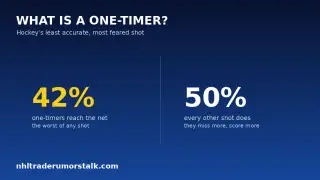
What Is a One-Timer in Hockey?
A one-timer reaches the net just 42% of the time, the worst of any shot, yet it is the most dangerous weapon in hockey and the shot Ovechkin...
By Mike Johnson · 11 min read
Comments
Be the first to share your take.
Get NHL trade rumors in your inbox
One email per week, zero spam, verified rumors only.