How Do Line Changes Work in Hockey?
A line change is hockey's strangest routine: you swap players while the puck is live, but only inside a five-foot pocket beside your own bench. Here's how it works, why the home team guards the last change, and the icing trap that pins tired legs on the ice.
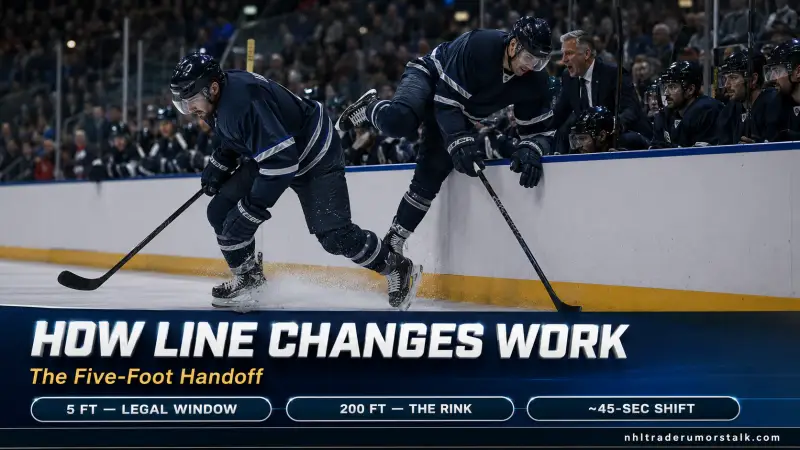
Five feet. On a sheet of ice that runs 200 feet end to end, that is all the room the rulebook gives you to legally change a hockey line: a five-foot pocket right beside your own bench.
Hockey is the odd sport out on this one: in basketball, football, and soccer you sub at a whistle, clock stopped, everybody watching. Hockey lets you swap bodies while the puck is live, players vaulting over the boards mid-rush at a dead sprint. It looks like chaos. It's actually one of the most governed routines in the game, and getting the timing wrong by half a second hands the other team a power play.
So here is how line changes work in hockey, start to finish: the five-foot rule that makes a swap legal, how a player knows it's his turn, why the home team guards the last change like a trade secret, and the icing trap that has stranded tired teams since 2005.
| Figure | What it represents |
|---|---|
| 5 feet | How close a departing player must be to his own bench, and out of the play, before his replacement can step on (Rule 74.1). Miss it and it's too many men. |
| 200 feet | Length of a regulation NHL rink end to end. So the only legal place to change is a sliver of ice next to the bench, on a surface the size of a football field. |
That gap is the whole story of a line change. Two hundred feet of ice, and the swap is only clean inside five of them. That five-foot margin is, to me, the most underrated number in hockey, because botching it is the easiest two-minute penalty in the sport.
Key Takeaways
- On the fly: hockey subs during live play, no whistle needed. Players change at the bench while the puck keeps moving.
- The five-foot rule: a departing player must be within five feet of the bench, and out of the play, before his sub jumps on (Rule 74.1). Botch it and it's a two-minute too-many-men bench minor.
- Short shifts: a shift lasts roughly 45 seconds because players skate near flat-out. Forwards take about 20 to 25 shifts a game, rolling four lines.
- Last change: after a stoppage the visiting team puts its line out first, then the home team answers (Rule 82.1). That matchup edge is a big piece of home-ice advantage.
- The icing trap: ice the puck and you're not allowed to change your gassed line before the faceoff (Rule 81.4).
What a line change actually is
A line change is simply swapping one or more players for fresh ones, and the twist is all in when it happens. Most of the time it's done "changing on the fly," meaning during live play, with nobody stopping the game. As the puck moves up the ice, a tired player skates to the bench, and a rested one climbs over the boards to take his place.
That's rare in team sports, because basketball, football, and soccer all make you wait for a stoppage to substitute. Hockey, almost alone, lets you do it with the clock running and the puck live. (Box lacrosse is the other oddball that changes on the fly, so it isn't literally unique, but among the major sports it's an outlier.)
Teams have plenty of bodies to cycle. A club dresses 18 skaters: 12 forwards, grouped into four forward lines, and six defensemen in three pairs, though a few coaches go 11 forwards and seven defensemen instead. Coaches "roll" those units so there's always a fresh line waiting, whether it's the top scoring line or the fourth-line grinders. Even pulling the goalie for an extra attacker is just a line change with the net empty.
One rule governs where it all happens: the change is made at the players' bench, over the boards, not through some other gate. Leave the ice anywhere else during play and it's a bench minor. So every legal swap funnels through that same small stretch of boards.
The five-foot rule (and how you get too many men)
Here's the sentence that runs the whole thing, straight from the rulebook:
"Players may be changed at any time during the play from the players' bench provided that the player or players leaving the ice shall be within five feet (5') of his players' bench and out of the play before the change is made." — NHL Official Rules, Rule 74.1, Too Many Men on the Ice
Read it slowly, because two conditions have to be true at once. The player coming off must be within five feet of the bench, and he must be out of the play. A substitute is officially "on" the second both his skates hit the ice. If the new guy touches the puck, or bumps an opponent, while his tired teammate is still eight feet out and involved, the referee blows it dead: too many men.
The punishment is a two-minute bench minor: the coach sends one of his skaters to the box for two minutes, and the other team gets a power play while you're stuck on the penalty kill. All for a swap that missed by a stride.
If you want proof that five feet matters, rewind to May 10, 1979. Boston led Montreal 4-3 late in Game 7 of the Stanley Cup semifinal, barely two and a half minutes from the Final. Then the whistle went for too many men on the Bruins' bench. Guy Lafleur tied it on the ensuing power play with 1:14 left, Yvon Lambert won it in overtime, and Montreal took the game 5-4 on its way to a fourth straight Cup. Boston's coach, Don Cherry, took the blame himself, and within weeks he was out of a job. It's still the most famous bench-minor in hockey history, and it turned on the exact margin in that rulebook line.
How a player knows it's his shift
New fans always ask the same thing: how does anyone know when to go? The answer is that a hockey shift is short, and it's basically a 40-second job interview. You get out there, you go as hard as you can, and if you don't produce, the bench boss rolls the next line. Nobody waits for you.
And they stay short for a reason. The average shift runs about 45 seconds, because players skate close to flat-out the whole time, and that near-maximal effort drains the body's anaerobic energy in well under a minute. You change before the tank hits empty and recover on the bench, so the smart play is a quick burst, then off. (It's fatigue from energy depletion, by the way, not the old "lactic-acid burn" that coaches used to preach.)
| Position | Average shift | Shifts per game |
|---|---|---|
| Forwards | ~46 seconds | ~20 to 25 |
| Defensemen | ~48 to 49 seconds | ~20 to 28 |
So how does the actual handoff happen? The next line hangs on the boards, sticks over the top, watching the play. The tired line calls for the change, usually when their team has the puck or it's safely deep in the other end. As the play moves away, the gassed group peels to the bench and the fresh group jumps on, all inside that five-foot pocket. That's the Five-Foot Handoff in motion, and the timing is everything: change while you're defending, with the puck coming at you, and you've just handed the other team an odd-man rush. Change on the attack and you're fine.
There's a wrinkle in the second period, when your bench sits far from the goal you're defending. That's the long change, and it stretches every one of these handoffs into a longer, riskier skate that deserves its own breakdown.
Last change: the home team's quiet weapon
Changing on the fly is a free-for-all, but after a stoppage there's a strict order, and it quietly favors the home team. The rulebook spells it out:
"Following the stoppage of play, the visiting team shall promptly place a line-up on the ice ready for play and no substitution shall be made from that time until play has been resumed. The home team may then make any desired substitution." — NHL Official Rules, Rule 82.1, Line Change
That's the "last change," and it's worth more than it sounds. The visitors have to commit their five skaters first. The home coach looks at who's out there, then answers: get his checking line against their top scorers, or throw his scorers at their weakest defense pair. Do that over 60 minutes and it adds up. It's one of the real, concrete reasons home-ice advantage exists at all.
The officials even keep it on a clock. The referee gives the visiting team up to five seconds to set, then the home team up to eight, then the linesman starts a five-second count to get everyone onside for the faceoff. On the fly, of course, nobody has last change. It only exists at a stoppage, which is exactly why coaches fight so hard over matchups on the road.
The icing trap
One more rule quietly shapes every tired team's night. Since 2005, a team that ices the puck can't change its line before the ensuing faceoff (Rule 81.4). Whoever was on the ice stays on the ice.
The logic is sharp, because icing is often what a gassed line does to survive, flinging the puck the length of the rink to buy a breather. The no-change rule takes that breather away and pins the exhausted five in their own end for a defensive-zone draw. You iced it because your legs were done, and now you're trapped out there defending with those same dead legs. Injuries and a goalie returning from an extra-attacker situation are the only real exceptions. It's a small rule that punishes the exact moment a change would help most.
The Verdict: The Five-Foot Handoff
Line changes look like the loosest thing in hockey, players hopping on and off while the game roars past, but they're the opposite of loose. Every legal swap threads the same five-foot needle beside the bench, on a 200-foot sheet, and the rhythm of a whole game, matchups, fatigue, penalties, the home-ice edge, hangs off that one margin. Watch a bench empty and refill in a blur sometime, and count the beat. One body a foot late, and that blur becomes a power play. Five feet out of two hundred, and everything else is just skating.
Sources and Reporting
- NHL Official Rules: Rule 74.1 (too many men / five-foot change), Rule 82.1 and 82.2 (line change, last change, timing), Rule 81.4 (no change on icing).
- Deseret News: how NHL line changes and substitutions work.
- Sound of Hockey: the last change and home-ice advantage.
- Hockey Answered: average shift lengths and shifts per game.
- NHL.com: per-player shift times and shifts per game.
- Bleacher Report: the 1979 too-many-men penalty, Game 7.
- SportsLingo: definition of changing on the fly.
Written by Mike Johnson, NHL Senior Editor, who has covered the league for 15+ years. Every rule number and quotation here was checked word-for-word against the current NHL Official Rules (Rules 74, 81 and 82), and the shift and 1979 game details were cross-checked against NHL.com, Hockey-Reference and contemporaneous reporting. Published July 2, 2026. Editorial review: Sarah Chen, Hockey Operations Editor. Corrections: editorial@nhltraderumorstalk.com.
Frequently Asked Questions
How do line changes work in hockey?
Players are swapped for fresh ones either "on the fly" during live play or after a stoppage. On-the-fly changes happen at the bench while the puck keeps moving, and the player leaving must be within five feet of the bench before his replacement steps on (Rule 74.1).
What does \"changing on the fly\" mean?
It means substituting players during live play, with no whistle. Tired players skate to the bench and fresh ones jump over the boards while the game continues. Hockey is one of the few team sports that lets you change without stopping play.
How long is a shift in hockey?
About 45 seconds. Players skate close to flat-out, so they change before fatigue sets in and recover on the bench. A typical forward takes roughly 20 to 25 shifts a game; a defenseman a similar number or more, since defensemen log the most ice time.
What is the too-many-men-on-the-ice penalty?
A two-minute bench minor, called when a team briefly has an extra skater on the ice during a change, usually because a substitute stepped on before his teammate was within five feet of the bench. The coach designates one of his skaters to serve the two minutes.
What is the \"last change\" and why does the home team get it?
After a stoppage the visiting team must put its line out first, then the home team may answer (Rule 82.1). Seeing the opponent's line first lets the home coach set favorable matchups, which is a core reason home-ice advantage exists.
Why can't a team change lines after icing?
Since 2005, a team that ices the puck cannot substitute before the next faceoff (Rule 81.4). Because icing is often a tired team's escape hatch, the rule forces those same worn-out players to stay on for a defensive-zone draw.
Related Stories

What Is the Long Change in Hockey?
The long change is not jargon, it is bench geography. Teams switch ends each period but keep the same bench, so in the second period a tired...
By Mike Johnson · 9 min read
What Is a Delayed Penalty in Hockey?
A delayed penalty is not a penalty yet. It is the referee holding the whistle after a foul until the penalized team touches the puck, which...
By Mike Johnson · 9 min read

What Is a One-Timer in Hockey?
A one-timer reaches the net just 42% of the time, the worst of any shot, yet it is the most dangerous weapon in hockey and the shot Ovechkin...
By Mike Johnson · 11 min read

What Is the Five-Hole in Hockey?
The five-hole is the gap between a goalie's legs, the only one of the goalie's five holes hockey ever agreed on a name for. Here is what it...
By Mike Johnson · 8 min read
Comments
Be the first to share your take.
Get NHL trade rumors in your inbox
One email per week, zero spam, verified rumors only.