What Is the Long Change in Hockey?
The long change is not jargon, it is bench geography. Teams switch ends each period but keep the same bench, so in the second period a tired defenseman has a 50-foot skate to change. Here is why that makes the middle period hockey's highest-scoring.
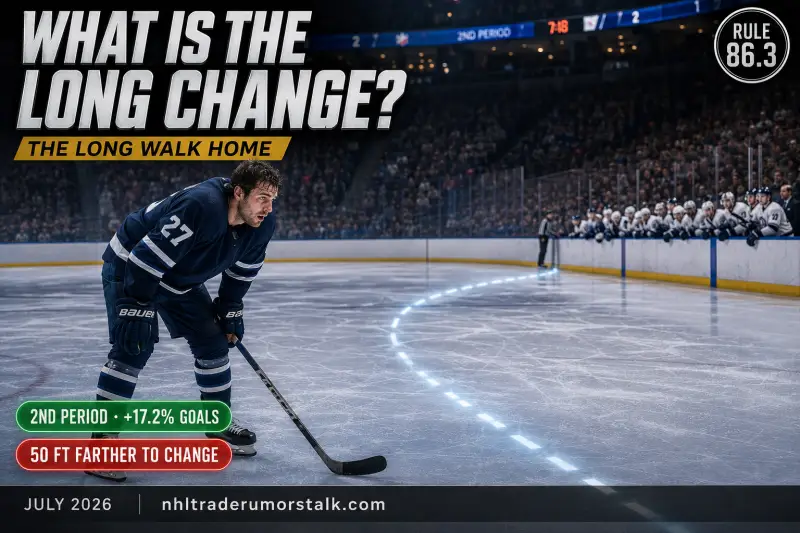
Sometime in the second period, a broadcaster says it like you already know what it means: "Watch out, it's the long change now." Then a tired defenseman gets pinned in his own end, can't get off, and the puck's in the net. That's the long change, and it's the quiet reason the middle period of a hockey game is the most dangerous twenty minutes on the schedule. In 2023-24 the NHL scored 2,752 goals in the second period against 2,349 in the first, and a fixed bench 50 feet from the wrong end of the ice is a big part of why.
Here's the whole thing in one breath. Benches sit along one side of the rink, and each bench is closer to one end. Teams switch ends every period but keep the same bench. So in the first and third periods a team defends the goal near its bench, a short skate to change. In the second period it defends the far goal, and getting off the ice becomes a long, lung-burning trip. Under NHL Rule 86.3 the switch isn't optional.
| Figure | What it represents |
|---|---|
| 2,752 | Goals scored in the second period, when every team is on the long change |
| 2,349 | Goals in the first period (and the same in the third), when the change is short |
That 403-goal gap is the whole case for what I call the long walk home: the same players, the same rink, but 50 feet of extra geography that quietly tilts a period.
Key Takeaways
- It's about bench geography: teams switch ends each period (Rule 86.3) but keep the same bench, so the distance to change flips.
- The long walk home: in the second period a team defends the far goal, so a tired defenseman has roughly 50 more feet to skate before he can get off.
- Why it matters: stuck-on skaters, botched changes, and odd-man rushes make the second period the NHL's highest-scoring — 2,752 goals to 2,349 in 2023-24.
- Overtime does it on purpose: since 2015 the NHL makes teams switch to the long-change ends for 3-on-3 overtime to force more scoring and fewer shootouts.
- The origin is mostly a story: the rulebook orders the switch but never says why; the "fairness in the outdoor era" reason is tradition, not documented history.
What the long change actually is
Start with the layout, because the whole thing is geometry. Both team benches run along the same side of the rink, and each one sits closer to one end. A team's bench never moves during the game. What moves is which goal the team defends, and that flips every period across hockey's three 20-minute periods.
In the first period, say a team defends the end near its bench. When a defenseman is gassed, the bench is right there. A few strides and he's off, fresh legs are on. That's the short change. Come the second period, the teams switch ends. Now that same team defends the goal at the far end, and the bench is all the way across the ice. A player buried in his own zone has to survive the shift, then skate close to 50 extra feet to get relief. That's the long change.
| Period | End defended | Skate to the bench |
|---|---|---|
| 1st | Near the bench | Short change |
| 2nd | Far from the bench | Long change (~50 ft farther) |
| 3rd | Near the bench | Short change |
| OT (3-on-3) | Far from the bench | Long change (by rule) |
None of it is a coaching choice, because the NHL rulebook simply orders the switch:
"The teams shall change ends for each period of regulation time and, in the playoffs, for each period of overtime." — NHL Official Rules, Rule 86.3 "Choice of Ends"
So the long change isn't a trick or a strategy. It's a fixed feature of every second period, built into the rules, and every team lives with the exact same disadvantage at the exact same time.
Why the second period gets wild
Now the payoff. When your bench is 50 feet from the fight, tired players get stuck. A shift that should end at 45 seconds stretches toward a minute and a half because nobody can safely peel off. Legs go. Reads get slow. And the worst decision in hockey, changing at the wrong moment, becomes tempting, because the alternative is dying on the ice.
That's where goals come from. A defender misjudges how much gas he has, jumps for the bench a beat too early, and suddenly it's a two-on-one the other way, which is exactly the kind of sequence that turns into a goal and a minus. A team that ices the puck can't change at all, so a botched icing in the second period traps its most exhausted unit for a defensive-zone faceoff. The penalty kill gets even uglier, because killers already run long shifts and now they run them from the far end.
The numbers back it up, and they hold up over time. Sound of Hockey's look at 2023-24 found 2,752 second-period goals against 2,349 in each of the first and third, a 17.2 percent jump, while shot attempts rose only about 3.7 percent. Read that again: teams weren't shooting much more in the second period, they were scoring far more per chance, which is what fatigue and broken coverage produce. And this isn't a one-year blip. Across 35 seasons, the second period has been the league's outright top-scoring period in roughly seven of every ten seasons. One honest caveat: the long change gets the headline credit, and it's the cleanest explanation, but intermission adjustments and matchup shuffles chip in too. Nobody has proven the geography is the only cause.
The flip side: the bench that helps you
The long change cuts both ways, and good teams press that edge. If your bench is far from your defensive zone in the second period, it's close to your offensive zone. So when you're the team cycling the puck down low, hemming the other side in, fresh legs are a short hop away. You can roll new attackers over the boards without ever letting off the pressure.
That's why coaches talk about "winning the long change" instead of just surviving it. The team stuck defending is bleeding energy at the far end while the team attacking keeps topping up. A five-second edge on a line change, repeated shift after shift, is how a period tilts one way and stays there.
Overtime runs the long change on purpose
Here's the part that shows the league knows exactly how powerful this is. Regular-season overtime is 3-on-3 for five minutes, and the NHL deliberately makes teams play it on the long change. Under Rule 84.1, clubs switch ends before overtime so they defend the same distant end they did in the second period.
The reason is blunt: the NHL wants overtime to end, not drift to a shootout. Three skaters a side already leaves acres of open ice. Add a bench too far away to change safely, and a tired defender can't escape a developing rush. Odd-man breaks multiply, and games get decided in open play instead of a skills contest. The long change went from a quirk teams endure in the second period to a tool the league wields on purpose after regulation.
Why teams switch ends at all
So why flip ends every period in the first place? The rulebook doesn't say. Rule 86.3 orders the switch and gives no reason at all. The story you'll hear most traces it to hockey's outdoor roots, when sun, wind, and rutted, snow-piled ice could favor one end, so alternating kept a full game fair. It's a sensible explanation and it may well be right, but it's tradition handed down more than documented history, so take it as the likely reason rather than settled fact. What's certain is the effect: switch the ends, keep the bench, and you've built the long change into the sport whether anyone planned it or not.
The verdict: the long walk home
The long change is the rare hockey concept that sounds like insider shorthand and turns out to be pure geography. A bench that can't move, ends that flip every period, and one stretch, the second, where getting off the ice is a 50-foot ordeal. That's the long walk home, and it shows up in the scoreboard every night: more goals in the middle frame, more chaos in three-on-three overtime, and a tired defenseman you'll now notice glancing at a bench that's suddenly very far away. Next time the broadcaster warns about the long change, watch the defensemen, not the puck. The team that can't get fresh legs is the one about to get scored on.
Written by Mike Johnson, NHL Senior Editor, who has spent 15-plus years translating the sport's quirks for new and lifelong fans. The rule wording here was checked against the current NHL Official Rules (Rules 86 and 84), and the scoring figures were traced to Sound of Hockey's per-period study and multi-season data. Published July 2, 2026. Editorial review: Sarah Chen, Hockey Operations Editor. Corrections or questions: editorial@nhltraderumorstalk.com.
Sources and reporting
- NHL Official Rules 2024-25: Rule 86.3 "Choice of Ends" (change ends each period) and Rule 84.1 (overtime ends).
- Sound of Hockey: 2023-24 per-period goal data (2,752 vs 2,349) and the shots-flat, goals-up finding.
- NHL.com (Seattle Kraken): how coaches manage the long change with offensive-zone line changes.
- StatsPros: beginner explainer on bench distance and second-period fatigue.
- Hockey Answered: the roughly 50-feet-farther bench and the offensive-pressure flip side.
- SportsLingo: glossary definition of the long change.
Frequently Asked Questions
What is the long change in hockey?
The long change is the second-period situation where a team defends the goal farthest from its bench. Teams switch ends each period but keep the same bench, so a tired player in his own zone has a much longer skate to change, roughly 50 extra feet.
Why is the second period the highest-scoring in hockey?
Mainly the long change. With the bench far from the defensive zone, tired players get stuck on the ice, line changes get risky, and odd-man rushes pile up. In 2023-24 the NHL scored 2,752 second-period goals versus 2,349 in each of the first and third.
Which periods have the long change?
Only the second period in regulation. In the first and third periods a team defends the goal near its bench, a short change. Three-on-three overtime is also played on the long change, by rule.
Does overtime use the long change?
Yes. Under Rule 84.1 teams switch ends for regular-season 3-on-3 overtime, defending the same distant end they did in the second period. The NHL does this on purpose to create more scoring chances and fewer shootouts.
Why do hockey teams switch ends each period?
The rulebook orders the switch (Rule 86.3) but gives no reason. The common explanation traces it to hockey's outdoor era, when sun, wind, and uneven ice could favor one end, so alternating kept a game fair. That origin is tradition, not documented history.
Related Stories
How Do Line Changes Work in Hockey?
A line change is hockey's strangest routine: you swap players while the puck is live, but only inside a five-foot pocket beside your own ben...
By Mike Johnson · 10 min read
What Is a Delayed Penalty in Hockey?
A delayed penalty is not a penalty yet. It is the referee holding the whistle after a foul until the penalized team touches the puck, which...
By Mike Johnson · 9 min read
What Is a One-Timer in Hockey?
A one-timer reaches the net just 42% of the time, the worst of any shot, yet it is the most dangerous weapon in hockey and the shot Ovechkin...
By Mike Johnson · 11 min read
What Is the Five-Hole in Hockey?
The five-hole is the gap between a goalie's legs, the only one of the goalie's five holes hockey ever agreed on a name for. Here is what it...
By Mike Johnson · 8 min read
Comments
Be the first to share your take.
Get NHL trade rumors in your inbox
One email per week, zero spam, verified rumors only.