NMC vs NTC NHL: The Real Difference in Trade Protection 2026
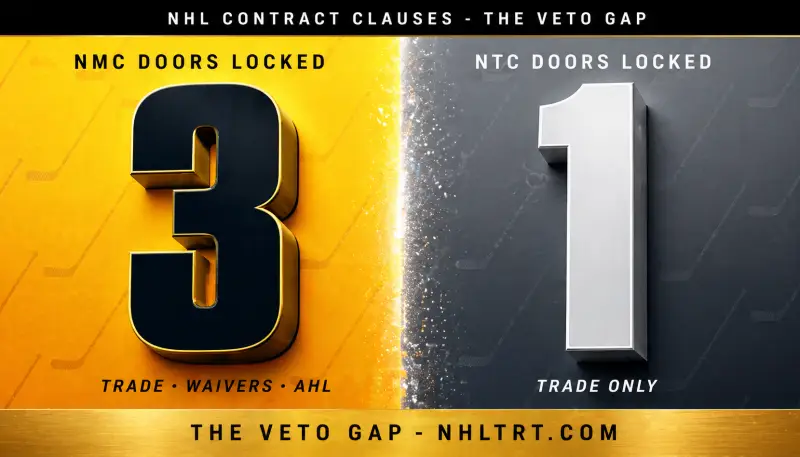
NMC blocks 3 doors. NTC blocks 1. Inside the Veto Gap with Parayko, Stamkos, Hamilton, the 2017 Fleury waiver, and the CBA Article 11.8 eligibility rules.
Live updates
No updates yet. Refreshing automatically.
Roughly 30 percent of the NHL's 861 players carried some form of trade protection during the 2025-26 season, but only a small slice of that group could stop their team from sending them to the AHL on a random Tuesday. That gap blew up the 2026 trade deadline. Colton Parayko vetoed Buffalo. Steven Stamkos said zero chance. Tyler Myers passed on Detroit and ended up in Dallas. Three different clauses, three different outcomes, one piece of CBA fine print called the Veto Gap.
Most fans hear NMC and NTC and assume they're roughly the same protection. They aren't. A no-movement clause locks three doors: trade, waivers, and minor-league assignment. A no-trade clause locks one door, the trade itself, and leaves the other two wide open. That's why front offices treat "trade protection" as a tier system, not a binary. The CBA spells it out in Article 11.8, and every general manager treats two letters versus three letters as completely different problems.
Here's the part that matters right now. The new CBA hits September 16, 2026. It tightens term limits, kills deferred salary, caps year-to-year variance at 20 percent. But the NMC versus NTC split? Untouched. So every July 1 phone call, every deadline pitch, every expansion-draft list still runs through that same Veto Gap. Time to break it down.
Key Takeaways
- The mechanic: An NMC blocks trade, waivers, and minor-league assignment. An NTC blocks the trade itself and nothing else. That single difference is the Veto Gap.
- The 30% reality: Roughly 258 of the league's 861 players had some form of trade protection in 2025-26, but full NMCs sit at the top of a four-tier hierarchy that very few players ever climb to.
- The eligibility door: CBA Article 11.8 limits these clauses to players who are 27 or older, or who have at least seven accrued NHL seasons. The clock starts at one of those two checkpoints.
- The expansion-draft kicker: NMC players must be protected on a team's expansion-draft list (or asked to waive). NTC players? Fully exposed. Just ask 2017 Marc-Andre Fleury.
- The 2026 deadline test cases: Parayko vetoed Buffalo. Stamkos shut Tampa down. Tyler Myers picked Dallas over Detroit. All three deals turned on which clause sat in their contract.
What an NMC Actually Locks Down
A No-Movement Clause is the strongest trade-protection tier in the CBA. The rule itself is short: any team-initiated movement of the player requires the player's written approval. Trade, sure. Waivers, also yes. Sending the player to an AHL affiliate, also yes. Even a quick conditioning stint requires sign-off.
That's why Steven Stamkos's "zero chance" comment to Tampa Bay reporters in February 2026 mattered legally, not just emotionally. Stamkos signed a four-year deal with Nashville on July 1, 2024, at $8.0 million AAV with a full NMC. When Tampa called Predators GM Barry Trotz at the deadline asking if Stamkos was movable, the answer flowed directly from the contract: only if Stamkos personally agreed. He didn't. Conversation over.
Sidney Crosby in Pittsburgh, Connor McDavid in Edmonton, Auston Matthews in Toronto, William Nylander, John Tavares, Morgan Rielly, Chris Tanev, Leon Draisaitl, Ryan Nugent-Hopkins, Zach Hyman, and Darnell Nurse all carry full NMCs into 2026. Toronto's GM-search overcorrection cycle can't touch any of those Leafs core deals because their NMCs override roster reshuffling. Their teams can't waive them, can't demote them, can't trade them without their say-so. The protection is total.
The one carve-out worth knowing: NMCs do not block buyouts. A team can still buy out an NMC contract, though waivers are skipped during the buyout process to avoid a procedural conflict with the clause. That's how Vegas eventually parted ways with Reilly Smith years ago, and it's the escape hatch every cap-strapped GM keeps in the back pocket.
The Veto Gap: Why an NTC Has a Real Backdoor
An NTC blocks one thing: the trade. Everything else is on the table. A team can place an NTC player on waivers without his approval. A team can demote that player to the AHL if he clears waivers. A team can buy him out. The clause stops nothing in the regular roster-management toolkit except an outright trade.
That backdoor is real, and teams use it. Not every season, not against every player. But the threat alone shifts negotiations. The Predators are running into the NMC Trap from the other side of the ledger, where their best contracts have full NMCs and their depth deals have NTCs. Guess which group has more pull in a rebuild conversation.
Tyler Myers's 2026 deadline path shows the NTC backdoor without anyone needing to use it. Vancouver wanted to move him to Detroit. Myers said no, exercising his trade list. Vancouver still had options if they wanted to play hardball: place him on waivers, eat the salary, demote him to Abbotsford in the AHL. They didn't, because the optics would have been ugly and Myers had value to a contender. He landed in Dallas, one of his preferred teams. But the structural truth was that Vancouver had cards Myers couldn't directly counter, even with a no-trade clause. With an NMC, those cards don't exist.
That's the Veto Gap in plain English. Two clauses with similar names, completely different defensive walls.
"Officially, Colton Parayko has declined to waive his no-trade clause to Buffalo, as is his contractual right. We will see where we go from here."
— Elliotte Friedman, Sportsnet, March 2026 trade deadline (via @FriedgeHNIC on X)Friedman's tweet captured the full mechanic in 32 words. Parayko's contract gives him the right. The team can't override it. The reporting flow stops there. The same Blues front office is also weighing Jordan Kyrou's offseason value at the same Blues address as part of its broader summer reset. Buffalo's 14-Year Exile would have ended faster with Parayko in the fold, but the clause did exactly what it was designed to do.
Officially, Colton Parayko has declined to waive his no-trade clause to Buffalo -- as is his contractual right. We will see where we go from here.
— Elliotte Friedman (@FriedgeHNIC) March 6, 2026
The Modified Tier: Submit Lists, Reverse Lists, and the Agent's Deadline
Most NHL clauses aren't full NMCs or full NTCs. They're modified versions, and the modification is where contracts get interesting. A modified clause limits the protection by team count, by time period, or both.
Two formats exist. The submit-list format requires the player to file a list of teams he will accept a trade to (typically 8 to 15 teams). The reverse-list format requires the player to file teams he will not accept (typically 5 to 12). Either way, the agent must file the list by the contract's stated deadline, usually June 15 of each season. Miss the deadline and the player can lose control of the destination entirely. The agent eats it if that happens.
Dougie Hamilton's contract is the textbook modified-NMC structure. The Devils' Hamilton retention ladder hinges on the fact that Hamilton spent the first four years of his deal on a full NMC. The clause then converted to an NMC paired with a 10-team trade list in year five. New Jersey's flexibility just expanded by exactly 22 teams overnight, and Friedman flagged the change as the moment Hamilton's future "could be in doubt." Contract structure dictated the rumor cycle.
Nazem Kadri's setup in Calgary uses a 13-team no-trade list. Cam Talbot's last deal had a 10-team M-NTC, per Pierre LeBrun reporting. Each list is a private negotiation, and once a player is traded to a team that's permitted under the list, the clause stays in effect. No re-waiving required.
| Tier | Blocks Trade | Blocks Waivers | Blocks AHL Demotion | Expansion-Draft Protection | Example (2026) |
|---|---|---|---|---|---|
| Full NMC | Yes | Yes | Yes | Mandatory protect (or waive) | Crosby, McDavid, Stamkos |
| Modified NMC | Yes (limited list) | Yes | Yes | Mandatory protect | Hamilton (10-team list) |
| Full NTC | Yes | No | No | Not required | Parayko, Stone |
| Modified NTC | Yes (limited list) | No | No | Not required | Kadri (13-team list) |
Read that table sideways and the Veto Gap stops being abstract. The first two rows protect against everything a GM can do. The bottom two rows protect against the trade and nothing else. Same general protection bucket, vastly different actual rights.
Trade Protection Tier Decoder
Where each clause sits on the protection ladder once you account for waivers, demotions, and expansion-draft exposure.
Veto Gap Power Index
Four real players, four different clauses, four different deadline outcomes. The actual score each clause delivered when the phone rang.
Historical Parallel: Fleury's 2017 Waiver and the Penguins' Cup Math
The cleanest historical case study for how an NMC actually plays out under pressure is Marc-Andre Fleury and the 2017 Vegas expansion draft. Fleury had a full NMC with Pittsburgh. Matt Murray had just emerged as the Penguins' goalie of the future. The Penguins could only protect one goalie on their expansion list. Fleury's NMC meant Pittsburgh could not expose him without his written sign-off.
So GM Jim Rutherford asked. Fleury said yes. He waived the clause in February 2017 to give the Penguins flexibility, and on June 21, 2017, the Vegas Golden Knights selected him in the expansion draft. Pittsburgh sweetened the deal further by attaching their 2020 second-round pick as an incentive for Vegas to take Fleury's roughly $6 million cap hit off the books.
Three lessons from that sequence for 2026 readers. First, the NMC didn't stop the move; it just gave Fleury the right to negotiate the terms of the move. Second, the team can sweeten the pot to make a clause-waiver worth the player's while. And third, expansion-draft mechanics treat NTCs and NMCs completely differently. NTC players were fully exposed in 2017 and again in 2021 for Seattle. Only the NMC tier required protect-or-waive treatment. Vegas's recent goalie identity crisis traces directly back to that Fleury moment, when the Knights got their first franchise face for free, and a draft pick.
"Players with only no-trade clauses do not have to be protected, as only no-movement clauses protect a player in an expansion draft."
— NHL.com Kraken official explainer (via NHL.com)That single sentence from the league's own explainer is the cleanest summary of the Veto Gap in expansion-draft terms. NTC means nothing in that context. NMC means everything.
Who Qualifies and What Happens When the Clause Is Broken
CBA Article 11.8 is precise about eligibility. A player cannot be granted an NMC, NTC, or modified version unless he is at least 27 years old at the start of the league year, or has accrued seven NHL seasons, whichever comes first. That's the same checkpoint that unlocks Group 3 unrestricted free agency, and it's not a coincidence. The CBA designed both rights to mature together.
So when an entry-level player gets traded, no clause. When a player on his second contract at age 24 gets moved, no clause. The protection is a veteran reward, not a default contract feature. Cole Eiserman just signed his ELC with the Islanders, and his ability to acquire trade protection is at least four full seasons away under the new CBA structure.
Two breaking points worth knowing. First, if a player is traded before his clause has activated (say a clause that kicks in year three of a five-year deal), the clause is automatically removed unless the acquiring team explicitly agrees to keep it. Acquiring teams almost never agree, because keeping the clause limits their own future flexibility. See Yzerman's recent step-back in Detroit for what front-office flexibility looks like at scale. Second, the clause's modified-list deadline is filed annually, and missing the filing window strips the player of destination control for that calendar year. Agents who blow that deadline get fired. Stamkos's 600-goal exit-clause structure shows what tightly drafted clause language can do at the elite-veteran end. Most contracts are not that surgical.
The 2026 CBA arriving in September brings tighter contract-term limits (six years for free agents, seven for in-house re-signings) and 20 percent year-to-year variance restrictions. Trade-protection clauses were not amended. The Veto Gap survives the new agreement intact.
Sources and Reporting
- PuckPedia: Definitive NMC/NTC mechanic explainer and tier definitions
- Pro Hockey Rumors: 2025-26 league-wide trade-protection player roster (30% league share)
- The Fourth Period: Annual NMC/NTC database with team-by-team breakdowns
- UB Law Sports Forum: Legal analysis of CBA Article 11.8 and modified-list mechanics
- General Fanager: CBA Article 11.8 27-year-old / 7-season eligibility threshold
- Daily Faceoff: Plain-English mechanic walkthrough with player examples
- NHL.com: Expansion-draft NMC protection requirement official ruling
- CapWages: 2026 CBA changes summary, contract-term and structure restrictions
The Verdict: The Veto Gap
The Veto Gap explains roughly 80 percent of trade-deadline drama. An NMC means a player controls everything the team can throw at him. An NTC just stops the trade. Three doors. One door. Crosby versus Parayko. That's the whole show.
The 2026 deadline made the math public. Buffalo lost out on Parayko. Tampa never got Stamkos. Vancouver burned every modified-list option Tyler Myers had before he picked Dallas. My read for the next 12 months? Expect more clause-waiver leaks before the player actually agrees. Expect at least two more high-profile NMC vetoes by next deadline. And expect agents to keep getting fired over missed filing deadlines. Two letters versus three letters has never mattered this much.
Frequently Asked Questions
What is the actual difference between an NMC and an NTC in the NHL?
An NMC blocks any team-initiated movement: trade, waivers, and minor-league assignment. An NTC blocks only the trade. With an NTC, the team can still place the player on waivers, demote him to the AHL after he clears, or buy him out, all without his approval. NMC players also must be protected on expansion-draft lists; NTC players do not. The CBA Article 11.8 framework treats them as separate tiers, not gradations of the same right.
Can a player with an NMC still be sent to the minors or bought out?
Sent to the minors: no, an NMC blocks AHL assignment outright. Bought out: yes, with a procedural twist. NMC players can be bought out under the standard buyout window, but they skip the waiver step that buyouts normally require. Buyouts are the one team-initiated mechanism that survives an NMC. That's why a small number of cap-strapped teams still pursue buyout-and-replace strategies even with NMC contracts on the books.
Who can have an NMC or NTC under the NHL CBA?
Per CBA Article 11.8, a player must be at least 27 years old at the start of the league year or have accrued seven NHL seasons before he is eligible to negotiate any version of trade protection in his contract. The standard kicks in alongside Group 3 unrestricted free agency. Younger players signing extensions before that age threshold cannot include an NMC or NTC. The protection is a veteran perk by design.
What is a modified no-trade clause and how does the list work?
A modified clause limits the protection to a fixed number of teams. Two formats exist. Submit-list players file teams they will accept a trade to (typically 8 to 15 teams). Reverse-list players file teams they will not accept (typically 5 to 12). The agent files the list by the contract's stated deadline each year. A trade to a permitted team requires no waiver, and the clause survives the trade unchanged. Missing the filing deadline can strip the player of destination control for that year.
What happens if a player with a clause is traded before it activates?
If a clause is structured to activate later in a contract (say year three of a five-year deal) and the player is traded before activation, the clause is automatically removed unless the acquiring team explicitly agrees to keep it in writing. Acquiring teams almost never agree, because keeping the clause limits their own future flexibility. That's why pre-activation trades sometimes happen quickly and quietly: the clause hadn't yet provided the player any protection.
Frequently Asked Questions
What is the actual difference between an NMC and an NTC in the NHL?
An NMC blocks any team-initiated movement: trade, waivers, and minor-league assignment. An NTC blocks only the trade. With an NTC, the team can still place the player on waivers, demote him to the AHL after he clears, or buy him out, all without his approval. NMC players also must be protected on expansion-draft lists; NTC players do not. The CBA Article 11.8 framework treats them as separate tiers, not gradations of the same right.
Can a player with an NMC still be sent to the minors or bought out?
Sent to the minors: no, an NMC blocks AHL assignment outright. Bought out: yes, with a procedural twist. NMC players can be bought out under the standard buyout window, but they skip the waiver step that buyouts normally require. Buyouts are the one team-initiated mechanism that survives an NMC. That's why a small number of cap-strapped teams still pursue buyout-and-replace strategies even with NMC contracts on the books.
Who can have an NMC or NTC under the NHL CBA?
Per CBA Article 11.8, a player must be at least 27 years old at the start of the league year or have accrued seven NHL seasons before he is eligible to negotiate any version of trade protection in his contract. The standard kicks in alongside Group 3 unrestricted free agency. Younger players signing extensions before that age threshold cannot include an NMC or NTC. The protection is a veteran perk by design.
What is a modified no-trade clause and how does the list work?
A modified clause limits the protection to a fixed number of teams. Two formats exist. Submit-list players file teams they will accept a trade to (typically 8 to 15 teams). Reverse-list players file teams they will not accept (typically 5 to 12). The agent files the list by the contract's stated deadline each year. A trade to a permitted team requires no waiver, and the clause survives the trade unchanged. Missing the filing deadline can strip the player of destination control for that year.
What happens if a player with a clause is traded before it activates?
If a clause is structured to activate later in a contract (say year three of a five-year deal) and the player is traded before activation, the clause is automatically removed unless the acquiring team explicitly agrees to keep it in writing. Acquiring teams almost never agree, because keeping the clause limits their own future flexibility. That's why pre-activation trades sometimes happen quickly and quietly: the clause hadn't yet provided the player any protection.
Related Stories

What Is GAA in Hockey?
What is GAA in hockey? Goals against average is goals per 60 minutes, the oldest goalie stat and the most misleading. How it is calculated,...
By Mike Johnson · 7 min read

Hockey Positions Explained
Hockey positions explained: six players per side, five skaters and a goalie. What the center, wingers, defensemen, and goalie each do, how l...
By Mike Johnson · 6 min read

What Is a Penalty Kill in Hockey?
What is a penalty kill in hockey? The short-handed team's stand against the power play, four against five. The rules that help the underdog...
By Mike Johnson · 7 min read

What Is a Pest in Hockey?
What is a pest in hockey? An agitator who chirps and goads stars into dumb penalties, usually without fighting. How a pest differs from an e...
By Mike Johnson · 8 min read
Comments
Be the first to share your take.
Get NHL trade rumors in your inbox
One email per week, zero spam, verified rumors only.