What Is a One-Timer in Hockey?
A one-timer reaches the net just 42% of the time, the worst of any shot, yet it is the most dangerous weapon in hockey and the shot Ovechkin built a career on. Here is what a one-timer is, why it misses so often, and why snipers keep firing it anyway.
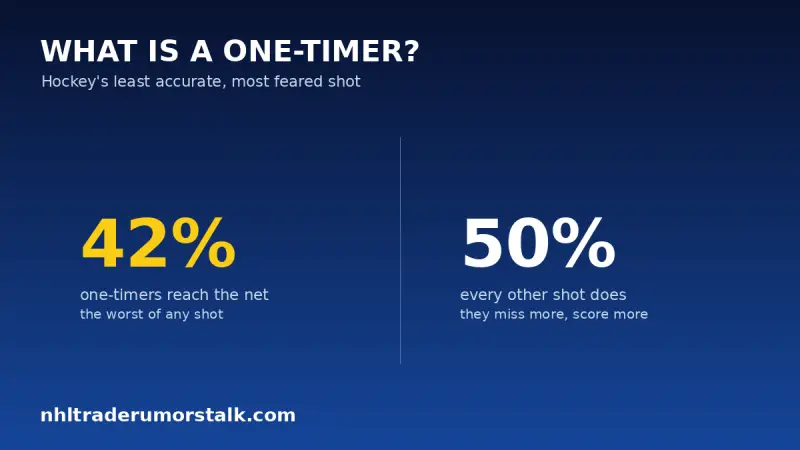
Forty-two percent. That is how often a one-timer even reaches the net, and every other shot in hockey is more accurate than that. So why do goalies fear the one-timer more than anything else, and why did Alex Ovechkin build a 900-goal career on it? Because the one-timer gives up accuracy for something deadlier: a puck fired the instant it arrives, before the goalie can slide across and square up.
A one-timer is exactly what it sounds like. You shoot the puck in one motion, straight off a teammate's pass, without ever stopping it or settling it down first. No catch, no reset, no second look. The pass comes, the stick meets it, and the puck is gone. That one missing beat, the moment where an ordinary shooter would corral the puck before firing, is what makes the one-timer both the hardest shot to pull off and the most dangerous when it lands.
Here is what a one-timer really is, why it misses the net more than any shot in the game, and why coaches and snipers keep calling for it anyway. Think of it as the Timing Gamble: you trade the sure handle for the killer angle, and you lose that bet more than half the time.
| Figure | What it represents |
|---|---|
| 42% | How often a one-timer actually reaches the net, per a Hockey Graphs study of NHL shots |
| 50% | How often every other type of shot reaches the net, which makes the one-timer the least accurate shot of them all |
The gap is the whole story, because a one-timer is the shot most likely to sail wide or get blocked, and yet Hockey Graphs rates it the second-most-dangerous shot in the game, behind only the deflection, once it does beat the goalie.
Key Takeaways
- What it is: a one-timer is a shot hit in one motion straight off a pass, without stopping the puck first. It can be a slap shot or a quick snap.
- The Timing Gamble: it reaches the net only 42% of the time versus 50% for every other shot, the worst accuracy in the game, yet it is the deadliest shot when it connects.
- Why it works: a cross-ice pass drags the goalie post to post, and the one-timer is fired before he can reset his angle, so he is beaten by his own movement.
- Why it is hard: you have to time the swing to meet a moving puck in a single motion, and the pass’s own speed feeds into the shot, so a harder pass makes a harder one-timer.
- The signature: Alex Ovechkin turned the left-circle one-timer into the most famous shot in modern hockey, more than half of his power-play goals since 2012-13.
What a One-Timer Actually Is
Strip away the highlight reels and the mechanic is simple. A teammate passes the puck, and instead of stopping it, the shooter swings through it in one continuous motion and sends it on net. The puck never stops moving, and that is the one and only thing that separates a one-timer from every other shot, which is why the name fits: you get one look, one time, and it is gone.
A one-timer is not a specific type of shot the way a wrist shot or a backhand is; it is a situation, and the blast itself can be a full slap shot, with a big wind-up timed to catch the pass, or a compact snap shot flicked off the incoming puck. What matters is that the shooter reacts to a moving puck rather than his own set-up. Because the shot skips the step where a player would normally catch and control the disc, it also skips the half-second a goalie needs to read it and get square. If you want to understand where the puck is aiming, our guide to the five-hole and the goalie’s five openings and the one to the crease the goalie is trying to protect both lay out the target a one-timer is trying to beat.
Why the One-Timer Misses the Net So Often
Here is the part nobody puts on a poster. The one-timer is the least accurate shot in hockey. In that Hockey Graphs study, one-timers reached the net just 42% of the time, while every other shot type combined got there 50% of the time. More one-timers miss wide, sail high, or get blocked than any other shot a player takes.
The reason is timing, pure and simple. Coaches compare it to a baseball swing: you are trying to make solid contact with a moving object at exactly the right point, except the puck may be rolling, bouncing, or standing on its edge when it arrives. Mistime the swing by a fraction and you top it, whiff it, or drag it wide. A player controlling the puck first can pick his spot; a one-timer shooter has to trust that the pass, the ice, and his own stick all line up in the same instant.
So why do it at all? Power. When the swing connects, the pass’s own speed feeds straight into the shot. Instructional coaches at Pro Stock Hockey put it plainly, noting that a shooter’s momentum toward the puck means “momentum flows into the shot, producing more power.” A physicist at Northeastern University made the same point about the moving puck adding energy on contact. The rule of thumb in every dressing room: the harder the pass, the harder the one-timer. You give up control to borrow the passer’s velocity, and you accept that a good chunk of those pucks will never hit the net at all.
Why It Is the Deadliest Shot Anyway
That 42% cuts both ways, because the one-timer misses more than any other shot, yet Hockey Graphs also found it is the second-most-dangerous shot in the sport, trailing only the deflection, on the shots that do get through. When a one-timer reaches the net, it beats the goalie far more often than an ordinary shot does. So the Timing Gamble pays for its low accuracy with a sky-high finish rate.
The mechanism is the power play, where the one-timer earns its reputation. Move the puck cross-ice, fast, and the goalie has to shove off one post and slide to the other to follow it. For a beat, he is moving sideways and cannot be square to the shooter. Fire the one-timer into that beat and the goalie is beaten by his own momentum before he ever sets his angle. There is no time to read the release, because the release happens the instant the pass arrives.
"If you think about it, the farther you get away from the goalie, you have to shoot it five miles an hour harder." — Adam Oates, on positioning Ovechkin lower in the left circle, NHL.com
That is also why the one-timer feeds so many goals that never touch a goalie’s save percentage on an empty net, and why it is such a weapon on the rush. It punishes a defense a half-step out of position, and it does it faster than any coverage can rotate.
Ovechkin’s Office: The Timing Gamble, Weaponized
No player has ever turned one shot from one spot into a career the way Alex Ovechkin has. His “office” is the top of the left faceoff circle, where a right-handed shooter on his off-wing can catch a cross-ice pass flat and blast it in stride. When coach Adam Oates installed Washington’s 1-3-1 power play in 2012-13 and moved Ovechkin lower into that circle, the one-timer became the most feared set play in the league.
The numbers are almost comical: in an NHL.com breakdown of his scoring, more than half of Ovechkin’s power-play goals since 2012-13, 71 of 128 at the time of the study, came on that single left-circle one-timer. Defenders know it is coming, penalty kills are built to take it away, and it still goes in. His longtime goaltender saw it every day in practice and never got used to it.
"It's probably the best shot in the history of the game." — Braden Holtby, on Ovechkin’s one-timer, NHL.com
Steven Stamkos built the same reputation from the opposite circle, and every power play in the league now designs at least one look for its best shooter’s office. If you want to see where those shooters line up on the sheet, our breakdown of the six hockey positions and how faceoffs decide who gets the first shot both show the geometry behind the play.
Where the One-Timer Came From
This is the honest part: nobody invented the one-timer. There is no patent, no origin game, no single name in the record book. Hitting a pass in stride is as old as the sport, and it simply grew into a featured weapon as the game sped up through the 1970s and 1980s and power plays got more sophisticated.
A few players are fairly credited with popularizing it. Jari Kurri was Wayne Gretzky’s trigger-man on the 1980s Oilers, burying one-timers off Gretzky’s cross-ice and behind-the-net feeds. Brett Hull made the right-handed one-timer his signature on the way to 741 goals, though even Hull is usually described as the man who perfected the shot, not the first to use it. Ovechkin is the one who weaponized it to a level nobody had reached. Watch tape of Kurri in 1985 and Ovechkin in 2016 and you are watching the same bet, placed a generation apart.
| Factor | Score /10 | Read |
|---|---|---|
| Timing difficulty | 9 | Meet a moving puck in one motion, no reset, no second chance |
| On-net accuracy | 3 | Reaches the net just 42% of the time, worst of any shot |
| Payoff when it lands | 9 | Second-deadliest shot in hockey, behind only deflections |
| Overall | 70/100 | The highest-risk, highest-reward shot in the book |
The Timing Gamble scores low on control and high on everything else. Average the three factors and you land at 70 out of 100: a shot most players cannot rely on, but the one that decides more power plays than any other when a sniper masters it.
About this analysis: written by Mike Johnson, NHL Senior Editor, 15+ years covering the sport. The shooting-accuracy split was taken from a Hockey Graphs study of NHL shot data; the mechanics were cross-checked against Pro Stock Hockey and a Northeastern University physics breakdown; the Ovechkin figures and quotes were traced to NHL.com. Published July 1, 2026 at the time stamped above, and last verified against the live source URLs the same day. Editorial review: Sarah Chen, Hockey Operations Editor. Corrections or factual disputes: editorial@nhltraderumorstalk.com.
Sources and Reporting
- One-timer (reference): the definition of a shot taken directly off a pass.
- Hockey Graphs: one-timers reach the net 42% versus 50% for other shots, second-most-dangerous when on net.
- Pro Stock Hockey: how a one-timer is executed and how momentum feeds the shot.
- Northeastern University: the physics of a puck’s momentum adding shot speed.
- NHL.com: Ovechkin’s left-circle one-timer, the Oates 1-3-1, and his power-play totals.
- Jari Kurri (reference): the Gretzky-era one-timer specialist who helped popularize the shot.
The Verdict: The Timing Gamble
The one-timer is the only shot in hockey that gets worse at hitting the net and more likely to score at the same time. That is the Timing Gamble, and it is why the shot survives despite a 42% success rate at the most basic job a shot has. My take: the next time you watch a power play, ignore the puck carrier and watch the shooter parked in his office. He is not waiting for a good look. He is waiting for the one beat where the goalie is still moving, and he only needs the pass to be on time. Would you take a shot that misses the net more than half the time if it were also the deadliest one you owned? Every sniper in the league already has.
Frequently Asked Questions
What is a one-timer in hockey?
A one-timer is a shot taken in one motion directly off a teammate's pass, without stopping or settling the puck first. The shooter times the swing to meet the moving puck as it arrives. It can be a slap shot or a quick snap shot; the defining feature is the timing, not the shot type.
Why is a one-timer so hard to score on... to make?
Because you have to hit a moving puck in a single motion, with no chance to catch and aim it first. In one Hockey Graphs study, one-timers reached the net only 42% of the time, versus 50% for all other shots, so they miss wide or get blocked more than any shot in the game.
Why is the one-timer so dangerous if it is inaccurate?
Because when it does reach the net it beats the goalie far more often than a normal shot. Hockey Graphs rated it the second-most-dangerous shot in hockey, behind only the deflection. On the power play, a cross-ice pass drags the goalie sideways and the one-timer is fired before he can reset.
Who has the best one-timer in the NHL?
Alex Ovechkin's left-circle one-timer is the most famous shot in modern hockey. In an NHL.com study, more than half of his power-play goals since 2012-13 came on it. Steven Stamkos is the other benchmark, firing his one-timer from the opposite faceoff circle.
Who invented the one-timer?
No one person did. The one-timer has no documented inventor and grew gradually as the game sped up through the 1970s and 1980s. Jari Kurri and Brett Hull are credited with popularizing it, and Ovechkin later raised it to a level no one had reached, but none of them invented the shot.
Related Stories
What Is the Five-Hole in Hockey?
The five-hole is the gap between a goalie's legs, the only one of the goalie's five holes hockey ever agreed on a name for. Here is what it...
By Mike Johnson · 8 min read

Why Do Teams Pull the Goalie?
Pulling the goalie ties the game only about 15% of the time, yet the math says do it, and do it far earlier than coaches dare. Here is how t...
By Mike Johnson · 10 min read
How Do Faceoffs Work in Hockey?
A faceoff looks like a coin flip, but it is a governed 50/50 battle: nine exact spots, a center on the dot, and a rule that ejects him when...
By Mike Johnson · 9 min read

What Is a Zamboni? How It Works
A Zamboni shaves, sweeps, washes, and floods a rink with hot water in one slow 9.7 mph pass. Here is how the ice resurfacer actually works,...
By Mike Johnson · 10 min read
Comments
Be the first to share your take.
Get NHL trade rumors in your inbox
One email per week, zero spam, verified rumors only.