Elias Pettersson Canucks Trade: The $92.8M Veto
Elias Pettersson's full no-movement clause on a $92.8M contract makes him untradeable. Three teams tried. None succeeded. The Decade Veto explained.

Live updates
No updates yet. Refreshing automatically.
Elias Pettersson's $92.8 million contract has 6 more seasons on it, a full no-movement clause through 2031-32, and a Swedish center who just told Vancouver media "I like it here. This feels like home." That's the mechanism behind the Elias Pettersson Canucks trade standoff in spring 2026 — president Jim Rutherford can shop him all he wants, and GM candidates can promise to move him, but nothing happens unless Pettersson himself signs off. The contract, signed March 2, 2024, runs through the 2031-32 season at an $11.6 million average annual value and includes $47 million in signing bonuses — the kind of protection that makes his position nearly bulletproof. I'm calling this the $92.8M Veto: the highest-value full-NMC contract in hockey right now, and the single biggest structural obstacle to Vancouver's rebuild.
Here's why the Elias Pettersson Canucks trade story matters even though it ends with him staying put: Rutherford publicly called Pettersson "not a cornerstone" this week, Patrik Allvin got fired April 17 after the Canucks finished 25-49-8, and Vancouver spent 2026 trying to sell the idea of a Pettersson deal to Detroit, Carolina, and Utah. None of those teams got within shouting distance of a handshake because Pettersson's clause shows no signs of budging. Elliotte Friedman confirmed it on 32 Thoughts: "I know there's a lot of talk about Elias Pettersson right now, I just haven't been given any indication that he is willing to waive."
My read: The $92.8M Veto will hold through July 1, through the new GM's hiring, and into next season. Pettersson stays. Rutherford eventually leaves anyway. The rebuild moves around him, not through him.
Companion read: For a full breakdown of Pettersson's trade destinations and what each team would realistically offer, read The $11.6M Exit Ramp. This article focuses on WHY the trade won't happen — the Exit Ramp focuses on WHERE he would go if it did.
Key Takeaways
- The $92.8M Veto: Pettersson holds a full no-movement clause through 2031-32 — he controls any trade destination, with 6 years left at $11.6M AAV and $47M in guaranteed signing bonuses.
- Production dip is real: 15 goals, 36 assists, 51 points in 73 games with a 46.0% expected goals share (xGF%) — his lowest possession numbers since 2020-21.
- Rutherford's message fell flat: "If somebody made just a great offer, we'd have to look at it" — but Pettersson signaled the opposite at end-of-season media, saying "I like it here. This feels like home."
- Detroit, Carolina, Utah all circled: All three teams had confirmed interest, none met Vancouver's asking price (reportedly Jesperi Kotkaniemi as the anchor piece in any Carolina deal).
- My projection: Pettersson stays through 2026-27. New GM rebuilds around him. Rutherford exits by December 2026 after fan pressure forces another front-office shakeup.
Why the Elias Pettersson Canucks Trade Story Died Before It Started
Pettersson's contract carries what contract wonks call a "functionally absolute" no-movement clause — full NMC, no modified list, active through the 2031-32 season. That means when Vancouver picks up the phone to call Detroit, the first question Pettersson's camp has to answer is "are you even willing to discuss Detroit." All season, the answer was no.
When asked about trading Pettersson at his end-of-season availability, Rutherford gave the kind of GM non-answer that reveals everything: "If somebody made just a great offer, we'd have to look at it. It's not a guy that we feel that we have to get out there and shop." Translation: we tried, we didn't get the call we wanted, we're done pushing publicly.
"I like it here. This feels like home."
— Elias Pettersson, end-of-season media availability (via Yahoo Sports)Six words. That's the entire story. Pettersson could have hedged — could have said "we'll see what happens," "I'm focused on next year," "the organization and I will sit down." Instead he picked the bluntest possible language a hockey player uses to end trade speculation. "Home" is the word agents tell clients to deploy only when a trade is fully dead in their head.
The Canucks' front office heard it the same way fans did. Friedman confirmed the takeaway on Sportsnet: the clause holds, the player wants to stay, and the only way that changes is if a deal materializes that directly fixes Vancouver's broken center position. Those deals don't exist in the current market.
The $92.8M Veto: What Pettersson Actually Controls
Pettersson's 8-year, $92.8 million extension is structured like a fortress. Signed March 2, 2024, the contract locks in a $11.6 million AAV through 2031-32 with zero ways to void, zero windows where Vancouver can force movement, and $47 million — over half the total value — paid out as signing bonuses that hit on July 1 each year. That bonus structure makes him essentially buyout-proof.
Here's the 2026-27 cap scenario for Vancouver compared to their realistic rebuild budget:
| 2026-27 Canucks Cap | Amount | Notes | Flexibility |
|---|---|---|---|
| Projected 2026-27 cap | $104M | First $100M+ cap in history | Record increase |
| Pettersson commitment | $11.6M | NMC — untouchable | None |
| Current roster (17 of 23 spots) | $85M | Including Pettersson | 6 slots to fill |
| Effective cap space | ~$19M | Before Hughes-style extension | Medium |
That $19M of theoretical room gets eaten fast. The Canucks need to extend Conor Garland's replacement options, fill at least two top-nine forward slots, and absorb whatever cap cost the new GM inherits from the Hughes trade fallout. None of that math works without Pettersson delivering at his $11.6M cap hit. If he's a $7M player (which his xGF% and production suggest right now), the deal becomes an anchor instead of a cornerstone.
The $92.8M Veto
Elias Pettersson's full no-movement clause, attached to the largest guaranteed contract held by any player under 30 in the Pacific Division, which gives him unilateral control over any trade destination. He is currently the highest-value NHL player whose team has actively tried to trade him and failed.
Pettersson's 2025-26 Numbers Make Moving Him Harder, Not Easier
Rutherford's trade pitch to rival GMs ran into a wall that had nothing to do with the NMC — it ran into the stat sheet. Pettersson produced 15 goals and 36 assists for 51 points in 73 games this season, a 57-point full-season pace and the first sub-point-per-game season of his career outside the injury-shortened 2020-21 campaign. His advanced profile tells a rougher story.
The possession metrics: 46.0% expected goals share (xGF% — meaning his team generated fewer high-danger chances than opponents with him on the ice) and 45.0% Corsi-For percentage (CF% — meaning Vancouver was outshot while he played). Both numbers represent the worst full-season marks of his eight-year career. His -17 plus/minus is just the surface confirmation of what the underlying data shows.
The defensive commitment, meanwhile, is real. Pettersson blocked 108 shots this season — the most by any forward in the NHL this year — and took more faceoffs than any other Canuck through November. Coach Adam Foote moved him into a shutdown role against top opposing centers, and Pettersson accepted the assignment without public complaint. That's not the résumé of a player shopping himself out.
"I know there's a lot of talk about Elias Pettersson right now, I just haven't been given any indication that he is willing to waive."
— Elliotte Friedman, Sportsnet 32 Thoughts (via Vancouver Hockey Daily)Friedman's read is the ball game. When a Tier-1 insider with that kind of Vancouver access says no movement signals are leaking from the player's camp, acquiring teams calibrate accordingly.
Detroit pulled back from deadline interest. Carolina never reopened the Kotkaniemi conversation. Utah moved on to other Pacific targets.
Three Teams That Tried — And Why Each Failed
The Elias Pettersson Canucks trade conversation involved three serious suitors across the 2025-26 season. None of them cleared the combination of Vancouver's asking price, Pettersson's clause, and the fit question at once. Here's where each one actually broke down.
Detroit Red Wings: Structurally the best fit on paper. Steve Yzerman had the $11.6M cap capacity to absorb Pettersson without retention, Lucas Raymond would've given him a genuine top-line right winger, and the Red Wings' long-term competitive window through the late 2020s aligns with Pettersson's remaining term.
Frank Seravalli confirmed heavy engagement. The kill shot: Pettersson didn't want to go to a team that had just missed the playoffs for the tenth straight year. The fit worked for Detroit; it didn't work for the player whose clause mattered most.
Carolina Hurricanes: The original suitor. Rod Brind'Amour's system had always been the best match for Pettersson's two-way game, and Tulsky had been a known admirer since the 2024 extension window. The reported sticking point: Vancouver wanted Jesperi Kotkaniemi (a third-line center under contract through 2030-31), and the Hurricanes refused to include him. Without Kotkaniemi, Vancouver didn't see a trade that fixed their center hole — and Friedman made clear that was the only reason the Canucks would even move the conversation forward.
Utah Mammoth: The wild-card bid. Bill Armstrong had just flipped a similar move grabbing JJ Peterka from Buffalo, and his front office signaled appetite for a second splash. The cap space existed.
The problem: Utah's young roster core (Clayton Keller, Logan Cooley, Dylan Guenther) still needs a second contract, and the franchise is only in Year 2 of Salt Lake. Pettersson's camp wanted clarity on the market fit before Utah even got a real conversation. That clarity didn't come.
Why Toronto Was Never Really In: The Maple Leafs appeared in early-season destination columns, but the cap math never worked. Toronto is projected to keep either Mitch Marner or absorb a Matthew Knies extension around $8M — and both Marner and Knies take up precisely the slot Pettersson would slide into. Plus Toronto's own Subtraction Spiral problem means adding another $11.6M contract with long term was a structural non-starter.
Pettersson vs the Historical NMC Trade Dance
The closest recent parallel is Jonathan Toews's Chicago NMC standoff in 2022-23 — a contract player whose team wanted to move him for salary relief but whose clause gave him the final say. Toews eventually walked in free agency. The Blackhawks got nothing.
Chicago's cap gain from his departure took 12 months to materialize, and the rebuild message ("we need the space") arrived a full year after fans and media had expected action. The Blues faced a similar four-first-round-pick dilemma with Robert Thomas, which forced St. Louis to rethink what "asking price" even means for a player under long-term control.
Patrik Laine's 2024 move from Columbus to Montreal reads different, though. Laine's modified-NTC (10-team list) actually allowed the trade because Montreal wasn't on his protected list. His camp engineered the destination.
That's the template Pettersson's camp has the power to execute whenever it wants — but they haven't. The structural read: the same Rutherford-era contract retention problem that produced Hughes's extension saga is now locking Pettersson in place.
A cleaner comparable might be Marc-Andre Fleury's Vegas departure in 2021. Fleury had a modified NTC, Vegas found a trade to Chicago that his clause technically allowed, and he famously found out via Twitter. The backlash in Vegas shaped how Kelly McCrimmon has operated since — and it's why Vancouver handled Pettersson's situation publicly instead of trying any maneuver behind his back. After Quinn Hughes got traded to Minnesota in December 2025, the front office couldn't afford a second star-management scandal.
What Comes Next for the Canucks With Pettersson Staying
Here's my projected sequence for the Elias Pettersson Canucks trade saga between now and December 2026:
Vancouver hires a new GM between May 15 and June 10, 2026. Ryan Johnson (current AHL GM in Abbotsford) is the internal favorite, though Rutherford confirmed the search will expand externally. The new GM walks into a front-office assignment where Pettersson is a set piece, not a tradable asset. His job one is to build around the $92.8M Veto, not through it.
Free agency on July 1 plays cleaner than the trade market did. Vancouver uses their ~$19M effective cap space on 2-3 mid-tier signings (my bet: a middle-six winger at $4-5M, a third-pair defenseman at $3M, and a backup goalie at $1.5M). Pettersson starts the 2026-27 season alongside Quinn Hughes's replacement at the blue line and whatever the front office decides about Nils Hoglander's third-line future.
Rutherford gets six months to show the rebuild logic works. My bet: by December 2026, with the Canucks 14-18 and out of the playoff picture again, ownership decides the president-of-hockey-operations role needs restructuring. Rutherford exits quietly into an advisory position, completing the second half of the Rutherford-Allvin power dynamic that started with Allvin's firing.
Pettersson? Still in Vancouver. Still at $11.6M. Still the highest-guaranteed-contract player in hockey with a veto nobody can break.
What stands out to me is that the organizational tension around him isn't going to resolve through a trade — it'll resolve through front-office change. Pettersson outlasts Rutherford. That's the structural read.
Sources and Reporting
- NHL.com — Pettersson end-of-season comments on staying in Vancouver
- NHL.com — Patrik Allvin fired as Canucks GM, Rutherford stays
- PuckPedia — Contract details: 8yr × $11.6M with full NMC + $47M signing bonuses
- ESPN — 2025-26 stats: 15G, 36A, 51P in 73 GP
- Yardbarker — Rutherford's Pettersson trade admission quotes
- Vancouver Hockey Daily — Elliotte Friedman's 32 Thoughts update on Pettersson NMC
- Canucks Army — 2026-27 cap space projection and Hughes extension context
- Daily Faceoff — Eight trade destinations analysis (Frank Seravalli)
- The Hockey News — Detroit Red Wings interest confirmation
The Verdict: The $92.8M Veto
Pettersson is not getting traded. Not this offseason, not at the 2027 deadline, probably not for the next three years. His full no-movement clause plus his six-word "I like it here" plus the absence of any market buyer willing to give up a top-three pick plus a ready-made replacement center equals a lockdown standoff.
The $92.8M Veto is the single most powerful contract clause in the NHL right now, and Rutherford just confirmed he doesn't have the clout to break it. My projection: Pettersson finishes the 2026-27 season as Vancouver's first-line center, puts up 65-70 points in a quieter system, and signs absolutely nothing. The next shoe to drop isn't Pettersson leaving Vancouver. It's Rutherford leaving Vancouver.
Frequently Asked Questions
Will Elias Pettersson waive his no-movement clause?
No. Pettersson has publicly signaled he will not waive his NMC this offseason, telling Vancouver media "I like it here. This feels like home." His full no-movement clause runs through 2031-32, meaning he controls every potential trade destination. Sportsnet's Elliotte Friedman confirmed on 32 Thoughts that Pettersson's camp has sent no signals suggesting he is open to waiving, which ended the trade conversation before it reached a deal.
How much is Elias Pettersson's contract?
Pettersson signed an 8-year, $92.8 million extension on March 2, 2024, carrying an $11.6 million average annual value. The contract structure includes $47 million in signing bonuses — over half the total — which are paid on July 1 each year and make him effectively buyout-proof. The full no-movement clause covers the final seven seasons of the deal, active from 2024-25 through 2031-32.
Why are the Canucks trying to trade Pettersson?
President Jim Rutherford has publicly questioned whether Pettersson remains a cornerstone piece, citing his production drop in 2025-26 (51 points in 73 games) and his sub-500 expected goals share. The Canucks finished last in the Pacific Division at 25-49-8 and fired GM Patrik Allvin on April 17, 2026. Rutherford's stance softened to "If somebody made just a great offer, we'd have to look at it" after Pettersson shut down the speculation.
Which teams were interested in trading for Pettersson?
Three teams had confirmed serious interest during the 2025-26 season: the Detroit Red Wings (structurally best fit per Frank Seravalli), the Carolina Hurricanes (original suitors from before the 2024 extension), and the Utah Mammoth (aggressive Armstrong front office). All three fell short of Vancouver's asking price, which reportedly included Jesperi Kotkaniemi from Carolina. The Toronto Maple Leafs appeared in some rumor columns but lacked cap space to make a serious offer.
What is the Canucks' 2026-27 salary cap space?
Vancouver enters 2026-27 with approximately $19 million in effective cap space, assuming the projected $104 million league cap. The Canucks currently have 17 of 23 roster spots filled at a cap hit near $85 million. That room will face pressure from the eventual Quinn Hughes replacement at defenseman and 2-3 new free agent signings targeted at a middle-six winger, third-pair defenseman, and backup goaltender.
Frequently Asked Questions
Will Elias Pettersson waive his no-movement clause?
No. Pettersson has publicly signaled he will not waive his NMC this offseason, telling Vancouver media "I like it here. This feels like home." His full no-movement clause runs through 2031-32, meaning he controls every potential trade destination. Sportsnet's Elliotte Friedman confirmed on 32 Thoughts that Pettersson's camp has sent no signals suggesting he is open to waiving, which ended the trade conversation before it reached a deal.
How much is Elias Pettersson's contract?
Pettersson signed an 8-year, $92.8 million extension on March 2, 2024, carrying an $11.6 million average annual value. The contract structure includes $47 million in signing bonuses — over half the total — which are paid on July 1 each year and make him effectively buyout-proof. The full no-movement clause covers the final seven seasons of the deal, active from 2024-25 through 2031-32.
Why are the Canucks trying to trade Pettersson?
President Jim Rutherford has publicly questioned whether Pettersson remains a cornerstone piece, citing his production drop in 2025-26 (51 points in 73 games) and his sub-500 expected goals share. The Canucks finished last in the Pacific Division at 25-49-8 and fired GM Patrik Allvin on April 17, 2026. Rutherford's stance softened to "If somebody made just a great offer, we'd have to look at it" after Pettersson shut down the speculation.
Which teams were interested in trading for Pettersson?
Three teams had confirmed serious interest during the 2025-26 season: the Detroit Red Wings (structurally best fit per Frank Seravalli), the Carolina Hurricanes (original suitors from before the 2024 extension), and the Utah Mammoth (aggressive Armstrong front office). All three fell short of Vancouver's asking price, which reportedly included Jesperi Kotkaniemi from Carolina. The Toronto Maple Leafs appeared in some rumor columns but lacked cap space to make a serious offer.
What is the Canucks' 2026-27 salary cap space?
Vancouver enters 2026-27 with approximately $19 million in effective cap space, assuming the projected $104 million league cap. The Canucks currently have 17 of 23 roster spots filled at a cap hit near $85 million. That room will face pressure from the eventual Quinn Hughes replacement at defenseman and 2-3 new free agent signings targeted at a middle-six winger, third-pair defenseman, and backup goaltender.
Related Stories

Darnell Nurse Trade: 4 Suitors
Edmonton wants Darnell Nurse's $9.25M off the books, but a buyout saves barely $1.53M and his no-move clause hands him the pen. The Bonus Sh...
By Mike Johnson · 12 min read

Darren Raddysh Free Agent 2026: 4 Teams
Darren Raddysh's 70-point breakout turned his $975K cap hit into a four-team bidding war. The Athletic linked him to Philadelphia, San Jose,...
By Mike Johnson · 13 min read
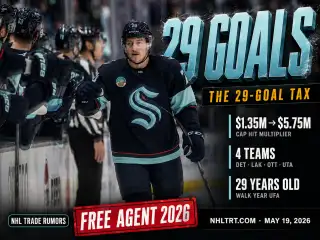
Bobby McMann Free Agent 2026 Destinations: 4 Teams Linked
Bobby McMann's career-high 29 goals just turned a $1.35M cap hit into Sharangovich-tier money. The Athletic locked him to 4 teams (Detroit,...
By Mike Johnson · 10 min read
Hellebuyck Trade Rumors 2026: The Vulture Watch Begins
Connor Hellebuyck is still under contract — but rivals circle as Winnipeg's window narrows.
By Sarah Chen · 1 min read
Get NHL trade rumors in your inbox
One email per week. Zero spam. Verified rumors only.