Rutherford Hughes Extensions 2026: The $112M Lure
Jim Rutherford admitted the $112.25M in Boeser, Garland, and Demko extensions were partly Hughes retention bait. Hughes left anyway. Inside The Hughes Lure — how $76.25M still sits on Vancouver's cap for a captain's chair that has belonged to Minnesota since December 2025.
Live updates
No updates yet. Refreshing automatically.
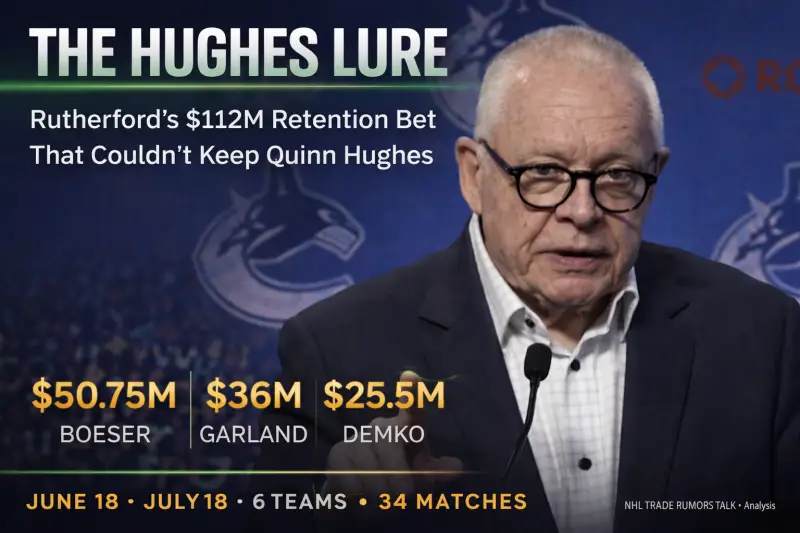
Jim Rutherford handed out $112.25 million in Canucks extensions on July 1, 2025 — seven years for Brock Boeser, six years for Conor Garland, three years for Thatcher Demko — and on Friday he admitted every one of those 2026 signings was, at least in part, a pitch to keep Quinn Hughes. Hughes was already gone in his head.
The Canucks president of hockey operations said at his 2026 end-of-season media availability that he knew before training camp Hughes wouldn't re-sign. He signed the others anyway, hoping the commitment to winning would change Hughes' mind. It didn't. Hughes was traded to Minnesota on December 12, 2025, and Vancouver finished 25-49-8 — last in the NHL — with roughly three-quarters of the original retention package still on the books.
That's the mechanism I want to name today. When a front office pre-commits to role players with the unspoken purpose of convincing a star to stay, it's building what I'll call The Hughes Lure — a bait package priced around the star's expected yes. When the star says no, the bait doesn't disappear — it becomes an expensive line item with no central reason for existing.
Rutherford's Friday admission didn't just close the book on a disastrous season. It retroactively reframed the entire summer of 2025 as a retention operation that failed — and left Vancouver with two long-term contracts, one reclamation goalie project, and a captain's chair that has belonged to Minnesota since December.
Key Takeaways
- The Hughes Lure: Rutherford confirmed Boeser, Garland, and Demko — $112.25M combined — were signed partly as retention bait for Quinn Hughes. Hughes left anyway.
- He knew before the season: Rutherford said he was aware Hughes wasn't staying "before the season started" — meaning the extensions were signed with a pessimistic read on the retention odds.
- The Tkachuk frame: Rutherford compared Hughes to Matthew Tkachuk, who left Calgary in 2022 despite an 111-point team. The comp has weaknesses but makes the behavioral point.
- Sunk cost, mostly: Garland already moved to Columbus in March for two draft picks. Boeser ($50.75M remaining) and Demko ($25.5M starting 2026-27) stay.
- The 2027 countdown: Hughes becomes a UFA on July 1, 2027. Vancouver's cap structure is now built around two players the fan base expected to play alongside him.
What Rutherford Admitted: The Canucks Knew Hughes Was Leaving
The most revealing line from Friday's session wasn't about Hughes at all. It was about timing. Rutherford said he'd known "for some time" that Hughes was not staying — and that he was aware of it "before the season for that matter."
"I'd known for some time that Hughes was not staying. I knew before the season for that matter. It's one of the reasons we signed the Garlands, the Boesers and the Demkos."
— Jim Rutherford, Canucks president of hockey operations (via NHL Trade Rumors)That's an admission with teeth. It means Boeser's seven-year deal at $7.25 million AAV, signed on the morning of July 1 less than an hour before he was set to hit unrestricted free agency, was structured with the understanding that the star it was designed to reassure was already leaning toward the exit. The Canucks had offered five years at $8 million earlier in negotiations. Boeser wanted length, which per PuckPedia he got — along with a no-movement clause for the first four years of the deal.
That framing recasts the retention pitch. A team that privately believes it's losing its franchise player in two years still has to look like a team trying to win. That pitch solves the appearance problem — you sign the role pieces on long deals, point to the raised payroll as evidence of commitment, and hope the star reads the bet the same way you do.
Hughes didn't. He had already told Pat Brisson, his agent, that he wasn't re-signing in Vancouver. Per reporting from The Hockey News, Hughes informed the Canucks around American Thanksgiving 2025 — roughly four weeks before the trade landed. An earlier framework with Detroit collapsed because Hughes wouldn't commit long-term to Steve Yzerman, a detail that would later inform my read on why Detroit's architect stepped back from the aggressive path.
Breaking Down $112M in Retention Extensions
The math of the retention package, signed in a single morning on July 1, 2025, looks like this:
| Player | Term | AAV | Total Value | Clause |
|---|---|---|---|---|
| Brock Boeser | 7 years (through 2032) | $7.25M | $50.75M | NMC y1-4, 15-team NTC y5-7 |
| Conor Garland | 6 years (through 2032) | $6.00M | $36.00M | NMC y1-3, 15-team NTC y4-6 |
| Thatcher Demko | 3 years (starts 2026-27) | $8.50M | $25.50M | NMC all 3 years |
| Total | 16 player-years | — | $112.25M | Heavy trade protection |
THE HUGHES LURE SCORECARD
\nHow Rutherford's $112M retention bet is grading one season in.
\nNone of these are disastrous contracts in isolation. Boeser's $7.25M AAV sits near the median for second-line wingers who can hit 40 goals on the right night. Garland's $6M is an overpay on term for a middle-six forward, but the cap inflation wave makes it more defensible than it looked that morning. Demko at $8.5M is a bet on health — his 2024-25 was wrecked by injuries — but if he rebounds, it's below-market for a starter.
The problem isn't the dollar figures. It's the purpose. These three deals were priced and termed around Hughes staying.
Boeser gets the extra years of security because he's supposed to be Hughes' right winger through 2029. Garland gets the NMC because he's supposed to be a third-line identity piece on a playoff roster, not a rebuild asset. Demko's three-year hammer at $8.5M is the spine of a starting rotation behind a defense Hughes quarterbacks. Remove Hughes and every one of those rationales softens.
The Hughes Lure
A retention-bait extension wave — multiple role or support players re-signed on long terms and hefty clauses at or near free agency, structured with the unstated goal of convincing a star to believe in the team's future. The contracts are priced around the star's yes. When the star says no, the lure remains as a multi-year cap obligation without its central purpose.
My read: this is a distinct failure mode from a classic overpay. An overpay is a mispriced asset. A retention-bait deal is a correctly-priced asset deployed for the wrong reason.
The cap hit on Boeser isn't crazy — it just isn't what it was supposed to buy. In a rebuild context, a four-year no-movement clause reshapes what Rutherford can do next. Similar cap-structure traps surfaced around Bobrovsky's Panthers extension negotiations and aging-star retention — but Florida at least had a Cup to show for the risk.
The Tkachuk Parallel and Where It Breaks
Rutherford leaned on a specific historical frame to justify the outcome. He compared Hughes to Matthew Tkachuk — arguing that Tkachuk left Calgary despite having "a good team," and that Hughes would have left Vancouver regardless.
"I chose the Florida Panthers, first and foremost, how great of a team they are and how great of a chance they have to win."
— Matthew Tkachuk on his 2022 Calgary exit (via Yahoo Sports)The behavioral point holds. Tkachuk walked away from a Calgary team that finished the 2021-22 season with 111 points — a real contender — and engineered a sign-and-trade to Florida in July 2022. Per NHL.com, the Flames returned Jonathan Huberdeau, MacKenzie Weegar, Cole Schwindt, and a conditional 2025 first-round pick. Tkachuk then signed an eight-year, $76 million contract with the Panthers.
But the structural comparison has a flaw. Calgary didn't hand out $112 million in retention extensions the summer before Tkachuk's exit. Johnny Gaudreau left Calgary first as a UFA in July 2022 — bolting to Columbus on a seven-year, $68.25 million deal — and Tkachuk's "I won't sign long-term" conversation happened in the aftermath.
Calgary's reaction wasn't a retention-bait package. It was a pivot to a different core.
Vancouver's sequence ran in the opposite direction. Rutherford's own admission places the big signings before Hughes' Thanksgiving notification, during a window where the front office privately suspected retention was a long shot. That's a different strategic gamble than anything Calgary ran. The Tkachuk comp flattens out an important distinction: whether you invested into the star's expected yes or accepted the no as it arrived.
The Canucks' situation has more in common with the New Jersey retention-ladder dynamic around Dougie Hamilton than with Calgary's post-Gaudreau pivot. Both teams paid security premiums to hold a core together. Both watched the core dissolve for different reasons. The lesson: retention contracts should be priced for the roster you'll actually ice, not the one you hope to save.
The Cap Hangover: What Vancouver Inherits in 2026-27
Now the $112.25M math gets interesting. Not all of it stays on Vancouver's books. Garland was traded to Columbus on March 6, 2026 for a 2026 third-round pick and a 2028 second-round pick — per NHL.com, a move announced months before his extension even kicked in. Columbus inherits the six-year, $36M obligation starting 2026-27.
That leaves two of the three original extensions active on Vancouver's ledger:
| Player | 2026-27 Cap Hit | Remaining Term | Trade-ability |
|---|---|---|---|
| Brock Boeser | $7.25M | 6 years | Locked by NMC through 2028-29 |
| Thatcher Demko | $8.50M | 3 years (starts 2026-27) | Locked by NMC for all 3 years |
| Active Cost | $15.75M | 9 player-years | Effectively immovable near-term |
On a cap projected to cross $100M by 2027-28, $15.75M across a winger and a goalie isn't cap-death — and it sits on top of the $11.6M Elias Pettersson contract that has its own exit-ramp problem. But Boeser's role is the thing that changes most when Hughes is gone. He was a top-line complement on a playoff-caliber group — 15 goals and 29 points through 57 games of his 2025-26 campaign, a 12.0 shooting percentage that sits right on his career median.
In a rebuild year without a true number one center, that same offensive context becomes harder to replicate. The goalie market context matters too: the recent $92M goalie haymaker between Shesterkin and Markstrom reset the starting-goalie ceiling, which makes Demko's $8.5M less scary in relative terms — if his body cooperates.
Demko's situation is more binary than Boeser's. After a January 27, 2026 hip surgery ended his season at 8-10-1 with a .897 save percentage and a 2.91 goals-against average over 20 starts, he needs to reestablish himself before the $8.5M kicks in next year. If the surgery takes, he's a tradeable starter on a short-term deal — the kind of goalie a contender would chase. If it doesn't, the contract becomes a three-year anchor with a no-movement wrapper.
The honest read: Rutherford's July 1 bill wasn't reckless, but it wasn't what he said it was either. It was a retention gamble priced as a roster decision — and only one of the three bets offloaded cleanly.
How Boeser and Demko Fit a Rebuild That Wasn't Supposed to Happen
Every rebuild has to decide what its veterans are for. The cleanest version is the Nils Hoglander-style analytics orphan reset — moving the players whose production doesn't travel. The complicated version is what Vancouver now owns: two long-term veterans locked to no-movement clauses, tied to a core that no longer exists.
Three paths the next GM can run:
- Ride it out. Let Boeser's goals buy cover while a younger center emerges. Let Demko stabilize the crease long enough for a rookie goalie to push. Most likely path because the no-movement clauses make the others harder.
- Reshape the clauses. Convince Boeser to waive for the right contender in year 3 or 4. Convince Demko to waive if the season disappoints and the Canucks need deadline capital. Neither is guaranteed.
- Eat retention to clear space. At the 2027 or 2028 deadline, retain 40-50% on Boeser's remaining deal to create a tradeable version — the surgical-but-expensive version of the exit.
What stands out to me is that the next GM — whoever Rutherford hires to replace Patrik Allvin after last week's firing of the GM Rutherford himself hired — inherits this structural constraint before they write their first trade. The playbook they can run is narrowed by contracts that exist for a reason that no longer applies.
That's the Maple Leafs-style overcorrection risk — the incoming executive faces pressure to invalidate the previous regime's bets, even when the bets aren't quite as bad as they look on paper. And it's the three-year closer problem in a different shape — the clock starts ticking the day the new chair is filled, not the day the strategy actually makes sense.
My projection: Boeser finishes this contract in Vancouver or gets 50% retained to finish it elsewhere. Demko gets traded at the 2027 deadline for a second-round pick and a B-tier prospect if he returns to a .915 save percentage by February.
The Garland move has already cashed out — two picks for a player who's scored four goals in his first three Columbus games per NHL.com. One of three extensions actually worked out for someone. Just not the person it was built for.
Update May 12, 2026: Hughes extension stability got reinforced when the Sedins received a senior front office offer per Friedman May 11.
Sources and Reporting
- NHL Trade Rumors — Rutherford Friday press conference quotes on Hughes, Tkachuk, extensions
- NHL.com — Hughes trade package and December 12, 2025 date
- PuckPedia — Hughes 6yr/$47.1M contract, UFA status 2027
- CapWages — Boeser 7yr/$50.75M contract breakdown
- CanucksArmy — Demko 3yr/$25.5M terms and no-movement structure
- The Hockey Writers — Garland 6yr/$36M extension details
- ESPN — Garland trade to Columbus March 6, 2026
- NHL.com — Tkachuk 2022 Calgary-Florida trade terms
- CBC News — Allvin firing April 17, 2026, 25-49-8 last-place finish
The Verdict: The Hughes Lure
Rutherford handed out $112.25 million in a single morning and admitted Friday that the central buyer — Quinn Hughes — was already mentally gone when the pens touched the paper. Two of the three extensions, worth $76.25M combined, remain as active cap commitments to a roster theory that no longer exists.
That's the Lure in full: the right contracts, priced reasonably, signed for the wrong underlying reason — locking the next regime into running a rebuild through veterans who were supposed to be a captain's supporting cast. Hughes becomes a UFA on July 1, 2027. The extensions don't expire that day — they expire in 2032.
Why did Quinn Hughes leave the Vancouver Canucks?
Per Jim Rutherford's April 17, 2026 press conference, Hughes wanted to return to the United States to play closer to his brothers Jack (New Jersey) and Luke. Rutherford compared the situation to Matthew Tkachuk's 2022 Calgary exit, arguing Hughes would have left regardless of team quality. Hughes was traded to Minnesota on December 12, 2025 for Marco Rossi, Liam Ohgren, Zeev Buium, and a 2026 first-round pick.
How much did the Canucks spend on extensions motivated by keeping Hughes?
Rutherford admitted three extensions signed July 1, 2025 were partly motivated by Hughes retention. Boeser signed seven years at $7.25M AAV, a deal that covers him through age 35. Garland signed six years at $6M AAV. Demko signed three years at $8.5M AAV starting 2026-27. Combined commitment: $112.25 million across 16 player-years — roughly 22% of a single 2025-26 season's cap allocated to three non-star signings.
Is Quinn Hughes signed with the Minnesota Wild long-term?
No. Hughes declined to sign a long-term extension in either Detroit (which killed a pre-existing Red Wings trade framework) or Minnesota. His current contract — six years, $47.1 million at $7.85M AAV — expires at the end of the 2026-27 season. He becomes an unrestricted free agent on July 1, 2027. The Wild paid a steep acquisition price knowing he could walk.
Did the Canucks actually benefit from any of these extensions?
One of the three was offloaded. Conor Garland was traded to Columbus on March 6, 2026 for a 2026 third-round pick and a 2028 second-round pick, before his extension even kicked in. Garland scored four goals in his first three games as a Blue Jacket per ESPN. Boeser and Demko remain on Vancouver's cap, with the Demko extension ($8.5M AAV) not starting until the 2026-27 season.
What does the Matthew Tkachuk comparison actually prove?
Tkachuk left Calgary in July 2022 despite the Flames posting 111 points the prior season — evidence stars sometimes leave good teams. However, Calgary did not hand out retention-bait extensions before Tkachuk's departure. Johnny Gaudreau left as a UFA first on a seven-year, $68.25 million deal to Columbus, and Calgary's response was acquiring Huberdeau and Weegar, not pre-emptively extending role players. The behavioral point holds; the structural comparison does not.
Frequently Asked Questions
Why did Quinn Hughes leave the Vancouver Canucks?
Per Jim Rutherford's April 17, 2026 press conference, Hughes wanted to return to the United States to play closer to his brothers Jack (New Jersey) and Luke. Rutherford compared the situation to Matthew Tkachuk's 2022 Calgary exit, arguing Hughes would have left regardless of team quality. Hughes was traded to Minnesota on December 12, 2025 for Marco Rossi, Liam Ohgren, Zeev Buium, and a 2026 first-round pick.
How much did the Canucks spend on extensions motivated by keeping Hughes?
Rutherford admitted three extensions signed July 1, 2025 were partly motivated by Hughes retention. Boeser signed seven years at $7.25M AAV, a deal that covers him through age 35. Garland signed six years at $6M AAV. Demko signed three years at $8.5M AAV starting 2026-27. Combined commitment: $112.25 million across 16 player-years — roughly 22% of a single 2025-26 season's cap allocated to three non-star signings.
Is Quinn Hughes signed with the Minnesota Wild long-term?
No. Hughes declined to sign a long-term extension in either Detroit (which killed a pre-existing Red Wings trade framework) or Minnesota. His current contract — six years, $47.1 million at $7.85M AAV — expires at the end of the 2026-27 season. He becomes an unrestricted free agent on July 1, 2027. The Wild paid a steep acquisition price knowing he could walk.
Did the Canucks actually benefit from any of these extensions?
One of the three was offloaded. Conor Garland was traded to Columbus on March 6, 2026 for a 2026 third-round pick and a 2028 second-round pick, before his extension even kicked in. Garland scored four goals in his first three games as a Blue Jacket per ESPN. Boeser and Demko remain on Vancouver's cap, with the Demko extension ($8.5M AAV) not starting until the 2026-27 season.
What does the Matthew Tkachuk comparison actually prove?
Tkachuk left Calgary in July 2022 despite the Flames posting 111 points the prior season — evidence stars sometimes leave good teams. However, Calgary did not hand out retention-bait extensions before Tkachuk's departure. Johnny Gaudreau left as a UFA first on a seven-year, $68.25 million deal to Columbus, and Calgary's response was acquiring Huberdeau and Weegar, not pre-emptively extending role players. The behavioral point holds; the structural comparison does not.
Related Stories

Darnell Nurse Trade: 4 Suitors
Edmonton wants Darnell Nurse's $9.25M off the books, but a buyout saves barely $1.53M and his no-move clause hands him the pen. The Bonus Sh...
By Mike Johnson · 12 min read

Alex Tuch Destinations: 4 Teams
Buffalo wants Alex Tuch back, but if the extension stalls, Columbus, Washington, Seattle, and Edmonton are circling. The cap math, the Kempe...
By Mike Johnson · 13 min read

Sabres Tuch Squeeze: 3 Players Departing
Buffalo broke a 14-year drought, then lost Game 7 in OT to Montreal. Now the Tuch Squeeze forces out Stanley, Malenstyn, and Levi. Cap math...
By Mike Johnson · 11 min read

Canucks Fire Foote: Malhotra Leading
Vancouver fired head coach Adam Foote on May 19, 2026 after a 25-49-8 season. Manny Malhotra leads the candidate list. The Voice Mandate exp...
By Mike Johnson · 9 min read
Get NHL trade rumors in your inbox
One email per week. Zero spam. Verified rumors only.