Elias Pettersson Trade: The $11.6M Exit Ramp
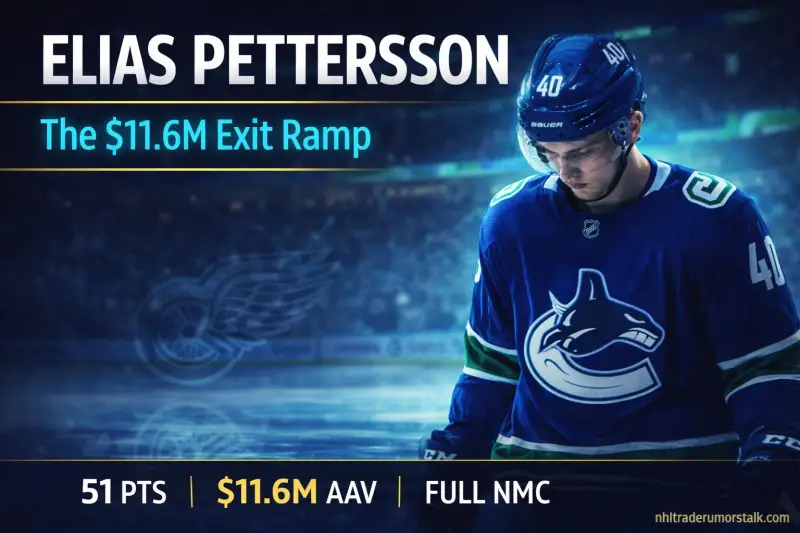
Elliotte Friedman reports the Canucks will sit down with Pettersson this offseason for a real conversation about his future. With 51 points in 73 games, $11.6M AAV, and a full NMC, the Exit Ramp leads to Detroit.
Live updates
No updates yet. Refreshing automatically.
$92.8 million and six years remaining — that's the number hanging over every conversation about Elias Pettersson's future with the Vancouver Canucks in 2026. Elliotte Friedman reported on Donnie and Dhali that the Canucks will sit down with Pettersson after the season for a "real conversation" where all options are on the table, including whether an Elias Pettersson trade is finally on the table. With 15 goals and 51 points in 73 games — a 0.70 points-per-game pace that represents the second consecutive year of declining production — Vancouver's $11.6 million AAV center has become the most expensive question mark in the NHL.
Companion read: For why Pettersson's full no-movement clause makes this trade nearly impossible to execute, read The $92.8M Veto. This article covers WHERE Pettersson could land — the Veto covers WHY he probably won't.
Friedman's exact framing tells you everything about where this is headed. He said the Canucks need to ask Pettersson directly: "Are you committed? What can we do to get you back to being the player you were a couple of years ago? Or does everybody believe that it's the right time to talk about places you're willing to go?" That's not a vote-of-confidence statement. That's an organization publicly preparing its fan base for a departure.
My read: this trade happens by the 2026 draft in late June. The Canucks have already traded Quinn Hughes, Conor Garland, Tyler Myers, and Nils Hoglander as an analytics orphan. Pettersson is the last major asset standing, and his full no-movement clause means only he decides when — and where — the $11.6M Exit Ramp leads.
Key Takeaways
- The $11.6M Exit Ramp: Pettersson's $92.8 million contract with a full NMC gives him total control over any trade — but his declining production (102 points in 2022-23 to 51 points in 2025-26) means Vancouver can't afford to keep paying franchise-center money for 50-point output
- Friedman confirms the sit-down: Elliotte Friedman reported the Canucks will have a "real conversation" with Pettersson this offseason, with all options including a trade explicitly on the table
- Detroit leads the race: The Red Wings have $30+ million in projected 2026-27 cap space, a Swedish heritage (Lidstrom, Zetterberg, Raymond), and Steve Yzerman reportedly "aggressively pursuing" Pettersson
- Analytics tell the decline story: Pettersson's 46.0% xGF% and 45.0% CF% in 2025-26 are career worsts — his team generates fewer chances with him on ice than off it
- Expected return: Per David Pagnotta, Vancouver needs "three quality pieces" — a first-round pick, a top-two center prospect, and another major asset
From 102 Points to 51: The Pettersson Decline in 2026
Two years ago, Elias Pettersson was a 39-goal, 102-point franchise center who carried Vancouver to the Pacific Division title. Then the Canucks rewarded him with an eight-year, $92.8 million extension — and the production started falling. He dropped to 89 points in 2023-24, a number the organization rationalized as a natural dip after a career year. Then came 2024-25, when things started to look genuinely concerning.
By 2025-26, the picture had become unmistakable. Here's how Pettersson's production has tracked since that contract extension, per Hockey-Reference and ESPN:
| Season | GP | Goals | Points |
|---|---|---|---|
| 2022-23 | 80 | 39 | 102 |
| 2023-24 | 82 | 34 | 89 |
| 2024-25 | 64 | 15 | 45 |
| 2025-26 | 73 | 15 | 51 |
Friedman called Pettersson "the $92.8 million elephant in the room" and described him as "a 50-point man the past two seasons." That characterization from the NHL's most connected insider isn't casual — it's a signal that the league's executive class has already downgraded Pettersson's trade value from "franchise centerpiece" to "expensive reclamation project."
"Are you committed? What can we do to get you back to being the player you were a couple of years ago? Or does everybody believe that it's the right time to talk about places you're willing to go?"
— Elliotte Friedman, Sportsnet (via Vancouver Hockey Daily)Friedman's framing isn't neutral — it's loaded with subtext. By publicly outlining both paths (recommit or leave), he's telling the hockey world that the Canucks' front office has already accepted that a trade is a realistic outcome. Teams across the league heard that broadcast and started making calls.
The $11.6M Exit Ramp: Why Pettersson's NMC Changes Everything
The $11.6M Exit Ramp
The contractual crossroads facing Elias Pettersson and the Vancouver Canucks — where a $11.6 million AAV, a full no-movement clause, and two consecutive years of declining production converge to create an impossible choice: pay franchise-center money for 50-point production through 2032, or trade the highest-paid player in team history at a discount because his NMC limits the destination pool.
Pettersson's full NMC means Vancouver cannot trade him without his written consent to a specific destination. He doesn't just get a say — he gets a veto. If Pettersson decides he only wants to play in Detroit, then Detroit is the only team Vancouver can negotiate with. That's the ultimate buyer's market for the acquiring team and the worst possible negotiating position for a franchise already shedding assets at a discount.
What kills me about this situation is the timing. Vancouver signed Pettersson to this deal in March 2024, just months before the entire roster collapsed. They locked in $11.6 million per year through 2032 based on a player who scored 102 points — and now they're stuck with a player who's producing at roughly half that rate. The NMC trap that caught Nashville is catching Vancouver in real time.
The salary cap element compounds the problem. At $11.6 million against the $95.5 million salary cap ceiling, Pettersson consumes 12.1% of any team's cap room. Nobody is absorbing that number at full freight for a player producing at a 57-point pace. Salary retention will almost certainly be required, meaning the Canucks eat cap space for a player who isn't even on their roster anymore.
Three Destinations for the Elias Pettersson Trade in 2026
Per David Pagnotta's reporting, the Canucks need "three quality pieces" in return — a first-round pick, a top-two center prospect, and another significant asset. Here's how the most realistic destinations stack up:
Detroit Red Wings: The Frontrunner
Every road in the Pettersson trade conversation leads back to Detroit. The Red Wings have $30-plus million in projected 2026-27 cap space — enough to absorb Pettersson's full $11.6 million hit without breaking a sweat. Steve Yzerman has been building toward this exact moment, stockpiling cap room and prospects for a franchise-altering acquisition.
Yzerman is reportedly "aggressively pursuing" Pettersson, per Octopus Thrower. The appeal for Pettersson goes beyond hockey — Detroit has the richest Swedish heritage in the NHL, from Nicklas Lidstrom to Henrik Zetterberg to current forwards Lucas Raymond and Simon Edvinsson. For a player who may need a psychological reset as much as a tactical one, Hockeytown's Swedish pipeline offers something no other franchise can.
Detroit's likely package: Marco Kasper (top center prospect), a 2026 first-round pick, and a conditional second. That's a premium return for a player producing at Pettersson's current rate, but Yzerman has the prospect depth to absorb the cost.
Pettersson's 46.0% xGF% (expected goals share — meaning his team was outchanced when he was on ice) looks dire on paper, but context matters: he played on a Canucks team that finished dead last in the NHL. His 0.70 points-per-game rate in 2025-26 would project to roughly 57 points on a full 82-game season — still above average for an NHL center, just not $11.6 million above average. Put him between Raymond and a competent roster, and I'd bet those numbers climb back toward 75-80 points within a single season.
Los Angeles Kings: The Family Factor
Pettersson has family ties to Los Angeles — a detail that carries real weight when a player holds a full NMC. The Kings have cap space opening up as Anze Kopitar's contract winds down, and adding a 27-year-old franchise center would extend their competitive window by five-plus years.
Can LA match Detroit's prospect offer? Their pipeline is thinner after years of win-now moves, and the Kings may need to include Quinton Byfield to make the math work for Vancouver. Byfield's own $5.2 million AAV and first-line potential makes him a painful piece to surrender, which is exactly why it might be the price of admission for a player of Pettersson's caliber.
"I haven't gotten any indication at all that Elias Pettersson wants out of Vancouver, but the conversation they need to have is real."
— David Pagnotta, The Fourth Period (via ClutchPoints)Pagnotta's nuance is worth noting — Pettersson hasn't demanded a trade. The decision tree branches based on what the Canucks say in that sit-down meeting. If GM Patrik Allvin tells Pettersson the rebuild will take three-to-four years, a player earning $11.6 million per year may reasonably conclude that his prime years shouldn't be spent developing teenagers.
Why Carolina Doesn't Work for Pettersson
The Hurricanes have been mentioned as an interested party, and on the surface, the fit looks appealing — a well-coached contender with a strong defensive structure. But Carolina's cap situation after the Shesterkin and Markstrom goalie spending spree leaves minimal room for an $11.6 million addition without significant roster surgery. Rod Brind'Amour's system also demands two-way centers who drive possession — Pettersson's 45.0% CF% (Corsi for percentage — meaning his team was outshot at 5-on-5) is the worst of his career and directly contradicts what Carolina needs. The Hurricanes would be paying franchise money for a player whose underlying game doesn't match their tactical identity.
The Joe Thornton Precedent: When Boston Traded a Franchise Center
Boston's November 2005 trade of Joe Thornton to San Jose is the historical parallel that looms largest here. Thornton was 26 years old — one year younger than Pettersson — the team's captain, and the reigning Hart Trophy winner. Boston's front office concluded that the team needed a full reset and shipped Thornton for Marco Sturm, Brad Stuart, and Wayne Primeau. Thornton went on to score 125 points that season and became San Jose's franchise player for the next decade.
The Canucks' situation rhymes uncomfortably with that Boston decision. Vancouver's rebuild is already underway after trading Quinn Hughes to Minnesota for Marco Rossi, Zeev Buium, and a first-round pick. Keeping Pettersson through a three-year rebuild means paying $11.6 million for a player who'll be 30 by the time the roster is competitive again. The Blues faced a similar calculus with Robert Thomas, and the asset return on a franchise player always decreases the longer you wait.
My projection: the Canucks trade Pettersson to Detroit by the June 2026 draft. Vancouver retains 20% of his salary ($2.32 million per year), bringing Detroit's effective cap hit to $9.28 million. The return package includes Marco Kasper, a 2026 first-round pick, and Detroit's 2027 second-rounder. Pettersson finishes next season with 75-plus points playing alongside Lucas Raymond, and Canucks fans spend the next five years wondering what could have been.
Sources and Reporting
- Vancouver Hockey Daily (Friedman) — Friedman's "real conversation" report and Pettersson sit-down details
- PuckPedia — Pettersson contract details ($11.6M AAV, 8yr/$92.8M, full NMC)
- Octopus Thrower — Yzerman "aggressively pursuing" Pettersson reporting
- ClutchPoints (Pagnotta) — Trade return expectations and Pettersson's mindset
- Hockey-Reference — Pettersson career statistics and year-over-year comparison
- ESPN — 2025-26 season stats (15G, 51pts, 73GP)
- NHL.com — Quinn Hughes trade details (December 2025)
- Pro Hockey Rumors — Analysis of Pettersson trade mechanics and NMC limitations
- Detroit Hockey Now — Red Wings trade package analysis for Pettersson
The Verdict: The $11.6M Exit Ramp
Elias Pettersson isn't a bad player. He's a very good player being paid like a generational one — and the gap between those two things is $11.6 million per year for six more years. The $11.6M Exit Ramp leads to Detroit, where Yzerman's $30 million in cap space and Swedish heritage create the one destination that makes sense for both sides.
My projection: Pettersson is a Red Wing by draft night, Vancouver retains salary, and the Canucks receive Kasper plus a first-round pick plus a conditional second. The player who scored 102 points in 2022-23 is still in there somewhere — he just needs a new zip code to find him again.
Frequently Asked Questions
Does Elias Pettersson have a no-trade clause?
Pettersson has a full no-movement clause (NMC) on his eight-year, $92.8 million contract, which is stronger than a standard no-trade clause. He cannot be traded, waived, or sent to the minors without his written consent. This gives Pettersson complete control over his destination if a trade happens. He signed this clause as part of his extension on March 2, 2024, and it runs through the 2031-32 season.
What would the Canucks get in an Elias Pettersson trade?
Per David Pagnotta of The Fourth Period, Vancouver would need "three quality pieces" in return — a first-round pick, a top-two center prospect, and another significant asset. However, because Pettersson's production has dropped to 51 points in 73 games this season, the Canucks may need to retain salary to maximize the return. Most analysts project Detroit's Marco Kasper as the centerpiece prospect in any Red Wings deal.
Why has Elias Pettersson's production declined?
Pettersson dropped from 102 points in 2022-23 to approximately 51 points in 2025-26. Multiple factors contributed: the departure of linemates like Brock Boeser and J.T. Miller who elevated his play, a Canucks roster in full teardown mode under first-year coach Adam Foote, and advanced metrics suggesting Pettersson's shot quality and chance generation have genuinely declined. His 46.0% xGF% in 2025-26 indicates his teams gets outchanced when he's on ice.
Will Elias Pettersson waive his NMC?
No public indication yet, but the circumstantial evidence points toward yes — if the right destination emerges. Pettersson has reportedly not demanded a trade, but Friedman's report suggests the Canucks will present a full rebuild timeline during their offseason sit-down. If Pettersson learns the team won't be competitive until 2029-30 at the earliest, waiving for a contender like Detroit becomes the logical choice for a player entering his prime years.
How much cap space do the Detroit Red Wings have for 2026-27?
Detroit projects to have over $30 million in cap space for 2026-27, making them one of the few teams capable of absorbing Pettersson's full $11.6 million AAV without requiring salary retention. The Red Wings currently carry 18 players under contract against the projected $104 million cap ceiling. Yzerman has deliberately kept the cap sheet flexible for exactly this type of franchise-altering acquisition.
Frequently Asked Questions
Does Elias Pettersson have a no-trade clause?
Pettersson has a full no-movement clause (NMC) on his eight-year, $92.8 million contract, which is stronger than a standard no-trade clause. He cannot be traded, waived, or sent to the minors without his written consent. This gives Pettersson complete control over his destination if a trade happens. He signed this clause as part of his extension on March 2, 2024, and it runs through the 2031-32 season.
What would the Canucks get in an Elias Pettersson trade?
Per David Pagnotta of The Fourth Period, Vancouver would need three quality pieces in return - a first-round pick, a top-two center prospect, and another significant asset. However, because Pettersson's production has dropped to 51 points in 73 games this season, the Canucks may need to retain salary to maximize the return. Most analysts project Detroit's Marco Kasper as the centerpiece prospect in any Red Wings deal.
Why has Elias Pettersson's production declined?
Pettersson dropped from 102 points in 2022-23 to approximately 51 points in 2025-26. Multiple factors contributed: the departure of linemates like Brock Boeser and J.T. Miller who elevated his play, a Canucks roster in full teardown mode under first-year coach Adam Foote, and advanced metrics suggesting Pettersson's shot quality and chance generation have genuinely declined. His 46.0% xGF% in 2025-26 indicates his team gets outchanced when he's on ice.
Will Elias Pettersson waive his NMC?
No public indication yet, but the circumstantial evidence points toward yes - if the right destination emerges. Pettersson has reportedly not demanded a trade, but Friedman's report suggests the Canucks will present a full rebuild timeline during their offseason sit-down. If Pettersson learns the team won't be competitive until 2029-30 at the earliest, waiving for a contender like Detroit becomes the logical choice for a player entering his prime years.
How much cap space do the Detroit Red Wings have for 2026-27?
Detroit projects to have over $30 million in cap space for 2026-27, making them one of the few teams capable of absorbing Pettersson's full $11.6 million AAV without requiring salary retention. The Red Wings currently carry 18 players under contract against the projected $104 million cap ceiling. Yzerman has deliberately kept the cap sheet flexible for exactly this type of franchise-altering acquisition.
Related Stories

Darnell Nurse Trade: 4 Suitors
Edmonton wants Darnell Nurse's $9.25M off the books, but a buyout saves barely $1.53M and his no-move clause hands him the pen. The Bonus Sh...
By Mike Johnson · 12 min read

Darren Raddysh Free Agent 2026: 4 Teams
Darren Raddysh's 70-point breakout turned his $975K cap hit into a four-team bidding war. The Athletic linked him to Philadelphia, San Jose,...
By Mike Johnson · 13 min read
Bobby McMann Free Agent 2026 Destinations: 4 Teams Linked
Bobby McMann's career-high 29 goals just turned a $1.35M cap hit into Sharangovich-tier money. The Athletic locked him to 4 teams (Detroit,...
By Mike Johnson · 10 min read
Hellebuyck Trade Rumors 2026: The Vulture Watch Begins
Connor Hellebuyck is still under contract — but rivals circle as Winnipeg's window narrows.
By Sarah Chen · 1 min read
Get NHL trade rumors in your inbox
One email per week. Zero spam. Verified rumors only.