Juuse Saros Trade Predators 2026: The $61.92M Saros Tax
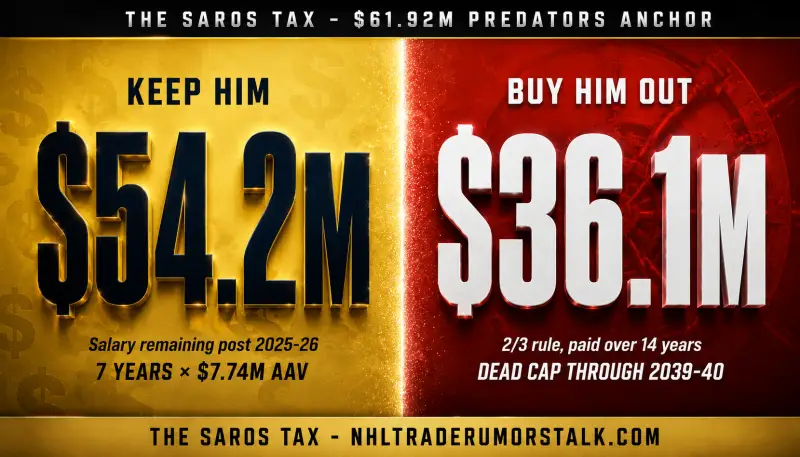
The Saros Tax: Nashville owes Juuse Saros $54.18M over 7 more years on his $61.92M extension. Buyout costs $36.12M dead cap across 14 seasons. Inside the keep-trade-buyout math after his worst-career 2025-26 season.
Live updates
No updates yet. Refreshing automatically.
Juuse Saros owns 7 more years and $54.18 million on a deal he just started honoring. The Nashville Predators owe him $7.74 million per season through 2032-33, and that's the easy math. The Juuse Saros trade Predators 2026 conversation is the hard math. What it actually costs Nashville to escape an 8-year, $61.92 million contract that just produced the worst statistical season of Saros's career.
Pro Hockey Rumors opened the angle on May 7. The Predators missed the playoffs for a second straight year. Saros faced more shots than any goalie in the NHL (1,700) and posted a .894 save percentage. His Goals Saved Above Expected sat at minus-9.27, per the analytics models. What that means in plain English? He gave up about nine more goals than an average goaltender should have, on a workload nobody else carried.
And here's the number nobody is putting on the front page. Buy out the Saros contract under the standard 2/3 rule and Nashville absorbs $36.12 million in dead cap, paid over 14 years. That's a long shadow. Trade him and the full no movement clause limits the market to the teams Saros approves. Keep him and the cap hit stays $7.74 million while the team rebuilds around him. Three options. Each one with its own ugly side.
Key Takeaways
- The Contract: Saros signed an 8-year, $61.92 million extension on July 1, 2024, kicking in for 2025-26 at $7.74 million AAV. Full no-movement clause for the first 5 years.
- The Saros Tax: Keep him for $54.2 million over 7 years OR buy him out for $36.1 million spread over 14 years. Either way, Nashville pays, the only question is whether the cost shows up on the team or off it.
- The Stats Drop: Saros posted his worst career numbers in 2025-26, .894 SV%, 3.13 GAA, minus-9.27 GSAx, while leading the NHL in shots faced (1,700) on a tilted-ice Predators team.
- The NMC Wall: Saros's full no-movement clause runs through 2030-31, meaning Nashville can only trade him to teams he approves. This collapses the realistic market to maybe 6-8 cap-rich, contender-adjacent destinations.
- The Rinne Precedent: The Predators handled Pekka Rinne's decline gracefully, 2-year extension, retirement, jersey retirement. Saros is 30, signed for 7 more years, and the same off-ramp doesn't exist.
How $61.92M Became Nashville's Goalie Anchor
Nashville signed Saros to the 8-year extension on July 1, 2024, locking in $61.92 million total at a $7.74 million annual cap hit, per Puckpedia. The deal kicked in this season (2025-26) and runs through 2032-33. He was 29 when he signed it. He'll be 37 when it ends.
The justification at the time was sound. Saros had been a top-10 goalie in the league for four straight seasons. He had carried the Predators on his shoulders during their 2023 playoff run. The market for elite goalies was rising. Connor Hellebuyck got $8.5 million per year in Winnipeg the same offseason. Igor Shesterkin's $11.5 million extension followed in late 2024. By those benchmarks, $7.74 million for Saros looked like Nashville keeping a franchise piece on a discount.
What changed? The team in front of him. The Predators went from 2023 playoff team to lottery team in 24 months. Nashville's NMC trap on its veteran core made every "let's get younger" idea harder to execute. Saros got buried under shot volume nobody asked him to absorb. And his numbers cratered.
The deal itself isn't the issue. What changed is the team in front of him.
The 2025-26 Numbers That Lit the Trade Talk
Saros faced 1,700 shots across 59 appearances in 2025-26 and stopped 1,519 of them. Both totals led the NHL, per The Hockey News. His goals against per game ran 3.13. His all-situations save percentage finished .894 (a number front offices read as the workload-adjusted floor, not the ceiling). His career marks before this season were 2.73 and .912, which works out to roughly half a goal more per game than his lifetime average.
"Saros had an especially frustrating season, facing the most shots in the NHL and finishing with the worst numbers of his 11-year career. With his second straight sub-.900 SV%, Saros's play is a cause for concern."
Pro Hockey Rumors, May 7, 2026
The advanced analytics tell the same story without sugar-coating. Saros's Goals Saved Above Expected (a model that adjusts for shot quality and location) finished at minus-9.27. That number means he allowed about nine more goals than an average NHL goalie would have given the same shots. Igor Shesterkin's $11.5M haymaker analysis shows the upper-tier goalie market expects positive GSAx, not negative.
The defense Nashville put in front of him was awful. That's the steel-man case. Some sources noted .900 has become "the new .915," meaning the entire goalie market is producing worse numbers under modern shot quality. But Saros's drop was not a league-wide drift. It was a personal cliff. Two straight sub-.900 seasons on a $7.74 million deal is the exact pattern that turns franchise players into trade rumors.
The Saros Tax Math: Keep, Trade, or Buy Out
Here's the actual math on each path. AAV verified via Puckpedia. Buyout calculation per the standard NHL 2/3 rule for players age 26-plus.
| Path | Annual Cost | Total Cost | Years of Drag |
|---|---|---|---|
| Keep Saros (status quo) | $7.74M cap hit | $54.18M | 7 (thru 2032-33) |
| Trade with full retention* | $3.87M cap hit | $27.09M dead | 7 (thru 2032-33) |
| Buy out (post 2025-26) | ~$2.58M average | $36.12M | 14 (thru 2039-40) |
*Trade math at maximum 50 percent retention: Nashville keeps $3.87M dead cap × 7 years = $27.09M total Nashville obligation. The receiving team picks up the other $3.87M × 7 years = $27.09M in real cap. Each side absorbs half of the $54.18 million remaining contract.
Look at the buyout column. The total dollars look smaller. The years are doubled. That's how the 2/3 rule works. Nashville saves $18 million in nominal salary but spreads $36 million in dead cap charges across 14 seasons, ending in 2039-40. Future GMs are tied to that decision for two full rebuilds.
The trade column has a different problem. Saros's no movement clause means Nashville cannot just shop him to anybody. Per Pro Hockey Rumors, the realistic market is "Saros's preferred destinations," typically a 6-to-8-team list. Sergei Bobrovsky's pay-cut extension dynamics in Florida show what happens when veteran goalies actually negotiate good situations. Saros has the same leverage. He picks the door, not the GM.
And the keep column? It works only if Nashville commits to a 3-year window where Saros plays behind a defense that lets him post a normal save percentage. Brendan Shanahan's insulation-layer logic applies here too. The Predators front office built a roster that exposed their goalie. Fix the roster, and the Saros Tax shrinks. Fail to fix it, and the contract becomes the franchise's biggest anchor.
The Saros Path Audit
SAROS TAX PATH AUDIT
Combined score = cap relief + roster flexibility + risk profile + likelihood Nashville actually executes. Higher = more realistic path forward.
SAROS BUYOUT TIMELINE
Approximate annual cap charge if Nashville buys out Saros after the 2025-26 season. Numbers smooth across 14 years per CBA 2/3 rule mechanics. Actual yearly figures vary slightly based on signing-bonus structure.
| SEASON | DEAD CAP | PHASE |
|---|---|---|
| 2026-27 | ~$2.58M | Year 1 of buyout window, within original contract term |
| 2029-30 | ~$2.58M | Halfway point of original deal, tied to today's choice |
| 2032-33 | ~$2.58M | Original contract end, buyout drag continues |
| 2035-36 | ~$2.58M | Saros would be 39, long retired, still on cap sheet |
| 2039-40 | ~$2.58M | Final year, 14 years after the buyout decision |
| TOTAL | $36.12M | $18M nominal savings · 14-year shadow |
The Pekka Rinne Precedent
Nashville's last goalie pivot is instructive, and it's also the warning. Pekka Rinne signed a 7-year, $49 million extension on November 3, 2011, the largest contract in franchise history at the time, per ESPN. He played out the deal, signed a 2-year, $10 million bridge in 2018, retired in July 2021, and got his number 35 retired by the franchise on February 24, 2022.
Why does this matter? Because the Rinne timeline is the cleanest goalie-decline arc Nashville has ever managed. The team protected the contract, eased him out at the right moment, and kept the legacy intact. Saros took over the starting role for 2021-22 the season after Rinne retired, per NHL.com. The Predators ran an 11-year goalie continuity from 2010 to 2025 because of how Rinne aged out.
"Saros is still owed over $50MM over the remaining seven years, and given how goalie-hungry the entire league is, there are many teams with ample cap space and major goaltending issues who would be all too happy to roll the dice on Saros despite his recent struggles and expensive contract."
Pro Hockey Rumors, May 7, 2026
The Saros math doesn't have a Rinne off-ramp. Rinne's last contract was 2 years and $10 million, a graceful tail. Saros has 7 years and $54.18 million ahead of him. He's 30, not 37. There's no "ride into retirement" exit. Steven Stamkos's exit-clause precedent shows the alternative path, veteran picks his market, team eats the optics. Saros owns that same lever.
What Comes Next: Three Realistic Saros Outcomes
So how does this play out? Nashville keeps Saros and tries to fix the roster around him. Here's the prediction in three steps:
- The Predators don't move Saros this summer. Barry Trotz's front office has $28.5 million in projected 2026-27 cap space. They use it on defensemen and a top-six forward, not on shipping Saros out. The 2026 NHL buyout window opens 48 hours after the Stanley Cup Final ends (typically mid-to-late June) and runs through June 30, per CBA Article 50.6 mechanics. They let it pass.
- Saros bounces back to a .905 to .910 SV% in 2026-27. Even partial defensive improvement and normal puck luck should pull him back to the .905-.910 range. That's still below his career mark, but it kills the trade-Saros narrative for at least a year.
- The 2027-28 deadline becomes the real decision point. Saros has 5 years left at that point, the NMC partial-list kicks in, and the Predators either compete or admit they're rebuilding. That's when a trade actually becomes possible. Maybe.
That's the path. Not because the Saros Tax goes away, but because the alternatives cost more. Smart rebuild moves in St. Louis show the pattern: protect the asset, let the market come to you, only pull the trigger when the math actually works. Predators GM Barry Trotz watched Doug Armstrong run that playbook for a decade.
The wild card is Saros himself. If he turns 31 next April with another sub-.900 season behind him, the Predators may not get to choose. Two more years like 2025-26 and the buyout becomes the only door left. Vancouver's $112M extension lure dynamics show what happens when teams refuse to act on declining contracts. Eventually the contract acts on the team.
Companion read:
Saros's $61.92M extension was signed in 2024, so his structure escapes The July 1 Bonus Wall grandfather window discussion entirely.
Sources and Reporting
- NHL.com: Saros 8-year extension official release: $61.92M total, $7.74M AAV, full NMC details
- Pro Hockey Rumors: Should The Predators Move Saros?: May 7 trade-talk catalyst article
- Puckpedia: Saros contract data: AAV, cap hit, and clause verification
- The Hockey News: Saros leads NHL in shots faced: 1,700 shots and 1,519 saves data
- ESPN: Saros 2025-26 stats page: GAA, SV%, GSAx
- Wikipedia: Pekka Rinne contract history: 7yr/$49M deal, retirement, jersey retirement timeline
- Puckpedia: NHL buyout calculator: Standard 2/3 rule mechanics for player age 26-plus
- Hockey Reference: Saros career stats: 2.73 career GAA, .912 career SV%, 27 career shutouts
The Verdict: The Saros Tax
The Predators don't have a Pekka Rinne ending in front of them. They have a 30-year-old goalie signed for 7 more years, two straight sub-.900 seasons, a no movement clause that cuts the trade market in half, and a buyout option that costs $36.1 million spread across 14 seasons of dead cap. The Saros Tax is real, and there's no version of it that costs zero.
My prediction stays the same. Nashville keeps him through 2026-27, fixes the defense, and reassesses at the deadline. The roster gets another full season to either justify the contract or condemn it. Saros gets one more shot to be the goalie his cap hit says he is.
If he doesn't bounce back? The Predators face the buyout window in June 2027 with the contract still ugly, Saros at 31, and 6 years of $7.74 million staring back at them. That's when the Saros Tax stops being a paper drag and becomes the franchise's actual problem.
Frequently Asked Questions
Will the Predators trade Juuse Saros in summer 2026?
Probably not. Nashville faces three barriers. Saros's full no movement clause limits the market to his preferred destinations, his contract's $7.74 million annual cap hit through 2032-33, and a goalie pool that hasn't produced obvious replacements at that price point. Pro Hockey Rumors floated the conversation on May 7, but any deal would require Saros's cooperation.
How much would a Juuse Saros buyout cost the Predators?
Approximately $36.12 million in total dead cap, calculated under the collective bargaining agreement's 2/3 rule of his $54.18 million remaining salary post-2025-26. That figure spreads across 14 seasons (twice the 7 years remaining), running through the 2039-40 cap year. Annual cap hit averages $2.58 million but varies by year based on the original signing-bonus structure of the deal.
What is Saros's no-movement clause status?
Saros holds a full no movement clause (NMC) for the first 5 years of his 8-year extension, meaning it stays active through the 2030-31 season. After that, the clause typically converts to a modified no-trade list, usually 8-15 teams the player can block. Nashville cannot trade him during the full-NMC window without his explicit waiver.
Why are Saros's 2025-26 numbers so bad?
Three factors compound. First, Nashville led the NHL in shots allowed by their goalie (1,700 against Saros), exposing him to far above-average workload. Second, his Goals Saved Above Expected sat at minus-9.27, meaning the analytics models say he underperformed the average NHL goalie by about 9 goals. Third, the league-wide save-percentage drift toward .900 is real, but Saros's drop was steeper than that drift alone explains.
How does Saros's contract compare to Pekka Rinne's?
Rinne signed a 7-year, $49 million deal in 2011 ($7 million AAV), the largest in franchise history at the time. Saros signed an 8-year, $61.92 million deal in 2024 ($7.74 million AAV), the largest in current Predators history. The structural difference is age. Rinne was 28 at signing and rode the deal to retirement. Saros was 29 and has 7 years remaining at age 30, with no graceful exit window currently in sight.
Frequently Asked Questions
Will the Predators trade Juuse Saros in summer 2026?
Probably not. Nashville faces three barriers — Saros's full no-movement clause limiting the market to his preferred destinations, his contract's $7.74 million annual cap hit through 2032-33, and a goalie pool that hasn't produced obvious replacements at that price point. Pro Hockey Rumors floated the conversation on May 7, but any deal would require Saros's cooperation.
How much would a Juuse Saros buyout cost the Predators?
Approximately $36.12 million in total dead cap, calculated as 2/3 of his $54.18 million remaining salary post-2025-26. That figure spreads across 14 seasons (twice the 7 years remaining), running through the 2039-40 cap year. Annual cap hit averages $2.58 million but varies by year based on the original signing-bonus structure of the deal.
What is Saros's no-movement clause status?
Saros holds a full no-movement clause for the first 5 years of his 8-year extension, meaning it stays active through the 2030-31 season. After that, the clause typically converts to a modified no-trade list — usually 8-15 teams the player can block. Nashville cannot trade him during the full-NMC window without his explicit waiver.
Why are Saros's 2025-26 numbers so bad?
Three factors compound. First, Nashville led the NHL in shots allowed by their goalie (1,700 against Saros), exposing him to far above-average workload. Second, his Goals Saved Above Expected sat at minus-9.27, meaning the analytics models say he underperformed the average NHL goalie by about 9 goals. Third, the league-wide save-percentage drift toward .900 is real, but Saros's drop was steeper than that drift alone explains.
How does Saros's contract compare to Pekka Rinne's?
Rinne signed a 7-year, $49 million deal in 2011 ($7 million AAV), the largest in franchise history at the time. Saros signed an 8-year, $61.92 million deal in 2024 ($7.74 million AAV), the largest in current Predators history. The structural difference is age — Rinne was 28 at signing and rode the deal to retirement; Saros was 29 and has 7 years remaining at age 30, with no graceful exit window currently in sight.
Related Stories
How Much Will Gavin McKenna Make?
How much will Gavin McKenna make? The No. 1 pick already earns a reported ~$700K in college NIL, but the NHL entry-level system caps his bas...
By Mike Johnson · 8 min read
NHL Waivers Explained: The 24-Hour Window
NHL waivers explained: the 24-hour noon-to-noon ET claim window, why the worst team in the league claims first, the age-and-games exemption...
By Mike Johnson · 8 min read
NHL Entry-Level Slide Rule: The 9-Game Window
NHL entry-level slide rule explained: CBA Article 9.1(d), the 10-game cutoff (playoffs included), the September-to-December age trap, what s...
By Mike Johnson · 8 min read

Cale Makar Contract Extension 2026
Cale Makar can sign a Colorado extension on July 1, 2026, but the new CBA cuts the re-sign max from eight years to seven on September 16, so...
By James Wright · 8 min read
Comments
Be the first to share your take.
Get NHL trade rumors in your inbox
One email per week, zero spam, verified rumors only.