NHL Recapture Penalty Rule Explained 2026: Cap Hit Math
NHL Article 50.10 recapture penalty in plain English. Kovalchuk, Luongo, Weber, Keith math + the 2020 rewrite that saved Nashville $24M + 2026 CBA survival rules.
Live updates
No updates yet. Refreshing automatically.
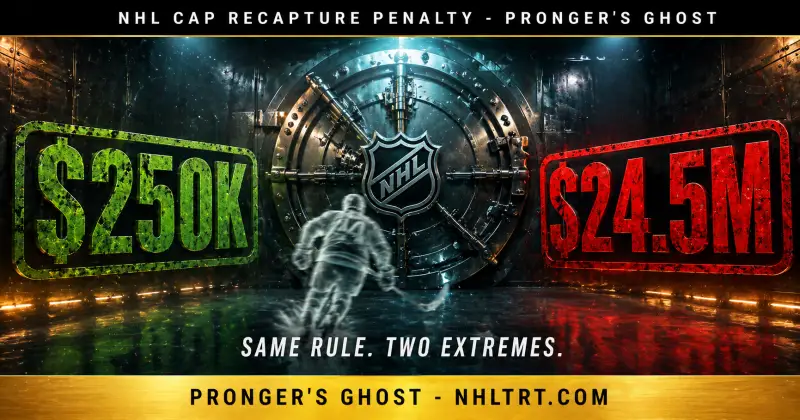
The Devils have been writing a $250,000 check to their salary cap every season since 2013-14 for a player who hasn't worn their jersey in over a decade. That's the NHL recapture penalty rule in one sentence. Ilya Kovalchuk left for the KHL in July 2013 with 12 years left on a front-loaded extension, and the league handed New Jersey a 12-year cap penalty as a parting gift. The 2026 version of this same rule still works exactly the same way for any contract signed before September 2013.
This is the punishment system the NHL bolted onto the CBA after teams figured out they could front-load mega-deals to push the cap hit way under the actual money paid. Pronger's 7-year, $34.45 million deal with Philadelphia. Hossa's 12-year, $62.8 million Blackhawks contract. Luongo's 12-year extension in Vancouver. The math gave teams real cap advantage on paper, the players walked away early in the back end of the deal, and the cap saving never got paid back. That's what Article 50.10 of the CBA was written to fix.
Here's the part fans never get explained properly. The recapture penalty doesn't hit when the player retires next year. It hits when the player retires before his contract ends, and the bill gets calculated based on every dollar the team underpaid relative to actual paychecks during the front-loaded years. Add up the cap savings, divide by years remaining, charge the team that benefit annually until the original contract would have expired. Cold math. No appeals.
Key Takeaways
- The mechanic in plain English: When a player on a front-loaded pre-2013 contract retires early, the team pays back the cap savings annually for the rest of what would have been the contract. That's Pronger's Ghost.
- The math: Total dollars paid minus total cap hit = cap advantage. Divide by years remaining. That number gets added to the team's cap until the original deal would have ended.
- The 2020 rewrite: The single-year penalty can no longer exceed the original cap hit. The full bill still gets paid, just spread over more seasons. Nashville dodged a $24.5M cliff.
- The eligible contracts: Only deals signed before the September 2013 CBA. The list still alive in 2026 is short: Crosby, Weber (LTIR), and a fading group of Pronger-era ghosts.
- The LTIR escape hatch: Stay on long-term injured reserve instead of officially retiring and the recapture trigger never fires. Luongo offered Vancouver this exact deal in 2019. The Canucks never called back.
How the Recapture Penalty Actually Works
The rule lives in CBA Article 50.10. It only touches contracts signed before September 2013, when the league shut the loophole. Two things both have to be true. The deal has to be front-loaded (early-year salary > AAV). And the player has to retire before the contract is up. Miss either trigger and the rule sits there harmless. Hit both and the bill arrives the next cap year.
If both conditions hit, the league runs a simple subtraction. Total dollars actually paid to the player up to the retirement date, minus the total cap hit charged to the team across those same years, equals the cap advantage. That cap advantage gets divided by the number of years left on the original contract, and the team eats that number annually until the deal would have ended naturally.
Real example. Kovalchuk had a $6.67M AAV with the Devils. He earned $23 million in cash during the first three years of the deal while being charged $20 million in cap hits over the same window. That's a $3 million cap advantage. He left for the KHL with 12 years left on the contract. Three million divided by 12 equals $250,000. New Jersey wore that $250,000 cap hit every season from 2013-14 through 2024-25. Twelve years of paying for one summer of paperwork.
The math doesn't care whether the player retires, signs elsewhere, plays in Russia, or just disappears. Anything other than playing out the contract triggers the calculation. The Veto Gap rules around clauses are easier to understand than this, and that's saying something.
The Five Contracts That Built Pronger's Ghost
Five front-loaded deals shaped the rule and most of the case law. Each tells a different story about how teams tried to dodge the cap and how the league responded when the loophole closed.
Chris Pronger signed a 7-year, $34.45 million extension with Philadelphia at age 35. Career-ending concussion symptoms ended his playing days after 2011-12. Pronger never officially retired. The Flyers parked him on long-term injured reserve, then traded the LTIR contract to Arizona in 2015 to clear cap space. That's the original Pronger's Ghost trick.
Marian Hossa signed a 12-year, $62.8 million deal with Chicago in 2009 with $59.3M paid in the first eight years. A skin disorder forced him out after 2016-17. Chicago shipped the contract to Arizona in July 2018 alongside two prospects, dumping the cap exposure entirely. Hossa officially retired in 2022 with no recapture penalty hitting Chicago because the contract had already moved.
Roberto Luongo, 12-year extension in Vancouver, retired as a Florida Panther in June 2019. Vancouver got hit with $3,033,206 per season for three years. Florida ate $1,094,128 per season for the same three. The Canucks were already in a front-office mess at the time, but the kicker is what didn't happen. Luongo told his agent to call Jim Benning and offer the Canucks a path to LTIR him back to Vancouver, no penalty either side. Benning never called.
Shea Weber, traded from Nashville to Montreal in 2016 for P.K. Subban. The recapture exposure stayed with Nashville under the rule's "team that benefited" clause. By 2025-26, if Weber retired, the Predators were facing a $24,571,428 single-year cap charge. The 2020 rewrite saved them. Nashville's rebuild math already runs through this kind of CBA pain, and Weber's ghost was the worst-case version.
Duncan Keith, 13-year, $72 million deal signed December 2009. Edmonton acquired him in July 2021 with Chicago retaining nothing. Keith retired in July 2022. Chicago ate $5,538,462 in 2022-23 and $1,938,456 in 2023-24. Edmonton walked away clean.
| Player | Team Penalized | Penalty Trigger | Annual Cap Hit | Years |
|---|---|---|---|---|
| Ilya Kovalchuk | New Jersey Devils | KHL departure 2013 | $250,000 | 12 (2013-25) |
| Roberto Luongo (1) | Vancouver Canucks | Retirement 2019 | $3,033,206 | 3 (2019-22) |
| Roberto Luongo (2) | Florida Panthers | Retirement 2019 | $1,094,128 | 3 (2019-22) |
| Duncan Keith | Chicago Blackhawks | Retirement 2022 | $5,538,462 | 2 (2022-24) |
| Mike Richards | Los Angeles Kings | Buyout settlement 2015 | $1,320,000 | 5 (2015-20) |
Read down that table and the 2020 rule change makes sense immediately. Luongo and Keith both lived inside the new ceiling rule because their AAVs were already in the right range. Weber was the outlier, the contract that would have blown a $24.5M crater into Nashville's books in a single year. The league saw the cliff coming and rewrote the math two months before the 2020-21 season.
The 2020 Rewrite That Saved Nashville $24M
In July 2020, as part of the CBA extension, the league snuck in a small but huge fix. The recapture penalty in any single season can no longer exceed the player's original cap hit. Translation: if a player's AAV was $7.86M (Weber), the recapture in any year is capped at $7.86M, even if the math says it should be triple that.
The full bill still gets paid. Nothing was forgiven. The penalty just gets stretched across more years until the total cap-advantage debt is collected. Nashville's worst-case shifted from a $24.6M one-year apocalypse to roughly $7M per year over four-plus seasons, ending sometime around 2029-30 if Weber officially retires.
"That number will now not eclipse the $7.86MM cap hit he carries, though that means it would be spread out over several years as the entire penalty must still be paid eventually."
— Pro Hockey Rumors, summarizing the 2020 recapture amendment (via Pro Hockey Rumors)This is the rule fans miss. The cap advantage is a debt, not a fine. The team owes the cap that money back regardless. The 2020 rewrite just controlled how brutal any single year of repayment can be. Nashville's management has weathered worse situations, but the Weber ghost was the kind of cliff that could have erased a contention window in one summer.
Recapture Risk Index: Pre-2013 Survivors
The contracts still ticking under Article 50.10 and the cap exposure each team is sitting on if their player walks before the deal ends.
The LTIR Escape Hatch Playbook
Three real franchise playbooks for handling a pre-2013 ghost contract. The cleanest move keeps the cap charge at zero. The worst one ate $9.1M from Vancouver.
Historical Parallel: The Kovalchuk Math vs The Weber Threat
Compare the two extremes head-to-head and the entire arc of this rule shows up. Kovalchuk left in summer 2013 with 12 years still left on his deal. He had only banked three years of cap advantage, and most of his front-loading was scheduled for years 4 through 8. By leaving early, he actually saved the Devils from a much bigger penalty later. New Jersey ate $250K a year for 12 seasons. Annoying. Survivable. Almost a rounding error on the cap.
Weber in Nashville was the inverse. The cap advantage from his 14-year, $110 million Philadelphia offer sheet (which Nashville matched) had been compounding for nine years by the time he was traded to Montreal in 2016. The "team that benefited" rule meant the bill stayed in Nashville even though Weber was wearing a Habs jersey. By the time Weber's body broke down, the recapture math had ballooned. Yzerman's step-back framework in Detroit wouldn't have survived this kind of single-year cap shock, and that's essentially the cliff the league closed in 2020.
"Luongo, who was a member of the Florida Panthers at the time, was willing to live out the remaining three years of his deal on LTIR rather than outright retire... However, a call never came from Jim Benning to the Panthers."
— Canucks Army, on the avoidable Luongo penalty (via Canucks Army)That Luongo detail is the most painful piece of recapture trivia ever. The Canucks took a $9.1 million cap hit across three seasons that they did not have to take. Florida was open to the trade. Luongo was open to staying paid through LTIR. Benning never picked up the phone. Front-office competence at this level matters more than fans realize, and the Luongo missed call is a textbook case of what happens when nobody in the building is reading the fine print.
What the 2026 CBA Changes (and What Stays)
The new CBA takes effect September 16, 2026, and the recapture rule is one of the few pieces of cap math that survives mostly untouched. The 2020 single-year ceiling stays in place. Pre-2013 contracts still trigger the penalty if the player retires early. The math still flows through Article 50.10.
What does change is the future supply of recapture-eligible deals. The new CBA caps adjacent-year salary variance at 20%, sets a 71% floor for the lowest year relative to the highest, and limits total signing bonuses to 60% of the contract value. These three rules together kill front-loading as a contract-structure tool going forward. The next Hossa deal can't exist on paper.
The 35+ contract penalty is also gone, which is a separate but related cap mechanic. Under the old rule, signing a player at age 35 or older meant the cap hit stuck even if the player retired mid-deal. Now, when a 35-plus player retires before his contract is up, the remaining years drop off the cap completely. Ovechkin's next contract negotiation gets way easier under this rule, and the same logic applies to Stamkos's exit-clause structure in Nashville.
So the lesson for any team carrying a pre-2013 ghost contract is simple. The window to creatively dispose of these deals is closing fast. Trade them, LTIR them, or run out the clock. After 2026, the only remaining live recapture exposures are Crosby in Pittsburgh and Weber's LTIR situation in Nashville. Florida's Bobrovsky extension shows what disciplined contract structure looks like in 2026, but that discipline only became league-wide because Pronger's Ghost taught everyone what unchecked front-loading actually costs.
Companion read:
Recapture penalty mechanics interact with The July 1 Bonus Wall when high-bonus stars retire early, where the penalty math compounds.
Sources and Reporting
- Pro Hockey Rumors: 2020 single-year ceiling rule change explainer and Weber math
- PuckPedia Luongo Recapture Tracker: Detailed annual recapture math with team splits
- Slappers and Stats: Kovalchuk math walkthrough and contract-by-contract case studies
- NBC Sports: Duncan Keith retirement penalty Edmonton vs Chicago breakdown
- CapWages: 2026 CBA full-text changes and recapture rule survival
- On The Forecheck: Weber LTIR strategy and Predators exposure analysis
- Canucks Army: Luongo LTIR offer and the Benning missed-call story
- CBS Sports: Mike Richards termination settlement Kings cap math
The Verdict: Pronger's Ghost
Pronger's Ghost is what you call a CBA rule that punishes paperwork older than some current rookies. Twelve years after Kovalchuk's KHL exit, the Devils are still writing $250K cap checks for that summer. Three years after Luongo retired, the Canucks were still paying for a phone call Jim Benning never made. Three. Million. Dollars. A. Year. The 2020 amendment kept Nashville from a $24M cliff but didn't cancel the bill, just rescheduled it.
My read for the next 24 months. Nashville will keep Weber on LTIR through 2025-26 and let the rule expire naturally rather than trigger one cent of recapture. Pittsburgh will manage Crosby's exit so cleanly nobody even mentions the recapture exposure. And the new CBA's contract-structure rules will mean that by 2030, the only remaining Pronger-style ghosts will be in highlight reels. Three letters of CBA fine print, two decades of cap pain, one rule that finally got teeth.
Frequently Asked Questions
What is the NHL recapture penalty rule and why does it exist?
The recapture penalty is a salary-cap charge under CBA Article 50.10 that hits a team when a player on a front-loaded contract signed before September 2013 retires before the deal ends. The league created the rule after teams used long, front-loaded contracts (Kovalchuk, Pronger, Hossa, Luongo, Weber) to deflate annual cap hits while paying real money up front. The penalty forces the team to repay the cap savings annually until the original contract would have expired.
How is the recapture penalty calculated?
The math is simple subtraction. Take the total cap hits charged to the team during the contract and subtract them from the total dollars actually paid to the player up to the retirement date. That difference is the cap advantage. Divide it by the years remaining on the contract, and that's the annual penalty until the deal would have ended. Since 2020, no single year of penalty can exceed the player's original cap hit, even if the math says higher.
Which NHL teams still have active recapture penalty exposure in 2026?
Only two teams carry meaningful active risk. Nashville is exposed to Weber's contract through 2025-26, with the worst-case scenario now spread to roughly $7M per year for four-plus seasons under the 2020 rewrite. Pittsburgh has small residual exposure on Crosby's 2012 deal but the cap advantage is minimal. Pittsburgh's Crosby-window planning already accounts for this in their long-term cap math, so it shows up as a footnote, not a fire alarm. Most other pre-2013 ghost contracts have been traded, bought out, or run out their clock.
Can teams avoid the recapture penalty using LTIR?
Yes, and this is the most important piece of practical CBA strategy. If a player stays on long-term injured reserve through the end of his contract instead of officially retiring, the recapture trigger never fires. Pronger never officially retired, parking on LTIR until his Philadelphia contract expired. Weber is using the same playbook in Nashville. Luongo offered Vancouver this exact arrangement in 2019 but the Canucks did not act.
Does the 2026 CBA eliminate the recapture penalty?
No. The recapture rule survives the September 2026 CBA mostly intact, including the 2020 single-year ceiling. What changes is contract structure going forward. New deals after September 16, 2026 must keep adjacent-year variance under 20%, set the lowest year at no less than 71% of the highest, and cap signing bonuses at 60% of total value. These rules eliminate front-loading as a structural tool, which means no new contract signed in the new CBA can trigger a recapture penalty.
Frequently Asked Questions
What is the NHL recapture penalty rule and why does it exist?
The recapture penalty is a salary-cap charge under CBA Article 50.10 that hits a team when a player on a front-loaded contract signed before September 2013 retires before the deal ends. The league created the rule after teams used long, front-loaded contracts (Kovalchuk, Pronger, Hossa, Luongo, Weber) to deflate annual cap hits while paying real money up front. The penalty forces the team to repay the cap savings annually until the original contract would have expired.
How is the recapture penalty calculated?
The math is simple subtraction. Take the total cap hits charged to the team during the contract and subtract them from the total dollars actually paid to the player up to the retirement date. That difference is the cap advantage. Divide it by the years remaining on the contract, and that's the annual penalty until the deal would have ended. Since 2020, no single year of penalty can exceed the player's original cap hit, even if the math says higher.
Which NHL teams still have active recapture penalty exposure in 2026?
Only two teams carry meaningful active risk. Nashville is exposed to Weber's contract through 2025-26, with the worst-case scenario now spread to roughly $7M per year for four-plus seasons under the 2020 rewrite. Pittsburgh has small residual exposure on Crosby's 2012 deal but the cap advantage is minimal. Most other pre-2013 ghost contracts have been traded, bought out, or run out their clock.
Can teams avoid the recapture penalty using LTIR?
Yes, and this is the most important piece of practical CBA strategy. If a player stays on long-term injured reserve through the end of his contract instead of officially retiring, the recapture trigger never fires. Pronger never officially retired, parking on LTIR until his Philadelphia contract expired. Weber is using the same playbook in Nashville. Luongo offered Vancouver this exact arrangement in 2019 but the Canucks did not act.
Does the 2026 CBA eliminate the recapture penalty?
No. The recapture rule survives the September 2026 CBA mostly intact, including the 2020 single-year ceiling. What changes is contract structure going forward. New deals after September 16, 2026 must keep adjacent-year variance under 20%, set the lowest year at no less than 71% of the highest, and cap signing bonuses at 60% of total value. These rules eliminate front-loading as a structural tool, which means no new contract signed in the new CBA can trigger a recapture penalty.
Related Stories

What Is GAA in Hockey?
What is GAA in hockey? Goals against average is goals per 60 minutes, the oldest goalie stat and the most misleading. How it is calculated,...
By Mike Johnson · 7 min read
Hockey Positions Explained
Hockey positions explained: six players per side, five skaters and a goalie. What the center, wingers, defensemen, and goalie each do, how l...
By Mike Johnson · 6 min read

What Is a Penalty Kill in Hockey?
What is a penalty kill in hockey? The short-handed team's stand against the power play, four against five. The rules that help the underdog...
By Mike Johnson · 7 min read

What Is a Pest in Hockey?
What is a pest in hockey? An agitator who chirps and goads stars into dumb penalties, usually without fighting. How a pest differs from an e...
By Mike Johnson · 8 min read
Comments
Be the first to share your take.
Get NHL trade rumors in your inbox
One email per week, zero spam, verified rumors only.