Nick Robertson Trade 2026: The Ice-Time Verdict Explained
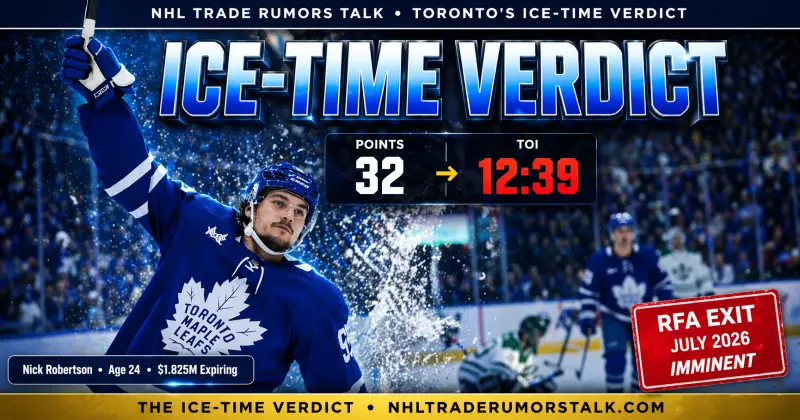
The Nick Robertson trade 2026 picture: career-high 32 points in 78 games on just 12:39 of ice time per night. RFA status, prior trade request, failed Chinakhov swap — all reasons the Ice-Time Verdict forces a summer exit.
Live updates
No updates yet. Refreshing automatically.
The Nick Robertson trade 2026 arithmetic is finally simple. Career-high 32 points in 78 games. Just 12:39 per night in ice time. A second trade request already on file. And an RFA deadline that gives Toronto's new GM one pressure point to solve the standoff.
Robertson's exit is what I'm calling the Ice-Time Verdict — the tacit team answer delivered through deployment minutes before any words get spoken. Anaheim, Pittsburgh, and Seattle all fit the return profile. My projection: Robertson moves by July 15 for a third-line center or a B-level prospect plus a mid-round pick.
The Nick Robertson trade 2026 picture crystallized the moment he told Toronto reporters he wouldn't commit to re-signing — 24 years old, a career-high 32 points in 78 games this season, an average of just 12:39 of ice time per night, and a $1.825 million expiring contract that makes him one of the cheapest RFAs on the Maple Leafs' 2026 summer ledger. His message to the new regime wasn't subtle.
He's been asked to wait his turn through Sheldon Keefe. He waited through Craig Berube. He filed a formal trade request in July 2024 that Brad Treliving rejected. Now Treliving is gone, Toronto missed the playoffs at 32-31-13 for the first time since 2016-17, and Robertson has run out of reasons to keep waiting.
Here's the mechanism at work: Robertson is a restricted free agent, which means Toronto holds his signing rights as long as they tender a qualifying offer by the late-June deadline. If they qualify him, he can file for salary arbitration (as he did in August 2025 before settling at $1.825 million) or wait for offer sheets. If they decline to qualify, he walks as an unrestricted free agent. The RFA exit ramp exists in the gap between those two decisions — and Robertson's refusal to commit is him telling the new GM to pick one.
My read: Toronto already tried and failed to move him once this season, offering Robertson to Columbus for Yegor Chinakhov before the Blue Jackets took Pittsburgh's better package instead. That failed swap is the single most important piece of context for everything that happens next. If Robertson's market value couldn't unlock a skilled CBJ winger in October, it won't unlock one in July either — which means the new Leafs GM is choosing between a third-line center return, a prospect-plus-pick return, or losing him for nothing.
Key Takeaways
- The Ice-Time Verdict: Robertson produced a career-high 32 points on a 12:39 TOI workload — a roughly 1.95 points-per-60 rate that qualifies as top-six production in bottom-six minutes. The deployment gap is his case for an exit.
- RFA status: Robertson's one-year $1.825 million contract expires July 1, 2026. Toronto must tender a qualifying offer by the late-June deadline or he walks as a UFA — one decision with four possible outcomes.
- Prior trade request: Robertson formally requested a trade in July 2024, held out of training camp, and eventually signed the current deal. This April 2026 non-commitment is functionally his second trade request in under two years.
- Failed Chinakhov swap: Toronto offered Robertson to Columbus in 2025-26 for Yegor Chinakhov. The Blue Jackets declined and sent Chinakhov to Pittsburgh for Danton Heinen, a 2026 second, and a 2027 third. That sets Robertson's market ceiling.
- Destination fit: Anaheim, Pittsburgh, and Seattle all make roster-fit sense. Pittsburgh has $47 million in cap space and draft capital; Seattle needs secondary scoring; Anaheim gets a California player on a cheap contract with secondary-scoring potential.
Nick Robertson Trade 2026 Math — The Ice-Time Verdict Explained
Look at the numbers two different ways. Robertson's raw line — 16 goals, 16 assists, 32 points in 78 games — places him ninth on Toronto's scoring leaderboard on a team that missed the postseason. That's unremarkable in isolation. The context flips it.
Divide 32 points by Robertson's total ice time (roughly 987 minutes at 12:39 per game × 78 games) and convert to a per-60 rate. The math comes out to approximately 1.95 points per 60 minutes of ice time. For reference, the NHL's top-six forward production threshold sits around 2.0 points per 60 at 5-on-5 — Robertson played at that rate while being deployed as a fourth-liner on most nights.
That's the Ice-Time Verdict. The Subtraction Spiral I mapped for Toronto's season explains the backdrop — the Marner sign-and-trade departure July 1 forced the coaching staff to redistribute power-play and top-six minutes among a narrower group. Robertson wasn't in that group. His 12:39 average was functionally identical to his 2024-25 deployment (12:51) despite a bigger point total, confirming the deployment wasn't about performance.
The Ice-Time Verdict
The Ice-Time Verdict is the tacit team answer delivered to a player through deployment minutes before any words get spoken. When a player produces at a top-six rate but gets bottom-six minutes over multiple seasons, the verdict has been rendered — the team isn't projecting them into an expanded role regardless of output. For an RFA, that verdict becomes the pressure point that forces a trade.
What's telling is Berube's usage pattern. Robertson's ice time under the new coaching staff climbed during Berube's first weeks, then receded to the 11-13 minute range through mid-season. The Cassidy-style structural coaching I've written about elsewhere emphasizes role clarity over experimentation — and Robertson's role clarity in Berube's system was fourth-line minutes with occasional power-play duty.
Why the Chinakhov Trade Failed — And What It Tells Us About Robertson's Market
The unreported story of Toronto's 2025-26 season is that general manager Brad Treliving actually tried to execute what Robertson wanted. Multiple outlets reported in early 2025-26 that the Maple Leafs shopped Robertson to the Columbus Blue Jackets in a one-for-one swap for Yegor Chinakhov, a skilled 24-year-old Russian winger. Columbus declined.
"The Leafs discussed a Nick Robertson for Yegor Chinakhov swap with the Blue Jackets, but their offers fell short."
— Pro Hockey Rumors (via Pro Hockey Rumors)That quote matters because it defines the market ceiling. Chinakhov had career numbers similar to Robertson's (mid-teens goal scorer, top-nine winger) but with two structural advantages: a 6'1" frame versus Robertson's 5'9", and two years of term remaining on his contract versus Robertson's expiring deal. Columbus eventually traded Chinakhov to Pittsburgh for Danton Heinen, a 2026 second-round pick, and a 2027 third-round pick.
That's the reference price. The Chinakhov-Penguins context explains why Columbus preferred the Pittsburgh package — NHL-rosterable veteran plus two mid-round picks beats an expiring RFA with height concerns. Robertson's market ceiling in July won't be a one-for-one for Chinakhov-caliber talent. It'll be a third-line center, or a pick-plus-prospect package similar to what CBJ extracted from Pittsburgh.
What stands out to me is that the Leafs' failed offer happened BEFORE Treliving was fired on March 30. The new regime walks into the summer knowing the previous GM tried and couldn't make the Robertson trade work at any price point Columbus would accept. That's useful information for any incoming GM — it means the realistic market for Robertson is sub-Chinakhov, not equivalent.
The RFA Exit Ramp — Three Destinations That Actually Fit
Multiple outlets have mapped Robertson's potential landing spots. After crossing them against roster fit, cap situation, and return-profile realism, three destinations survive the filter. Here's the breakdown.
| Destination | Cap Space | Roster Fit | Probable Return (TOR receives) |
|---|---|---|---|
| Pittsburgh Penguins | $47M projected 2026-27 | Secondary scoring alongside Crosby-era core | B-level prospect + 2027 3rd |
| Anaheim Ducks | Moderate — rebuild flexibility | California native, cheap RFA, bottom-six upside | Middle-six forward depth or mid-round pick |
| Seattle Kraken | Moderate post-Stephenson | Top-nine winger slot, versatility match | Secondary pick + depth roster player |
| Ottawa Senators | Tight — contending phase | RFA rights hoarding, limited immediate role | Would demand discount — unlikely fit |
Pittsburgh is the cleanest fit. Kyle Dubas drafted Robertson in Toronto (2019, 53rd overall) and publicly backed his development trajectory during his Toronto tenure. The Penguins just completed their own secondary-scoring acquisition cycle, but Robertson slots into an entirely different role — bottom-six energy scorer with power-play second-unit minutes, cost-controlled through an RFA negotiation with the GM who already knows him. The Bobrovsky pay-cut extension framework I've used before applies here — veteran franchises signing cheap productive role players is how contenders stay competitive.
Anaheim fits for a different reason: Robertson is a California native from Arcadia, the Ducks organization prizes "doing right by the player" narrative signals, and bottom-six secondary scoring is exactly what their forward group needs heading into 2026-27. An Anaheim move also gives Robertson an expanded role guarantee — the Ducks have the depth chart opening to play him 16-plus minutes per night, which is the deployment floor he couldn't extract from Toronto.
Seattle's case rhymes with the Bobby McMann analysis I built for their roster — the Kraken are perpetually hunting for mid-cost secondary forwards on second contracts. Robertson's $2-3 million projected second contract fits their cap architecture, and their top-nine has one natural opening if Jaden Schwartz or Eeli Tolvanen moves this summer.
Why Ottawa Isn't the Fit Everyone Thinks It Is
The Ottawa Senators get mentioned in Robertson speculation because of cap flexibility and the "young team on the rise" narrative. I don't buy it. Ottawa's top-six is fully constructed around Tim Stutzle, Brady Tkachuk, Drake Batherson, Dylan Cozens, and Claude Giroux — there's no daylight for Robertson to crack anything above 14:00 per night, which replicates his Toronto problem at a different address.
Ottawa also doesn't have the prospect depth to make a pure hockey trade work, meaning the return would have to include a pick Toronto's new GM won't want to deliver for a non-elite RFA. The destination fails on both the player side (no expanded role) and the trade-structure side (return too thin). That's why it keeps showing up on lists and never in actual reporting.
The Qualifying Question — Will Toronto Actually Tender an Offer?
The operational question no one is asking clearly: does Toronto's new GM even QUALIFY Robertson by the June deadline? Qualifying requires extending at least 100 percent of his $1.825 million cap hit, which preserves Toronto's negotiation rights but locks in a floor.
If they don't qualify, Robertson walks as a UFA on July 1 and Toronto gets nothing. That's the worst outcome — zero asset return on a 24-year-old with NHL term. Every incoming GM prioritizes qualifying first and sorting the trade market second. My projection: the new GM qualifies Robertson before June 25, then works the trade market aggressively through the July 1 opening.
The trade window runs roughly July 1 through the NHL Scouting Combine follow-up conversations in Buffalo. The Maple Leafs GM search overcorrection cycle I wrote about previously matters here — if Keith Pelley's new hire is a rebuild-oriented executive rather than a retool-oriented one, Robertson gets traded faster because his expiring RFA status makes him a lower-priority asset to ship out for future capital. The Matthew Knies deadline situation also frames the negotiating environment Toronto enters the summer with.
"It's very likely that Robertson is going to ask for a trade this summer, and with a retool needed more than ever, don't be surprised to see Robertson moved for a third-line center."
— NHL Trade Rumors reporting (via NHL Trade Rumors)That third-line center framing captures the realistic return ceiling. Robertson's not extracting a top-nine forward in trade because his market profile — RFA, 5'9", bottom-six deployment, injury history including knee, leg, and shoulder surgery — caps what contenders will pay. A fourth-line-plus center who can take defensive-zone draws is the rational exchange.
Historical Precedent — The Franz Nielsen Path
The closest historical parallel isn't an RFA exit; it's the 2016 Frans Nielsen situation in New York. Nielsen was an expiring UFA center who spent years in an underused role under Jack Capuano, accumulated strong per-60 analytics, and ultimately walked to Detroit via free agency for six years and $31.5 million — a number the Islanders could have acquired talent for via trade if they'd engaged the market earlier.
Robertson's situation differs in that he's RFA, not UFA, so Toronto retains negotiating rights. But the pattern rhymes: a player whose per-minute production exceeds their deployment eventually forces the team's hand. The Islanders lost Nielsen for nothing. Toronto can still extract value here, but only if the new GM moves fast.
The Prediction — How This Ends
My projection: Toronto qualifies Robertson before the June 25 deadline to preserve trade rights. The new GM opens conversations with Pittsburgh, Anaheim, and Seattle at the NHL Scouting Combine. A deal closes between July 1 and July 15, with Robertson moving to either Pittsburgh or Anaheim for a third-line center or a B-level prospect plus a 2027 mid-round pick.
Pittsburgh is my 40 percent favorite because of the Dubas familiarity, cap space, and draft-pick depth. Anaheim sits at 30 percent because of the California fit and roster-need alignment. Seattle is 15 percent, with other destinations combined at 15 percent.
The one scenario I find unlikely is Robertson playing another season in Toronto. Both sides have signaled it's over, and an incoming GM won't want the distraction of a third consecutive trade-request cycle heading into 2026-27.
Sources and Reporting
- NHL.com — Toronto's 2025-26 elimination and Marner departure context
- PuckPedia — Robertson contract, $1.825M AAV, RFA status confirmation
- Wikipedia — Career history, injury timeline, 2019 draft (53rd overall) details
- Maple Leafs Hot Stove — Summer 2024 trade request and RFA standoff reporting
- Pro Hockey Rumors — Brad Treliving firing on March 30, 2026
- PensBurgh — Near-miss Robertson-for-Chinakhov trade attempt
- NHL.com — Chinakhov Trade — Full Pittsburgh acquisition details setting market reference price
- The Leafs Nation — Analysis of Pittsburgh, Anaheim, and Seattle as Robertson destinations
- The Hockey Writers — Robertson injury history and development trajectory
The Verdict: The Ice-Time Verdict
The Nick Robertson trade 2026 is happening because Toronto already delivered the verdict in deployment minutes — 12:39 per night over three head coaches, two general managers, and one career-high season. When a player produces at 1.95 points per 60 in bottom-six minutes across multiple seasons, he has a case. When that player also has a trade request on file and refuses to commit to re-signing in public, the case becomes a demand.
My projection stays at Pittsburgh in a deal that closes between July 1 and July 15, with Toronto receiving a third-line center or a B-level prospect plus a mid-round pick. Whoever Keith Pelley hires as GM inherits exactly one job here — qualify Robertson, then move him before training camp. The Ice-Time Verdict isn't reversible in Toronto.
Frequently Asked Questions
Will the Maple Leafs trade Nick Robertson this summer?
Very likely. Robertson publicly declined to commit to re-signing, filed a formal trade request in summer 2024, and Toronto already attempted to move him for Yegor Chinakhov in 2025-26 before Columbus declined. With Brad Treliving fired and the roster heading into retool mode, trading Robertson before training camp is the expected outcome. The realistic timeline is between July 1 (free agency opens) and July 20, 2026.
What is Nick Robertson's current contract status?
Robertson signed a one-year, $1.825 million deal with Toronto in August 2025 after filing for salary arbitration. That contract expires on July 1, 2026, making him a restricted free agent. Toronto must tender a qualifying offer by the late-June RFA deadline to retain his signing rights. If they don't qualify, he becomes an unrestricted free agent.
How old is Nick Robertson and where was he drafted?
Robertson is 24 years old, born September 11, 2001 in Arcadia, California. Toronto selected him 53rd overall in the second round of the 2019 NHL Entry Draft. He made his NHL debut during the 2020 Stanley Cup playoffs as the youngest player on all NHL rosters at the time — a debut that was followed by three serious injuries (knee, leg, and shoulder surgery) that limited his development through 2022-23.
Why didn't the Chinakhov trade happen?
Columbus rejected Toronto's offer of Robertson for Chinakhov because the Blue Jackets valued Chinakhov's height (6'1" versus Robertson's 5'9") and remaining contract term over a same-profile swap. Columbus instead accepted Pittsburgh's package of Danton Heinen, a 2026 second-round pick, and a 2027 third-round pick. That return sets the market reference for any future Robertson trade.
Which teams are best-fit destinations for Robertson?
Pittsburgh, Anaheim, and Seattle are the realistic fits. Pittsburgh offers $47 million in 2026-27 cap space plus Kyle Dubas familiarity. Anaheim offers a California native a top-nine role with expanded ice time, and Seattle needs secondary scoring at cap-efficient second-contract prices.
Frequently Asked Questions
Will the Maple Leafs trade Nick Robertson this summer?
Very likely. Robertson publicly declined to commit to re-signing, filed a formal trade request in summer 2024, and Toronto already attempted to move him for Yegor Chinakhov in 2025-26 before Columbus declined. With Brad Treliving fired and the roster heading into retool mode, trading Robertson before training camp is the expected outcome. The realistic timeline is between July 1 (free agency opens) and July 20, 2026.
What is Nick Robertson's current contract status?
Robertson signed a one-year, $1.825 million deal with Toronto in August 2025 after filing for salary arbitration. That contract expires on July 1, 2026, making him a restricted free agent. Toronto must tender a qualifying offer by the late-June RFA deadline to retain his signing rights. If they don't qualify, he becomes an unrestricted free agent.
How old is Nick Robertson and where was he drafted?
Robertson is 24 years old, born September 11, 2001 in Arcadia, California. Toronto selected him 53rd overall in the second round of the 2019 NHL Entry Draft. He made his NHL debut during the 2020 Stanley Cup playoffs as the youngest player on all NHL rosters at the time — a debut that was followed by three serious injuries (knee, leg, and shoulder surgery) that limited his development through 2022-23.
Why didn't the Chinakhov trade happen?
Columbus rejected Toronto's offer of Robertson for Chinakhov because the Blue Jackets valued Chinakhov's height (6'1" versus Robertson's 5'9") and remaining contract term over a same-profile swap. Columbus instead accepted Pittsburgh's package of Danton Heinen, a 2026 second-round pick, and a 2027 third-round pick. That return sets the market reference for any future Robertson trade.
Which teams are best-fit destinations for Robertson?
Pittsburgh, Anaheim, and Seattle are the realistic fits. Pittsburgh offers $47 million in 2026-27 cap space plus Kyle Dubas familiarity. Anaheim offers a California native a top-nine role with expanded ice time, and Seattle needs secondary scoring at cap-efficient second-contract prices.
Related Stories

Darnell Nurse Trade: 4 Suitors
Edmonton wants Darnell Nurse's $9.25M off the books, but a buyout saves barely $1.53M and his no-move clause hands him the pen. The Bonus Sh...
By Mike Johnson · 12 min read
Darren Raddysh Free Agent 2026: 4 Teams
Darren Raddysh's 70-point breakout turned his $975K cap hit into a four-team bidding war. The Athletic linked him to Philadelphia, San Jose,...
By Mike Johnson · 13 min read
Bobby McMann Free Agent 2026 Destinations: 4 Teams Linked
Bobby McMann's career-high 29 goals just turned a $1.35M cap hit into Sharangovich-tier money. The Athletic locked him to 4 teams (Detroit,...
By Mike Johnson · 10 min read
Hellebuyck Trade Rumors 2026: The Vulture Watch Begins
Connor Hellebuyck is still under contract — but rivals circle as Winnipeg's window narrows.
By Sarah Chen · 1 min read
Get NHL trade rumors in your inbox
One email per week. Zero spam. Verified rumors only.