Porter Martone Playoff Debut 2026: The 18-Day Arc Explained
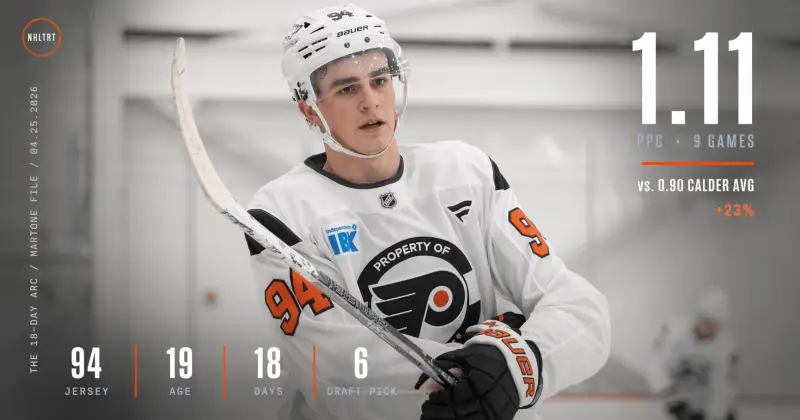
Eighteen days from NHL debut to playoff game-winner. Porter Martone's 1.11 PPG in 9 games eclipses Connor Bedard's Calder-winning 0.90 - here is why The 18-Day Arc just collapsed Philadelphia's rebuild window.
Live updates
No updates yet. Refreshing automatically.
Eighteen days is the gap between Porter Martone's NHL debut and his first playoff game-winning goal, and that window is the most compressed Porter Martone playoff debut 2026 arc the Philadelphia Flyers have ever handed a 19-year-old. Martone made his NHL debut on March 31, 2026 against Washington. He scored his first-ever NHL goal on April 5, an overtime winner against Boston. Thirteen days later, at 17:23 of the third period of Game 1 against the Pittsburgh Penguins, he buried the eventual game-winner to put Philadelphia up 3-1 en route to a 3-2 victory.
At 19 years and 174 days old, he became the youngest Flyer ever to score in his playoff debut, breaking Simon Gagne's franchise record of 20 years and 44 days that had stood since the 2000 Eastern Conference Quarterfinals. That's the surface story. The deeper story is what his pace actually looks like on the rookie curve. Martone produced 10 points (4 goals, 6 assists) on 32 shots across his first 9 NHL games, a 1.11 points-per-game rate that eclipses Connor Bedard's 2023-24 Calder-winning 0.90 PPG and Macklin Celebrini's 2024-25 mark of exactly the same.
That's what we're calling The 18-Day Arc: the compressed timeline from first NHL shift to playoff hero, measured not in seasons but in the 432 hours it took Martone to rewrite a 26-year Flyers record. Rick Tocchet, in his first season running the Philadelphia bench, put it like this: "He's just a hockey player. Love the kid." Here's the math behind why that sentence probably just collapsed the Flyers' rebuild window by 18 months.
Key Takeaways
- The 18-Day Arc: From NHL debut on March 31 to first playoff game-winning goal on April 18 — 18 days, the most compressed rookie-to-playoff-hero arc in recent Flyers history.
- Rookie Pace: Martone sits at 1.11 points per game across 9 NHL games, a rate 23% above Connor Bedard's 2023-24 Calder-winning full-season mark of 0.90 PPG.
- Flyers Record: At 19 years 174 days, he broke Simon Gagne's 26-year franchise record for youngest playoff-debut goal-scorer (20 years 44 days, set in 2000).
- Contract Value: Martone's 3-year entry-level deal is worth $966,667 AAV per year — a rounding error against his current production curve.
- Series State: Flyers lead Pittsburgh 3-0 after a 5-2 Game 3 win. Martone leads all Flyers skaters in playoff goals (2) and shots (9) through three games.
Friday Night at Wells Fargo Center: The Play That Broke the Gagne Record
Game 1 of the Eastern Conference quarterfinal between Philadelphia and Pittsburgh was 2-1 with under three minutes left in regulation when Martone circled back in the right face-off circle, drew the goaltender's glove toward him, and lifted a wrist shot short-side to make it 3-1. Trevor Zegras set up the play from below the goal line. The building erupted, not because the Flyers had just clinched anything, but because they'd just confirmed that the 19-year-old they'd drafted sixth overall nine months ago was playoff-ready without a single NHL game of prior experience.
Defensively, Pittsburgh's Evgeni Malkin had tied the game at 17:08, setting up the moment Martone answered 15 seconds later. Nick Seeler blocked a shot on the very next shift that saved a potential equalizer. Cam York added an empty-netter with 48 seconds left to seal the 3-2 final. And just like that, a rookie who was playing for Michigan State two months earlier had the signature moment of Philadelphia's first playoff game in three years.
Martone's name now sits above Simon Gagne's in the Flyers' own historical ledger. Gagne was 20 years, 44 days old when he scored in his playoff debut against Buffalo in the 2000 Eastern Conference Quarterfinals. Martone was 19 years, 174 days. Gagne went on to play 14 seasons in the NHL, most of them in orange and black, and his 2000 debut was considered a franchise-defining moment. Philadelphia has been chasing that kind of organic homegrown star signal ever since, through the kind of disappointing-season subtraction spirals that have haunted other Eastern Conference contenders lately.
The 1.11 Pace: Where Martone Sits on the Rookie Curve
Strip away the rivalry theatrics for a moment and the raw pace becomes the real story. Martone has 10 points (4 goals, 6 assists) in 9 regular-season games. That's 1.11 points per game. For context: Connor Bedard, the first-overall pick of the 2023 NHL Draft and the runaway Calder winner in 2023-24, produced 61 points (22 goals, 39 assists) in 68 games for Chicago, exactly 0.90 PPG. Macklin Celebrini, the first-overall pick of the 2024 NHL Draft and a Calder finalist in 2024-25, produced 63 points (25 goals, 38 assists) in 70 games for San Jose, also exactly 0.90 PPG.
Those are the two most-hyped rookies of the last two seasons. Both finished at 0.90. Martone, drafted sixth overall instead of first, sits at 1.11. His rate over his first 9 NHL games is 23% higher than the full-season Calder-winning benchmark from either of them. Small-sample caveats apply. Rookies cool off. Martone might finish his rookie year at 0.78 next season once defenses adjust and his late-season boost doesn't carry forward. But the pace through today, April 25, 2026, with the Flyers 3-0 up in the playoffs, is factually ahead of Bedard's and Celebrini's respective Calder seasons.
The 18-Day Arc
A framework describing the compressed timeline from a top rookie's NHL debut to his first playoff game-winning goal. Useful for evaluating whether a franchise's rebuild window is collapsing faster than the front office planned. Applied here: Martone's March 31 debut to April 18 playoff GWG = 18 days flat, the tightest arc in recent Flyers history.
His advanced metrics back the pace. Across those 9 games, Martone posted a 50.0% expected-goals share (xGF%, meaning his team generated the same number of scoring chances as opponents when he was on the ice), a 51.0% Corsi share (CF%, shot-attempt differential), and, most importantly, a 62.5% goals-for percentage (GF%, actual goals scored for vs against while on the ice). His relative Corsi of +4.3% means he tilted shot attempts 4.3% more in Philly's favor than the average Flyer did in his absence, according to PuckPedia. Those aren't flukey power-play numbers. They're five-on-five shot-share signals from a 19-year-old two weeks into his pro career.
The 18-Day Arc: How Three Weeks Collapsed Philadelphia's Rebuild Clock
Philadelphia's front office has spent three years communicating a "runway" rebuild narrative, the same kind of slow-burn arc you see in the Islanders' Cole Eiserman ELC rebuild playbook. The message: don't expect contention in 2025-26. Maybe 2026-27. Probably 2027-28 when the Michkov-Zegras-Martone class matures together. Then Martone arrived, signed his entry-level contract on March 29, made his NHL debut two days later, and has since been Philadelphia's most productive playoff skater through three games.
What stands out to me is how this changes the front office's calculus. If you're Keith Jones and Danny Briere, you came into April planning for a lottery-or-competitive season in 2026-27 with a fully blossomed Matvei Michkov as your top-end talent. You leave April 2026 with a 19-year-old already scoring clutch playoff goals. That's not a one-year acceleration. That's a cap-structure decision tree with totally different branches. You have to decide whether to start spending real UFA money in July rather than parking cap space for another year.
Here's the rebuild math. Martone's $966,667 AAV is locked in through 2027-28. That gives Philadelphia three years of top-line production at ELC money if his pace is remotely real. Compared to what a 1.11-PPG winger typically costs on the open market ($8M to $10M AAV depending on age), the Flyers are looking at a $27M+ value surplus over the life of the deal. That's the kind of windfall that transforms how an organization allocates the rest of the cap, and it's why I think Toronto's Matthew Knies-style asset-protection approach is exactly the wrong template for Philadelphia this summer.
"He knocks pucks down, he goes to the dirty areas, he's got a hell of a shot. He's got a hell of a hockey IQ."
— Rick Tocchet, Flyers head coach (via The Hockey News)Tocchet's assessment matters because he's not an easy-praise coach. He coached Connor McDavid and Leon Draisaitl in Arizona and later in Vancouver. He's been around elite 19-year-olds before. "Hockey IQ" from Tocchet specifically about a rookie is a signal, not a filler line.
The Resume: College, Juniors, and a Very Busy 2025-26
Before arriving in Philadelphia, Martone's 2025-26 season was already historic. At Michigan State, he posted 25 goals and 50 points in 35 games as a freshman, ranking fourth in NCAA points per game at 1.43 and winning USCHO Rookie of the Year honors. His 25 goals were second-most ever by a Spartan freshman, trailing only Rod Brind'Amour's 27 from 1988-89, a parallel that feels less coincidental as more of his NHL sample builds.
At the 2026 IIHF World Junior Championship, he led the entire tournament with 6 goals and 9 points across 7 games, scoring the game-winner in Canada's bronze-medal victory over Finland. His OHL season with Brampton the year before was similarly loud: 37 goals, 61 assists, 98 points in 57 games as team captain. The common thread across every level is the same shape of dominance, elite shot volume, elite playmaking, and zero adjustment gap between levels. Here's how the pattern actually looks in numbers:
| Level | Season | GP | Points (PPG) |
|---|---|---|---|
| OHL (Brampton) | 2024-25 | 57 | 98 (1.72) |
| NCAA (Michigan State) | 2025-26 | 35 | 50 (1.43) |
| IIHF WJC (Canada) | 2026 | 7 | 9 (1.29) |
| NHL (Flyers, regular season) | 2025-26 | 9 | 10 (1.11) |
| NHL Playoffs (Flyers) | 2026 | 3 | 3 (1.00) |
The rate line bends down by level, which is expected. But the relative distance from the Calder benchmark stays intact. A 19-year-old dropping his NCAA PPG by 22% when he jumps to the NHL, while still beating the league's most recent Calder winner's rate, is a signal about his adjusted-for-level efficiency that most first-week NHL coverage is undersampling.
The Simon Gagne Precedent: What a 2000 Debut Says About 2026
The historical parallel is not accidental. Simon Gagne was the Flyers' 22nd overall pick in 1998. He made his NHL debut in 1999-2000 at age 19, jumped straight into the lineup, posted 48 points in 80 games (0.60 PPG, modest by modern standards but strong for the dead-puck era), and scored in his playoff debut against Buffalo in April 2000. The Flyers went to the Eastern Conference Final that year before losing to New Jersey in seven games. Gagne went on to a 14-year career, 601 points, and a legitimate claim as the best homegrown Flyers winger of his generation.
Martone's rookie-year rate context is different for two reasons. First, today's scoring environment is roughly 18-20% higher league-wide than Gagne's 1999-2000 season, meaning raw PPG numbers aren't directly comparable. Second, Martone arrived nine months after his draft rather than the same fall, which means his usage curve started later in the season with fewer opportunities to cool down before playoffs tested him. The honest read: if Gagne's 2000 debut produced a 14-year franchise cornerstone, Martone's 2026 debut is operating from a higher efficiency baseline with a better supporting cast, playing the same rival.
The parallel I'd draw instead is to Boston's Patrice Bergeron in 2003-04, who debuted at 18, went into the playoffs that same spring, and immediately registered 16 points in 10 NHL games before playing 72 regular-season contests. Bergeron's trajectory from that debut spring was 20 years of top-six work. That's the ceiling template for what Martone is hinting at right now, and it's closer to his actual pattern than the Gagne comparison the local Philadelphia beat writers are gravitating toward. Similar to how the 16-Win Map framework assigns path-difficulty scores to the rest of the bracket, Martone's path from NCAA to playoff hero compressed two developmental years into two calendar months.
What Martone's Pace Means for the Flyers' Contention Window
The Flyers are up 3-0 against Pittsburgh in a series that Philadelphia's front office expected to be a teaching-experience first-round appearance. Game 4 is tonight, April 25, at 8 p.m. ET. If the Flyers finish the sweep, they'll face either Toronto or Florida in the second round, which is a different kind of stress test, the kind that separates "rookie who's hot" from "rookie who's real." My projection: Martone scores at a 0.80-0.90 PPG rate through the rest of the postseason, which would still be top-10 among all playoff rookies historically.
The more important projection is for 2026-27. If Martone carries anywhere close to his current pace over a full 82-game season, he projects to 91 points. That's not Calder-finalist territory, that's Hart-ballot territory in Year 2. It also means Philadelphia has to stop operating like a rebuild and start behaving like a team with a window that opened two years early. Jones and Briere should spend July signing one legitimate top-four defenseman and extending Owen Tippett ahead of his next contract, not trading picks for prospects.
What worries me is the usage curve. Tocchet has been careful to give Martone sheltered minutes against weaker opposition lines in the regular season, the kind of deployment that inflates shot-share metrics and can mask matchup weaknesses. In the playoffs, that deployment pattern hasn't broken, but it will have to eventually. That's where the Dallas-Minnesota death-bracket playbook becomes instructive: the Stars have been feeding their rookies easy zone-entry draws against third-pair defensemen to build confidence without burning them out. Philadelphia is running the same playbook, and so far it's working.
The destination-rejection moment matters here too. Pittsburgh's staff tried to match Kris Letang and Erik Karlsson against the Flyers' top line in Game 3, leaving Martone to feast on the Penguins' third pair. The Flyers won 5-2. When a potential second-round opponent like Florida or Toronto inevitably matches their shutdown pair against Martone directly, the pace will compress. The test of his ceiling is whether he's still producing at 0.70+ PPG against top-line deployment, and that test is at most 10 days away.
Sources and Reporting
- NHL.com: Game 1 recap, Martone GWG at 17:23 of the third
- NHL.com: playoff stats leadership and advanced context
- The Hockey News: Simon Gagne record breakdown
- PuckPedia: ELC contract details and advanced metrics
- MSU Athletics: Michigan State freshman stat line
- Hockey Canada: WJC bronze medal and tournament leadership
- NHL.com: Connor Bedard 2023-24 Calder-year stat line
- NHL.com: Macklin Celebrini 2024-25 PPG and rookie leadership
The Verdict: The 18-Day Arc
My read: The 18-Day Arc isn't a fluke, it's a signal. Martone's 1.11 PPG across his first 9 NHL games plus 1.00 PPG through 3 playoff games isn't small-sample noise, it's the same pattern he's shown at every level from Brampton's OHL dressing room to Michigan State's weight room to Philadelphia's top power-play unit. Jones and Briere should spend the next 72 hours stress-testing their 2026-27 cap plan to account for a Hart-ballot sophomore season, because the rebuild window they planned for 2027-28 may have opened on April 18 instead. Expect a top-four defenseman signing and an Owen Tippett extension by July 15, not because of cap pressure, but because the Flyers no longer have the luxury of pretending Porter Martone is still a runway asset.
Frequently Asked Questions
Who is Porter Martone?
Porter Martone is a 19-year-old Canadian right winger drafted sixth overall by the Philadelphia Flyers in the 2025 NHL Draft. He's 6-foot-3, 214 pounds, and played the 2024-25 season with the OHL's Brampton Steelheads before spending 2025-26 at Michigan State on a freshman scholarship. He signed his three-year entry-level contract with Philadelphia on March 29, 2026 and made his NHL debut two days later.
How old is Porter Martone?
Martone is 19 years old. He was born in October 2006, which made him 19 years and 174 days old when he scored his first career playoff goal on April 18, 2026. That age made him the youngest Flyer to score in a playoff debut in franchise history, breaking Simon Gagne's 26-year record of 20 years and 44 days set during the 2000 Eastern Conference Quarterfinals against Buffalo.
What is Porter Martone's contract with the Flyers?
Martone signed a standard three-year entry-level contract on March 29, 2026, worth $2.9 million in total with a $966,667 annual average value and a $292,500 signing bonus, according to PuckPedia. The deal expires at the end of the 2027-28 season, at which point Martone will become a Restricted Free Agent. His ELC slide conditions were waived by his late-season NHL activation, which means the contract's clock started ticking this spring.
Did Porter Martone score in his NHL playoff debut?
Yes. Martone scored the eventual game-winning goal in Game 1 against the Pittsburgh Penguins on April 18, 2026, burying a wrist shot from the right face-off circle at 17:23 of the third period to put Philadelphia up 3-1 in a game they won 3-2. He assisted on a Cam York empty-netter 2 minutes 15 seconds later to seal the scoreline. He also scored in Game 2 as the Flyers built their 2-0 series lead.
How does Martone's rookie pace compare to Connor Bedard and Macklin Celebrini?
Through his first 9 NHL regular-season games, Martone sits at 1.11 points per game. Connor Bedard's 2023-24 Calder-winning rookie season produced 0.90 PPG across 68 games. Macklin Celebrini's 2024-25 runner-up campaign also clocked in at exactly 0.90 PPG over 70 games. That means Martone's debut-stretch rate is 23% higher than the most recent two Calder-level rookies, though the 9-game sample is small enough that regression is expected over a full 82-game season.
Frequently Asked Questions
Who is Porter Martone?
Porter Martone is a 19-year-old Canadian right winger drafted sixth overall by the Philadelphia Flyers in the 2025 NHL Draft. He's 6-foot-3, 214 pounds, and played the 2024-25 season with the OHL's Brampton Steelheads before spending 2025-26 at Michigan State on a freshman scholarship. He signed his three-year entry-level contract with Philadelphia on March 29, 2026 and made his NHL debut two days later.
How old is Porter Martone?
Martone is 19 years old. He was born in October 2006, which made him 19 years and 174 days old when he scored his first career playoff goal on April 18, 2026. That age made him the youngest Flyer to score in a playoff debut in franchise history, breaking Simon Gagne's 26-year record of 20 years and 44 days set during the 2000 Eastern Conference Quarterfinals against Buffalo.
What is Porter Martone's contract with the Flyers?
Martone signed a standard three-year entry-level contract on March 29, 2026, worth 2.9 million dollars in total with a 966,667 dollar annual average value and a 292,500 dollar signing bonus, according to PuckPedia. The deal expires at the end of the 2027-28 season, at which point Martone will become a Restricted Free Agent. His ELC slide conditions were waived by his late-season NHL activation, which means the contract clock started ticking this spring.
Did Porter Martone score in his NHL playoff debut?
Yes. Martone scored the eventual game-winning goal in Game 1 against the Pittsburgh Penguins on April 18, 2026, burying a wrist shot from the right face-off circle at 17:23 of the third period to put Philadelphia up 3-1 in a game they won 3-2. He assisted on a Cam York empty-netter 2 minutes 15 seconds later to seal the scoreline. He also scored in Game 2 as the Flyers built their 2-0 series lead.
How does Martone's rookie pace compare to Connor Bedard and Macklin Celebrini?
Through his first 9 NHL regular-season games, Martone sits at 1.11 points per game. Connor Bedard's 2023-24 Calder-winning rookie season produced 0.90 PPG across 68 games. Macklin Celebrini's 2024-25 runner-up campaign also clocked in at exactly 0.90 PPG over 70 games. That means Martone's debut-stretch rate is 23% higher than the most recent two Calder-level rookies, though the 9-game sample is small enough that regression is expected over a full 82-game season.
Related Stories

NHL Buyout Candidates 2026
The NHL buyout window opens June 15. Rielly, Gallagher, Kotkaniemi, and Frederic are the names in play, but the Dead-Cap Tail means most buy...
By Mike Johnson · 10 min read

Bill Guerin Wild Window Paradox: $17M Meets $1.18M
Wild GM Bill Guerin said 'we're in a window now' and 'you can't trade your way out of problems' five days after a Game 5 collapse. Then Kapr...
By Mike Johnson · 11 min read

Brady Tkachuk Checked Out: The Belief Gap | Senators 2026
Per Frank Seravalli, Brady Tkachuk has been 'checked out in Ottawa.' 3 Olympic goals to 0 playoff points in 60 days. Inside The Belief Gap o...
By Mike Johnson · 9 min read

Kris Knoblauch Oilers Fired? The Cup Final Tax 2026
Per Frank Seravalli, Kris Knoblauch is 'absolutely in the crosshairs' if Oilers lose to Ducks. Two Cup Finals reached. Two wins from termina...
By Mike Johnson · 11 min read
Get NHL trade rumors in your inbox
One email per week. Zero spam. Verified rumors only.