Rasmus Andersson Asking Price: The Calgary Delta Explained
Calgary opened at two first-round picks plus Easton Cowan for Rasmus Andersson. The final Vegas price was structurally different. The gap between them — the Asking Price Delta — reveals how selling GMs anchor markets and why Toronto walked.

Live updates
No updates yet. Refreshing automatically.
The Rasmus Andersson asking price Calgary opened with — two first-round picks plus Easton Cowan — was never going to land, and Darren Dreger's reveal is the final confirmation. Toronto walked. Vegas eventually paid a structurally different price: Zach Whitecloud, prospect Abram Wiebe, a 2027 first, and a conditional 2028 second.
The gap between what Conroy demanded and what he settled for is the Asking Price Delta — and it tells you more about the rental-defenseman market than either price alone.
Calgary's original Rasmus Andersson asking price was two first-round picks plus Easton Cowan, according to TSN's Darren Dreger — a demand that equated to roughly a top-15 prospect plus two years of draft capital for a 29-year-old defenseman on a rental contract with 50 percent salary retention on the table. The number Vegas eventually paid on January 18, 2026 — Zach Whitecloud, college defender Abram Wiebe, a 2027 first-round pick, and a conditional 2028 second — was structurally different and meaningfully less. The space between those two prices is what I'm calling the Asking Price Delta, and it explains almost everything about why this trade took eight weeks to close and why Toronto walked.
Dreger's confirmation matters because it anchors the public understanding of a negotiation that had been reported in fragments all season. When Elliotte Friedman said in December that Calgary's ask was "the equivalent of two first-round picks," the phrasing left room for interpretation. Now we know the actual demand included a specific name: Cowan, the 2023 first-round pick (28th overall) and 2025 Memorial Cup MVP who had become the most meaningful positive story of Toronto's 2025-26 campaign. That changes the math.
My read: Craig Conroy did not get his opening number, but he didn't lose this negotiation either. He extracted a structurally different return — an NHL defenseman on reasonable term plus a college prospect plus draft capital — that fit what Calgary actually needs in a rebuild. The Asking Price Delta is where rebuilding GMs reveal their second preference, and Conroy's second preference was more interesting than his first.
Key Takeaways
- The Asking Price Delta: Calgary opened at two first-round picks plus Easton Cowan and settled for one first (2027), a conditional 2028 second, Zach Whitecloud, and prospect Abram Wiebe — a materially different return.
- Why Toronto walked: Cowan had emerged as a 28-point rookie and 2025 Memorial Cup MVP on a Maple Leafs team with a collapsing prospect pool. Including him was a non-starter for Brad Treliving's successor.
- Vegas's actual cost: Andersson's $4.55 million cap hit is 50 percent retained by Calgary, meaning Vegas pays $2.275 million for a playoff rental — one of the cleanest retention structures of the deadline.
- Rental context: Andersson's contract expires July 2026. He joined a Vegas team that won the Pacific Division at 39-26-17 and drew a first-round matchup against the Utah Mammoth.
- Conditional upside: The 2028 second-rounder converts to a first-round pick if Vegas wins the Stanley Cup — a structure that pays Calgary more if Andersson delivers on the Cup run he was acquired to enable.
The Rasmus Andersson Asking Price Reveals the Market Calgary Thought Existed
Dreger's "two firsts plus Cowan" reveal isn't surprising in isolation. Rebuilding GMs routinely open negotiations with asks that function as anchors rather than final positions. What's surprising is how specific the Cowan request was, because including a named 2023 first-round pick turned a draft-capital conversation into a prospect-valuation conversation.
Cowan scored 96 points in 54 games during his 2023-24 OHL season with the London Knights. He captured a Memorial Cup MVP in 2025 with 39 points in 17 playoff games. In his rookie NHL season, he posted 11 goals and 17 assists across 65 games while averaging 14:38 of ice time — a bottom-six forward with middle-six upside on a team desperate for young identity.
Valuation gaps like this — Cowan-the-Memorial-Cup-MVP versus Cowan-the-rookie-averaging-under-15-minutes — are exactly the gray zones selling GMs exploit. Conroy framed Cowan as the former. Toronto valued him closer to the latter. Neither position is wrong — that's the point of asking prices.
The Asking Price Delta
The Asking Price Delta is the structural distance between a selling GM's opening demand and their eventual settlement price. It isn't a measure of failure — it's a measure of how much the seller was willing to alter the SHAPE of the return (more roster players, less prospect capital) to close a deal. Large deltas tell you the opening ask was ceiling-setting. Small deltas tell you the seller found their first preferred buyer.
The delta on Andersson was not small. Trading two firsts plus a named top-40 prospect is a fundamentally different return than trading one first plus a conditional second plus an NHL defenseman plus a college project. The Blues ran a similar ceiling-setting exercise with Robert Thomas, where the reported four-first asking price served as a framing device rather than a genuine settlement target.
Introducing the Asking Price Delta — And Why Conroy's Second Preference Was Smarter
Selling GMs get judged almost entirely on their settlement price. That's a mistake. The more interesting data is the SHAPE of what they accepted when the opening ask collapsed.
Conroy's opening ask (two firsts plus Cowan) was pure prospect and draft capital — the return structure of a traditional tear-it-down rebuild. His settlement return was hybrid. Whitecloud is a 29-year-old NHL defenseman with two years left at a $2.75 million cap hit — a roster player, not a future asset.
Wiebe is a 22-year-old left-shot blueliner from the University of North Dakota with 29 points in 40 games and a 6'3" frame. The 2027 first is standard draft capital, while the conditional 2028 second converting to a first if Vegas wins the Cup is the cleanest embedded upside a selling GM could design.
That hybrid shape tells me Conroy isn't running a pure tank. He took an NHL player back because Calgary needs rosterable bodies for 2026-27, not just picks. That's a different strategy than the Chicago model or the Buffalo model — it's closer to what the Flyers did with Ivan Provorov in 2023, where the return was built to keep the team functional rather than bottom-out the standings.
The historical precedent that rhymes best is Noah Hanifin's 2024 departure from Calgary. Conroy got Daniil Miromanov, a conditional first-rounder, and a 2026 second from Vegas in that deal. The blueprint is identical: one NHL defenseman, one prospect or pick, one draft-capital piece, one conditional. Conroy uses the same four-slot architecture every time he trades a veteran defenseman, which fits the broader Saddledome Exit Strategy I mapped at the start of the offseason.
That consistency is what makes the Asking Price Delta useful. If you know a GM's return architecture preference, you can read their opening ask as a ceiling and their settlement as the real market value of their structural preference. For Conroy's defensemen, the real market value is the Hanifin-Andersson hybrid template — not the two-firsts number he opens with.
Why Toronto Walked: The Cowan Problem
Brad Treliving was fired in March 2026, but the Andersson conversation happened while he was still Toronto's GM. Reports from Yardbarker and Toronto Hockey Daily consistently pointed to the same stumbling block: Treliving refused to move Cowan, and nobody inside Toronto's front office argued the point. There was no internal debate because there was no internal disagreement.
"I believe the Flames wanted two 1sts and Easton Cowan for Rasmus Andersson."
— Darren Dreger, TSN (via Toronto Hockey Daily)The refusal reads cleanly in retrospect. Cowan was one of only three meaningful prospect-to-NHL graduations in Toronto's last four drafts. Moving him for a 29-year-old UFA rental while the organization simultaneously needed to convince fans that the prospect pipeline wasn't empty would have been political suicide for a GM already on the hot seat — and the Maple Leafs GM search overcorrection cycle that followed Treliving's firing validates how acute that organizational pressure was.
Toronto's season had already collapsed into what I called the Subtraction Spiral — trading away veterans for cap relief while the core underperformed. Adding Andersson via Cowan would have inverted that logic at the exact moment the organization was accepting that a reset was coming. Treliving made the right call.
What I'd flag as the real question: if Calgary's ask had been two firsts WITHOUT Cowan, does Toronto do that deal? My projection is yes — a straight two-first rental for a month of Andersson plus cap retention probably gets done around Matthew Knies-adjacent discussions. The Knies conversation from the deadline hinted that Toronto was willing to move significant future capital, just not named prospects with Memorial Cup pedigree.
The Vegas Settlement — What $2.275 Million Actually Bought
Vegas paid an effective $2.275 million cap hit for Andersson because Calgary retained 50 percent of his $4.55 million AAV. That's a meaningful structural detail that gets buried in most trade coverage. For a playoff defenseman averaging 21:42 of ice time on his new team, $2.275 million is elite value — roughly 1.5 percent of Vegas's cap structure.
Here's what the four-slot settlement looked like on the Vegas side:
| Asset | Role | Cost Structure | Calgary's Use Case |
|---|---|---|---|
| Zach Whitecloud | NHL RHD | $2.75M AAV × 2 more yrs | Third-pair minutes, cap-controlled |
| Abram Wiebe | LHD prospect | ELC / college | Development depth, 6'3" frame |
| 2027 1st-round pick | Draft capital | Conditional lottery protection typical | Top-of-draft swing |
| 2028 2nd (conditional 1st) | Upside pick | Upgrades if VGK wins Cup | Cup-tied kicker |
Andersson's Vegas production has justified the deal so far. In 33 games after the trade, he recorded 17 points (7G-10A), averaged 21:42 in ice time, and reunited with former Flames partner Noah Hanifin on the second pair. His late-season form was the cleanest signal: 10 points in his final 11 games (5G-5A) entering the playoffs.
His full 2025-26 line across both teams: 17 goals, 46 points, 176 shots, 148 blocks, 71 penalty minutes in 80 games. The advanced numbers are league-average — a 50.0 percent expected goals share (xGF%, meaning his team generated exactly as many expected scoring chances as opponents when he was on ice) and 50.0 percent Corsi, with relative numbers at -3.7 and -3.8 respectively. That's not a top-pair analytics profile, but Andersson has never been sold as one. He's a reliable second-pair defender with power-play touch, which is exactly what Vegas needed.
Historical Precedent — How the Andersson Return Compares to Recent Rentals
The Andersson return looks smaller than Calgary's ask, but it looks larger than comparable 2026 deadline rentals. Let's build the precedent ladder.
MacKenzie Weegar went from Calgary to Utah for three 2026 second-round picks, Olli Maatta, and Jonathan Castagna — pure second-round capital with one rosterable veteran. Nazem Kadri returned to Colorado for a still-being-reported package described as veteran depth plus a pick. John Carlson went from Washington to Anaheim for a conditional 2026-or-2027 first plus a 2027 third.
The retention-ladder framework I built for the Dougie Hamilton market applies directly here — 50 percent retention is the structural compromise that lets a rental defenseman move at all.
Against that field, Andersson's return — one first, one conditional 2nd-to-1st, one rosterable NHL defenseman, one college prospect — is the highest-total package. Conroy didn't get his two-firsts ask, but he got the most structurally diversified rental return of the 2026 deadline.
"The second in 2028 — that if [the Golden Knights] win the Cup, we'll get another pick in 2028 that's a first-round pick."
— Craig Conroy, Calgary Flames GM (via Daily Faceoff)Conroy's framing of the conditional matters because it reveals his read on Vegas's Cup probability. If he thought Vegas was a clear favorite, he'd have pushed for the conversion to be automatic — it isn't.
The second-to-first bump is contingent on actually winning the Cup, not on reaching the Final or winning the conference. That structure tells me both sides view Vegas as a credible contender but not a lock. Given where the Pacific Division played out, that's accurate.
Rasmus Andersson Trade — Conroy's Negotiation Scorecard
Grading the gap between Calgary's opening ask and the actual Vegas settlement
Why Boston, Carolina, and Dallas Dropped Out
The Andersson market had more bidders than buyers. Friedman reported in December that Boston was "in the driver's seat," Seravalli had Carolina circling, and The Hockey News placed Dallas in the final four. None of them closed.
Boston's problem was structural. The Bruins had their own cap retention issues and were managing a roster transition — bringing in a UFA rental at full freight didn't fit the 2025-26 timeline, and matching Calgary's ask would have required trading a prospect Boston didn't have available.
Carolina fit analytically — Andersson's right-handed shot and puck-moving profile mapped cleanly to what Rod Brind'Amour deploys. The Hurricanes didn't want to pay the top-of-market price Conroy was anchoring because they'd already spent significant future capital on Mikko Rantanen during the previous calendar year and were unwilling to stack another rental premium.
Dallas's quiet lurking was real but never aggressive. The Stars preferred the higher-term options that eventually went elsewhere at the deadline — their internal read was that Andersson's expiring contract made him worse value than a second-pair defender with multi-year term even at a slightly higher cost. That's a respectable analytics position even if it didn't pan out.
Vegas won the bid because they had three structural advantages: a deep enough prospect pool to move Wiebe without regret, a tradeable NHL defenseman in Whitecloud who was redundant to the Knights' 2026-27 blueline plan, and a clear playoff need that justified paying a premium now. Vegas's goalie situation heading into the offseason adds pressure to win now rather than later — a selling GM reads that urgency and extracts more.
Sources and Reporting
- NHL.com — Official trade announcement with Vegas acquisition details
- PuckPedia — Full trade asset breakdown plus 50 percent retention structure
- Yardbarker — Toronto's position on refusing to pay the asking price
- ESPN — Full trade details with Vegas post-acquisition analysis
- NHL EDGE — Advanced metrics on Andersson's Vegas fit
- PuckPedia — Andersson contract — Six-year $27.3M deal details and UFA timing
- Daily Faceoff — Conroy deadline recap — Context on Calgary's six deadline trades
- FlamesNation — Side-by-side grading of all six Conroy deadline moves
The Verdict: The Asking Price Delta
Calgary's original Rasmus Andersson asking price of two first-round picks plus Easton Cowan was never going to land — but that was never really the point. Conroy used the opening demand to anchor a market, then pivoted to the hybrid settlement he actually preferred: one NHL defenseman, one prospect, one first, one conditional second. The Asking Price Delta on this trade looks large at first glance and smaller the longer you study it.
My projection: if Vegas wins the Cup, the 2028 pick converts to a first, Whitecloud plays 120 plus games on his contract for Calgary, and this deal gets remembered as Conroy's best deadline work. If Vegas flames out in round two, Andersson walks as a UFA in July, and the asking price Calgary opened with looks reasonable in hindsight because the second alternative captured more asset diversity than two picks and a prospect ever would have.
Frequently Asked Questions
What did Calgary want for Rasmus Andersson originally?
According to TSN's Darren Dreger, Calgary's opening asking price for Andersson was two first-round picks plus Toronto prospect Easton Cowan. That demand functioned as a market-anchoring ceiling rather than a realistic settlement target, which is why it took roughly eight weeks of negotiations before Vegas closed a structurally different deal on January 18, 2026.
Why didn't Toronto trade for Rasmus Andersson?
Brad Treliving refused to include Easton Cowan in any package, and reports indicated there was no internal Maple Leafs debate on that point. Cowan had emerged as a rare bright spot for a collapsing Toronto prospect pipeline after winning 2025 Memorial Cup MVP honours, which made him structurally untradeable for a rental UFA even at 50 percent salary retention.
What is Rasmus Andersson's contract and is he a free agent?
Andersson is on the final year of a six-year, $27.3 million contract signed in 2020, with an average annual value of $4.55 million. Calgary retained 50 percent of that cap hit in the trade, meaning Vegas is paying $2.275 million. He becomes an unrestricted free agent on July 1, 2026, unless Vegas extends him before then.
What did Vegas give up for Rasmus Andersson?
The Golden Knights sent defenseman Zach Whitecloud, prospect Abram Wiebe, a 2027 first-round pick, and a conditional 2028 second-round pick to Calgary. The conditional second upgrades to a first-round pick if Vegas wins the 2026 Stanley Cup. Whitecloud carries a $2.75 million cap hit through 2028-29, giving Calgary a rosterable NHL piece.
Has Rasmus Andersson performed well in Vegas?
In 33 games with Vegas after the trade, Andersson recorded 17 points (7 goals, 10 assists) while averaging 21:42 of ice time. He finished the regular season on a 10-point streak in his final 11 games (5G-5A) and reunited on the second defensive pair with Noah Hanifin, his former Calgary partner. Vegas won the Pacific Division at 39-26-17 entering their first-round matchup with the Utah Mammoth.
Frequently Asked Questions
What did Calgary want for Rasmus Andersson originally?
According to TSN's Darren Dreger, Calgary's opening asking price for Andersson was two first-round picks plus Toronto prospect Easton Cowan. That demand functioned as a market-anchoring ceiling rather than a realistic settlement target, which is why it took roughly eight weeks of negotiations before Vegas closed a structurally different deal on January 18, 2026.
Why didn't Toronto trade for Rasmus Andersson?
Brad Treliving refused to include Easton Cowan in any package, and reports indicated there was no internal Maple Leafs debate on that point. Cowan had emerged as a rare bright spot for a collapsing Toronto prospect pipeline after winning 2025 Memorial Cup MVP honours, which made him structurally untradeable for a rental UFA even at 50 percent salary retention.
What is Rasmus Andersson's contract and is he a free agent?
Andersson is on the final year of a six-year, $27.3 million contract signed in 2020, with an average annual value of $4.55 million. Calgary retained 50 percent of that cap hit in the trade, meaning Vegas is paying $2.275 million. He becomes an unrestricted free agent on July 1, 2026, unless Vegas extends him before then.
What did Vegas give up for Rasmus Andersson?
The Golden Knights sent defenseman Zach Whitecloud, prospect Abram Wiebe, a 2027 first-round pick, and a conditional 2028 second-round pick to Calgary. The conditional second upgrades to a first-round pick if Vegas wins the 2026 Stanley Cup. Whitecloud carries a $2.75 million cap hit through 2028-29, giving Calgary a rosterable NHL piece.
Has Rasmus Andersson performed well in Vegas?
In 33 games with Vegas after the trade, Andersson recorded 17 points (7 goals, 10 assists) while averaging 21:42 of ice time. He finished the regular season on a 10-point streak in his final 11 games (5G-5A) and reunited on the second defensive pair with Noah Hanifin, his former Calgary partner. Vegas won the Pacific Division at 39-26-17 entering their first-round matchup with the Utah Mammoth.
Related Stories

Darnell Nurse Trade: 4 Suitors
Edmonton wants Darnell Nurse's $9.25M off the books, but a buyout saves barely $1.53M and his no-move clause hands him the pen. The Bonus Sh...
By Mike Johnson · 12 min read

Darren Raddysh Free Agent 2026: 4 Teams
Darren Raddysh's 70-point breakout turned his $975K cap hit into a four-team bidding war. The Athletic linked him to Philadelphia, San Jose,...
By Mike Johnson · 13 min read
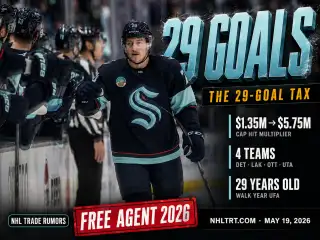
Bobby McMann Free Agent 2026 Destinations: 4 Teams Linked
Bobby McMann's career-high 29 goals just turned a $1.35M cap hit into Sharangovich-tier money. The Athletic locked him to 4 teams (Detroit,...
By Mike Johnson · 10 min read
Hellebuyck Trade Rumors 2026: The Vulture Watch Begins
Connor Hellebuyck is still under contract — but rivals circle as Winnipeg's window narrows.
By Sarah Chen · 1 min read
Get NHL trade rumors in your inbox
One email per week. Zero spam. Verified rumors only.