Rielly Knies Maple Leafs Offseason: Locker-Room Pact
Morgan Rielly and Matthew Knies just told Toronto they\'re staying. Full breakdown of the NMC math, the 6-year extension gamble, and why the new GM keeps both. The Locker-Room Pact explained.
Live updates
No updates yet. Refreshing automatically.
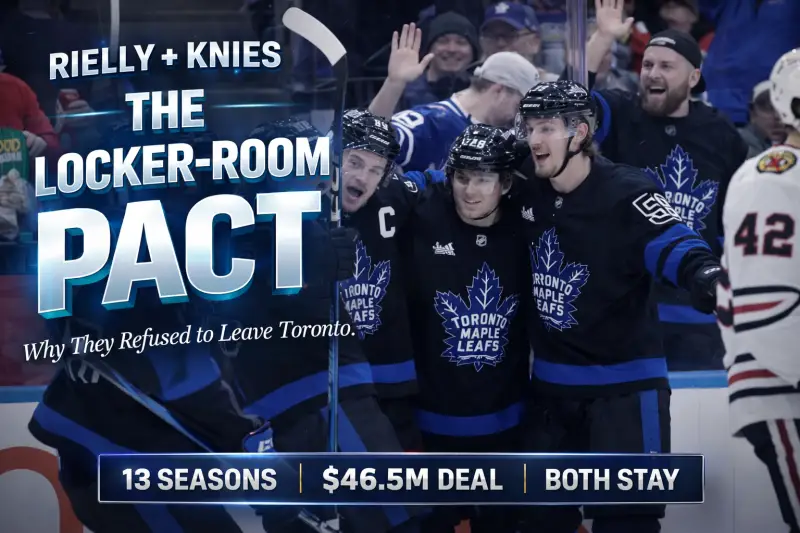
Morgan Rielly has spent 13 seasons in Toronto, carries an $7.5 million cap hit on a contract that runs through 2029-30 with a full no-movement clause until 2028, and just told Maple Leafs media he is not going anywhere. A few stalls over, 23-year-old Matthew Knies — fresh off signing a 6-year, $46.5 million extension last June — said "I'd look at it as a crappy thing" when asked about being shopped again. That Rielly Knies Maple Leafs offseason stay-pact is the single most important statement the 2025-26 roster's remaining stars made this week, and it lands squarely at the feet of whoever MLSE president-CEO Keith Pelley hires as the next GM.
Here's the mechanism behind the Rielly Knies Maple Leafs offseason story: Both players have contracts that make them movable, both have teams willing to pay. Rielly's NMC gives him total control until 2028. Knies has no NMC — his $7.75M AAV and RFA-to-UFA structure make him a tradable asset for any new GM who wants to reset the core.
The catch is that Knies has now told the front office, on record, that being traded would feel "crappy." That's not a demand. It's a signal. I'm calling the combined effect of these two public declarations The Locker-Room Pact — two players using post-playoff-miss media access to redraw the boundaries of what a Leafs rebuild actually looks like.
This article breaks down why both players said what they said, what the contract math actually allows Toronto's new GM to do, and my read on where this lands between now and July 1. Short version: Rielly stays through 2028 because his NMC holds. Knies gets kept because the new GM can't afford to burn political capital on trading a 23-year-old power forward the locker room publicly rallied around.
Key Takeaways
- The Locker-Room Pact: Rielly (13 seasons, NMC through 2028) and Knies (23, 6-year deal) publicly committed to staying in Toronto during the same end-of-season media week.
- Rielly's contract math: 4 years remaining at $7.5M AAV = $30M still owed, with full no-movement clause until 2028 — effectively untradeable without his consent.
- Knies's $7.75M bet: Signed his 6-year extension in June 2025 at $46.5M total — Toronto rejected multiple trade offers at the deadline per Nick Kypreos (two 1st-round picks + a high-quality prospect was the lowest ask).
- New GM inherits the pact: Keith Pelley's GM search (Sunny Mehta, Kevyn Adams, Mike Gillis among candidates) means Treliving's potential trade plans are now null. A new voice sets the next direction.
- My projection: Both stay through July 1. Knies becomes a top-six wing with Matthews on the rebuild. Rielly's trade window only reopens after 2028 when his NMC converts to limited NTC.
Why Rielly and Knies Publicly Declared They Want to Stay
Both players spoke at end-of-season media availabilities that happened the same week the Maple Leafs were eliminated from the 2026 playoff race. The timing matters. When Toronto missed the playoffs for the first time since 2016 and owner Keith Pelley publicly fired Brad Treliving on March 30, 2026, the roster had every incentive to wait and see who the new GM would be before making public commitments. Rielly and Knies didn't wait.
Rielly went first. "I still want to stay in Toronto. I still want to stay," he told Leafs beat reporters. That's the cleanest possible statement a veteran with NMC protection can offer — no hedging, no "we'll see what the new GM wants." Just an on-the-record commitment to remain.
Knies followed the next day with language even more direct for a 23-year-old with no NMC and a new contract: "I want to stay here. I want to play here. That's not in my hands." He went further when asked about being traded at the deadline after Toronto reportedly shopped him to Montreal and Chicago.
"I'd look at it as a crappy thing. I don't want to leave this group of guys."
"I want to stay here. I want to play here. That's not in my hands."
— Matthew Knies, end-of-season media availability (via Heavy Sports)The "not in my hands" line is the tell. Knies knows he doesn't have NMC protection. He's signaling to the front office that while he can't veto a trade, he is making the case — loudly, publicly, and with teammate backing — for why staying matters. That's as close to a trade-rejection as a young player without contract clout can offer.
The Locker-Room Pact: What It Actually Means for the Rebuild
To understand how much weight The Locker-Room Pact carries, you need to understand what MLSE has publicly said about the next roster cycle. Pelley has explicitly stated the Maple Leafs are not rebuilding — they plan to compete next season.
That framing changes the Rielly-Knies calculus completely. If the plan were a full teardown, both would be on the block. With "not rebuilding" as the official position, both become anchors of whatever retool the new GM designs.
The Locker-Room Pact
A post-playoff-miss public declaration by key roster pieces committing to stay with the franchise despite movable contract structures — designed to signal cohesion to incoming management and pre-emptively reject trade rumors. The Rielly-Knies 2026 Pact is the cleanest example of this dynamic in modern NHL front-office history.
The contract math reinforces the Pact's effectiveness. Here's how Rielly and Knies's current deals structurally prevent an easy reset:
| Player | Contract | Years Remaining | Clause |
|---|---|---|---|
| Morgan Rielly | $7.5M AAV (8yr × $60M total) | 4 yrs ($30M owed) | Full NMC through 2028, then limited NTC |
| Matthew Knies | $7.75M AAV (6yr × $46.5M total) | 5 yrs ($38.75M owed) | None (but public stay-commitment) |
| Combined commitment | $15.25M AAV | ~$68.75M through 2029-30 | NMC + social lock |
That $15.25M combined AAV is roughly 14.7% of the projected 2026-27 cap of $104 million. Keeping both doesn't structurally break Toronto — the Leafs project roughly $46.4 million in cap space for next season. What The Locker-Room Pact does is force the new GM to allocate that $46.4M on new additions rather than replacing Rielly and Knies.
Morgan Rielly's 2025-26 Numbers — And Why His NMC Still Protects Him
Rielly's statistical profile for the 2025-26 season is the kind that invites a trade pitch on the surface. He played 78 games, posted 11 goals and 25 assists for 36 points, and logged a -18 plus-minus — his worst mark in a decade. Those are middle-pairing offensive numbers from a player making top-pairing money.
Dig into the advanced metrics and the picture shifts. Rielly's expected goals share (xGF%) landed at 49.0% — meaning the team generated slightly fewer scoring chances than opponents when he was on the ice. His Corsi-For percentage (CF%) finished at 48.0%, also just under breakeven.
But his relative xGF% was +4.9 — meaning Toronto generated significantly more scoring chances with Rielly on the ice than without him. That relative number is why his trade market exists.
Rielly averaged 21:08 of ice time per game, quarterbacked Toronto's top power-play unit, and crossed into the franchise's second-highest career scoring mark for a defenseman when he recorded an assist in a 5-3 loss to Boston on November 11, 2025. Those are cornerstone résumé items for a 31-year-old who turned 32 in March.
"I've always loved being in Toronto and being a part of this organization. I still want to stay."
— Morgan Rielly, Maple Leafs defenseman (via Pro Football Network)The practical barrier is the NMC. Rielly's clause remains fully locked until 2028, at which point it converts to a limited no-trade clause. That means any new GM who wants to move him this offseason has to either (a) convince Rielly to waive, or (b) wait two years.
Neither path produces real negotiating room for Toronto right now. If the new GM decides the defense corps needs a reset, Rielly's consent becomes the gate — not the asking price.
Matthew Knies's $7.75M Gamble and the 2025-26 Breakout
Knies signed his $46.5M extension in June 2025 — well before the 2025-26 season turned into a playoff-miss disaster. That timing matters. Toronto locked him up at $7.75M AAV when he had 46 points (22G, 24A) in 78 games as a 22-year-old, and the extension price looked aggressive then. It looks even better now.
His 2025-26 line through 52 tracked games: 13 goals, 31 assists, 44 points — a pace of roughly 69 points over a full 82-game season. That would be a career high by 23 points. His 12.6% shooting percentage and 103 shots on goal put him in the top tier of young left wings in the league. As I broke down in Knies's trade deadline analysis, the asking price Treliving set in March made the trade effectively impossible — two first-round picks plus a top prospect was the lowest tier ask.
Nick Kypreos reported three specific Treliving asking prices during the February-March shopping window: first pick + prospect + prospect tier, a single first-rounder plus two top prospects tier, or three high-quality prospects alone. The Hockey News confirmed Montreal and Chicago got close but never matched any of the three. Pierre LeBrun's take on The Athletic was that the two sides discussed a deal but never got close.
That's the context behind Knies's "crappy thing" comment. He knows Treliving spent a month trying to trade him. He knows the offers existed.
He also knows the dressing room reacted — and he just spent an entire media availability making it clear he'd rather stay and lose than be shipped to a rebuild. That matters for the new GM. Toronto's GM search dynamic after Treliving's firing already leans toward stability over churn — Knies's public stance pushes that needle harder.
The New GM's First Decision: Keep Both or Trade One?
Keith Pelley's GM search is real. Sunny Mehta (former Devils analytics VP, now the reported favorite at -160 betting odds), Kevyn Adams (former Sabres GM), Mike Gillis (former Canucks GM), and Doug Armstrong (Blues GM who just stepped aside from Team Canada duties) are the publicly floated candidates. Whichever of them lands the job walks into a dressing room where Rielly and Knies have already announced they're staying.
If Mehta gets the job: Analytics-first approach. Rielly's -18 plus-minus and 48.0% CF% look bad in isolation, but the +4.9 REL xGF% flags him as a team-positive player. Mehta keeps Rielly as a rental-to-retain and builds around Knies as the top-six anchor. The Pact holds fully.
If Adams gets the job: Culture-first, experienced voice. Adams is more likely to honor The Locker-Room Pact for its message about dressing-room buy-in. Both stay. The focus shifts to defense reinforcements via free agency.
If Gillis gets the job: Gillis historically ran Vancouver with star-retention logic. He'd see Rielly's NMC as binding and treat Knies as untouchable given the $7.75M extension already locks him through 2030-31. Both stay.
Why Doug Armstrong unlikely to come: Armstrong just stepped away from his Team Canada dual-GM duties specifically to focus on St. Louis. Taking the Toronto job would contradict that reset unless the Blues relationship fully unwinds. Most likely he stays.
My read: Whoever wins the chair, neither player moves before July 1. The structural barriers (NMC + public commitment + no cap urgency) combined with new-GM political caution produce the same outcome regardless of who Pelley hires.
Historical Parallel: When Leafs Keepers Survived Rebuilds
The closest precedent in Leafs history is the 2013-14 retention of Dion Phaneuf during the Shanahan-era reset. Phaneuf had a full NMC on a long-term contract, missed-playoff pressure mounting, and a reported shopping list that never produced a trade.
He stayed two additional years before eventually getting moved to Ottawa in 2016. The difference then: Phaneuf's production had declined. Rielly's production slipped in 2025-26 but his relative advanced metrics remain positive.
A cleaner parallel for Knies is Mitch Marner's 2019 negotiation. Marner used his RFA bargaining power to secure $10.9M AAV on a 6-year extension that Toronto ultimately let expire — he departed to Vegas in 2025 via sign-and-trade, triggering what I called the Subtraction Spiral.
Knies is 5 years younger than Marner was at that decision point. The extension Toronto gave Knies in June 2025 was designed specifically to avoid a repeat. It bought them through 2030-31 at 71% of Marner's final-year Toronto cap hit.
What stands out to me: The 2014 Phaneuf parallel worked because the NMC held. The 2019 Marner divergence happened because the contract expired and RFA bargaining power flipped. The Rutherford-Hughes extension framework in Vancouver shows what happens when franchises try to anchor stars before they can walk — Toronto already applied that playbook to Knies in June 2025. The Locker-Room Pact is just the second chapter of that same retention strategy.
What Comes Next: Timeline + Decision Points
My projected sequence between now and July 1, 2026:
Pelley names a new GM between May 20 and June 10. Mehta is the betting favorite but Armstrong-watch stays live until his Blues situation fully resolves. The new GM opens a player assessment window covering Rielly, Knies, Tavares, and the defensemen. Both Rielly and Knies get clarity within two weeks.
Knies gets an on-record conversation with the new GM confirming he's not being shopped. The message gets leaked to Friedman or LeBrun within 72 hours to lock it in publicly. Rielly gets the same treatment but with less urgency given his NMC. Both exit that first cycle with the same conclusion: Stay.
Free agency on July 1 becomes the real story. Toronto has $46.4M of projected cap space, John Tavares expiring, and Mitch Marner's departure still a wound. The new GM targets a top-four defenseman ($7-9M) and a second-line right winger ($5-7M) without touching Rielly or Knies. with a new bench voice potentially arriving inside the Three-Year Closer window by July 10.
What I'd bet against: A Rielly trade before 2028. His NMC doesn't convert to limited NTC until then, and no scenario forces him to waive. Toronto's next reset decision on Rielly sits in 2028, not 2026. The Pact, for now, holds everything together.
Sources and Reporting
- NHL.com — Maple Leafs playoff elimination, first miss since 2016
- PuckPedia — Rielly contract: 8yr × $7.5M, NMC through 2028
- PuckPedia — Knies contract: 6yr × $7.75M ($46.5M), signed June 2025
- Heavy Sports — Knies end-of-season stay commitment quotes
- Pro Football Network — Rielly "still want to stay" quote + NMC analysis
- Pro Hockey Rumors — Treliving trade asking prices for Knies
- The Hockey News — Post-mortem on 2025-26 Toronto disaster
- ESPN — Keith Pelley + Treliving firing context
- ESPN — Rielly 2025-26 stats: 36 pts in 78 GP, -18
The Verdict: The Locker-Room Pact
Both stay. Rielly holds his NMC through 2028. Knies gets the new GM's confirmation he's off the block by mid-June. The combined $15.25M AAV commitment anchors Toronto's retool rather than blocks it — that's the structural read The Locker-Room Pact enforces. My bet: Pelley hires Mehta or a Mehta-style analytics-first GM by June 10, and the first public statement from the new chair includes the phrase "Morgan and Matthew are cornerstones." That resolves the Rielly Knies Maple Leafs offseason saga in three sentences of press-conference language, and Toronto moves into free agency focused on new additions, not on replacing the two players who already declared they want to stay.
Frequently Asked Questions
Will Morgan Rielly be traded by the Maple Leafs in 2026?
No. Rielly has a full no-movement clause that runs through 2028 before converting to a limited no-trade clause, and he publicly stated he wants to stay in Toronto at end-of-season media availabilities. With four years remaining on his 8-year, $60 million contract at a $7.5 million AAV, Toronto cannot move him without his consent. Rielly also became the second-highest scoring defenseman in franchise history on November 11, 2025.
How much is Matthew Knies's contract?
Knies signed a 6-year, $46.5 million contract extension with the Maple Leafs in June 2025, carrying a $7.75 million average annual value. The deal runs through the 2030-31 season, at which point he becomes an unrestricted free agent at age 28. The extension buys only one UFA year, meaning Toronto prioritized term and cost certainty over maximum free-agent runway.
Why did the Maple Leafs want to trade Matthew Knies?
Then-GM Brad Treliving reportedly shopped Knies at the 2026 trade deadline with three specific asking prices: two first-round picks plus a high-quality prospect, one first-rounder plus two top prospects, or three high-quality prospects alone. Montreal and Chicago were the most interested teams but never matched any of the three tiers. Treliving was fired on March 30, 2026, which effectively ended the Knies trade market.
Who will be the next Maple Leafs GM?
Sunny Mehta is the leading betting favorite at -160 odds, followed by Kevyn Adams (+500), Mike Gillis (+700), Bill Scott (+1000), and Dave Hunter (+1000). Former Blues GM Doug Armstrong has also been mentioned as a dark-horse candidate, though his recent Team Canada duties suggest he's focused on St. Louis. MLSE president-CEO Keith Pelley is leading an "exhaustive search" for a "data-centric" manager, with a hire expected by mid-June 2026.
How much cap space do the Maple Leafs have for 2026-27?
Toronto projects approximately $46.4 million of free cap space for 2026-27 under the projected $104 million league cap. That room will face pressure from John Tavares's expiring contract (a potential extension or exit), Mitch Marner's cap charge now fully off the books, and the new GM's free agency targets. Knies and Rielly together consume $15.25 million of the 2026-27 cap — roughly 14.7% of the total.
Frequently Asked Questions
Will Morgan Rielly be traded by the Maple Leafs in 2026?
No. Rielly has a full no-movement clause that runs through 2028 before converting to a limited no-trade clause, and he publicly stated he wants to stay in Toronto at end-of-season media availabilities. With four years remaining on his 8-year, $60 million contract at a $7.5 million AAV, Toronto cannot move him without his consent. Rielly also became the second-highest scoring defenseman in franchise history on November 11, 2025.
How much is Matthew Knies contract?
Knies signed a 6-year, $46.5 million contract extension with the Maple Leafs in June 2025, carrying a $7.75 million average annual value. The deal runs through the 2030-31 season, at which point he becomes an unrestricted free agent at age 28. The extension buys only one UFA year, meaning Toronto prioritized term and cost certainty over maximum free-agent runway.
Why did the Maple Leafs want to trade Matthew Knies?
Then-GM Brad Treliving reportedly shopped Knies at the 2026 trade deadline with three specific asking prices: two first-round picks plus a high-quality prospect, one first-rounder plus two top prospects, or three high-quality prospects alone. Montreal and Chicago were the most interested teams but never matched any of the three tiers. Treliving was fired on March 30, 2026, which effectively ended the Knies trade market.
Who will be the next Maple Leafs GM?
Sunny Mehta is the leading betting favorite at -160 odds, followed by Kevyn Adams (+500), Mike Gillis (+700), Bill Scott (+1000), and Dave Hunter (+1000). Former Blues GM Doug Armstrong has also been mentioned as a dark-horse candidate, though his recent Team Canada duties suggest he is focused on St. Louis. MLSE president-CEO Keith Pelley is leading an exhaustive search for a data-centric manager, with a hire expected by mid-June 2026.
How much cap space do the Maple Leafs have for 2026-27?
Toronto projects approximately $46.4 million of free cap space for 2026-27 under the projected $104 million league cap. That room will face pressure from John Tavares expiring contract (a potential extension or exit), Mitch Marner cap charge now fully off the books, and the new GM free agency targets. Knies and Rielly together consume $15.25 million of the 2026-27 cap — roughly 14.7% of the total.
Related Stories

Darnell Nurse Trade: 4 Suitors
Edmonton wants Darnell Nurse's $9.25M off the books, but a buyout saves barely $1.53M and his no-move clause hands him the pen. The Bonus Sh...
By Mike Johnson · 12 min read
Darren Raddysh Free Agent 2026: 4 Teams
Darren Raddysh's 70-point breakout turned his $975K cap hit into a four-team bidding war. The Athletic linked him to Philadelphia, San Jose,...
By Mike Johnson · 13 min read
Bobby McMann Free Agent 2026 Destinations: 4 Teams Linked
Bobby McMann's career-high 29 goals just turned a $1.35M cap hit into Sharangovich-tier money. The Athletic locked him to 4 teams (Detroit,...
By Mike Johnson · 10 min read
Hellebuyck Trade Rumors 2026: The Vulture Watch Begins
Connor Hellebuyck is still under contract — but rivals circle as Winnipeg's window narrows.
By Sarah Chen · 1 min read
Get NHL trade rumors in your inbox
One email per week. Zero spam. Verified rumors only.