What Is High-Sticking in Hockey? Explained
What is high-sticking in hockey? A plain-English guide to NHL Rule 60: the 2-minute minor, the 4-minute double on injury, the 5-minute match for deliberate intent, the 4-foot crossbar rule that disallows goals, and the coach's challenge.
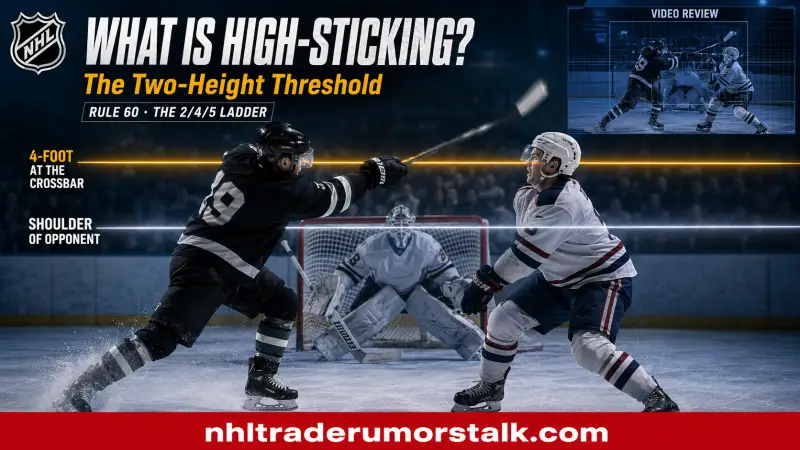
A stick comes up, catches a jaw, and blood hits the ice. That is four minutes, not two. Somewhere else on the same sheet, a different blade lifts a puck a half-inch too high on its way into the net, and a sure goal simply vanishes on replay. One motion, one height, two completely different verdicts. That is the strange double life of high-sticking, and it is why the call confuses fans every single night. So what is high-sticking in hockey, why does the rulebook measure it two different ways, and when does one careless stick turn a 2-minute minor into a 4-minute double? Here is the whole rule through one idea: The Two-Height Threshold.
High-sticking is the most misunderstood penalty on the ice because the rulebook actually treats it as two related but separate ideas. One rule governs sticks hitting opponents. A different rule governs sticks hitting the puck. Each test uses a different height standard, and the difference is what trips up casual fans every time a high-stick is called or a goal is reviewed.
| Figure | What it represents |
|---|---|
| 2 / 4 / 5+game | The escalating penalty ladder for the same act: 2-minute minor for clean contact, 4-minute double-minor when injury or blood results, 5-minute match plus a game misconduct if the contact is deliberate |
| Shoulder vs Crossbar | The two height standards in the same rulebook: the opponent's shoulders for penalty calls (Rule 60), and the 4-foot crossbar for disallowed goals (Rule 78.5) |
One number shows how violently a single play can escalate; the other shows why the league uses different yardsticks for hitting a person versus hitting a puck.
Key Takeaways
- What it is: high-sticking covers two scenarios: a stick carried above the opponent's shoulders that makes contact (Rule 60), or a puck contacted above the crossbar that scores (Rule 78.5).
- Penalty ladder: 2 minutes for stick contact with no injury, 4 minutes (double-minor) when blood is drawn or there is visible injury, 5 minutes plus a game misconduct if deliberate.
- The Two-Height Threshold: the opponent's shoulders define the penalty line; the 4-foot crossbar defines the goal-disallow line.
- The own-net exception: a defending player who tips the puck into his own net with a high stick still concedes a goal; the rule only invalidates attacking-team goals.
- Coach's challenge: since 2019-20, coaches can challenge a missed high-stick stoppage in the attacking zone that led to a goal.
What High-Sticking in Hockey Actually Means
NHL Rule 60.1 defines a high stick as one carried above the height of the opponent's shoulders. Every player is judged responsible for the position of his own stick, so where the blade goes is his problem if it lands on another player's face, neck or upper body. A normal shooting wind-up or follow-through that brushes an opponent does not count, and accidental contact with a face-off opponent bent over the dot is also excepted. Everything else on a person above shoulder height is in play for the officials.
The shoulder-height test exists by design. Referees cannot run a tape measure to a fixed point in open ice, so the rule sets a moving threshold tied to the opponent's own body. That keeps the call practical at every level of hockey, which is why USA Hockey's Rule 621 uses the same shoulder standard for amateur and youth play. Our penalty-minutes guide breaks down how each of these calls actually shows up on the scoresheet.
The 2 / 4 / 5-Minute Penalty Ladder
The penalty depends entirely on the consequence of the contact, not the swing itself. Rule 60.2 sets the baseline at a 2-minute minor for stick contact above the shoulders. Rule 60.3 doubles that to a 4-minute double-minor whenever the contact draws blood or causes a visible injury, even if the contact was accidental and the player had no intent to hurt anyone. The rulebook is blunt about it: any contact above the shoulders that causes injury triggers the doubled penalty.
Rule 60.4 takes the ladder one final step. If the referee judges that a player attempted to or deliberately injured an opponent while carrying his stick above the shoulders, the call jumps to a 5-minute match penalty and an automatic game misconduct, with a possible suspension to follow. That is the difference between accidental, reckless and intentional in three rule numbers. Our power-play explainer shows what each of those tiers hands the other team.
The Crossbar Rule for Disallowed Goals
The second half of the term lives under Rule 78.5 and Rule 80, and it has nothing to do with hitting a person. When an attacking player contacts the puck with a stick above the height of the crossbar (four feet exactly) and the puck enters the net, the goal is disallowed. The determining factor is where on the stick the puck made contact, not where the swing started or finished. That is why a high follow-through can still be a clean goal as long as the puck met the blade below the bar.
This is the rule that erased Josh Anderson's apparent goal in Tampa on April 19, 2026. The Situation Room reviewed the play and confirmed the puck made contact above the crossbar.
Anderson's stick was above the height of the crossbar when he directed the puck into the Tampa Bay net.
— NHL Situation Room ruling, Apr 19 2026, NHL.com
This is also why the rulebook can look contradictory at first glance. The same word, high-sticking, uses two different yardsticks because referees need different tools. They need a body-relative measure to call a penalty, and a fixed measure to call a goal back. One stick, two tests.
The Coach's Challenge and the Own-Net Exception
Since the 2019-20 season, the league has let coaches challenge a goal when a high-stick was missed earlier in the play. The category covers a missed stoppage in the attacking zone that led to the goal, including a high-stick on a teammate that should have killed the play. The deputy commissioner framed the scope plainly when the rule expanded.
It's not a high stick – it's a skill play. There's nothing illegal about it right now. … I don't see any reason to take it out of the game – it makes it exciting.
— Cam Talbot, NHL goaltender, on lacrosse-style goals where the puck is lifted but stays below the crossbar, Scouting The Refs
There is one quirk almost nobody knows: the crossbar rule only invalidates attacking-team goals. A defending player who tips the puck into his own net with a stick above the bar still concedes the goal. The rule was written to punish illegal scoring by the attacking side, not to bail out a defender whose own stick goes airborne. That asymmetry is the cleanest sign that the goal-disallow test exists to protect the integrity of the score, not to enforce stick-height generally.
High-sticking sits inside a wider rulebook worth understanding in full. The same officiating logic threads through icing, offside, fighting, the crease and goalie interference, how overtime is decided, and even how long a hockey game actually takes once every video review is counted.
Written by Mike Johnson, NHL Senior Editor, with 15 years covering the league. The Rule 60 penalty mechanics, Rule 78.5 and Rule 80 disallowed-goal logic, the 2019-20 coach's-challenge expansion and the own-net exception were checked against the NHL Official Rulebook on media.nhl.com, the NHL Situation Room ruling for the April 19 2026 review, USA Hockey Rule 621, and Scouting The Refs. Both quotes were traced verbatim to their sources with inline links. The Two-Height Threshold is my framework for the shoulder-versus-crossbar split in the rulebook, introduced in this piece. Published June 24, 2026. Editorial review and fact-check: Sarah Chen, Hockey Operations Editor. Corrections: editorial@nhltraderumorstalk.com.
Sources and Reporting
- NHL Official Rules 2024-25 (PDF): Rule 60 high-sticking penalties; Rule 78.5 disallowed goals; Rule 80 high-sticking the puck
- NHL.com: April 19 2026 Situation Room ruling (Anderson disallowed goal)
- Scouting The Refs: Rule 78.5 and Rule 80 walkthrough + Cam Talbot quote
- USA Hockey Rulebook: Rule 621 (high sticks) sister rule
The Verdict: The Two-Height Threshold
Blood on the ice buys four minutes. A puck off a raised blade erases a goal. The rulebook never flinches at the contradiction because it was never one rule to begin with. The Two-Height Threshold is two tests wearing a single name, the opponent's shoulders for the body and the four-foot crossbar for the goal. Watch which line the official is actually measuring, and the most confusing call in hockey suddenly reads clean.
Frequently Asked Questions
What is high-sticking in hockey?
High-sticking covers two scenarios under NHL rules. Under Rule 60, a stick carried above the height of the opponent's shoulders that makes contact draws a 2-minute minor (no injury), a 4-minute double-minor (when blood is drawn or there is visible injury), or a 5-minute match plus a game misconduct if the contact is judged deliberate. Under Rule 78.5, a puck contacted by an attacking player above the height of the crossbar that enters the net is a disallowed goal.
When is high-sticking a 2-minute vs a 4-minute penalty?
The penalty tier depends on the result, not the swing. Stick contact above an opponent's shoulders with no injury is a 2-minute minor. The same contact that draws blood or causes a visible injury is a 4-minute double-minor, even if the contact was accidental. The rulebook is explicit that any contact above the shoulders causing injury triggers the doubled penalty.
Why does the NHL use two different heights for high-sticking?
Because referees need different tools for different jobs. Rule 60 uses the opponent's shoulders as the threshold for penalty calls, because shoulder height is a body-relative measure officials can judge anywhere on the ice. Rule 78.5 uses the 4-foot crossbar for disallowed goals, because video review needs a fixed reference at the net. One stick, two yardsticks.
Does a high stick disallow a goal scored into your own net?
No. The crossbar rule only invalidates goals scored by the attacking team. If a defending player tips the puck into his own net with a stick above the crossbar, the goal still counts. The rule was written to prevent illegal scoring by the attacking side, not to bail out a defender whose stick goes airborne in his own end.
Can a coach challenge a high-stick goal?
Yes. Since the 2019-20 season, coaches can challenge a goal on the basis of a missed stoppage in the attacking zone that led to the goal, which includes a missed high-stick. If video review confirms the puck was contacted above the crossbar, or that a high-stick on a teammate was missed in the attacking-zone sequence, the goal comes off the board.
Related Stories
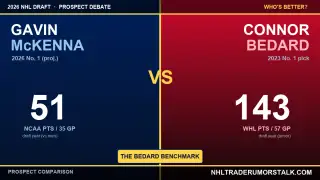
Gavin McKenna vs Connor Bedard
Gavin McKenna vs Connor Bedard: Bedard set the bar with 143 junior points and a Calder, but they are different players entirely. The honest...
By Mike Johnson · 7 min read
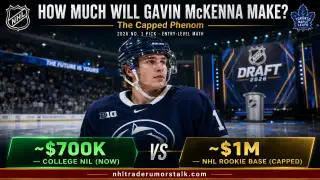
How Much Will Gavin McKenna Make?
How much will Gavin McKenna make? The projected No. 1 pick already earns a reported ~$700K in college NIL, but the NHL entry-level system ca...
By Mike Johnson · 8 min read
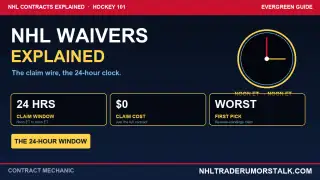
NHL Waivers Explained: The 24-Hour Window
NHL waivers explained: the 24-hour noon-to-noon ET claim window, why the worst team in the league claims first, the age-and-games exemption...
By Mike Johnson · 8 min read
What Does the C on a Hockey Jersey Mean?
What does the C on a hockey jersey mean? Plain-English guide to NHL Rule 6: the three-inch captain's letter, the alternate A, the one rulebo...
By Mike Johnson · 8 min read
Comments
Be the first to share your take.
Get NHL trade rumors in your inbox
One email per week, zero spam, verified rumors only.