What Is the Five-Hole in Hockey?
The five-hole is the gap between a goalie's legs, the only one of the goalie's five holes hockey ever agreed on a name for. Here is what it is, where the word came from, and why it is not even the easiest hole to score on.
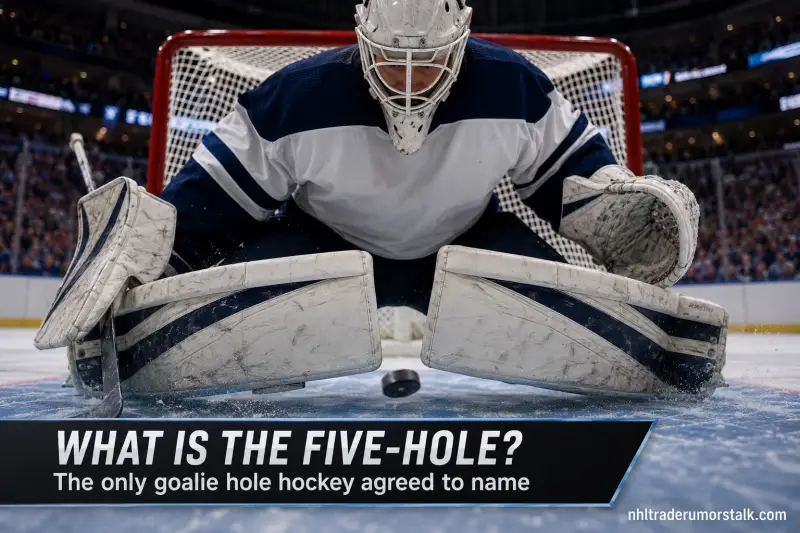
Ask any hockey fan to point at the five-hole and the hand goes straight to the same spot: the gap between the goalie's legs. Ask them to name the other four holes, and the room goes quiet. That silence, oddly, is the point. The five-hole is the one piece of goalie shorthand everyone knows, and the only one hockey ever actually agreed on.
So what is the five-hole in hockey? It is the space between a goaltender's legs, the fifth of the five openings a goalie has to guard. Merriam-Webster liked the term enough to add it to the dictionary in February 2017, with a definition that is hard to improve on: “the space between the legs of a goaltender.” Put the puck through there and you have gone five-hole. Everything else about the numbering, it turns out, is a fight.
| Share of goals | Where it went |
|---|---|
| 15.7% | Glove-side high — the most-scored spot on the net |
| 14.0% | The five-hole — second, not first |
Those figures come from a World Hockey Lab study that charted where 3,854 NHL goals ended up. The takeaway stings the legend a little: the hole everyone can name is not even the easiest one to beat. Glove-high edges it. The five-hole gets all the fame, which is exactly why its number stuck when the others did not. Call it The Number That Stuck.
Key Takeaways
- What it is: the five-hole is the gap between a goaltender's legs, the fifth of five openings a goalie must cover.
- The other four are disputed: the corners are numbered 1 through 4, but sources genuinely disagree on which corner is which, so only “five-hole” ever entered common speech.
- Origin is hedged: the numbering is usually credited to Jacques Plante, but the term's first documented print use is 1980, years after his early-1970s book.
- The butterfly closed it: dropping the pads to the ice, pioneered by Glenn Hall and popularized by Patrick Roy, sealed the spot that was once a soft target.
- Still second, not first: in one 3,854-goal study the five-hole took 14.0% of goals, behind glove-high's 15.7%.
What the Five-Hole Actually Is
The geometry is simple enough to sketch on a napkin. A goalie standing square to the shooter leaves five ways to be beaten: the four corners of the net around the body, and the tunnel between the pads. Broadcasters lump the corners into glove-side and stick-side, high and low. The tunnel is the five-hole. When a shooter or a passing deke slips the puck between the legs, that is the shot the crowd remembers, because it looks like the goalie got nutmegged at the rink.
It is not the same as the crease, the painted area a goalie works inside, and it does not have its own rule the way goalie interference does. The five-hole is pure geometry: a moving gap that opens and shuts as the goalie skates, drops, and reaches. Every save percentage you have ever seen is really a running tally of how well a goalie closed those five openings, five-hole included.
The Four Holes Nobody Agrees On
Here is the part that surprises people. If there is a five-hole, there must be a one, two, three, and four, and there is. The trouble is that hockey never settled on which corner gets which number. In the version usually traced to Jacques Plante, holes 1 and 2 are the low corners. In the version you will find on most websites today, hole 1 is glove-side high. A third layout floats around too. Multiple guides say the same thing out loud: there is honest debate about how to number one through four, partly because “high” and “low” flip depending on whether you mean the shooter's view or the goalie's.
Because nobody agreed, nobody used them. You will never hear a play-by-play voice shout that a shooter went “four-hole.” Only the five-hole survived into everyday hockey talk. There are even a sixth and seventh hole, the gaps tucked under each arm between the elbow and the body, though sources cannot agree on which side is the six and which is the seven, so those stay in coaching drills, not broadcasts. Five is the number that stuck, and it stuck alone.
Where the Word Came From
The tidy story you will read everywhere is that Plante invented the whole system in his early-1970s goaltending book and coined “five-hole” on the page. The honest version is fuzzier. Merriam-Webster, which is careful about this sort of thing, says the concept only likely originated with Plante, and it dates the word's first documented print use to 1980, several years after the book came out. If Plante had put the exact term in a widely read 1972 book, the dictionary's earliest sighting would not land in 1980.
What holds up is softer and probably truer: Plante organized the idea of numbered openings a goalie must protect, and the language grew from there over the decade. A stray theory even traces the numbering to the pockets on a billiards table. However it started, the slang went mainstream enough that the dictionary made it official in 2017, one of the few pieces of rink jargon to earn an entry. The origin is credited, not proven, and an explainer that pretends otherwise is guessing.
Why the Five-Hole Got Harder to Hit
For decades the five-hole was a genuine soft spot. In the stand-up era goalies stayed on their skates, and a hard low shot could squeeze through before the pads clamped shut. Then the position changed underneath them. Glenn Hall started dropping to his knees and flaring his pads, the move that became the butterfly, and he was blunt about where it came from.
“What I got from Rayner was the importance of skating, plus good balance and recovery. That helped me develop what they came to call ‘The Butterfly.’” — Glenn Hall, NHL.com
Patrick Roy carried the modern version to its peak in the 1980s and 90s, refined under goalie coach François Allaire, and every kid who plays net now learns it. The whole trick of the butterfly is that when the pads drop, their tops come together in the middle and the five-hole vanishes behind the stick. Ask a goalie coach and the instruction is almost mechanical.
“Keep that stick on the ice and then get those pads together so there's no five-hole.” — Maria Mountain, Goalie Training Pro
That is why the study number lands where it does. The five-hole still gives up its share, but a modern butterfly goalie seals it on most nights, which is a big reason league save percentage and goals-against average tell the story they do. Beating a good goalie between the legs is not the freebie it was in your grandfather's highlight reels, and it never shows up on his stat line differently either, whether he is at even strength, on the penalty kill, or scrambling after a lost faceoff.
The Most Famous Five-Hole Moment
If one goal fixed the five-hole in the sport's memory, it is Bobby Orr's. On May 10, 1970, 40 seconds into overtime, Orr scored the Stanley Cup winner for Boston past St. Louis goalie Glenn Hall, off a Derek Sanderson feed, then flew through the air after a trip. The shot is often remembered as a between-the-legs finish as Hall slid across, and the photo of Orr airborne is the most reproduced image in hockey history. It is a fitting mascot for the five-hole: the fame outran the details, and nobody has ever cared to correct it.
Written by Mike Johnson, NHL Senior Editor, drawing on the Merriam-Webster dictionary entry, NHL.com, Wikipedia's goaltending references, and goalie-coaching sources. The origin claim is deliberately hedged to match what the sources actually support; the scoring split is attributed to a single World Hockey Lab study, not stated as a league constant. Published June 2026. Editorial review: Sarah Chen, Hockey Operations Editor. Corrections: editorial@nhltraderumorstalk.com.
Sources and Reporting
- Merriam-Webster: the dictionary definition and the 1980 first-known-use date.
- NHL.com: the term's February 2017 addition to the dictionary.
- Five-hole (reference): the numbered holes, the disputed 1-4 order, and the 6 and 7 holes.
- Butterfly style (reference): Glenn Hall and Patrick Roy's roles in the technique.
- World Hockey Lab: the scoring-location study of 3,854 NHL goals.
The Verdict: The Number That Stuck
The five-hole endures because it is the rare bit of hockey vocabulary that a beginner and a lifer both use the same way. The corners never got that gift; they are still argued over, still nameless in real speech, still just “glove-side low” when anyone bothers. The gap between the legs got a number, a dictionary entry, and the most famous goal in the sport, while the other four holes got nothing. That is The Number That Stuck, and the next time a puck slides between the pads and the barn groans, you will know you just watched the only goalie hole hockey could ever agree to name.
Frequently Asked Questions
What is the five-hole in hockey?
The five-hole is the gap between a goaltender's legs. Scoring by putting the puck through that gap is called going "five-hole." It is the fifth of the five openings a goalie must protect: the four corners of the net plus the space between the pads.
Why is it called the five-hole?
Because a goalie has five openings to defend: four at the corners of the net, numbered 1 through 4, and the gap between the legs, which is number five. Only the five-hole caught on as everyday slang, and sources still disagree on how to number the four corners.
Where did the term five-hole come from?
It is usually credited to goaltender Jacques Plante, who organized the idea of numbered goalie openings around his early-1970s book. Merriam-Webster says the concept "likely" originated with him and dates the word's first printed use to 1980. It entered the dictionary in February 2017.
What are the 6-hole and 7-hole in hockey?
They are less-common terms for the gaps under each of the goalie's arms, between the arm and the body. Goalie coaches use them in drills, but sources disagree on which side is the 6 and which is the 7, so you rarely hear them on a broadcast.
Is the five-hole the easiest place to score?
Not anymore. In one study of 3,854 NHL goals the five-hole took 14.0%, second behind glove-side high at 15.7%. The butterfly style, which drops the pads together to seal the gap, made the five-hole much harder to beat than it was in the stand-up era.
Related Stories
What Is a One-Timer in Hockey?
A one-timer reaches the net just 42% of the time, the worst of any shot, yet it is the most dangerous weapon in hockey and the shot Ovechkin...
By Mike Johnson · 11 min read

Why Do Teams Pull the Goalie?
Pulling the goalie ties the game only about 15% of the time, yet the math says do it, and do it far earlier than coaches dare. Here is how t...
By Mike Johnson · 10 min read

How Do Faceoffs Work in Hockey?
A faceoff looks like a coin flip, but it is a governed 50/50 battle: nine exact spots, a center on the dot, and a rule that ejects him when...
By Mike Johnson · 9 min read

What Is a Zamboni? How It Works
A Zamboni shaves, sweeps, washes, and floods a rink with hot water in one slow 9.7 mph pass. Here is how the ice resurfacer actually works,...
By Mike Johnson · 10 min read
Comments
Be the first to share your take.
Get NHL trade rumors in your inbox
One email per week, zero spam, verified rumors only.