2026 NHL Mock Draft: First-Round Predictions, Pick by Pick

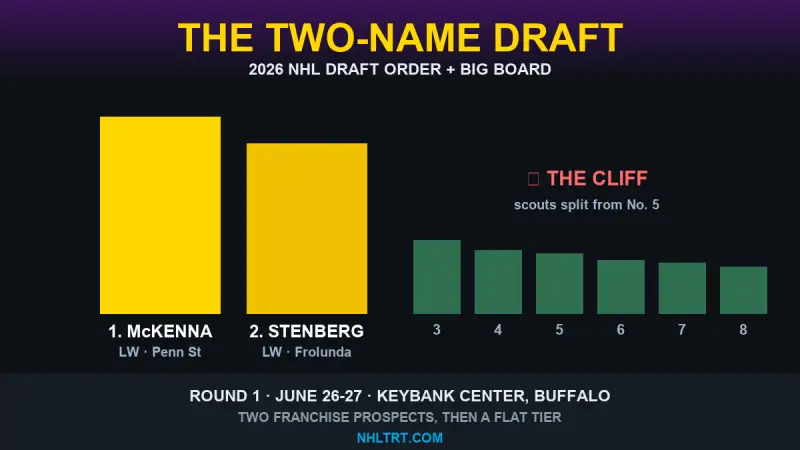
Tankathon ranks the 2026 NHL Mock Draft algorithmically. We rank it editorially: McKenna alone in Tier 1, Stenberg and Verhoeff fighting for picks 2-3, and a wide-open field that snaps into focus only after pick 6.

By Mike Johnson · 11 min read ✓ Fact-checked by Mike Johnson, Senior Editor. Deep refine April 28, 2026 at 22:31 IST verified against NHL.com mock draft, McKeen's Hockey, Daily Faceoff, NHL Central Scouting final rankings.
2026 NHL Mock Draft first round graphic showing Gavin McKenna Ivar Stenberg Keaton Verhoeff Tier Break framework Vancouver Chicago Rangers
The Tier Break: Gavin McKenna alone in Tier 1, Stenberg-Verhoeff-Reid in Tier 2, and an open field after pick 6.

Live updates

Gavin McKenna ended his draft year with 51 points in 35 NCAA games, an 8-point performance that broke a 39-year Division I record, and a NHL Central Scouting verdict that called his lead over the field "considerable." That is the entire premise of the 2026 NHL Mock Draft first round predictions you are about to read. McKenna is not a debate. The next 15 picks are.

Tankathon ranks this draft algorithmically, the way computers rank everything. The Athletic paywalls its mock drafts. What's missing is the editorial layer: who actually fits which team, and why. This is that breakdown, ordered by pre-lottery seeding from the May 5 lottery field, with reasoning attached to every selection rather than vibes-based intuition. The Vancouver Canucks own the heaviest stack of ping-pong balls. KeyBank Center in Buffalo hosts the draft itself on June 26 and 27.

One framework runs through every pick on this board. I'm calling it the Tier Break: McKenna alone in Tier 1, three names competing for picks 2 through 4, and the field opening up only after pick 6. Once you accept that structure, the order of the first round stops feeling like 32 random guesses and starts feeling like three different draft conversations stacked on top of each other.

Two #1s, One Draft Class
MCKENNA (NCAA)
51
Points in 35 NCAA games (1.46 PPG)
Penn State, draft year
STENBERG (SHL)
33
Points in 43 SHL games as an 18-year-old
Most since Sedins, 1998-99
The Tier Break, in two scoring lines that lead two separate continents.

Key Takeaways

  • The Tier Break: McKenna sits alone in Tier 1; Stenberg, Verhoeff, and Reid fight for picks 2-4; the real intrigue starts at pick 6.
  • McKenna gap: NHL Central Scouting calls his lead over the field "considerable": the largest top-end margin in this class.
  • Two #1 boards: Stenberg holds NHL Central Scouting's #1 International ranking; McKenna holds #1 North American.
  • Defense surplus: Verhoeff (North Dakota) and Reid headline a position that could see four blueliners go in the top 10.
  • Lottery dependency: Vancouver's 25.5% top-pick odds reshape the entire board if they hit; the field flattens dramatically after pick 6.

The Tier Break Framework, Explained

Most mock drafts rank prospects 1 through 32 like it's a continuous slope. This one isn't. The 2026 NHL Mock Draft first round predictions you build correctly need to acknowledge a structural reality: there's a cliff, then a plateau, then a longer plateau.

The Tier Break

A 2026 NHL Draft framework where Gavin McKenna sits alone in Tier 1 with a "considerable" lead per NHL Central Scouting, Ivar Stenberg, Keaton Verhoeff, and Chase Reid form Tier 2 competing for picks 2-4, and Tier 3 begins after pick 6 with no clear hierarchy among 10-plus prospects who could realistically go anywhere from 7 through 25.

This matters for one practical reason. The lottery on May 5 only meaningfully shifts the first six selections; after that, the draft order matters less than which team's regional bias, positional need, or head-of-amateur-scouting preference takes over. That's why some boards have Cole Reschny going at pick 8, others at pick 18, and both versions can be defended.

Picks 1-3: The McKenna Lock and the Stenberg-Verhoeff Coin Flip

1. Vancouver Canucks: Gavin McKenna (LW, Penn State). The franchise has never picked first overall. They almost certainly will here. McKenna's draft-year resume reads like a Hall of Fame application: 1.46 points per game in the NCAA (second among all eligible skaters), the Penn State single-season assist record at 36, and an 8-point night against Ohio State that was the largest individual game in NCAA Division I in 39 years. McKeen's Hockey calls him "the most exciting player in this draft class, bar none." For Vancouver, this isn't a draft pick. It's a generational franchise reset that happens to come with a top-three floor. The new front office under Jim Rutherford needs exactly this swing.

2. Chicago Blackhawks: Ivar Stenberg (LW, Frolunda SHL). Chicago drafted Connor Bedard first overall in 2023. Pairing him with Stenberg gives the rebuild a cerebral, two-way winger who has already passed the SHL test against grown men. Stenberg's 33 points as an 18-year-old at the SHL level is the kind of marker that historically projects cleanly to NHL ice. Chicago's 13.5% direct-draw lottery odds matter only if they push to pick one; otherwise this slot is theirs by pre-seeding math, and Stenberg fills it without debate.

3. New York Rangers: Keaton Verhoeff (D, North Dakota). The Rangers spent April in a season-ending tailspin and quietly slid into the third-worst pre-lottery seed. Verhoeff is the cleanest organizational fit on the board: 6-foot-3, 208-pound right-handed defenseman ranked second among all North American skaters by NHL Central Scouting, with a comparison to two-time Stanley Cup champion Alex Pietrangelo from one veteran scout. The Rangers retool that's already in motion needs a top-pair right-shot blueliner. Verhoeff is the answer.

"He's skilled, he thinks the game at a true difference-making level, and he plays with a lot of confidence."

— Daily Faceoff scouting report on Gavin McKenna (via Daily Faceoff)

That quote frames why McKenna is the lock at pick one. The phrase "true difference-making level" is the line that scouts use sparingly. It's reserved for prospects who change line deployments and power-play structure on day one.

Picks 4-6: The Edge of the Tier Break

4. Calgary Flames: Chase Reid (D, USHL/NCAA-bound). Reid is the best skater in the draft at any position, with what Bleacher Report describes as a Bowen Byram floor and a Thomas Chabot or Zach Werenski ceiling if every checkpoint hits. Calgary is the rare team that can absorb a developmental defenseman without time pressure, because the Flames' rebuild calendar already runs three to five years out. Reid's two-way profile gives Craig Conroy a player to build a top-four pairing around in 2027-28.

5. Toronto Maple Leafs (cond. Boston): Tynan Lawrence (C, Boston U). Toronto's first-round pick is protected if it lands in the top five. In this scenario, the pick stays with the Leafs. Lawrence is a two-way center prospect with the foot speed to project as a long-term third-line option, with the Daily Faceoff describing his skating as "smooth and effortless." For a franchise that lost most of its forward depth in the season's collapse, drafting a center who can defend is non-negotiable.

6. Seattle Kraken: Cole Reschny (C, Victoria WHL). Reschny is sub-six feet but plays a 200-foot game with what scouts call "suffocating defense." Seattle's identity, coaching staff, and arena culture all rotate around defense-first forwards. Reschny fits the Kraken profile better than any other prospect available here, and he's the kind of player who outperforms his draft slot inside three years.

Picks 7-12: Where the Field Opens Up

This is where the Tier Break gets interesting. The next six picks could go in roughly any order depending on which front-office bias takes over. I'm not promising these are the consensus picks. I'm promising the reasoning is defensible.

7. Winnipeg Jets: Roger McQueen (C, Brandon WHL). McQueen has the size-skill combination Winnipeg's amateur staff has historically chased. The Jets have produced multiple WHL first-rounders under Kevin Cheveldayoff. McQueen continues the pattern.

8. Florida Panthers: Caleb Malhotra (C, Brantford OHL). The Panthers don't pick this high often. Malhotra, the son of NHL veteran Manny, brings a face-off-and-defense profile that translates instantly to Florida's structure. Bill Zito's draft history rewards pro-readiness over upside swings.

9. San Jose Sharks: Aleksei Medvedev (G, OHL). San Jose is the franchise that needs a goalie pipeline. With the Sharks already collecting young centers, the next premium asset is in the crease. Medvedev (or whoever is the consensus top G when boards finalize) makes sense as a long-horizon swing.

10. Nashville Predators: Michael Misa (C/LW, Saginaw OHL). Nashville's roster is stuck in transition. Misa gives Barry Trotz's front office a forward who can play either wing, with enough ceiling to replace whoever exits next on the Predators' growing not-expected-back list.

11. St. Louis Blues: Elton Hermansson (Sweden). The Blues have nailed the Swedish development pipeline before. Hermansson, who Bleacher Report has projected to Boston in their mock, slots here in our reasoning because St. Louis values cerebral two-way wingers and has the Lehrer Center infrastructure to develop them.

12. New Jersey Devils: Mathis Preston (W). Tom Fitzgerald has been quietly retooling. Preston is a high-skill winger who could revive his stock at the U-18 World Championship, and the Devils have the runway to wait on a developmental winger.

Picks 13-16: The Lottery Floor

Pick 13 onward is where the Tier Break gives way to pure team-need bingo. The depth of the 2026 class beyond Tier 2 is real, but no two scouting agencies agree on the order. Just like with veteran free-agent fits, the answer is more about organizational alignment than absolute talent ranking.

13. New York Islanders: Defenseman, Patrick Roy preference. The Islanders need defense. Roy's coaching staff prefers physical, structurally sound blueliners. A name like Alberts Smits fits that profile.

14. Columbus Blue Jackets: Skill winger. Columbus has been retooling its forward group since the trade deadline. A high-ceiling winger with European pedigree fits Don Waddell's stated draft preferences.

15. St. Louis (from Detroit): Goalie or two-way C. The Blues' second first-rounder via Detroit is a luxury pick. Best player available regardless of position is the right call here, and given pick 11 already covered Hermansson, this slot grabs the next best center available.

16. Washington Capitals: Best blueliner remaining. The Capitals own the 16th pre-lottery seed and rarely move up. Brian MacLellan has historically used first-round picks on pro-ready defensemen. With Tier 2 long gone, that means swinging on a project blueliner with NHL bloodlines.

First-Round Pick Risk Index

2026 NHL DRAFT TIER ANALYSIS

Historical bust rate plus this-class confidence, rated against the past decade of NHL first-round outcomes.

82
CLASS CONFIDENCE
Tier 1: Pick 1 (McKenna)9.5
Bust risk near-zero. Generational draft-year resume. Floor: 70-point NHL center.
Tier 2: Picks 2-48.4
Stenberg + Verhoeff + Reid. Top-pair D or top-six F projection on all three.
Tier 3: Picks 7-166.1
Wide variance. League-average bust rate (~38%). Team scouting matters more than slot.
Verdict
Tier 1 is the safest first-overall projection of the past five drafts. Tier 2 is one comparable upset away from being remembered as a three-headed top of the board. Tier 3 is where front-office track record decides the class.
Source: NHL Central Scouting final rankings, draft-history bust-rate baseline (2014-2024)
Tier Picks Defining Trait Margin Over Next Tier
Tier 1 1 (McKenna) Generational scoring + IQ Wide ("considerable" per NHL CS)
Tier 2 2-4 (Stenberg, Verhoeff, Reid) League-leading production at age 18 Narrow but real
Tier 3 5-12 One elite trait + role projection Almost zero across 8-10 names
Tier 4 13-32 Team-need / development bets Indistinguishable

2026 Draft Position Audit

CLASS DEPTH BY POSITION

First-round depth and ceiling rated 1-10 across the four primary draft positions.

84
CLASS GRADE /100
Centers / Wingers9.4
McKenna and Stenberg headline an unusually deep forward class.
Defensemen8.6
Verhoeff and Reid lead a pool that could send 4 blueliners in the top 10.
Goaltenders6.2
Casey, Wendt, and Boettinger headline; no first-round consensus name.

"Stenberg's case for going first overall is real and shouldn't be overlooked just because McKenna has dominated the North American conversation."

— Tony Ferrari, scouting analyst (via The Hockey News)

That quote is the part most editorial mock drafts skip. The Stenberg-vs-McKenna debate is closer than the consensus reflects, and that closeness is exactly why pick two has organizational stakes that pick one doesn't. Chicago doesn't get to pick the best player. They pick the best fit alongside Bedard.

The Information Gap Algorithmic Mocks Miss

Tankathon, MyNHLDraft, and the volume content engines are excellent at one thing: keeping prospect rankings updated to the latest scouting service. They're poor at one thing: explaining why one team takes Pick A over Pick B. That's the entire reasoning premium of an editorial mock.

Take pick five. An algorithm sees Toronto's pick (Boston-conditional, top-five protected) and slots whoever ranks fifth on the consolidated big board. An editor sees that Toronto's first-round pick has a real chance of converting via the lottery, that the Maple Leafs lost their GM in March, that the franchise is structurally short on cost-controlled centers, and that Tynan Lawrence is the cleanest projection of those traits. The algorithm gives you a name. The editor gives you the reasoning behind why the pick lands there.

That gap multiplies once you cross the Tier Break. Pick 12 in any algorithmic mock is essentially noise. Pick 12 in an editorial mock is a thesis about how New Jersey's organizational philosophy aligns with a specific prospect profile. The first version is interchangeable; the second version is durable.

What Comes Next: Lottery Night and Beyond

The May 5 NHL Draft Lottery determines which team executes pick one. Vancouver enters with a 25.5% maximum chance and a top-three floor. If the Canucks hit, McKenna goes to British Columbia and the rest of this board rolls cleanly. If a Tier 2-or-lower seed wins (like the Islanders did in 2025 from 3.5% odds), the entire top six reshuffles, and at least three of the picks I've listed above move locations.

What does not change is the Tier Break itself. The structural reality of this class is that one player sits alone, three more sit close behind, and the field opens up after pick six no matter how the lottery balls fall. My projection: McKenna goes first. Stenberg goes second. The third pick is the only real coin flip in the top six, between Verhoeff and a wildcard scenario where a team like Calgary gambles on Reid's skating ceiling. Buffalo's KeyBank Center on June 26 is where we find out.

Sources and Reporting

The Verdict: The Tier Break

The 2026 NHL Mock Draft first round predictions only work if you accept the Tier Break as a structural fact. McKenna goes first, alone, with daylight between him and the field. Stenberg and Verhoeff split picks two and three depending on which team needs forward versus blueline. The real action begins at pick six, where editorial reasoning beats algorithmic ranking by a wide margin. My final read: this is the deepest forward class since the 2020 draft, but the gap from Tier 1 to Tier 4 is the largest of any draft this decade. McKenna is the lock. Everything else is a story.

Frequently Asked Questions

Who will be the first overall pick in the 2026 NHL Draft?

Penn State freshman Gavin McKenna is the consensus projected first overall selection across every major board, including NHL Central Scouting, McKeen's Hockey, and Daily Faceoff. McKenna posted 51 points in 35 NCAA games during his draft year and recorded an 8-point game against Ohio State that was the most by any NCAA Division I player in 39 years.

Who is the second-best prospect in the 2026 NHL Draft?

Frolunda left wing Ivar Stenberg holds the No. 1 spot on NHL Central Scouting's final International ranking. Stenberg recorded 33 points in 43 SHL games as an 18-year-old, the most by an 18-year-old SHL skater since Henrik and Daniel Sedin in 1998-99. McKeen's Hockey describes him as a cerebral two-way winger with elite vision.

When and where is the 2026 NHL Draft?

The 2026 NHL Entry Draft runs Friday, June 26 and Saturday, June 27 at KeyBank Center in Buffalo, New York. Round 1 airs in primetime on Friday night; rounds 2 through 7 fill the Saturday floor session. The draft order is locked in by the May 5, 2026 NHL Draft Lottery.

Who is the top defenseman in the 2026 NHL Draft?

University of North Dakota freshman Keaton Verhoeff is the consensus top defenseman, ranked second among all North American skaters by NHL Central Scouting. Verhoeff is a 6-foot-3, 208-pound right-handed shot whom one veteran NHL scout publicly compared to two-time Stanley Cup champion Alex Pietrangelo.

Frequently Asked Questions

Who will be the first overall pick in the 2026 NHL Draft?

Penn State freshman Gavin McKenna is the consensus projected first overall selection across every major board, including NHL Central Scouting, McKeen's Hockey, and Daily Faceoff. McKenna posted 51 points in 35 NCAA games during his draft year and recorded an 8-point game against Ohio State that was the most by any NCAA Division I player in 39 years.

Who is the second-best prospect in the 2026 NHL Draft?

Frolunda left wing Ivar Stenberg holds the No. 1 spot on NHL Central Scouting's final International ranking. Stenberg recorded 33 points in 43 SHL games as an 18-year-old, the most by an 18-year-old SHL skater since Henrik and Daniel Sedin in 1998-99. McKeen's Hockey describes him as a cerebral two-way winger with elite vision.

When and where is the 2026 NHL Draft?

The 2026 NHL Entry Draft runs Friday, June 26 and Saturday, June 27 at KeyBank Center in Buffalo, New York. Round 1 airs in primetime on Friday night; rounds 2 through 7 fill the Saturday floor session. The draft order is locked in by the May 5, 2026 NHL Draft Lottery.

Who is the top defenseman in the 2026 NHL Draft?

University of North Dakota freshman Keaton Verhoeff is the consensus top defenseman, ranked second among all North American skaters by NHL Central Scouting. Verhoeff is a 6-foot-3, 208-pound right-handed shot whom one veteran NHL scout publicly compared to two-time Stanley Cup champion Alex Pietrangelo.

Related Stories

Get NHL trade rumors in your inbox

One email per week. Zero spam. Verified rumors only.