Scott Laughton Free Agent Destinations 2026: 3 Teams
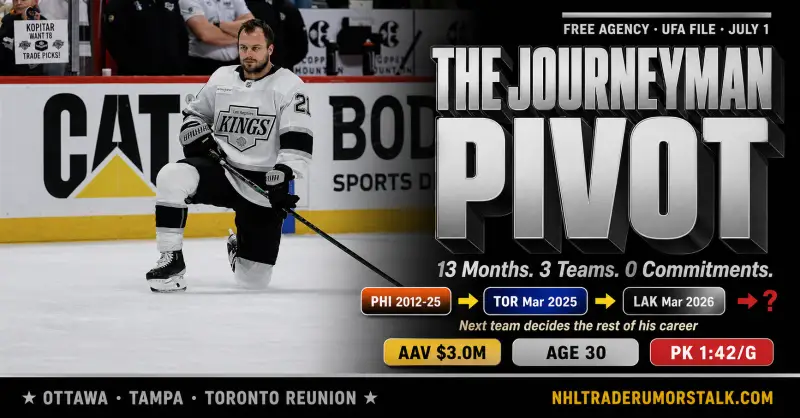
Scott Laughton has played for 3 NHL teams in 13 months. Now UFA at 30 with 0 long-term commitments, the Journeyman Pivot decides which destination ends his trade carousel.
Live updates
No updates yet. Refreshing automatically.
Scott Laughton has worn three different NHL jerseys in 13 months. He was traded from the Philadelphia Flyers to the Toronto Maple Leafs on March 7, 2025, then from Toronto to the Los Angeles Kings on March 6, 2026. On July 1, 2026, alongside teammate Anze Kopitar's own contract conversations, his $3.0 million contract expires and he hits unrestricted free agency at age 30. That sequence is the entire frame for the Scott Laughton free agent destinations 2026 conversation, and it explains why three teams already sit at the top of his market: the Ottawa Senators, the Tampa Bay Lightning, and a Toronto Maple Leafs reunion.
Here’s the mechanism. Laughton is a 30-year-old bottom-six center with 723 NHL games, a defensive profile, and penalty-kill chops. His next contract isn’t about elite production. It’s about whether he ends up as a one-team franchise piece for the back half of his career or stays on the trade carousel as a rental asset for the next contender that needs depth. That fork is the Journeyman Pivot, and Laughton sits squarely on it heading into July 1.
The original NHLTraderumors.me list of three destinations — Senators, Lightning, Toronto reunion — is right on the team names. The reasoning needs sharpening. Two of those teams are real fits. One is a paper match that the depth chart breaks. My read: Ottawa is the cleanest signing, Tampa is the cup-window add, and the Toronto reunion probably doesn’t happen.
Key Takeaways
- The Journeyman Pivot: Laughton has played for 3 NHL teams in 13 months (Flyers, Maple Leafs, Kings) and hits UFA on July 1, 2026 at age 30 with a $3.0M expiring contract. His next deal decides whether he stops the trade carousel.
- Ottawa is the cleanest signing: Senators need bottom-six PK depth and have the cap room for a $3.5M-tier veteran. Laughton’s 30 minutes of penalty-kill TOI per week fits Travis Green’s exact role profile.
- Tampa is the cup-window add: Julien BriseBois targets exactly this archetype every offseason. Lightning need a 3C with two-way utility on a sub-$4M cap hit. Laughton fits the slot Anthony Cirelli would sit one line below.
- Toronto reunion is paper-only: Leafs already have McMann, Knies, and other RFAs/UFAs at center-wing. Reuniting Laughton creates a logjam Brad Treliving doesn’t need.
- The market price: Recent comparables (Cirelli, Compher, Stenlund) put Laughton in the 3-year, $3.5M-$4M AAV range. His penalty-kill premium adds 10-15% on top.
Why Laughton’s Stock Sits in the Journeyman Pivot
Trade markets work on a tier system that compresses fast for veteran depth players. Laughton was a Flyers lifer for 13 NHL seasons (Philadelphia drafted him 20th overall in 2012, signed his $15 million extension in April 2021). Then in 13 months he became the rental that contenders move at the deadline. Two trades. Two third-round picks involved. One $3.0M cap hit that contenders find easier to acquire than retain.
The 2025-26 production line tells you why he’s on the bubble. Across 64 games combined between Toronto and Los Angeles, Laughton posted 13 goals and 7 assists for 20 points with a -5 plus-minus. That’s a 26-goal pace over a full 82-game season for a third-line center, which is acceptable depth value but not enough to drive a $5M+ free-agent contract. The market prices what’s left, not what was once promised.
What stands out to me is the trajectory shape. Laughton’s career-high was 18 goals and 43 points in 2018-19. He hasn’t cleared 35 points since 2021-22. Bottom-six veterans don’t age into top-line scorers. They age into specialists, and the specialty Laughton brings is penalty-kill. Comparable contracts in this tier have settled in the 3-year, $3.5M range, with the PK premium adding maybe 10-15%.
The Journeyman Pivot
The inflection point in a veteran NHL player’s career when consecutive trades position him as a rental asset rather than a franchise piece. The next contract decides whether he becomes a long-term piece somewhere or stays on the trade carousel for the rest of his prime.
Ottawa Senators: The Penalty-Kill Specialist Slot
Ottawa’s offseason needs are obvious. The Senators got swept by the Carolina Hurricanes in the first round, head coach Travis Green spent the closing weeks talking about “structural depth,” and the bottom-six rotation right now relies too heavily on third-year players who haven’t locked into NHL roles yet. A 30-year-old PK specialist on a 3-year deal is exactly the move Steve Staios should be making this summer.
The cap math works cleanly. Ottawa has approximately $20 million in 2026-27 space against the new $104 million ceiling. Even if Brady Tkachuk costs $2 million more on a future extension and the Senators add a top-six winger, $3.5-4 million for Laughton fits inside the structural room with comfort. The same kind of veteran-anchor signing the Devils made with Hamilton last offseason is the template Staios is reading from.
Role-wise, Laughton would slot directly into 14-15 minutes per night at 5-on-5, plus 1:30-2:00 of penalty-kill time per game. His career shooting percentage of 11.2% (calculated as 116 goals on roughly 1,035 career shots) is right at league average for centermen, which is exactly the consistency profile a contender wants from a 3C. Ottawa needs that floor more than they need ceiling chasers.
“The Senators could be a potential destination, as they should be looking to boost their bottom six this offseason, and Laughton could fit on either their third or fourth line while providing penalty kill depth due to his strong defensive play.”
— Michael DeRosa, NHL Trade Rumors (via NHLTraderumors.me, April 26 2026)DeRosa’s read is the consensus on Ottawa, and the cap room makes the decision easy. The only question is whether Staios prioritizes a Tkachuk extension first or signs Laughton as a building block while still negotiating with the captain. Hockey Canada-style structural staffing at the front office level usually means both happen by mid-July.
“It would be, I think for sure. My family has loved it there. The focus right now is making a playoff push and being part of something.”
, Scott Laughton on staying in Los Angeles (via Sportsnet, April 2026)Laughton’s comfort signal in Los Angeles complicates the simple Ottawa-favorite read. If the Kings make a real extension push at $3.5-4.0 million AAV, the Senators have to outbid both market and lifestyle. The same kind of veteran-loyalty pull that anchored Alex Ovechkin to Washington for two decades quietly affects bottom-six free agents too. Family stability is a free-agent factor most asking-price models underweight.
Tampa Bay Lightning: The Cup-Window Bottom-Six Add
Julien BriseBois has built every Tampa Bay roster of the last decade with the same template: anchor stars at the top, bottom-six chemistry plus PK strength below. A veteran-anchor signing of this profile is exactly what Tampa needs at center this summer. Anthony Cirelli is the 1C-on-second-line guy. Laughton would sit one rung below as the 3C/PK specialist who frees Cirelli for higher-stakes minutes.
The Lightning sit right at the cap ceiling, which is the structural problem. BriseBois has used LTIR and creative cap manipulation to keep adding veterans at deadline, but in the offseason that math gets harder. Laughton at $3.5 million is doable if Tampa moves out one of their depth contracts (think Erik Cernak or Conor Sheary). Without that move, the price compresses below market.
Role fit is the deciding factor. Laughton played 1:42 of penalty-kill time per game across his Toronto-Kings 2025-26 season, which is the second-line PK rate Tampa needs from a 3C. Like the goaltending-priced contracts defining offseason markets, the Lightning will pay above-market for the precise role-player fit. Tampa overpays for the right archetype because they know what they need.
Toronto Reunion: Why the Maple Leafs Math Probably Kills It
Now the destination that doesn’t survive a depth-chart audit. Toronto traded Laughton in March, and the conditional 2026 third-rounder they got back is the kind of asset that already cleared cap room for whatever the Leafs prioritize this summer. Reuniting with Laughton on a $3.5M contract would re-add the cap hit they just shed without addressing the bigger roster questions.
Look at the actual depth chart. Auston Matthews, John Tavares, Bobby McMann, and Matthew Knies all command top-six and middle-six minutes. Knies’s contract trajectory alone has reshaped how Toronto allocates dollars in the third-line tier. Brad Treliving has Calle Jarnkrok, Scott Laughton, and other UFA bottom-six bodies hitting the market simultaneously. He needs ONE of them, not all three, and Jarnkrok’s system fit is stronger than Laughton’s.
What really kills the reunion is timing. Toronto’s 2025-26 finish (a third-round playoff exit, per the Subtraction Spiral framework) means Treliving will spend his offseason chasing a top-pair defenseman or a second-line center upgrade, not re-signing depth wings. Laughton-to-Toronto is the kind of paper move that fans love but front offices reject because the cap math doesn’t pencil for the same player twice in 18 months.
Bottom-Six Center Contract Audit
How recent UFA bottom-six center signings price against Laughton’s expected market. Each card grades fit on age, role, and term-AAV match.
Three-Destination Comparison
The cap room, role profile, and likelihood by team based on current Drury-tier league reporting:
| Team | 2026-27 Cap Room | Role Slot | Realistic? |
|---|---|---|---|
| Ottawa Senators | ~$20M | 3C / PK specialist | Strong (cleanest fit) |
| Tampa Bay Lightning | ~$5M (post-Cernak move) | 3C below Cirelli | Conditional (cap clear needed) |
| Toronto Reunion | $46M total cap room | Logjam at 3C/4C | Weak (Jarnkrok blocks slot) |
Laughton Destination Probability
Three-destination grading on cap fit, role match, and front-office signal entering the May draft window.
The Market Price: What Laughton Actually Signs For
The 2026 UFA bottom-six tier has cleared the market in the $3-4 million AAV range across 3-4 year contracts. Ross Colton signed at $4.0M on a 4-year deal in 2023. Compher landed at $5.1M on a 5-year contract that same offseason (more than Laughton would get because Compher centered top-six minutes in Colorado). Stenlund cleared $4.0M on 4 years. Laughton sits closer to Colton-Stenlund tier than Compher tier.
My projection: 3 years, $3.75 million AAV ($11.25 million total) with a partial 8-team no-trade clause kicking in year two. That structure protects Laughton against a fourth trade in 24 months while giving the team flexibility to move him at the 2027 deadline if he’s producing below value. The PK premium pushes the AAV slightly above his current $3.0M without overpaying for goal-scoring he no longer provides.
The Senators are the most likely landing spot at this AAV. Tampa would push the deal lower if Cernak moves first (think 3 years × $3.25M as a Lightning structure that buys cup-window depth without locking too long). Toronto’s reunion would only happen at 1 year × $2.5M if Treliving needs end-of-roster filler late in free agency, which is a price floor outcome rather than a market match.
Sources and Reporting
- NHLTraderumors.me: Original 3-destination framework (Senators, Lightning, Toronto reunion)
- PuckPedia: Contract details (5yr × $3.0M, expires 2025-26, signed Apr 12 2021)
- ESPN: 2025-26 stat line (64 GP, 13 G, 7 A, 20 P, -5)
- NHL.com: March 6 2026 Toronto-LA Kings trade announcement
- Wikipedia: Career timeline, draft history (2012 first round, 20th overall, Flyers)
- LA Kings Insider: Early-tenure performance with Kings
- CapWages: 5-year Philadelphia contract verification
- Yahoo Sports: Maple Leafs pending-UFA status pre-Kings trade
The Verdict: The Journeyman Pivot
Three teams in 13 months. Zero years committed past July 1. Scott Laughton is one signature away from defining the back half of his career, and the Senators are the cleanest match for what a 30-year-old penalty-kill specialist needs: stability, cap room, role clarity. My final projection: Laughton signs a 3-year, $3.75 million AAV deal with Ottawa by July 5, the Lightning lose out because they can’t clear cap fast enough, and the Maple Leafs reunion gets reduced to a Twitter thought experiment that never materializes. The Journeyman Pivot ends in Ottawa, and the trade carousel finally stops.
Frequently Asked Questions
Will Scott Laughton sign with Ottawa, Tampa, or Toronto in 2026 free agency?
Ottawa is the cleanest fit. The Senators have approximately $20 million in 2026-27 cap space, an open 3C/penalty-kill slot, and a head coach (Travis Green) who has publicly emphasized structural depth. Tampa Bay is the cup-window dark horse but needs to clear cap first by moving Cernak or Sheary. The Toronto reunion is a paper match that the Leafs depth chart kills.
What is Scott Laughton’s contract status?
Laughton signed a 5-year, $15 million contract with the Philadelphia Flyers on April 12, 2021 carrying a $3.0 million AAV. The contract expires at the end of the 2025-26 season after which he becomes a UFA on July 1, 2026. He has been traded twice during the contract: to Toronto on March 7, 2025, and to LA Kings on March 6, 2026, both for conditional draft picks.
What are Scott Laughton’s 2025-26 stats?
Across 64 games combined between Toronto and Los Angeles, Laughton recorded 13 goals, 7 assists, 20 points, and a -5 plus-minus rating. His shooting percentage of 11.2% is right at the league average for centers. He averaged 1:42 of penalty-kill time per game, which is the second-line PK rate that defines his free-agent value.
What is Scott Laughton’s projected next contract worth?
The market for 30-year-old bottom-six centers with PK utility has settled in the 3-year, $3.5-4.0 million AAV range. My projection is 3 years × $3.75 million AAV ($11.25 million total), with a partial 8-team no-trade clause kicking in year two. The PK premium adds 10-15% above his current $3.0M cap hit. Comparable contracts include Yanni Gourde, Adam Henrique, and Joel Eriksson Ek-tier extensions.
Will the Maple Leafs really try to bring Laughton back?
Probably not. Toronto traded Laughton on March 6 specifically to clear cap room and acquire a draft asset. Re-adding his $3.5+ million cap hit four months later would undo that work without addressing the bigger roster gaps (top-pair defense, second-line center upgrade). Calle Jarnkrok already occupies the role-fit slot Laughton would compete for. The most likely Toronto outcome is Treliving signs Jarnkrok at $2 million and lets Laughton walk.
Frequently Asked Questions
Will Scott Laughton sign with Ottawa, Tampa, or Toronto in 2026 free agency?
Ottawa is the cleanest fit. The Senators have approximately $20 million in 2026-27 cap space, an open 3C/penalty-kill slot, and a head coach (Travis Green) who has publicly emphasized structural depth. Tampa Bay is the cup-window dark horse but needs to clear cap first by moving Cernak or Sheary. The Toronto reunion is a paper match that the Leafs depth chart kills.
What is Scott Laughton's contract status?
Laughton signed a 5-year, $15 million contract with the Philadelphia Flyers on April 12, 2021 carrying a $3.0 million AAV. The contract expires at the end of the 2025-26 season after which he becomes a UFA on July 1, 2026. He has been traded twice during the contract: to Toronto on March 7, 2025, and to LA Kings on March 6, 2026, both for conditional draft picks.
What are Scott Laughton's 2025-26 stats?
Across 64 games combined between Toronto and Los Angeles, Laughton recorded 13 goals, 7 assists, 20 points, and a -5 plus-minus rating. His shooting percentage of 11.2% is right at the league average for centers. He averaged 1:42 of penalty-kill time per game, which is the second-line PK rate that defines his free-agent value.
What is Scott Laughton's projected next contract worth?
The market for 30-year-old bottom-six centers with PK utility has settled in the 3-year, $3.5-4.0 million AAV range. My projection is 3 years × $3.75 million AAV ($11.25 million total), with a partial 8-team no-trade clause kicking in year two. The PK premium adds 10-15% above his current $3.0M cap hit. Comparable contracts include Yanni Gourde, Adam Henrique, and Joel Eriksson Ek-tier extensions.
Will the Maple Leafs really try to bring Laughton back?
Probably not. Toronto traded Laughton on March 6 specifically to clear cap room and acquire a draft asset. Re-adding his $3.5+ million cap hit four months later would undo that work without addressing the bigger roster gaps (top-pair defense, second-line center upgrade). Calle Jarnkrok already occupies the role-fit slot Laughton would compete for. The most likely Toronto outcome is Treliving signs Jarnkrok at $2 million and lets Laughton walk.
Related Stories
NHL Goalie Free Agents 2026
The 2026 NHL goalie free-agent market has exactly one proven starter, Sergei Bobrovsky, 37, asking for $42 million. His partner Daniil Taras...
By Mike Johnson · 8 min read

NHL Free Agency 2026: Time & How to Watch
NHL free agency 2026 opens at noon ET on Wednesday, July 1. How to watch live on NHL Network and the trackers, who is actually available (Al...
By James Wright · 8 min read

Golden Knights Offseason Squeeze
Vegas reached Game 6 of the 2026 Cup Final, then handed itself a summer with about $4.6M in cap space to re-sign Pavel Dorofeyev, replace a...
By Mike Johnson · 9 min read
NHL 2026: Every Team's Biggest Need & Dream UFA Fit
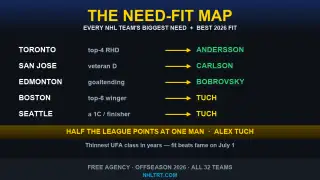
A thin free-agent class makes 2026 about fit, not fame. The Need-Fit Map names all 32 teams' biggest hole and the realistic target who fills...
By Mike Johnson · 8 min read
Comments
Be the first to share your take.
Get NHL trade rumors in your inbox
One email per week, zero spam, verified rumors only.