Rangers Offseason Trade Rumors 2026: Trocheck Schneider
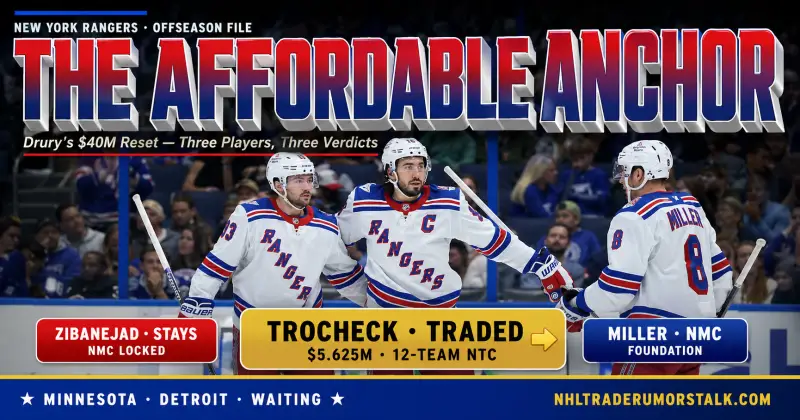
Drury's offseason reset hinges on trading Vincent Trocheck, the $5.625M Affordable Anchor. Inside the Wild and Red Wings destinations, plus why Schneider and Lafreniere stay.
Live updates
No updates yet. Refreshing automatically.
Chris Drury inherited a 33-37-9 record this season, the second consecutive year the New York Rangers missed the playoffs, and a $40 million projected 2026-27 cap-space window. He spent the closing months trading Artemi Panarin, Carson Soucy, Brennan Othmann, and Sam Carrick. None of those moves were the headline. The Rangers offseason trade rumors 2026 cycle is built around three players still on the roster: Vincent Trocheck, Braden Schneider, and Alexis Lafreniere. Trocheck is the most likely to actually move, and the reason is the Affordable Anchor framework that defines Drury’s next 60 days.
Here’s the mechanism. When a veteran’s AAV sits in the $5-6 million range and his contract has 3 years remaining, he becomes the rare asset that’s both retainable AND tradeable. Premium contracts are stuck. Cheap rentals don’t move the needle. The middle tier is where GMs can extract a young NHL-ready player as the centerpiece return. Trocheck’s $5.625 million AAV through 2028-29 sits exactly in that window. Drury is preparing to use him as the anchor of his summer reset.
The reporting layer makes this concrete. According to Elliotte Friedman on NHL Now in early March, Minnesota tried to acquire Trocheck at the deadline; the price was “very high” and Drury wasn’t boxed into a corner. The Minnesota Wild are still the leading favorite three weeks after the deadline closed. Detroit is the dark-horse second option per multiple insider reports. The 2026 NHL Draft Lottery on May 5 is the calendar pivot that opens the negotiation window.
Key Takeaways
- The Affordable Anchor: Trocheck’s $5.625M AAV through 2028-29 is the precise mid-tier window where Drury can extract a young NHL-ready player as the centerpiece. Friedman confirmed Minnesota tried at the deadline; the Wild remain the favorite for the offseason resumption.
- Trocheck’s NTC compression: His 12-team no-trade list shrinks to 10 teams on July 1, 2026, then to 6 teams from 2027-28 onward. The window for a clean trade is opening, not closing.
- Schneider is the second-most-likely move: The 24-year-old right-shot defenseman is an RFA whose value is at peak demand around the league. Rangers reportedly want NHL-ready return, not draft picks.
- Lafreniere is the foundation, not the chip: 24 goals and 57 points in 82 games at age 24, plus a 76-point pace through calendar 2026 (12 G in last 25 games). Trade is unlikely unless a top target like Robert Thomas becomes available.
- Cap space firepower: Rangers are projected to have approximately $40 million in 2026-27 space against a $104 million ceiling, the largest reset window of Drury’s tenure as GM.
Why the Affordable Anchor Frames Drury’s Summer
Drury’s January letter to fans formalized what the standings already suggested. The Rangers’ record, 33 wins against 37 regulation losses with 9 overtime defeats, was the worst Eastern Conference finish since the team’s last rebuild cycle. He committed to a “retool” with the explicit caveat that veteran trades were on the table. The deadline moves (Panarin to Los Angeles, Soucy to the Islanders, Othmann to Calgary, Carrick to Buffalo) were prologue. The summer is the actual story.
What separates a retool from a fire-sale is the asset selection logic. Drury can’t move Igor Shesterkin (NMC), Mika Zibanejad (NMC), Adam Fox (NMC), J.T. Miller (NMC), or Vladislav Gavrikov (NMC). The locked-in core has $40+ million in committed cap space, which limits the actual roster surgery to the layer of players in the $5-7 million AAV range with 2-4 years of contract control. That’s where the Affordable Anchor lives. Trocheck is the textbook example.
This isn’t a frame Drury invented. The Devils’ Dougie Hamilton retention conversation followed the same logic earlier this offseason, and the same dynamic shapes how teams price mid-tier veterans across the league. The Rangers just happen to have the cleanest example of the framework in their roster right now, plus the cap room to actually act on it.
The Affordable Anchor
A veteran whose mid-tier AAV ($5-6M range) and 3-year contract length make him simultaneously retainable AND tradeable. He becomes the central asset a GM uses to anchor an offseason reset, because premium contracts can’t move and cheap rentals don’t move the needle. The middle tier is where young NHL-ready players come back in trade.
Vincent Trocheck: The Most Likely Move
Trocheck’s 2025-26 line was 16 goals, 37 assists, and 53 points across 67 games, with a strong defensive layer. He won 56.9 percent of his faceoffs (top-quartile in the league for centermen logging 17-plus minutes), recorded 193 hits, and chipped in two shorthanded goals. He’s not in decline. He’s the kind of two-way center contenders consistently overpay for at the deadline.
The contract structure is what makes him the cleanest move. PuckPedia confirms his 7-year, $39.375 million deal signed July 2022 carries a $5.625 million cap hit through 2028-29. The no-trade clause structure runs 12 teams in 2025-26, drops to 10 on July 1, and shrinks further to 6 teams from 2027-28 onward. That kind of NTC compression schedule is a deliberate feature, not a bug. It tells you Drury and Trocheck’s agent built the contract anticipating a possible mid-deal move.
“Re Vincent Trocheck: I do think Minnesota tried; the price was very high; [the Rangers are] not boxed into the corner with Trocheck, ‘cause they still have him under contract for 3 more years.”
— Elliotte Friedman, NHL Now (via NHL Rumour Report, March 6 2026)Friedman’s March reporting matters because it locked in Minnesota as the destination of record. Bill Guerin spent the season as the most aggressive GM in the league, having already acquired Quinn Hughes and signed Kirill Kaprizov to the largest contract in NHL history. The Wild’s remaining gap is depth at center, the exact role Trocheck plays. The 4-3 OT loss to Colorado in the first round of the 2026 playoffs reinforced what Guerin already knew about his middle-six center group.
The Detroit Red Wings are the realistic backup. Steve Yzerman’s Red Wings missed the playoffs and have approximately $31 million in 2026-27 cap room, plus a clear need for a 2C with playoff experience. Yzerman’s architectural approach to roster construction has historically favored exactly the Trocheck profile. The asking-price standoff at the deadline was about asset value, not fit, and that conversation reopens cleanly in late June.
Braden Schneider: The 24-Year-Old RFA Wild Card
Schneider is the second name on the trade chatter board, and it’s for a non-obvious reason. The Rangers don’t actively want to move him. Multiple teams want him enough that Drury has to at least listen. PuckPedia has Schneider on a 2-year, $4.4 million contract that expires this offseason, making him a restricted free agent with arbitration rights. His age and right-shot status combine into the rarest combination in defenseman trade markets.
The 2025-26 stat line tells the value story. Across 80 games, he posted 6 goals and 21 points with a plus-9 rating, 145 blocked shots, 146 hits, and 95 shots on goal. The points-per-game rate of 0.26 looks modest until you control for usage. He’s logging 19-plus minutes against top-six lines, taking on the dirty defensive minutes that don’t generate points but do generate playoff-team value. That’s the Schneider profile contenders pay a premium for.
The reported Rangers position is they want NHL-ready forward in any Schneider package, not draft picks. The Blues’ Kyrou-style trade-asset play shows how a young forward can headline a defenseman-out package, and Drury appears to be steering Schneider conversations in exactly that direction. San Jose was specifically named by The Athletic as a forward-rich, defense-needy partner, and the Sharks just moved several depth pieces to clear room for an upgrade defensive cycle.
Alexis Lafreniere: Why a Trade Is Unlikely
Lafreniere finished 2025-26 with 24 goals, 33 assists, and 57 points across all 82 games. The headline is the post-Panarin stretch. After the deadline trade sent Panarin to Los Angeles, Lafreniere posted 12 goals and 25 points across the Rangers’ final 25 games. His calendar 2026 line (16 G, 21 A, 37 P in 40 games) projects to a 76-point pace over a full season. The shooting profile underlines the breakout.
His 14.6% shooting percentage (calculated as 24 goals on roughly 165 shots) sits in the top quartile for left wings under age 25. Volume plus efficiency at his age, on a 7-year, $7.45 million AAV deal signed in 2024, makes him exactly the asset profile other teams want and the Rangers can’t afford to move. The same draft-year-ascendant pattern Cole Eiserman is showing across the river is what Lafreniere finally delivered in his sixth NHL season.
The Adam Gretz exception keeps the door technically open. Gretz wrote at Bleacher Report that Drury could trade Trocheck (or Lafreniere as part of a bigger package) for St. Louis Blues center Robert Thomas, the 26-year-old whose contract runs through 2030-31. Thomas at 26 with five years of cost certainty is the kind of first-line center a real retool needs. The Lafreniere-for-Thomas math doesn’t work straight up, but if Drury could combine Trocheck plus a young asset to land Thomas, the cap structure penciling out shifts dramatically.
Drury’s Three-Layer Trade Probability Audit
Each candidate sits at a different point on the move-vs-stay scale. The grading framework I’ve built combines GM intent, player veto power, asking-price flexibility, and demand-side market depth. Trocheck scores high on all four. Schneider scores high on three. Lafreniere only scores on demand.
Rangers Trade Probability Audit
Move-probability grading on Drury’s three trade-discussion subjects entering the May draft lottery window.
Trocheck Trade Return Audit
The asset categories Drury is most likely to receive in a Trocheck deal, scored against current league trade-market behavior.
Three-Candidate Comparison
The contract math, age, and 2025-26 production line for each trade-conversation subject:
| Player | AAV / Term | Age | 2025-26 Stats |
|---|---|---|---|
| Vincent Trocheck | $5.625M / 3 yrs | 32 | 67 GP, 16 G, 53 P |
| Braden Schneider | $2.2M / RFA | 24 | 80 GP, 6 G, 21 P, +9 |
| Alexis Lafreniere | $7.45M / long-term | 24 | 82 GP, 24 G, 57 P |
The Drury Doctrine in Practice
Drury’s deadline blueprint already shipped four veterans for picks and prospects: Panarin to Los Angeles, Soucy to the Islanders, Othmann to Calgary, Carrick to Buffalo. Three of those four were rentals. The Panarin move was the headline because of his profile, but the structural read on each deal was identical: clear cap, secure asset return, signal the retool direction to the locker room. That logic explicitly continues in June.
“I want to be here to turn this around.”
— Mika Zibanejad, Rangers center, at breakup day (via NHL.com)Zibanejad’s commitment matters because he holds a no-movement clause and could have signaled a willingness to be moved. He didn’t. The locked-in core (Shesterkin, Zibanejad, Fox, Miller, Gavrikov) tells you what stays. Shesterkin’s $92 million extension structure is the cap anchor that defines the rest of the build. Drury isn’t reshaping the team. He’s reshaping the layer just outside the core.
What stands out to me is the cap-space arithmetic. Rangers are projected to enter the offseason with approximately $40 million of room (the Athletic’s March projection was $27.5 million, but the recent cap-rise to $104 million pushed the figure higher). That’s enough to absorb a Trocheck trade plus add a $6 million-tier free agent plus retain Schneider through arbitration. The math says the retool is fully fundable inside one offseason.
The Robert Thomas Wildcard and What Comes Next
The Adam Gretz idea, published at Bleacher Report this week, is the editorial pivot worth taking seriously. Gretz argued that Drury should trade Trocheck (and possibly more) to acquire Robert Thomas from St. Louis. Thomas is 26 with a contract running through 2030-31, off a 90-point season for the Blues. If the Blues are willing to move him (and they’re not, currently), he’s the foundational first-line center the Rangers need.
The asking price for Thomas is reportedly four first-round picks plus prospect filler, which is the kind of asset cost the Blues already used to set the market. The current Vancouver-style trade-conversation environment shows how a desperate buyer can accelerate a market that wasn’t supposed to open. Drury isn’t in that desperate position, but he does have the assets if the Blues blink.
My projection: Drury moves Trocheck to Minnesota by July 5 in exchange for Marco Rossi or a Wild prospect package centered on a young forward, plus a 2026 first-round pick. Schneider gets a 4-year extension at $4.5 million AAV rather than being moved (Drury keeps him because the trade market couldn’t deliver an NHL-ready forward at his price). Lafreniere stays. The Rangers enter 2026-27 with the same locked-in core, a younger 2C, and $20 million in flex room to chase a free-agent winger. That’s the Affordable Anchor working as designed.
Sources and Reporting
- NHL.com: Drury retool letter and locker-room context
- The Athletic (Baugh + Mercogliano): Three-name trade-candidate framework
- NHL Rumour Report (Friedman): Minnesota tried at deadline, “not boxed in” quote
- PuckPedia: Trocheck contract and NTC structure
- ESPN: Trocheck 2025-26 stats
- PuckPedia (Lafreniere): 7yr × $7.45M contract details
- PuckPedia (Schneider): RFA status and current cap hit
- Bleacher Report (Gretz): Trocheck-for-Robert Thomas proposal
- Forever Blueshirts: Lafreniere post-Panarin breakout reporting
The Verdict: The Affordable Anchor
Drury’s offseason isn’t a fire-sale and it isn’t a stand-pat. It’s the cleanest example in the league this summer of a GM using a mid-tier veteran as the asset that anchors a younger return. Trocheck moves. Schneider probably doesn’t. Lafreniere stays. The Affordable Anchor isn’t a slogan, it’s the math that defines what gets done in the next 60 days. My final projection: by the July 5 buyout window, the Rangers will have completed at least one major roster surgery, and Trocheck will be wearing a Wild sweater for the start of 2026-27.
Frequently Asked Questions
Will Vincent Trocheck be traded by the New York Rangers in 2026?
Probably yes. Per Friedman’s reporting, Minnesota was the closest team at the trade deadline (deal “on the table” per insider speak), and the asking price standoff has had two months to soften. Trocheck’s $5.625M AAV through 2028-29 fits the cap math for multiple contenders. His 12-team no-trade list shrinks to 10 on July 1, expanding the destination market just as offseason trade volume peaks.
What is Vincent Trocheck’s contract?
Trocheck signed a 7-year, $39,375,000 deal with the Rangers in July 2022, carrying a $5,625,000 cap hit. The contract runs through the 2028-29 season, after which he becomes an unrestricted free agent on July 1, 2029. The no-trade clause structure is graduated: 12 teams in 2025-26, 10 teams in 2026-27, and 6 teams from 2027-28 onward.
Why is Braden Schneider on the trade discussion list?
Schneider is a 24-year-old right-shot defenseman with arbitration rights as an RFA this summer. Right-shot defensemen at his age and usage profile are scarce in the trade market, and multiple teams reportedly inquired before the deadline. The Rangers want NHL-ready forward in any package, not draft picks. San Jose, Vancouver, and Boston have been named as potential partners by The Athletic.
Why is Alexis Lafreniere unlikely to be traded?
Lafreniere’s 24 goals and 57 points in 82 games at age 24 represent his best NHL season, and his 76-point pace through calendar 2026 makes him a foundation piece. He’s on a 7-year, $7.45 million AAV deal signed in 2024, which the Rangers can’t replace via trade or free agency. He moves only if a top target like Robert Thomas becomes available in a larger package.
How much cap space do the Rangers have for 2026-27?
The Rangers project approximately $40 million in 2026-27 cap space against the new $104 million salary cap ceiling. The Athletic’s March estimate was $27.5 million, but the cap-rise factor pushed the working number into the $35-40 million range. The May 5 draft lottery (Rangers hold 11.5% odds at first overall) is the next major calendar pivot, with significant trade activity expected between June 27 (NHL Draft) and July 1 (free agency open).
Frequently Asked Questions
Will Vincent Trocheck be traded by the New York Rangers in 2026?
Probably yes. Per Friedman's reporting, Minnesota was the closest team at the trade deadline (deal "on the table" per insider speak), and the asking price standoff has had two months to soften. Trocheck's $5.625M AAV through 2028-29 fits the cap math for multiple contenders. His 12-team no-trade list shrinks to 10 on July 1, expanding the destination market just as offseason trade volume peaks.
What is Vincent Trocheck's contract?
Trocheck signed a 7-year, $39,375,000 deal with the Rangers in July 2022, carrying a $5,625,000 cap hit. The contract runs through the 2028-29 season, after which he becomes an unrestricted free agent on July 1, 2029. The no-trade clause structure is graduated: 12 teams in 2025-26, 10 teams in 2026-27, and 6 teams from 2027-28 onward.
Why is Braden Schneider on the trade discussion list?
Schneider is a 24-year-old right-shot defenseman with arbitration rights as an RFA this summer. Right-shot defensemen at his age and usage profile are scarce in the trade market, and multiple teams reportedly inquired before the deadline. The Rangers want NHL-ready forward in any package, not draft picks. San Jose, Vancouver, and Boston have been named as potential partners by The Athletic.
Why is Alexis Lafreniere unlikely to be traded?
Lafreniere's 24 goals and 57 points in 82 games at age 24 represent his best NHL season, and his 76-point pace through calendar 2026 makes him a foundation piece. He's on a 7-year, $7.45 million AAV deal signed in 2024, which the Rangers can't replace via trade or free agency. He moves only if a top target like Robert Thomas becomes available in a larger package.
How much cap space do the Rangers have for 2026-27?
The Rangers project approximately $40 million in 2026-27 cap space against the new $104 million salary cap ceiling. The Athletic's March estimate was $27.5 million, but the cap-rise factor pushed the working number into the $35-40 million range. The May 5 draft lottery (Rangers hold 11.5% odds at first overall) is the next major calendar pivot, with significant trade activity expected between June 27 (NHL Draft) and July 1 (free agency open).
Related Stories

Golden Knights Offseason Squeeze
Vegas reached Game 6 of the 2026 Cup Final, then handed itself a summer with about $4.6M in cap space to re-sign Pavel Dorofeyev, replace a...
By Mike Johnson · 9 min read
Hischier Trade Clock Hits July 1
Nico Hischier trade rumors are rising: extension talks with new GM Sunny Mehta are in their infancy, Montreal, LA and Minnesota are circling...
By Mike Johnson · 9 min read

Larkin-Robertson Swap: Who Says No?
Dallas has checked in on Dylan Larkin, but the Stars cannot fit his $8.7M until Jason Robertson and his unsigned $14M ask move out. Inside t...
By Mike Johnson · 11 min read

Darnell Nurse Trade: 4 Suitors
Edmonton wants Darnell Nurse's $9.25M off the books, but a buyout saves barely $1.53M and his no-move clause hands him the pen. The Bonus Sh...
By Mike Johnson · 12 min read
Comments
Be the first to share your take.
Get NHL trade rumors in your inbox
One email per week, zero spam, verified rumors only.