Sharks Rejected Canucks Chernyshov Trade Offer 2026
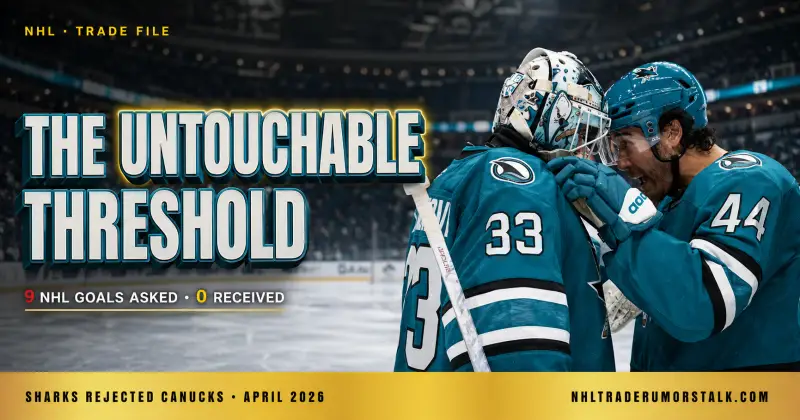
Friedman confirmed Vancouver opened the Sherwood trade talks by asking for Igor Chernyshov. Mike Grier said no. Inside the Untouchable Threshold the Canucks crossed three months too late.
Live updates
No updates yet. Refreshing automatically.
On April 17, Elliotte Friedman dropped a single sentence in his 32 Thoughts column that explained why the Vancouver Canucks finished a franchise-worst 58-point season. Vancouver, Friedman reported, initially asked for Sharks rookie Igor Chernyshov in the Kiefer Sherwood trade talks. Chernyshov, a 20-year-old top-line forward, already had 9 NHL goals in his rookie season. Mike Grier said no, and Vancouver eventually got two second-round picks plus a 25-year-old undrafted defenseman in Cole Clayton.
That’s the Untouchable Threshold in one paragraph. Some young prospects cross a developmental line where they stop being trade-eligible, not because their team can’t move them, but because the team finally has a reason to refuse. Chernyshov hit that line somewhere between his September AHL start and his late-season promotion to Macklin Celebrini’s wing. The Sharks rejected the Canucks’ Chernyshov trade offer in 2026 because, by the time Vancouver called, the prospect was no longer a prospect.
The trade itself happened January 19, 2026, per TSN’s reporting: Sherwood for two seconds and Cole Clayton. The original ask, the one Friedman just confirmed three months later, is the story competitors missed. It tells you how Mike Grier reads his own roster, and why Jim Rutherford’s GM search is happening in chaos two weeks before the May 5 draft lottery.
Key Takeaways
- The Untouchable Threshold: Friedman confirmed Vancouver’s opening ask was Igor Chernyshov, a 2024 2nd-round pick already producing 9 goals and 19 points in 28 NHL games as a 20-year-old rookie alongside Macklin Celebrini.
- What Vancouver actually got: Two second-round picks (2026, 2027) and Cole Clayton, an undrafted 25-year-old defenseman with 257 AHL games and zero career NHL goals.
- Mike Grier’s hard line: The Sharks GM has publicly said his trade philosophy is “guys in their 20s who can keep growing with the group,” making Chernyshov the textbook untouchable example.
- Sherwood landed his contract extension: San Jose extended the 31-year-old winger to a 5-year, $28.75 million deal in March, locking him through 2030-31 at a $5.75M AAV.
- The bigger Vancouver problem: Allvin was fired the same day Friedman published, April 17, 2026, capping a 58-point season that’s now 14 points below the 30th-place team.
The Untouchable Threshold: How Chernyshov Crossed the Line
Trade markets work on a moving threshold that’s invisible until somebody crosses it. A 2024 second-round pick playing in the AHL is a tradeable asset. The same player at age 20, with 33 points in 41 AHL games, then 9 goals and 19 points in 28 NHL games, slotting into the top line alongside a 110-point Celebrini and Will Smith, is a different player entirely. Mike Grier’s only job in January was recognizing the gap between those two versions.
The numbers tell you he did. Chernyshov’s NHL pace, 9 goals in 28 games, projects to roughly 26 goals over an 82-game schedule, which would land him in the upper third of NHL rookies in any normal season. His shooting profile is the kind of high-event Russian skill set Sharks scouts identified at the 2024 draft when they took him 33rd overall. He doesn’t need ideal deployment to drive offense, which is exactly the trait you protect when you’re rebuilding around Macklin Celebrini.
What stands out to me is the timing of Vancouver’s ask. The trade went through January 19, which means the asking conversation likely started in early January or late December. Chernyshov had already racked up over 30 AHL points and was on the radar for a call-up. By the time the deal closed, he’d be in San Jose’s NHL lineup, and Vancouver was asking Grier to trade a prospect who was in the process of stepping out of prospect status in real time.
The Untouchable Threshold
The developmental moment when a young player’s trade value compounds faster than buyers can keep up with. NHL goals as a 20-year-old, a top-line role with a star center, AHL dominance: once a prospect lights up two of those three signals in the same season, the asking team’s window has closed. The Threshold is invisible until someone crosses it.
Vancouver’s Calculation: Why They Went Big From the Start
The Canucks’ opening ask wasn’t unreasonable on paper. Sherwood was 30 at the time, on a pending UFA, and posting career-best numbers (17 goals in 44 games before the trade, on pace for a 32-goal season). Hits leaderboard, top-line versatility, two-way utility. That’s a real asset, and asking for a young top-six forward in return is the textbook front-office move.
What it ignored was the buyer’s depth chart. San Jose has Celebrini, Will Smith, William Eklund, and Chernyshov as their core young top-six forward group, with the latter two now signed through 2027 and beyond. Sherwood didn’t move San Jose’s needle into contention. Sherwood was insurance, a winger who could play above his AAV on a young team that needs veteran finishing. That’s worth two second-rounders. It isn’t worth a 20-year-old top-six prospect.
My read: Patrik Allvin’s front office was operating from a playoff-window scenario the team had already exited. Vancouver’s record this year exposed how disconnected that calculation was. You don’t ask for a generational-age forward when your roster is heading for a 58-point finish. You ask for first-round picks and prospects you can stack on top of a McKenna-tier draft pick. Allvin’s instinct was right to ask big. His asset target was wrong.
It’s the same pattern that haunted Vancouver’s deadline-week calls all year. The Hoglander market collapse in February showed how badly the front office was reading its own assets, and the Sherwood-for-Chernyshov ask was the same arithmetic with a different name on the asking side.
“I think Vancouver initially asked for Igor Chernyshov when they were talking about Kiefer Sherwood.”
— Elliotte Friedman, 32 Thoughts (via Sportsnet, April 17, 2026)Friedman’s reporting matters because it surfaces what front offices ask for, not just what they get. Trade post-mortems usually focus on the closed deal. The opening ask is where you see the buyer’s worldview, and Vancouver’s worldview, three months before the GM search began, was already misaligned with the team’s actual position.
Mike Grier’s Hard Line: The 20-Something Window
Grier has been more public about his trade philosophy than most GMs in his position. At the deadline, he told reporters his target profile is “guys in their 20s who can keep growing with the group.” Chernyshov is exactly that, a 20-year-old who fits the development-curve window Grier cares about more than any individual trade return. The Sharks GM made his bones by drafting and retaining young talent, not by flipping it for short-term help.
The numbers underline why he wouldn’t move. Chernyshov’s 4 goals and 1 assist over the last 5 games of his second NHL stint isn’t the bottom-six call-up profile that gets traded for picks. It’s the profile of a top-six forward in the second half of his rookie year. Grier signed Eklund to a 3-year extension last summer and is already prepping Celebrini for an 8-year max contract on July 1. Adding Chernyshov to that mix is the lock, not an asset to liquidate.
What Grier was willing to move was the surplus. The Edmonton Oilers’ 2026 first-round pick (acquired in a previous trade) was reportedly on the table at the deadline. Veterans like Tyler Toffoli or even Timothy Liljegren got moved. The young core stayed put. That’s the kind of clear roster sorting that separates rebuilds in their fourth year from teams stuck in perpetual transition.
“That’s the discipline I have to have, as well as this year went, with the excitement that’s in the building and in the fanbase, to not overstep and do something that, in two years, we’re regretting.”
— Mike Grier, end-of-season exit interview (via NBC Sports Bay Area, April 2026)That sentence is the entire Sharks rebuild thesis, applied. Grier’s discipline this year is the opposite of the architect-ceiling problem that has Detroit stuck in playoff-window denial. The next GM who calls about a young Sharks forward will know the answer before they pick up the phone.
What Vancouver Actually Got: The Negotiation Gap
Here’s the deal that got done: Sherwood for two second-round picks (2026, 2027) and Cole Clayton. Clayton is 25, undrafted out of WHL Medicine Hat, with 257 AHL games between Cleveland and the Barracuda. He went to the 2024 Eastern Conference Finals with the Monsters and signed a one-year, $775,000 deal with San Jose last offseason. He’s a depth defenseman, not a prospect.
The two second-round picks have real value, especially for a team heading to a draft where the talent at the top of the board is genuinely elite. Gavin McKenna is the projected first overall pick after a 110-point freshman season at Penn State, and the secondary class around him is deep enough that two extra seconds give Vancouver real flexibility on draft day. That’s the win Allvin walked away with.
The negotiation gap, though, is what’s worth tracking. Vancouver opened with a 20-year-old top-six prospect. Vancouver closed with two seconds and a depth defenseman. That’s the asset compression Sherwood-tier rentals always produce, and it’s the math teams forget when they overvalue their own pending UFAs. Even the four-first-round-pick valuation chase the Blues used as a deadline anchor came out the same way: the market doesn’t reward what you used to be worth, it prices what’s left.
The Sherwood Trade: 3-Month Audit
Three-team grade card on the January 19 deal, scored against what each side actually walked away with.
Trade Asset Comparison
The deal in numbers, side by side, after three months of Sharks development on Chernyshov:
| Asset | Age | 2025-26 NHL Stats | Status |
|---|---|---|---|
| Igor Chernyshov (asked) | 20 | 9 G, 19 P in 28 GP | Top line w/ Celebrini |
| Kiefer Sherwood (sent) | 31 | 18 G, 25 P in 49 GP | Signed 5yr/$28.75M with SJS |
| Cole Clayton (received) | 25 | AHL primary, recalled briefly | Depth dman in Abbotsford |
Historical Parallel: When the Big Ask Becomes the Smaller Deal
This isn’t the first time a buyer’s opening trade ask got publicly exposed three months after the fact. The closest parallel is the 2018 Tomas Tatar trade between the Red Wings and Vegas, where Detroit’s reported initial ask included Cody Glass, Vegas’s then-top prospect, who is no longer a Knight. Vegas held the line, Tatar got moved for picks plus a prospect that wasn’t Glass, and the “ask” story leaked over the following months. Detroit’s window for that ask had closed by the time they made the call.
The Chernyshov-for-Sherwood ask is the same template, just earlier in the prospect’s development. Vancouver wasn’t out of line to try. Grier’s job was to recognize the inflection point in his own roster faster than the market did, and based on Chernyshov’s NHL pace since the trade closed, he did exactly that. The lesson for buying GMs is consistent across two decades: the moment a young player’s trajectory changes, the asking price has to move with it.
That sentence is the entire Sharks rebuild thesis. Grier won’t trade his 20-somethings, and now the rest of the league has the receipt to prove it.
Sources and Reporting
- NHL.com: Official trade announcement (Jan 19, 2026)
- PuckPedia: Full trade asset breakdown and contract context
- TSN: Sherwood-Sharks trade reporting and stats at trade time
- Daily Faceoff: Canucks GM search and Allvin firing context
- ESPN: 58-point season, Allvin firing announcement
- San Jose Hockey Now: Grier 20-something quote and trade strategy
- NBC Sports Bay Area: Grier exit interview discipline quote
- Wikipedia: Chernyshov draft history and career timeline
- Canucks Army: Cole Clayton background and asset analysis
The Verdict: The Untouchable Threshold
The closing trade looks reasonable on paper for both sides. San Jose got the rental finisher they needed and locked him long-term, Vancouver got two second-round picks heading into a deep draft, and Cole Clayton became Abbotsford depth. The opening ask is where the franchise gap shows up. Vancouver thought Chernyshov was tradeable. San Jose knew he wasn’t. My projection: this is the last time anyone calls Mike Grier about a Sharks 20-something forward until the team’s actually contending, which is the entire point of the Untouchable Threshold. Once a young player crosses it, the trade window doesn’t reopen on the buyer’s schedule.
Frequently Asked Questions
Why did the Sharks reject the Canucks’ initial trade offer for Kiefer Sherwood?
The Sharks rejected Vancouver’s opening ask because it included Igor Chernyshov, San Jose’s 2024 second-round pick (33rd overall) who was already producing on the top line with Macklin Celebrini. GM Mike Grier had publicly said his trade target profile is “guys in their 20s who can keep growing with the group,” making Chernyshov untouchable. Vancouver eventually settled for Cole Clayton and two second-round picks.
What did the Canucks actually get for Kiefer Sherwood?
Vancouver received defenseman Cole Clayton plus second-round picks in the 2026 and 2027 NHL Drafts. Clayton, 25, is a right-shot defenseman from Strathmore, Alberta, and signed a one-year $775,000 deal with San Jose before being moved. He played briefly in Vancouver before being assigned to the Abbotsford Canucks of the AHL, where he had been projected as a depth call-up option.
Who is Igor Chernyshov and why is he untouchable?
Chernyshov is a 20-year-old Russian left wing the Sharks selected 33rd overall in the 2024 NHL Draft from Dynamo Moscow in the KHL. Through his first two NHL stints in 2025-26, he posted 9 goals and 19 points in 28 games, including 4 goals in his last 5 games of his second call-up. He’s currently slotted on the top line alongside Celebrini and Will Smith.
How did Kiefer Sherwood do after the trade to San Jose?
Sherwood signed a five-year, $28.75 million contract extension with the Sharks in March 2026, locking him through the 2030-31 season at a $5.75 million AAV. His season totals across both teams reached 18 goals, 25 points, and a league-leading 238 hits in 49 games. The contract makes him one of San Jose’s longest-tenured veterans on a roster otherwise built around 20-something forwards.
When is the 2026 NHL Draft Lottery and how does it affect Vancouver?
The 2026 NHL Draft Lottery is scheduled for May 5, 2026. Vancouver finished with the league’s worst record at 58 points, 14 points behind the 30th-place team, making them the favorite to land the No. 1 overall pick. Penn State freshman Gavin McKenna, the projected first overall selection, posted 110 points in his draft season and is widely regarded as a generational talent.
Frequently Asked Questions
Why did the Sharks reject the Canucks' initial trade offer for Kiefer Sherwood?
The Sharks rejected Vancouver's opening ask because it included Igor Chernyshov, San Jose's 2024 second-round pick (33rd overall) who was already producing on the top line with Macklin Celebrini. GM Mike Grier had publicly said his trade target profile is "guys in their 20s who can keep growing with the group," making Chernyshov untouchable. Vancouver eventually settled for Cole Clayton and two second-round picks.
What did the Canucks actually get for Kiefer Sherwood?
Vancouver received defenseman Cole Clayton plus second-round picks in the 2026 and 2027 NHL Drafts. Clayton, 25, is a right-shot defenseman from Strathmore, Alberta, and signed a one-year $775,000 deal with San Jose before being moved. He played briefly in Vancouver before being assigned to the Abbotsford Canucks of the AHL.
Who is Igor Chernyshov and why is he untouchable?
Chernyshov is a 20-year-old Russian left wing the Sharks selected 33rd overall in the 2024 NHL Draft from Dynamo Moscow in the KHL. Through his first two NHL stints in 2025-26, he posted 9 goals and 19 points in 28 games, including 4 goals in his last 5 games of his second call-up. He's currently slotted on the top line alongside Celebrini and Will Smith.
How did Kiefer Sherwood do after the trade to San Jose?
Sherwood signed a five-year, $28.75 million extension with the Sharks in March 2026, locking him through the 2030-31 season at a $5.75 million AAV. His season totals across both teams reached 18 goals, 25 points, and a league-leading 238 hits in 49 games. The contract makes him one of San Jose's longest-tenured veterans.
When is the 2026 NHL Draft Lottery and how does it affect Vancouver?
The 2026 NHL Draft Lottery is scheduled for May 5, 2026. Vancouver finished with the league's worst record at 58 points, 14 points behind the 30th-place team, making them the favorite to land the No. 1 overall pick. Penn State freshman Gavin McKenna, the projected first overall selection, posted 110 points in his draft season.
Related Stories

Golden Knights Offseason Squeeze
Vegas reached Game 6 of the 2026 Cup Final, then handed itself a summer with about $4.6M in cap space to re-sign Pavel Dorofeyev, replace a...
By Mike Johnson · 9 min read
Hischier Trade Clock Hits July 1
Nico Hischier trade rumors are rising: extension talks with new GM Sunny Mehta are in their infancy, Montreal, LA and Minnesota are circling...
By Mike Johnson · 9 min read
Larkin-Robertson Swap: Who Says No?
Dallas has checked in on Dylan Larkin, but the Stars cannot fit his $8.7M until Jason Robertson and his unsigned $14M ask move out. Inside t...
By Mike Johnson · 11 min read

Darnell Nurse Trade: 4 Suitors
Edmonton wants Darnell Nurse's $9.25M off the books, but a buyout saves barely $1.53M and his no-move clause hands him the pen. The Bonus Sh...
By Mike Johnson · 12 min read
Comments
Be the first to share your take.
Get NHL trade rumors in your inbox
One email per week, zero spam, verified rumors only.