Carey Price NHL Comeback 2026: The Cartilage Ceiling
The Carey Price NHL comeback 2026 story broke in Moncton on April 17: Price tried returning to Montreal last season, woke up with knee pain, shut it down in 24 hours. Inside the Cartilage Ceiling that ended his career.
Live updates
No updates yet. Refreshing automatically.
The Carey Price NHL comeback 2026 story broke in Moncton on April 17, when Price reportedly told a fan he tried returning to the Habs last season — felt great one night, woke up with knee pain the next morning, shut everything down by lunch.
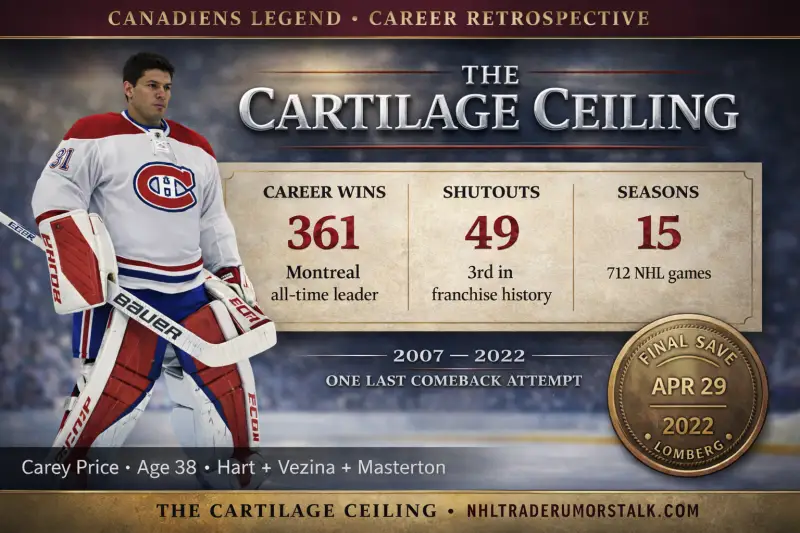
That's what I'm calling the Cartilage Ceiling — the structural physical limit that ended the winningest goaltender in Canadiens history. 361 regular-season wins. 49 shutouts. 1 morning of knee pain that closed the door for good. Price now wants to coach goalies for Montreal instead.
The Carey Price NHL comeback 2026 revelation came from Moncton fan Paul Langille on April 18, not from Price himself — but the details match everything we know about the knee that ended his career. Price told the fan he attempted a comeback to Montreal during the 2024-25 season, felt physically ready after a training block, and woke up the next morning with knee pain severe enough to end the effort in under 24 hours. He hasn't suited up in an NHL game since April 29, 2022, a 712-game Hall of Fame career closed by an osteochondral defect that left his right knee joint almost bone-on-bone after a 2021 meniscus surgery revealed far worse damage underneath.
Here's the mechanism — the Cartilage Ceiling that no amount of rehabilitation can push through: Price's surgical team found cartilage worn completely off his femoral condyle. The invasive corrective procedure offered would have required transplanting cartilage from another part of his leg, a surgery Price declined. Instead, he tried to push through the 2021-22 season with the knee he had, played five games (1-4-0, 3.63 GAA, .878 SV%), and retired to long-term injured reserve when the swelling returned after every on-ice session.
My read: this reported comeback attempt tells you more about where Price is mentally than anything his official silence has. A player who missed April 29, 2022 enough to try again in 2024-25 isn't done with hockey — he's just done playing it. The goalie-coach pivot he reportedly mentioned to Langille is the actual next chapter, and Montreal has been preparing for this transition since they asked him about a player-development role in 2023.
Key Takeaways
- The Cartilage Ceiling: Price attempted a comeback during the 2024-25 season, trained to NHL readiness, then woke up with knee pain that ended the effort inside 24 hours. His surgically compromised right knee can't sustain goaltending loads no matter how fit the rest of him gets.
- Career scale: 712 regular-season NHL games, 361 wins (Montreal all-time leader), 2.51 career GAA, .917 SV%, and 49 shutouts (third in franchise history behind George Hainsworth's 75 and Jacques Plante's 58).
- 2015 history: In 2014-15 Price became the first goaltender in NHL history to win the Hart Trophy, Vezina Trophy, Ted Lindsay Award, and William M. Jennings Trophy in the same season — a season with 1.96 GAA, .933 SV%, and 44 wins.
- Contract status: Price's $10.5 million AAV contract runs through 2025-26 and was traded to San Jose in September 2025 (plus a 2026 fifth-round pick) for defender Gannon Laroque. $2 million of actual salary remains after his $5.5 million September 2025 signing bonus.
- Next chapter: Price reportedly expressed interest to Langille about becoming a goalie coach for Montreal. He's already worked informally with Sam Montembeault ahead of Canada's 2023 IIHF World Championship gold-medal run.
Paul Langille's Reveal — What Carey Price NHL Comeback 2026 Actually Looked Like
The story broke on X on April 18, 2026, through a single post from Moncton-based fan Paul Langille after attending "In The Crease with Carey Price" — a Q&A-style appearance Price held at the Molson Canadian Centre on April 17. Langille's account is the only public source for the comeback attempt, but the specifics align with everything medical staff have said about Price's knee since 2022.
"Home from Moncton. Was amazing meeting Carey Price. Was crazy hearing his story about attempting a comeback to Habs last year as he felt great. But woke up next morning with knee pain. He misses the game and the Habs. But mentioned about being a goalie coach for MTL."
— Paul Langille (@PLangille31) (via Montreal Hockey Fanatics)That quote matters because it's the first confirmation, even secondhand, that Price actively tried to play during the 2024-25 season rather than continuing to passively ride out his LTIR status. Technically, Price was on the San Jose Sharks roster at the time of the reported attempt — the Canadiens traded his contract to San Jose in September 2025, so the 2024-25 comeback window would have been while he was still property of Montreal. The timing matters because it means the Habs knew.
What stands out to me is the specificity of the knee-pain timeline. "Felt great" the night of a training session, then "woke up next morning with knee pain" — that's not the language of someone who's been out of competitive shape for three years. That's the language of someone who got close enough to game shape to test the knee under real load, then felt the structural reality of the joint reassert itself.
Inside The Cartilage Ceiling — The Injury That Made a Comeback Impossible
To understand why the comeback attempt failed within 24 hours, start with what surgeons actually found in Price's knee after the 2021 Stanley Cup Final. The initial procedure was a routine meniscus cleanup. What surgeons discovered underneath was catastrophically worse — an osteochondral defect, meaning the shock-absorbing cartilage had worn completely off the femoral condyle from years of wear and repeated trauma.
The Cartilage Ceiling
The Cartilage Ceiling is the structural physical limit that ends elite goaltending careers when worn-down cartilage in the knee joint reaches bone-on-bone territory. Unlike soft-tissue injuries that rehabilitate, osteochondral defects don't regenerate — the only corrective option is invasive cartilage transplantation, which many goalies decline given the risk-reward calculus at the end of a long career.
Price declined the recommended cartilage-transplant surgery. Instead, he tried to grind through the 2021-22 season with anti-inflammatory management. He played five games that year — 1-4-0, 3.63 GAA, .878 SV% — and the pattern became predictable. Ramp up training, return to on-ice work, play a game, experience joint swelling severe enough to prevent the next session.
The swelling wasn't a rehabilitation problem. It was a structural one. Similar to what Cale Makar's team managed with his shutdown protocol, modern sports medicine can extend athletic careers dramatically — but only when the underlying joint has enough tissue left to work with. Price's knee had run out of cartilage to protect.
That's why a 24-hour comeback failure actually makes medical sense. Price could train his cardiovascular system, his reflexes, his shoulder and core conditioning. What he couldn't do was manufacture new cartilage. The moment he asked that knee to absorb NHL-load impacts repeatedly in a short window, the inflammation response shut the attempt down.
The Price Career Ledger — 15 Seasons, 361 Wins, and the 2015 Historical Anomaly
Before the injury story became the story, Price built one of the most complete goaltending résumés of his era. Fifteen NHL seasons. 712 regular-season games.
His 361 wins stand as Montreal's all-time franchise leader. A 2.51 career GAA and .917 save percentage across 19,304 saves. Forty-nine career shutouts — third in Habs history behind Hall of Famers George Hainsworth (75) and Jacques Plante (58).
Here's the career peak in numerical form:
| Metric | 2014-15 Season | Career Total |
|---|---|---|
| Goals-against average | 1.96 (career high) | 2.51 |
| Save percentage | .933 (career high) | .917 |
| Wins | 44 (career high) | 361 (franchise record) |
| Major awards | Hart + Vezina + Ted Lindsay + Jennings | 6 total including Masterton (2022) |
| NHL first | First goalie to win all 4 in one season | Rare career intersection |
The 2014-15 season is the statistical anchor. Price became the first goaltender in NHL history to win the Hart Trophy (MVP), Vezina Trophy (top goaltender), Ted Lindsay Award (best player per NHLPA), and William M. Jennings Trophy (fewest goals against) in the same season. Modern comparisons like the Hellebuyck Vezina Verdict analysis I wrote earlier only make the 2015 Price achievement look more unique — no goalie before or since has swept all four in one year.
Montreal's 2021 playoff run was the other peak. Price went 12-5 with a .934 save percentage (second only to Andrei Vasilevskiy's .936) and a 2.02 GAA (third in that postseason) as he dragged an otherwise average team all the way to the Stanley Cup Final for the first time in 28 years. He received 11 of 13 first-place votes from NHL.com staff for Playoff MVP entering the Final. The modern goalie contract pressure I mapped in the $92M Haymaker analysis shows how rare Price's single-year ability to carry a roster this far has become in the cap era.
Why the Sharks Trade Was the First Sign of Finality
The Carey Price contract trade to San Jose in September 2025 was the corporate equivalent of Montreal accepting what Price's body had already decided. The Canadiens sent Price's $10.5 million cap hit and a 2026 fifth-round pick to the Sharks for defender Gannon Laroque — a transaction that shifted the last year of the contract off Montreal's books entirely.
"The last shot Price faced came April 29, 2022, a save on a 38-foot try by Florida Panthers forward Ryan Lomberg at 16:57 of the third."
— Yahoo Sports / The Canadian Press (via Yahoo Sports)That Lomberg save has become the poetic bookend nobody expected to be the final one. When Price stopped that 38-foot shot at 16:57 of the third period, neither he nor Montreal knew they were watching the last 0:03 of his career clock. Four years later, the Canadiens' cap accounting caught up to the medical reality.
San Jose's motivation for taking on the contract was pure cap-accounting math. The Sharks had space, the 2025-26 cap ceiling rose to $95.5 million, and Price had already received a $5.5 million signing bonus on September 1 — meaning only $2 million in actual salary remained. The Bobrovsky pay-cut contract framework I mapped for Florida applies in inverse here: instead of a veteran taking a discount to help his team, Price's full-value LTIR contract became a trade asset for cap-strapped Montreal. Different mechanism, same structural truth — aging-goalie contracts are their own asset class.
Here's the signal inside that trade. Teams don't move $10.5M LTIR contracts unless they're certain the player isn't coming back. Montreal had the option to simply keep Price on LTIR as they had for three straight seasons. They chose to move the contract entirely because the math of the comeback — the Cartilage Ceiling — had become too predictable to plan around.
What Comes Next — Price's Path to the Montreal Goalie Crease Room
The most important line in Langille's Moncton tweet isn't about the failed comeback. It's about what Price "mentioned" next — becoming a goalie coach for Montreal. That framing lines up with what Price told NHL.com staff writer Nicholas Cotsonika in 2023 when asked directly about player-development work: "Maybe eventually, but for now, I have young kids. I want to make sure I'm with them. But when the time is right, I would definitely be interested in that kind of role."
Three years later, "when the time is right" appears close. Price has already built informal coaching reps. He worked with Sam Montembeault ahead of the 2023 IIHF World Championship in Riga — Montembeault went on to backstop Canada to gold. That real-world coaching outcome matters because goalie coach hires are typically built on trust and player-testimonial evidence, not credentials.
My projection: Price joins Montreal in a goalie coach or goalie-development consultant capacity within 12 months of his contract expiring June 30, 2026. The role won't be full-time on-bench goaltending coach initially — that's still Eric Raymond's position. Price slots in as a player-development specialist, working primarily with prospects in the AHL Laval pipeline and offering Montembeault the kind of mentorship that moves a starter from "good" to "Vezina-conversation." The goalie-coach talent market I mapped for Vegas shows how scarce this role's qualified candidates actually are.
There's also the long-game question of whether Price enters the Hockey Hall of Fame on first ballot once eligibility arrives in 2029 (three years after official retirement). His credentials include a Hart, a Vezina, the Ted Lindsay, the Jennings, a Masterton, an Olympic gold medal (2014), a World Cup championship (2016), and two World Junior golds. The 361 Montreal wins and 49 career shutouts make the case overwhelmingly.
What I can't stop thinking about is the NMC contract trap. The framework I wrote for Nashville's rebuild applies here in reverse — Price's full NMC and $10.5M contract made him untradeable for years until Montreal found a rare willing partner in San Jose. The NHL's modern cap era creates these structural binds, and Price's career became collateral damage partly because his contract outlived his knee.
Sources and Reporting
- NHL.com — Carey Price Profile — Career stats, 361 wins, 712 games, franchise records
- Wikipedia — Carey Price — Complete career timeline, awards, injury history
- TSN — Price's personal reflections on career cut short by injury
- NHL.com — Price Sharks Trade — Full trade details, Gannon Laroque return
- San Jose Hockey Now — $10.5M cap hit + $5.5M signing bonus + $2M remaining analysis
- CBC Sports — "Unable to train at a professional level" career status reporting
- Bleacher Report — "Barring a miracle" career-end framing and osteochondral defect details
- The Hockey Writers — Player development role trajectory and Montembeault mentorship
The Verdict: The Cartilage Ceiling
The Carey Price NHL comeback 2026 story is the definitive closing chapter on a Hall of Fame career — not because Price officially retired this week, but because he reportedly tried again and found his knee still said no. Price spent 15 seasons building a 361-win résumé that ranks him first in Canadiens franchise history. He closed that career on a 38-foot save against Ryan Lomberg on April 29, 2022, without knowing it was the last shot he'd face.
The Cartilage Ceiling is the reason he can't cross back over that line no matter how much he wants to. My projection: Price joins Montreal's hockey operations department within 12 months, slots into a goalie-development specialist role, and enters the Hockey Hall of Fame on the first ballot once eligible in 2029.
Frequently Asked Questions
Did Carey Price attempt an NHL comeback?
Yes, reportedly. On April 18, 2026, Moncton-based fan Paul Langille tweeted that Price told him at an "In The Crease with Carey Price" Q&A event in Moncton on April 17 that he attempted to return during the 2024-25 season. Price reportedly felt physically ready after a training block but experienced knee pain the next morning that ended the attempt within 24 hours.
Why did Carey Price retire from the NHL?
Price hasn't officially retired, but he hasn't played since April 29, 2022 due to a severe right knee injury. A 2021 meniscus surgery revealed an osteochondral defect — cartilage worn down to bone on the femoral condyle. Price declined a complex cartilage transplant procedure and has remained on long-term injured reserve since, with his contract expected to expire June 30, 2026.
Will Carey Price be a goalie coach for Montreal?
Price reportedly expressed interest to Paul Langille about a goalie coaching role with Montreal. Price previously told NHL.com he'd consider such a role once his children were older, citing family priorities. He has informal coaching experience, having worked with Sam Montembeault ahead of the 2023 IIHF World Championship where Canada won gold.
What is Carey Price's current contract?
Price's eight-year, $84 million contract carries a $10.5 million AAV through the 2025-26 season. Montreal traded the contract to the San Jose Sharks in September 2025 along with a 2026 fifth-round pick in exchange for defender Gannon Laroque. Price received a $5.5 million signing bonus on September 1, 2025, with only $2 million of actual salary remaining on the deal.
When did Carey Price last play an NHL game?
Price's final NHL appearance came on April 29, 2022 against the Florida Panthers. His last save came at 16:57 of the third period — a 38-foot shot attempt by Panthers forward Ryan Lomberg. Price played five games that 2021-22 season, posting a 1-4-0 record with a 3.63 GAA and .878 save percentage while managing the knee injury that ultimately ended his career.
Frequently Asked Questions
Did Carey Price attempt an NHL comeback?
Yes, reportedly. On April 18, 2026, Moncton-based fan Paul Langille tweeted that Price told him at an "In The Crease with Carey Price" Q&A event in Moncton on April 17 that he attempted to return during the 2024-25 season. Price reportedly felt physically ready after a training block but experienced knee pain the next morning that ended the attempt within 24 hours.
Why did Carey Price retire from the NHL?
Price hasn't officially retired, but he hasn't played since April 29, 2022 due to a severe right knee injury. A 2021 meniscus surgery revealed an osteochondral defect — cartilage worn down to bone on the femoral condyle. Price declined a complex cartilage transplant procedure and has remained on long-term injured reserve since, with his contract expected to expire June 30, 2026.
Will Carey Price be a goalie coach for Montreal?
Price reportedly expressed interest to Paul Langille about a goalie coaching role with Montreal. Price previously told NHL.com he'd consider such a role once his children were older, citing family priorities. He has informal coaching experience, having worked with Sam Montembeault ahead of the 2023 IIHF World Championship where Canada won gold.
What is Carey Price's current contract?
Price's eight-year, $84 million contract carries a $10.5 million AAV through the 2025-26 season. Montreal traded the contract to the San Jose Sharks in September 2025 along with a 2026 fifth-round pick in exchange for defender Gannon Laroque. Price received a $5.5 million signing bonus on September 1, 2025, with only $2 million of actual salary remaining on the deal.
When did Carey Price last play an NHL game?
Price's final NHL appearance came on April 29, 2022 against the Florida Panthers. His last save came at 16:57 of the third period — a 38-foot shot attempt by Panthers forward Ryan Lomberg. Price played five games that 2021-22 season, posting a 1-4-0 record with a 3.63 GAA and .878 save percentage while managing the knee injury that ultimately ended his career.
Related Stories

NHL Buyout Candidates 2026
The NHL buyout window opens June 15. Rielly, Gallagher, Kotkaniemi, and Frederic are the names in play, but the Dead-Cap Tail means most buy...
By Mike Johnson · 10 min read

Bill Guerin Wild Window Paradox: $17M Meets $1.18M
Wild GM Bill Guerin said 'we're in a window now' and 'you can't trade your way out of problems' five days after a Game 5 collapse. Then Kapr...
By Mike Johnson · 11 min read

Brady Tkachuk Checked Out: The Belief Gap | Senators 2026
Per Frank Seravalli, Brady Tkachuk has been 'checked out in Ottawa.' 3 Olympic goals to 0 playoff points in 60 days. Inside The Belief Gap o...
By Mike Johnson · 9 min read

Kris Knoblauch Oilers Fired? The Cup Final Tax 2026
Per Frank Seravalli, Kris Knoblauch is 'absolutely in the crosshairs' if Oilers lose to Ducks. Two Cup Finals reached. Two wins from termina...
By Mike Johnson · 11 min read
Get NHL trade rumors in your inbox
One email per week. Zero spam. Verified rumors only.