TJ Hughes NHL Free Agent: The Zero-Dollar Bidding War
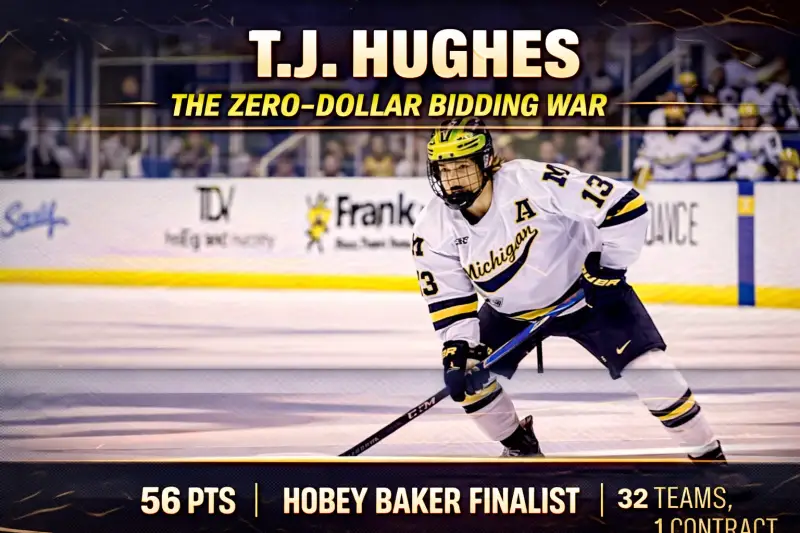
T.J. Hughes is the most wanted college free agent in the NHL — and every team offers the exact same deal. The Zero-Dollar Bidding War scores five contenders on what actually matters: minutes, fit, geography, and relationships. Montreal leads. But can they close?
Live updates
No updates yet. Refreshing automatically.
The Most Wanted Player Nobody Wanted
Thirty-two NHL teams will chase T.J. Hughes the moment Michigan's season ends. Every single one of them passed on him when it mattered. Hughes went undrafted in 2020. Went undrafted again in 2021. Not one organization spent a late-round pick on the kid from Hamilton, Ontario, who was putting up monster numbers in Alberta's junior A league.
Now he's the most coveted college free agent in a decade — a Hobey Baker Hat Trick finalist, the Big Ten's all-time leading scorer, and the captain of a team two wins from a national championship. The TJ Hughes NHL free agency pursuit has at least a dozen teams lined up. But every team offers the exact same deal. Same money. Same term. This isn't a bidding war. It's a sales pitch. That single fact transforms who actually wins.
I'm calling it The Zero-Dollar Bidding War — because in the most competitive player pursuit of the 2026 offseason, cash is the one weapon no team can use.
Key Takeaways
- The contract is fixed: At 24, Hughes signs a 1-year entry-level contract ($950K base). Every team offers the same deal — the fight is about opportunity, not dollars.
- Montreal leads the pack: Hughes grew up a Habs fan, plays with Canadiens prospect Michael Hage at Michigan, and has Max Pacioretty — now on Michigan's coaching staff — in his ear daily.
- Toronto's hometown pitch: Hughes is from Hamilton, 40 minutes from Scotiabank Arena. But the franchise has no GM, no direction, and no coaching certainty.
- The 72-hour window: Michigan plays Denver in the Frozen Four semifinal on April 9. Hobey Baker winner announced April 10. Championship game April 11. The signing frenzy begins the instant Michigan's season ends.
- Nashville's hidden fit: The Predators have the NHL's most desperate center depth problem — but zero personal connection to Hughes.
Why Every Team Offers the Exact Same Contract
This is the detail that transforms the entire pursuit. Because Hughes is 24 years old and undrafted, he's subject to NHL entry-level contract rules that cap what any team can offer. The maximum base salary sits at $950,000. Signing bonuses max out at $92,500 per year. Performance bonuses can push the total higher, but the structure is essentially identical across all 32 teams.
The real kicker? At 24, his ELC is only one year long.
Players who sign their first NHL deal between ages 18 and 21 get a standard three-year ELC. At 22-23, it drops to two years. At 24, you get one. Hughes will play a single season on this contract and then become a restricted free agent. The team that signs him doesn't own his future. They rent 12 months of it.
Compare that to a 21-year-old college free agent who locks in a three-year ELC at the same $950K cap hit. That team gets three full years of cost-controlled production. With Hughes, you get one season to prove your organization is worth staying for — and then you're negotiating again. Contract dynamics like these rarely get the attention they deserve in NHL free agency coverage.
So what can teams actually compete on? Four things: path to NHL minutes, lineup fit, geography, and personal relationships. I scored every serious contender on those four categories.
The Recruitment Pitch Scorecard
Each team rated 1-10 across four non-monetary factors: Path to Minutes, Lineup Fit, Geography Pull, and Relationship Factor. Maximum score: 40.
| Team | Score /40 | Why They Win | Why They Lose |
|---|---|---|---|
| Montreal | 33 | Habs fan + Hage + Pacioretty + 2C need | Cap flexibility is tighter than it looks |
| Toronto | 27 | Hometown kid + rebuilding roster = open path | No GM, no coach, no organizational direction |
| Detroit | 24 | Familiar city + $41.8M in projected cap room | Already signed Augustine; less acute center need |
| Nashville | 23 | NHL's most desperate center depth hole | Zero personal connection, far from home |
| Edmonton | 22 | Cup contender cachet + $25.5M in space | McDavid and Draisaitl block the path to minutes |
Montreal (33/40): The Pitch Everyone Else Has to Beat
The Canadiens have the most complete recruiting package in the NHL. Hughes grew up a Habs fan in Hamilton. His grandfather watched Montreal. His father watched Montreal. Hughes himself attended games at the Bell Centre as a kid. That emotional wiring doesn't disappear because a scout from Edmonton buys him dinner.
Then there's the Hage factor. Michael Hage — Montreal's 2024 first-round pick — is Hughes' teammate and close friend at Michigan. They share the ice daily, run the power play together, and have built chemistry you can't replicate in a free agent pitch meeting. Adding Hughes to an organization that already employs his college linemate is a recruiting cheat code.
The risk? Montreal's cap situation isn't as clean as the sales pitch suggests. Lane Hutson's extension looms as the biggest financial commitment of the offseason, and the Canadiens have significant salary already locked in for 2026-27. The $104 million cap ceiling provides some relief, but roster management still matters. Montreal can sell the dream. Whether they can clear the cap space is a separate conversation.
Toronto (27/40): The Hometown Play With a Broken Foundation
Hughes grew up 40 minutes from Scotiabank Arena. The Maple Leafs have reportedly intensified their pursuit, with insider David Pagnotta confirming Toronto is heavily interested. On paper, a rebuilding roster means fewer established players blocking Hughes' path to ice time. A new GM will be eager to land a signature early win.
I don't buy it. Not right now. The Leafs are mid-GM search with no clear direction. The coaching staff's future is uncertain. The prospect pipeline is thin after years of trading first-round picks. Hughes would be walking into an organization that can't tell him who his boss will be in three months, let alone what the roster looks like in October.
Geography pull is real. But organizational chaos is a dealbreaker for a player who waited four years for exactly the right moment to go pro.
Detroit (24/40): The Comfortable Choice That Lacks Urgency
Hughes has lived in Ann Arbor for four years. Detroit is a 45-minute drive. The Red Wings have a staggering $41.8 million in projected 2026-27 cap space and an aggressive front office that already signed Michigan State's Trey Augustine to a three-year ELC this spring.
But Detroit's center need isn't as acute as Montreal's or Nashville's. The Red Wings just invested in Augustine and are eyeing Max Plante — both Hobey Baker finalists, both Michigan State products. Hughes would be the third college signing competing for attention, not the centerpiece of the rebuild.
Nashville (23/40): The Best Hockey Fit With the Worst Sales Pitch
No team needs a center more desperately than the Predators. Erik Haula is logging second-line minutes. Fifth-overall pick Brady Martin isn't ready for a full NHL workload. David Edstrom has nine points in 32 AHL games. The center depth chart reads like a distress signal.
Nashville's post-Marchessault identity is still being shaped. The franchise has been reshaping its forward group all season, and Hughes would slot immediately into a meaningful role — potentially as a top-six center from day one.
But the Predators have no personal connection to Hughes. No shared history. No Michigan pipeline. No family ties to Tennessee. In The Zero-Dollar Bidding War, Nashville's pitch is purely professional. My read: that's not enough against Montreal's emotional gravity.
Edmonton (22/40): The Trophy Case vs. the Depth Chart
The Oilers can sell something no other team can: proximity to a championship. McDavid. Draisaitl. A franchise built to win now. Edmonton also carries $25.5 million in projected 2026-27 cap space and has already demonstrated willingness to sign college free agents — Owen Michaels inked an ELC this spring.
Edmonton's center depth chart starts with two of the greatest players in NHL history. Hughes would be a 3C at best, buried behind McDavid and Draisaitl with limited power play access. For a player whose decision will hinge on minutes and role, Edmonton is pitching a supporting part in someone else's movie.
The Pacioretty Factor: Montreal Has Been Recruiting for Eight Months
Max Pacioretty retired from the NHL in September 2025 after a 17-year career. He joined Michigan's coaching staff as special assistant to head coach Brandon Naurato days later. For eight months, the former Canadiens captain has worked alongside Hughes daily — running drills, sharing film sessions, offering pro-level mentorship no recruiting dinner can replicate.
"I grew up watching him. Him, Price, Markov, Gallagher. So when I found out he was joining the staff, I was so excited."
— T.J. Hughes, March 2026 (via R.Org)Hughes didn't just grow up watching the Canadiens. He idolized the specific player who now coaches him. Pacioretty hasn't publicly lobbied for Montreal — that's not his role — but the implicit connection is impossible to ignore. Every practice, every conversation about life in the NHL, every story about suiting up at the Bell Centre reinforces the idea that Montreal is home.
"My grandpa was a Habs fan, my dad was a Habs fan, so I grew up watching them. Going to games at the Bell Centre with my family, that was special."
— T.J. Hughes, March 2026 (via R.Org)Other teams can promise ice time. Other teams can flash analytics decks. Montreal has something none of them can manunrestricted free agency rulescture: a childhood dream, a trusted mentor already on staff, and a built-in best friend in the organization. That combination has been compounding for eight months. Try matching that in a 48-hour pitch window.
From Brooks to the Bigs: What Happens When the Draft Gets It Wrong
The NHL's scouting apparatus has a persistent blind spot for players who take the junior A-to-NCAA path instead of the CHL highway. The most famous example is Martin St. Louis — a two-time Hobey Baker finalist at Vermont who went completely undrafted, signed with Calgary as a free agent, and eventually became a Hart Trophy winner, Art Ross winner, and Stanley Cup champion with Tampa Bay.
Hughes isn't St. Louis. I'm not projecting a Hall of Fame career from a player whose skating has been flagged as a limitation by multiple scouts. What kills me is the structural similarity: both were drafted by zero teams, both dominated college hockey, both chose to stay in school when they could have left earlier, and both entered professional hockey with something to prove.
His scouting report reads like a paradox. Elite hockey IQ. One of the best forecheckers in college hockey. Penalty kill specialist who anchors Michigan's shorthanded unit. Point-per-game producer across four NCAA seasons — 178 points in 155 career games, including 56 points in 39 games this season at a 1.44 points-per-game clip.
Scouts project him as a middle-to-bottom-six center — a 3C or 4C who kills penalties, wins board battles, and chips in 30-40 points. That ceiling isn't sexy, but it's exactly the profile contenders pay real money for once the ELC expires. For teams actively reshaping their rosters through the trade and free agent markets, Hughes fills a gap most GMs can't address cheaply.
Don't confuse "undrafted" with "unwanted." Hughes wasn't invisible because he lacked talent. He was invisible because he played for the Brooks Bandits in the AJHL — Alberta's junior A league. Not the OHL. Not the WHL. Not the QMJHL. NHL scouting departments allocate the vast majority of their resources to the CHL pipeline. If you take the university route through a junior A league, you functionally don't exist until you produce at the Division I level. Hughes produced — 217 points in 149 AJHL games. It just took four years of NCAA dominance for the rest of the hockey world to notice.
72 Hours in Las Vegas: The Timeline That Changes Everything
April 9 — Frozen Four Semifinal. Michigan faces Denver at T-Mobile Arena in Las Vegas. This is Hughes' third Frozen Four appearance, having reached Tampa in 2023 and Minneapolis in 2024. Michigan hasn't won a national championship since 1998, and the Big Ten's all-time leading scorer wants to change that before his college career ends.
April 10 — Hobey Baker Award Ceremony. Hughes, Max Plante (Minnesota Duluth), and Eric Pohlkamp (Denver) are the three Hat Trick finalists. The winner will be announced live on NHL Network from Park MGM. Hughes is the heavy favorite.
April 11 — Potential Championship Game. If Michigan beats Denver, they face North Dakota or Wisconsin for the title. Win or lose, the moment Michigan's final buzzer sounds, the phones light up.
Every team has already prepared its pitch. The Leafs' front office candidates, the Oilers' scouting staff, the Canadiens' player development team — they've all done their homework. The difference between winning and losing this Zero-Dollar Bidding War might come down to who gets Hughes on the phone first after the handshake line.
Sources and Reporting
- R.Org — "You Come to Michigan to Win" — Hughes interview with direct quotes on background and Canadiens fandom
- University of Michigan Athletics — Official career statistics and biographical data
- Michigan Athletics — Hobey Hat Trick announcement — Finalist confirmation and 2025-26 season summary
- Daily Faceoff — NCAA free agent rankings and scouting assessment
- Last Word on Sports — Detailed scouting report on Hughes' strengths and weaknesses
- NHL Rumors — Team interest roundup covering Predators, Canadiens, Flames, Red Wings
- Hockey Patrol — Pagnotta report on Maple Leafs' pursuit of Hughes
- Michigan Athletics — Max Pacioretty joins coaching staff announcement
- Oilers Nation — Edmonton Oilers 2026-27 cap space projections
The Final Pitch: Where T.J. Hughes Signs
The Zero-Dollar Bidding War ends the same way it started — with the team that has the strongest relationship, not the biggest bank account. My bet: Hughes signs with the Montreal Canadiens within 72 hours of Michigan's final game.
The Hage connection. The Pacioretty mentorship. The generational Habs fandom. The second-line center hole that fits his skill set perfectly. Every non-monetary variable points to Montreal. I'd bet the only thing that could derail it is if the Canadiens can't clear enough cap flexibility to add his ELC — and even then, organizations find a way when the player wants to be there.
My projection for Hughes' NHL rookie season: 30-40 points, penalty kill regular, potential 3C by January. Not a franchise cornerstone. But a foundational depth piece that contenders spend years trying to acquire through trades. Montreal gets that for one year at $950,000. That's not a signing. That's a heist.
When can T.J. Hughes sign with an NHL team?
Hughes cannot sign until Michigan's season ends. The Wolverines play Denver in the Frozen Four semifinal on April 9 in Las Vegas. If Michigan loses, Hughes could sign as early as April 10. If they reach the championship on April 11, the earliest signing date shifts to April 12. Multiple insiders expect him to choose quickly once available.
Which team is the frontrunner to sign T.J. Hughes?
Montreal leads the race. Hughes grew up a Canadiens fan in Hamilton, Ontario, and his Michigan teammate Michael Hage is a Montreal first-round pick. Former Habs captain Max Pacioretty has coached Hughes all season at Michigan. Those personal connections give Montreal an edge no other franchise can replicate in a compressed pitch window.
What kind of contract will T.J. Hughes sign?
A one-year entry-level contract with a base salary of $950,000. Because Hughes is 24, his ELC is one year instead of the standard three for 18-to-21-year-olds. He becomes a restricted free agent after the 2026-27 season. Performance bonuses could push total compensation past $1.5 million depending on games played and production milestones.
Is T.J. Hughes going to win the Hobey Baker Award?
He is the favorite. Hughes led Michigan to the Frozen Four with 56 points in 39 games, won Big Ten Player of the Year, and holds the conference's all-time scoring record at 108 points. The other finalists — Max Plante and Eric Pohlkamp — had strong seasons but lack Hughes' combination of production, captaincy, and sustained four-year dominance.
Why was T.J. Hughes never drafted by an NHL team?
Scouting infrastructure, not talent. Hughes played three seasons for the Brooks Bandits in Alberta's junior A league (AJHL) before college. NHL scouting departments concentrate resources on the CHL — the OHL, WHL, and QMJHL. Players who take the AJHL-to-NCAA route are functionally invisible to pro scouts until they produce sustained offense at the Division I level. By then, Hughes was past draft eligibility.
Frequently Asked Questions
Key Takeaways The contract is fixed: At 24, Hughes signs a 1-year entry-level contract ($950K base). Every team offers the same deal — the fight is about opportunity, not dollars. Montreal leads the pack: Hughes grew up a Habs fan, plays with Canadiens prospect Michael Hage at Michigan, and has Max Pacioretty — now on Michigan's coaching staff — in his ear daily. Toronto's hometown pitch: Hughes is from Hamilton, 40 minutes from Scotiabank Arena. But the franchise has no GM, no direction, and no coaching certainty. The 72-hour window: Michigan plays Denver in the Frozen Four semifinal on April 9. Hobey Baker winner announced April 10. Championship game April 11. The signing frenzy begins the instant Michigan's season ends. Nashville's hidden fit: The Predators have the NHL's most desperate center depth problem — but zero personal connection to Hughes. Why Every Team Offers the Exact Same Contract This is the detail that transforms the entire pursuit. Because Hughes is 24 years old and undrafted, he's subject to NHL entry-level contract rules that cap what any team can offer. The maximum base salary sits at $950,000. Signing bonuses max out at $92,500 per year. Performance bonuses can push the total higher, but the structure is essentially identical across all 32 teams. The real kicker? At 24, his ELC is only one year long. Players who sign their first NHL deal between ages 18 and 21 get a standard three-year ELC. At 22-23, it drops to two years. At 24, you get one. Hughes will play a single season on this contract and then become a restricted free agent. The team that signs him doesn't own his future. They rent 12 months of it. Compare that to a 21-year-old college free agent who locks in a three-year ELC at the same $950K cap hit. That team gets three full years of cost-controlled production. With Hughes, you get one season to prove your organization is worth staying for — and then you're negotiating again. Contract dynamics like these rarely get the attention they deserve in NHL free agency coverage. So what can teams actually compete on? Four things: path to NHL minutes, lineup fit, geography, and personal relationships. I scored every serious contender on those four categories. The Recruitment Pitch Scorecard Each team rated 1-10 across four non-monetary factors: Path to Minutes, Lineup Fit, Geography Pull, and Relationship Factor. Maximum score: 40. TeamScore /40Why They WinWhy They Lose Montreal33Habs fan + Hage + Pacioretty + 2C needCap flexibility is tighter than it looks Toronto27Hometown kid + rebuilding roster = open pathNo GM, no coach, no organizational direction Detroit24Familiar city + $41.8M in projected cap roomAlready signed Augustine; less acute center need Nashville23NHL's most desperate center depth holeZero personal connection, far from home Edmonton22Cup contender cachet + $25.5M in spaceMcDavid and Draisaitl block the path to minutes Montreal (33/40): The Pitch Everyone Else Has to Beat The Canadiens have the most complete recruiting package in the NHL. Hughes grew up a Habs fan in Hamilton. His grandfather watched Montreal. His father watched Montreal. Hughes himself attended games at the Bell Centre as a kid. That emotional wiring doesn't disappear because a scout from Edmonton buys him dinner. Then there's the Hage factor. Michael Hage — Montreal's 2024 first-round pick — is Hughes' teammate and close friend at Michigan. They share the ice daily, run the power play together, and have built chemistry you can't replicate in a free agent pitch meeting. Adding Hughes to an organization that already employs his college linemate is a recruiting cheat code. The risk? Montreal's cap situation isn't as clean as the sales pitch suggests. Lane Hutson's extension looms as the biggest financial commitment of the offseason, and the Canadiens have significant salary already locked in for 2026-27. The $104 million cap ceiling provides some relief, but roster management still matters. Montreal can sell the dream. Whether they can clear the cap space is a separate conversation. Toronto (27/40): The Hometown Play With a Broken Foundation Hughes grew up 40 minutes from Scotiabank Arena. The Maple Leafs have reportedly intensified their pursuit, with insider David Pagnotta confirming Toronto is heavily interested. On paper, a rebuilding roster means fewer established players blocking Hughes' path to ice time. A new GM will be eager to land a signature early win. I don't buy it. Not right now. The Leafs are mid-GM search with no clear direction. The coaching staff's future is uncertain. The prospect pipeline is thin after years of trading first-round picks. Hughes would be walking into an organization that can't tell him who his boss will be in three months, let alone what the roster looks like in October. Geography pull is real. But organizational chaos is a dealbreaker for a player who waited four years for exactly the right moment to go pro. Detroit (24/40): The Comfortable Choice That Lacks Urgency Hughes has lived in Ann Arbor for four years. Detroit is a 45-minute drive. The Red Wings have a staggering $41.8 million in projected 2026-27 cap space and an aggressive front office that already signed Michigan State's Trey Augustine to a three-year ELC this spring. But Detroit's center need isn't as acute as Montreal's or Nashville's. The Red Wings just invested in Augustine and are eyeing Max Plante — both Hobey Baker finalists, both Michigan State products. Hughes would be the third college signing competing for attention, not the centerpiece of the rebuild. Nashville (23/40): The Best Hockey Fit With the Worst Sales Pitch No team needs a center more desperately than the Predators. Erik Haula is logging second-line minutes. Fifth-overall pick Brady Martin isn't ready for a full NHL workload. David Edstrom has nine points in 32 AHL games. The center depth chart reads like a distress signal. Nashville's post-Marchessault identity is still being shaped. The franchise has been reshaping its forward group all season, and Hughes would slot immediately into a meaningful role — potentially as a top-six center from day one. But the Predators have no personal connection to Hughes. No shared history. No Michigan pipeline. No family ties to Tennessee. In The Zero-Dollar Bidding War, Nashville's pitch is purely professional. My read: that's not enough against Montreal's emotional gravity. Edmonton (22/40): The Trophy Case vs. the Depth Chart The Oilers can sell something no other team can: proximity to a championship. McDavid. Draisaitl. A franchise built to win now. Edmonton also carries $25.5 million in projected 2026-27 cap space and has already demonstrated willingness to sign college free agents — Owen Michaels inked an ELC this spring. Edmonton's center depth chart starts with two of the greatest players in NHL history. Hughes would be a 3C at best, buried behind McDavid and Draisaitl with limited power play access. For a player whose decision will hinge on minutes and role, Edmonton is pitching a supporting part in someone else's movie. The Pacioretty Factor: Montreal Has Been Recruiting for Eight Months Max Pacioretty retired from the NHL in September 2025 after a 17-year career. He joined Michigan's coaching staff as special assistant to head coach Brandon Naurato days later. For eight months, the former Canadiens captain has worked alongside Hughes daily — running drills, sharing film sessions, offering pro-level mentorship no recruiting dinner can replicate. "I grew up watching him. Him, Price, Markov, Gallagher. So when I found out he was joining the staff, I was so excited." — T.J. Hughes, March 2026 (via R.Org) Hughes didn't just grow up watching the Canadiens. He idolized the specific player who now coaches him. Pacioretty hasn't publicly lobbied for Montreal — that's not his role — but the implicit connection is impossible to ignore. Every practice, every conversation about life in the NHL, every story about suiting up at the Bell Centre reinforces the idea that Montreal is home. "My grandpa was a Habs fan, my dad was a Habs fan, so I grew up watching them. Going to games at the Bell Centre with my family, that was special." — T.J. Hughes, March 2026 (via R.Org) Other teams can promise ice time. Other teams can flash analytics decks. Montreal has something none of them can manunrestricted free agency rulescture: a childhood dream, a trusted mentor already on staff, and a built-in best friend in the organization. That combination has been compounding for eight months. Try matching that in a 48-hour pitch window. From Brooks to the Bigs: What Happens When the Draft Gets It Wrong The NHL's scouting apparatus has a persistent blind spot for players who take the junior A-to-NCAA path instead of the CHL highway. The most famous example is Martin St. Louis — a two-time Hobey Baker finalist at Vermont who went completely undrafted, signed with Calgary as a free agent, and eventually became a Hart Trophy winner, Art Ross winner, and Stanley Cup champion with Tampa Bay. Hughes isn't St. Louis. I'm not projecting a Hall of Fame career from a player whose skating has been flagged as a limitation by multiple scouts. What kills me is the structural similarity: both were drafted by zero teams, both dominated college hockey, both chose to stay in school when they could have left earlier, and both entered professional hockey with something to prove. His scouting report reads like a paradox. Elite hockey IQ. One of the best forecheckers in college hockey. Penalty kill specialist who anchors Michigan's shorthanded unit. Point-per-game producer across four NCAA seasons — 178 points in 155 career games, including 56 points in 39 games this season at a 1.44 points-per-game clip. Scouts project him as a middle-to-bottom-six center — a 3C or 4C who kills penalties, wins board battles, and chips in 30-40 points. That ceiling isn't sexy, but it's exactly the profile contenders pay real money for once the ELC expires. For teams actively reshaping their rosters through the trade and free agent markets, Hughes fills a gap most GMs can't address cheaply. Don't confuse "undrafted" with "unwanted." Hughes wasn't invisible because he lacked talent. He was invisible because he played for the Brooks Bandits in the AJHL — Alberta's junior A league. Not the OHL. Not the WHL. Not the QMJHL. NHL scouting departments allocate the vast majority of their resources to the CHL pipeline. If you take the university route through a junior A league, you functionally don't exist until you produce at the Division I level. Hughes produced — 217 points in 149 AJHL games. It just took four years of NCAA dominance for the rest of the hockey world to notice. 72 Hours in Las Vegas: The Timeline That Changes Everything April 9 — Frozen Four Semifinal. Michigan faces Denver at T-Mobile Arena in Las Vegas. This is Hughes' third Frozen Four appearance, having reached Tampa in 2023 and Minneapolis in 2024. Michigan hasn't won a national championship since 1998, and the Big Ten's all-time leading scorer wants to change that before his college career ends. April 10 — Hobey Baker Award Ceremony. Hughes, Max Plante (Minnesota Duluth), and Eric Pohlkamp (Denver) are the three Hat Trick finalists. The winner will be announced live on NHL Network from Park MGM. Hughes is the heavy favorite. April 11 — Potential Championship Game. If Michigan beats Denver, they face North Dakota or Wisconsin for the title. Win or lose, the moment Michigan's final buzzer sounds, the phones light up. Every team has already prepared its pitch. The Leafs' front office candidates, the Oilers' scouting staff, the Canadiens' player development team — they've all done their homework. The difference between winning and losing this Zero-Dollar Bidding War might come down to who gets Hughes on the phone first after the handshake line. Sources and Reporting R.Org — "You Come to Michigan to Win" — Hughes interview with direct quotes on background and Canadiens fandom University of Michigan Athletics — Official career statistics and biographical data Michigan Athletics — Hobey Hat Trick announcement — Finalist confirmation and 2025-26 season summary Daily Faceoff — NCAA free agent rankings and scouting assessment Last Word on Sports — Detailed scouting report on Hughes' strengths and weaknesses NHL Rumors — Team interest roundup covering Predators, Canadiens, Flames, Red Wings Hockey Patrol — Pagnotta report on Maple Leafs' pursuit of Hughes Michigan Athletics — Max Pacioretty joins coaching staff announcement Oilers Nation — Edmonton Oilers 2026-27 cap space projections The Final Pitch: Where T.J. Hughes Signs The Zero-Dollar Bidding War ends the same way it started — with the team that has the strongest relationship, not the biggest bank account. My bet: Hughes signs with the Montreal Canadiens within 72 hours of Michigan's final game. The Hage connection. The Pacioretty mentorship. The generational Habs fandom. The second-line center hole that fits his skill set perfectly. Every non-monetary variable points to Montreal. I'd bet the only thing that could derail it is if the Canadiens can't clear enough cap flexibility to add his ELC — and even then, organizations find a way when the player wants to be there. My projection for Hughes' NHL rookie season: 30-40 points, penalty kill regular, potential 3C by January. Not a franchise cornerstone. But a foundational depth piece that contenders spend years trying to acquire through trades. Montreal gets that for one year at $950,000. That's not a signing. That's a heist. When can T.J. Hughes sign with an NHL team?
Hughes cannot sign until Michigan's season ends. The Wolverines play Denver in the Frozen Four semifinal on April 9 in Las Vegas. If Michigan loses, Hughes could sign as early as April 10. If they reach the championship on April 11, the earliest signing date shifts to April 12. Multiple insiders expect him to choose quickly once available.
Which team is the frontrunner to sign T.J. Hughes?
Montreal leads the race. Hughes grew up a Canadiens fan in Hamilton, Ontario, and his Michigan teammate Michael Hage is a Montreal first-round pick. Former Habs captain Max Pacioretty has coached Hughes all season at Michigan. Those personal connections give Montreal an edge no other franchise can replicate in a compressed pitch window.
What kind of contract will T.J. Hughes sign?
A one-year entry-level contract with a base salary of $950,000. Because Hughes is 24, his ELC is one year instead of the standard three for 18-to-21-year-olds. He becomes a restricted free agent after the 2026-27 season. Performance bonuses could push total compensation past $1.5 million depending on games played and production milestones.
Is T.J. Hughes going to win the Hobey Baker Award?
He is the favorite. Hughes led Michigan to the Frozen Four with 56 points in 39 games, won Big Ten Player of the Year, and holds the conference's all-time scoring record at 108 points. The other finalists — Max Plante and Eric Pohlkamp — had strong seasons but lack Hughes' combination of production, captaincy, and sustained four-year dominance.
Why was T.J. Hughes never drafted by an NHL team?
Scouting infrastructure, not talent. Hughes played three seasons for the Brooks Bandits in Alberta's junior A league (AJHL) before college. NHL scouting departments concentrate resources on the CHL — the OHL, WHL, and QMJHL. Players who take the AJHL-to-NCAA route are functionally invisible to pro scouts until they produce sustained offense at the Division I level. By then, Hughes was past draft eligibility.
Related Stories
NHL Buyout Candidates 2026
The NHL buyout window opens June 15. Rielly, Gallagher, Kotkaniemi, and Frederic are the names in play, but the Dead-Cap Tail means most buy...
By Mike Johnson · 10 min read

Bill Guerin Wild Window Paradox: $17M Meets $1.18M
Wild GM Bill Guerin said 'we're in a window now' and 'you can't trade your way out of problems' five days after a Game 5 collapse. Then Kapr...
By Mike Johnson · 11 min read

Brady Tkachuk Checked Out: The Belief Gap | Senators 2026
Per Frank Seravalli, Brady Tkachuk has been 'checked out in Ottawa.' 3 Olympic goals to 0 playoff points in 60 days. Inside The Belief Gap o...
By Mike Johnson · 9 min read
Kris Knoblauch Oilers Fired? The Cup Final Tax 2026
Per Frank Seravalli, Kris Knoblauch is 'absolutely in the crosshairs' if Oilers lose to Ducks. Two Cup Finals reached. Two wins from termina...
By Mike Johnson · 11 min read
Get NHL trade rumors in your inbox
One email per week. Zero spam. Verified rumors only.