Larkin-Robertson Swap: Who Says No?
Dallas has checked in on Dylan Larkin, but the Stars cannot fit his $8.7M until Jason Robertson and his unsigned $14M ask move out. Inside the one-for-one math, the 2016 precedent, and who blinks first.
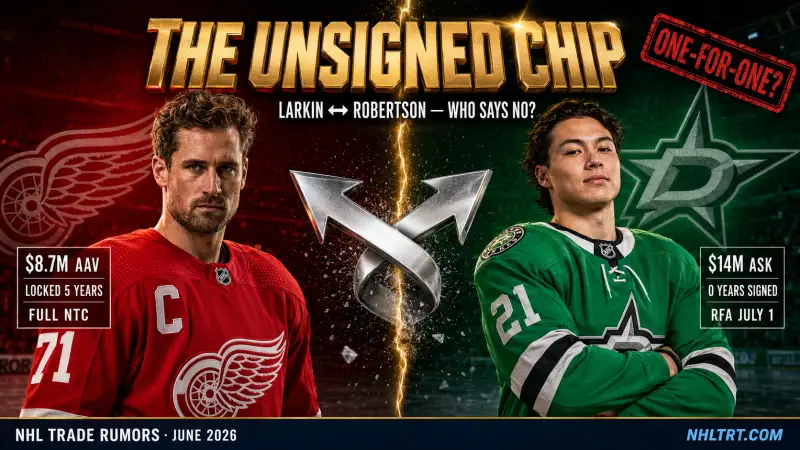
Dallas can lock in five more years of Dylan Larkin at $8.7 million a season, and the cost in every workable version of the math is the $14 million question still sitting unsigned in its own dressing room. That tension is why Larkin Robertson trade chatter took over the league this week: Pierre LeBrun confirmed the Stars have "absolutely checked in" on Detroit's captain, and the only clean way the money fits is a swap built around Jason Robertson's rights. How would a one-for-one actually work in June 2026? Slower and stranger than the podcast version, because one of these contracts exists and the other one doesn't.
11 min read · ~2,150 words•Updated June 12, 2026•Share: X · Reddit · Facebook · EmailIn this analysis| Figure | What it represents |
|---|---|
| $8.7M | Larkin's cap hit, locked for five more years with a full no-trade clause |
| $14M | Robertson's reported ask per Frank Seravalli, with zero years signed |
One number is a contract and the other is a negotiation, and trading the second to afford the first is the whole Unsigned Chip idea in a single line.
Key Takeaways
Dallas called: Pierre LeBrun says the Stars have "absolutely checked in" on Larkin, joining a long line of callers since the June 4 trade request.
The Unsigned Chip: Robertson's unsigned RFA rights are the one asset whose departure frees the exact cap room Larkin's $8.7M needs.
List problem: Larkin's original three approved teams (Vegas, Minnesota, Florida) are cap-jammed, and Vegas sits at just $4.6M in space.
The gap: Robertson wants around $14M while Dallas reportedly anchors near Thomas Harley's $10.6M tier, and that standoff is the fuel under every version of this trade.
- Daily Faceoff: Stars cap squeeze around Robertson and the $13-14M market read
Precedent: One-for-one star swaps feel impossible until they happen twice in 20 minutes, like June 29, 2016.
What Dallas Actually Asked About
The timeline matters, because each step changed who could realistically call. Larkin's trade request landed on June 4, first reported by Elliotte Friedman, after the captain watched a 10th straight Detroit season end without playoffs, the longest active drought in the NHL. Four days later came the list: Vegas, Minnesota, Florida. And by June 10, the Detroit News reported that list was growing, because Steve Yzerman went back to agent Pat Brisson and asked him to open the doors wider.
That re-opening is the part Dallas walked through.
It helps Detroit's asking price that Larkin is coming off the best goal-scoring year of his career. He put up 67 points with a career-high 34 goals in 74 games, his sixth 30-goal season, on a team that gave him very little to work with. Sellers usually move damaged goods in June. Yzerman gets to shop a captain at his peak, which is rare enough that the phone keeps ringing without Detroit lifting a finger.
"All kinds of teams have called to see what's what." — Pierre LeBrun, The Athletic, via Pro Football Network (June 2026)
LeBrun's reporting added the line that turned this from gossip into a real scenario: Dallas has "absolutely checked in." But checking in costs nothing. The Stars can't add an $8.7M center while their best winger's camp is asking for franchise-record money, which is exactly why every serious version of this conversation circles back to one structure. Robertson goes the other way, or Robertson goes somewhere, before Larkin arrives.
The Cap Math Only Works in One Order
Here's the standoff in plain numbers. Robertson has played the past four seasons at $7.75 million per year, and he's a restricted free agent on July 1. His side opened around $14 million, per Seravalli. Dallas reportedly wants something closer to the $10.6 million tier where Thomas Harley's new deal sits, with Mikko Rantanen's $12 million as the line management would rather not cross.
"Quite a bit a ways apart." — Frank Seravalli, Daily Faceoff, on the Robertson talks, via RMNB (June 2, 2026)
And that quote is from June 2, before the Larkin request even existed. The gap hasn't closed since. When a $3M-plus canyon sits between an RFA and his team this late in June, GMs around the league start treating the player less like a roster piece and more like currency.
Stack the two situations side by side and the order of operations writes itself.
| Player | Status | Money | Control |
|---|---|---|---|
| Dylan Larkin | Signed through 2030-31 | $8.7M AAV | Full no-trade clause |
| Jason Robertson | RFA on July 1 | ~$14M ask vs ~$10.6M comfort | Arbitration rights, no contract |
Because Dallas runs a tight sheet, the Stars cannot carry both outcomes. Sign Robertson at his number and Larkin's $8.7M has no home. Trade Robertson's rights and suddenly the Larkin fit is comfortable, with money left over. There's no third lane where Dallas keeps everyone and adds a top-line center, and Jim Nill has been around long enough to know it (this is the same front office that resolved the Rantanen question fast when the math demanded it).
The leverage clock makes it worse for Dallas. Once July 1 hits, Robertson's camp can entertain an offer sheet, and his arbitration rights mean even the fallback scenario hands a neutral third party the pen on next season's salary. Neither path gives Nill cost certainty, and cost certainty is the entire reason a GM would prefer trading the negotiation away to fighting it through August. A team acquiring his rights before July 1 gets a short exclusive window to make its own pitch, which has real value to a buyer who believes a fresh city changes the tone of the talks.
For the wider market context on what Robertson's camp is playing for, our breakdown of the Stars-Robertson contract gap and the 2026 offer-sheet board cover the leverage game in detail. Short version: his side has options that don't require being polite.
The Unsigned Chip: Why Detroit Would Even Listen
Now flip to Yzerman's chair, because this is where the idea either lives or dies. Detroit's return for a 29-year-old captain has to start a competitive reset, and Robertson's rights are a strange but real asset: a 26-year-old winger who has already had a 100-point NHL season, arriving without a single dollar committed. That's the Unsigned Chip. You're not trading for a player so much as trading for the exclusive right to finish his negotiation.
The appeal for Detroit runs through the books too. Larkin's deal was front-loaded, and PFN's reporting notes the remaining real-dollar commitment is manageable for an acquiring team over the final five years, which makes the contract easier to move than the cap hit suggests. Meanwhile a Robertson extension, even at $12M-plus, starts fresh on Detroit's timeline with no playoff-drought baggage attached.
But let's not pretend the risk is small. Whoever trades for Robertson's rights inherits the exact fight Dallas wants to escape, with less goodwill and the same arbitration calendar ticking. If his camp held firm at $14M against the team that drafted him, why would Detroit get a discount? My honest answer: it wouldn't, and Yzerman would be underwriting a record contract for a winger while trading away his captain. He's been patient to a fault his entire rebuild (ask any Red Wings fan about the last three Marches), and patience argues for picks and prospects instead.
Weigh the alternative honestly, though. A futures package for Larkin probably looks like a first-round pick, a top prospect and a roster body, and Detroit has stockpiled enough of those assets that another batch doesn't change the franchise's timeline. Robertson would. He's the kind of finisher this roster hasn't iced since the rebuild started, young enough to be the centerpiece of the next good Red Wings team rather than a bridge to it. A patient GM can still recognize when the impatient move is the right one, and that's the genuinely interesting question Yzerman has to answer before July 1, not whether the picks are nice.
So the one-for-one is real, defensible, and still probably not Detroit's first choice. That's an important distinction the loudest versions of this rumor skip.
The Day It Happened Twice
The obvious comp here is the Taylor Hall trade. Actually, the better parallel landed twenty minutes after it. On June 29, 2016, Edmonton sent Hall to New Jersey one-for-one for Adam Larsson at 3:34 p.m., and at 3:54 p.m. Montreal moved P.K. Subban to Nashville for Shea Weber, also one-for-one. Two franchise players each, no sweeteners, two days before free agency.
Ten years later, the lesson still holds. Star-for-star deals don't develop gradually in public. They detonate, usually in the dead week before July 1, when cap pressure and deadline pressure finally point the same direction. Which is precisely the week we're standing in.
Who Says No First
Run the rejection test team by team and the swap survives it better than most rumors. Vegas can't realistically take Larkin straight up with $4.6 million in space, 31st in the league, without surgery elsewhere on the roster. Minnesota and Florida have more room but sit at $15.2M or less, and neither owns an Unsigned Chip equivalent, a single departing salary slot that cleanly becomes a Larkin-sized hole. Dallas does, and that alone explains why a team that wasn't on the original list keeps coming up in serious conversations.
Minnesota and Florida fail quieter versions of the same test. The Wild have the room on paper, but their pitch to Larkin competes directly with whatever extension math they're protecting for their own core, and nothing on their roster doubles as a clean Robertson-sized return for Detroit. Florida's appeal to a player chasing a Cup is obvious, except the Panthers' cap sheet is built wall to wall with playoff-proven contracts that Bill Zito will not break apart for a center he didn't ask for. Both teams can want Larkin. Wanting him with a workable two-way trade attached is a different sport, and it's the one LeBrun hinted at when he floated a third team entering the deal to make Detroit's side of the assets work.
The real obstacles are softer than cap math. Larkin controls everything with his full no-trade clause, and Dallas wasn't one of his three approved destinations, so he'd have to want a Stars roster that just lost its best winger. And Friedman has reported the whole point of leaving Detroit is to land somewhere genuinely closer to a Cup. A Dallas team minus Robertson still clears that bar more convincingly than two of the three teams he originally named, but it's his call, not Nill's.
Where I land, with stakes attached: I'd put real money on the Robertson situation resolving first, one way or the other, because it has a hard deadline and the Larkin market doesn't. I expect Robertson's future settled by July 1, and if the resolution is a trade rather than a signature, Detroit will be one of the first three calls. Larkin moving anywhere before the free-agent market opens is the longer shot, maybe one chance in three, because full no-trade clauses turn every negotiation into a three-party vote.
Track every name in this market on our live trade board, and for the cap mechanics behind all of it, the 2026 salary cap guide walks through why unsigned rights move differently than contracts. Robertson's own career night against Edmonton is a reminder of what Dallas would be giving up.
About this analysis: written by Mike Johnson, NHL Senior Editor, 15 years covering trade markets and cap mechanics. Every contract figure was checked against PuckPedia and Spotrac directly; both pull quotes trace to a named insider with an inline source URL beside the quote; the June 29, 2016 precedent was verified against NHL.com's own retrospective. The Unsigned Chip is our analytical framework, introduced in this piece, for valuing unsigned RFA rights as trade currency. Published June 12, 2026. Editorial review: Sarah Chen, Hockey Operations Editor. Corrections or factual disputes: editorial@nhltraderumorstalk.com.Sources and Reporting
ESPN: Larkin's three-team list, cap-space figures, season stats
Pro Football Network: LeBrun quotes, Dallas interest, contract front-loading
RMNB: Seravalli on the Robertson negotiation gap
PuckPedia: Larkin contract structure and clause details
PuckPedia: Robertson expiring contract details
Detroit News: list expansion, Detroit's timeline
Last Word On Sports: Harley and Rantanen comparables in talks
NHL.com: June 29, 2016 one-for-one trades retrospective
The Verdict: The Unsigned Chip
Strip the noise away and this rumor is a sequencing problem wearing a blockbuster costume. Dallas holds the one asset in the Larkin market that creates its own cap space on departure, and that's why the Stars stay in this conversation despite never appearing on the original list. I expect the Unsigned Chip gets played by July 1, through a signature or a trade, and Larkin's market only takes real shape after it does. If Yzerman and Nill shake hands on the one-for-one before then, remember the 2016 rule. These deals don't simmer. They detonate.
Frequently Asked Questions
Did Dylan Larkin request a trade from the Red Wings?
Yes. The request was first reported by Elliotte Friedman on June 4, 2026, after Detroit missed the playoffs for a 10th straight season, the longest active drought in the NHL. Larkin has captained the Red Wings since 2021 and holds a full no-trade clause, so he controls where any deal sends him.
Which teams are on Dylan Larkin trade list?
His original approved list had three teams: the Vegas Golden Knights, Minnesota Wild and Florida Panthers. The list has since expanded after GM Steve Yzerman asked agent Pat Brisson to consider more destinations. Vegas is the tightest fit of the three, with only $4.6 million in cap space, 31st in the league.
What is Jason Robertson asking for on his next contract?
Around $14 million per year, according to Daily Faceoff insider Frank Seravalli. Robertson earned $7.75 million in each of the past four seasons and becomes a restricted free agent on July 1, 2026, with salary arbitration rights as leverage if talks stall further.
Has a one-for-one NHL star trade happened before?
Twice in 20 minutes. On June 29, 2016, Edmonton traded Taylor Hall to New Jersey for Adam Larsson at 3:34 p.m. ET, and Montreal sent P.K. Subban to Nashville for Shea Weber at 3:54 p.m. Both were straight one-for-one swaps completed two days before free agency opened.
Related Stories
Hischier Trade Clock Hits July 1
Nico Hischier trade rumors are rising: extension talks with new GM Sunny Mehta are in their infancy, Montreal, LA and Minnesota are circling...
By Mike Johnson · 9 min read
NHL Buyout Candidates 2026
The NHL buyout window opens June 15. Rielly, Gallagher, Kotkaniemi, and Frederic are the names in play, but the Dead-Cap Tail means most buy...
By Mike Johnson · 10 min read
Darnell Nurse Trade: 4 Suitors
Edmonton wants Darnell Nurse's $9.25M off the books, but a buyout saves barely $1.53M and his no-move clause hands him the pen. The Bonus Sh...
By Mike Johnson · 12 min read
Darren Raddysh Free Agent 2026: 4 Teams
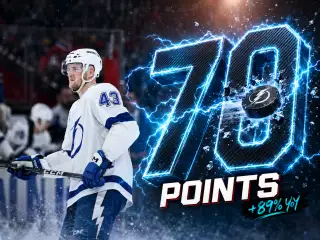
Darren Raddysh's 70-point breakout turned his $975K cap hit into a four-team bidding war. The Athletic linked him to Philadelphia, San Jose,...
By Mike Johnson · 13 min read
📊 Fan Poll
Where will Dylan Larkin be traded this offseason?
Comments
Be the first to share your take.
Get NHL trade rumors in your inbox
One email per week. Zero spam. Verified rumors only.