NHL Offer Sheet Targets 2026: Top 8 RFAs Ranked
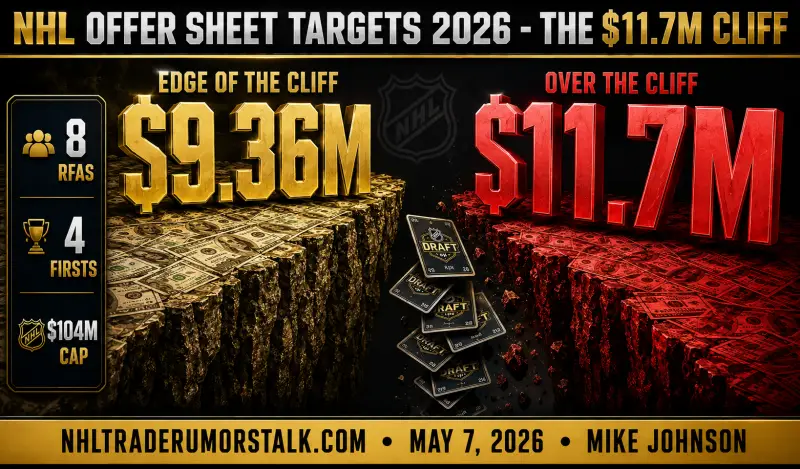
The 2026-27 NHL cap jumps to $104M, the biggest single-year leap in league history. Eight RFAs sit in the offer-sheet kill zone. Plus the Pick Ownership Trap that blocks Pittsburgh, Rangers, and Senators from attacking.
Live updates
No updates yet. Refreshing automatically.
The 2026-27 NHL salary cap jumps to $104 million, an 8.9 percent leap from the $95.5M ceiling that ran the 2025-26 season. That is the biggest single-year cap raise in league history, and it sets up the most dangerous offer sheet summer the NHL has seen since the cap era started in 2005. NHL Offer Sheet Targets 2026 means one number more than any other: $11.7 million. That is the cliff. Any RFA contract above $11.7M AAV costs the attacking team four first-round picks. Anything below it, the bidding gets dirty. Per PuckPedia's 2025-26 compensation tiers, eight RFAs sit inside the realistic poaching window heading into July 1.
This page is the offer-sheet hunter's map. Every compensation tier broken down. Eight names ranked by vulnerability. Plus the trap that is going to keep three contender franchises out of the bidding entirely, because they do not own their own draft picks. Read it before July 1. Read it after the first offer sheet drops, because the rest of the board re-prices in 24 hours.
Key Takeaways
- The $11.7M Cliff is real: Any offer sheet above that AAV costs four first-round picks. Below it, the comp tiers drop fast: $9.36M to $11.7M = 2 firsts + 2nd + 3rd. $7.02M to $9.36M = 1 first + 2nd + 3rd.
- Connor Bedard sits on the cliff edge: Projected $13M+ AAV puts him over the line. No team is sending Chicago four first-round picks. He gets matched no matter what.
- The real action is at $7M-$9.36M: Leo Carlsson, Adam Fantilli, and Simon Nemec all project into this band. One first-round pick plus a 2nd and 3rd is the price tag, which is what the Blues paid for Holloway and Broberg in 2024.
- The Pick Ownership Trap is real but narrower than headlines suggest: A team must own its own next-three years of first, second, and third round picks. Acquired picks do not count. The Rangers are the cleanest example of a contender locked out by missing picks.
- Pittsburgh has $45.8M of cap space and the picks to weaponize it: The Pens stockpiled 19 selections across the first three rounds of the next four drafts, per PuckPedia. The picks they sent Columbus in the Chinakhov trade were originally St. Louis property, so Pittsburgh's own portfolio survived intact.
Cap update: The $11.7M Cliff offer-sheet threshold lives under the new $20.8M individual ceiling confirmed by NHL/NHLPA for 2026-27 — see the 9-Digit Era audit for the full picture.
How the $11.7M Cliff Works
Look, the rule is simpler than the math suggests. When Team A signs Team B's restricted free agent to an offer sheet, Team B has seven days to either match the contract or accept the draft-pick compensation built into the offer. The compensation scales with AAV. Higher offer, more picks owed.
Per PuckPedia's 2025-26 figures, here is the table that runs every July 1 hunting party.
| AAV Range | Compensation | Realistic Targets |
|---|---|---|
| Under $1.54M | None | Depth, fringe AHL call-ups |
| $1.54M to $2.34M | 3rd round pick | Bottom-six forwards |
| $2.34M to $4.68M | 2nd round pick | Mid-tier RFAs (Drysdale tier) |
| $4.68M to $7.02M | 1st + 3rd | Top-six skaters |
| $7.02M to $9.36M | 1st + 2nd + 3rd | True top-line forwards (Carlsson, Fantilli) |
| $9.36M to $11.7M | 2 firsts + 2nd + 3rd | Borderline stars |
| $11.7M and up | 4 first-round picks | Generational talent (Bedard tier) |
The cliff is the jump from one first-round pick to four. That is a 4x ratio. No analytics department in hockey signs off on that math, which is why the highest offer sheet ever signed historically was Shea Weber's 14-year, $110M deal back in 2012, and Nashville matched it. The $11.7M number is more important than the cap itself, because it draws the line nobody is willing to cross. Matthew Knies's 6-year, $46.5M Toronto extension is the cautionary tale here, the Maple Leafs locked him up at $7.75M AAV last June specifically so they would not have to defend an offer sheet conversation in 2026.
"The 2026 cap jump unlocks every offer sheet conversation that has been theoretical for ten years. Eight teams will start July 1 with cap overages, and the rest of the league knows exactly which RFAs they cannot afford to match. That is the real shift."
Mike Johnson, Senior EditorThe 8 RFAs Most Vulnerable to a 2026 Offer Sheet
I ranked these by what I'm calling the Vulnerability Score. Three inputs go into it. First, the player's projected AAV vs. their current team's cap space. Second, whether the team has any existing offer sheet in their recent history (the Blues took two in 2024 and matched zero). Third, whether the player's public preference is to stay or test the market.
| Rank | Player | Team | Projected AAV | Vulnerability |
|---|---|---|---|---|
| 1 | Adam Fantilli | Columbus | $8.5M | High |
| 2 | Jason Robertson | Dallas | $12.0M+ | High (cliff edge) |
| 3 | Leo Carlsson | Anaheim | $8.0M | High |
| 4 | Simon Nemec | New Jersey | $5.5M | High |
| 5 | Zach Benson | Buffalo | $5.0M | Medium-High |
| 6 | Cole Perfetti | Winnipeg | $4.5M | Medium-High |
| 7 | Jamie Drysdale | Philadelphia | $4.5M | Medium |
| 8 | Connor Bedard | Chicago | $13.0M+ | Symbolic only |
Bedard sits at #8 even though his name carries the loudest. His projected AAV soars over the cliff. No team would actually pay four first-round picks for his rights, and Chicago would match anyway. But every offer sheet conversation in the league has to confirm that math first, then move on. He is the floor of the discussion, not the ceiling.
One name conspicuously missing from this list: Cutter Gauthier. The Anaheim winger projects at $9-10M AAV after a 40-goal breakout, which would slot him right under the cliff. But per PuckPedia's April 2026 eligibility audit, Gauthier is classified as a 10.2(c) player because his entry-level contract burned its first year in 2023-24 without enough NHL games to qualify him for offer-sheet rights. He cannot legally receive an offer sheet this summer. The same exemption protected Luke Hughes from New Jersey last year, when no rival could attack his RFA window. Anaheim got a free pass on its biggest contract negotiation of the off-season because of a paperwork wrinkle nobody outside the league office cares about until it matters.
Adam Fantilli is the actual offer-sheet target nobody is talking about loudly enough. Columbus is staring at an extension stack that resembles the Cole Eiserman ELC dynamic, where one cap-friendly young star sits next to another whose number is about to spike. The Blue Jackets' cap projection for 2026-27 leaves them roughly $14M of headroom, which gets eaten if Fantilli prices at $8.5M and Marchenko's 2027 RFA looms. The Bobby McMann RFA extension breakdown is the closest model for how Columbus has to handle this kind of negotiation.
Jason Robertson is the cliff's edge target. At a projected $12M+ AAV after his third 40-goal season, an offer sheet would land just over the $11.7M line and trigger four first-round picks in compensation. The Stars are already cap-stacked from the Rantanen, Johnston, and Harley extensions, walking into the off-season with roughly $11.1M of true cap room. Per Sportsnet's Luke Fox, Dallas explored trading him last summer when the math first started looking impossible. A $12M offer sheet from a deep-pocketed pick-rich club forces Jim Nill into a bind no other 2026 RFA situation creates, because Robertson's number lands exactly where the cliff falls.
"The Carlsson decision is going to define Anaheim's next five years. He is the C1 they drafted to build around, but if a cap-rich contender pushes 7 years at $8.5M and ties up Anaheim's sheet, the Ducks have to think hard about what their actual rebuild ceiling looks like."
Mike Johnson, Senior EditorThe Pick Ownership Trap: Why Some Teams Cannot Attack
Here is the wrinkle every casual fan misses. To submit an offer sheet, a team must own its own first, second, and third round picks for the next three drafts. Acquired picks from other teams do not count. Trade away your own and you lose offer sheet eligibility entirely. PuckPedia tracks the eligibility list every July, and the trap snares fewer contenders in 2026 than headlines suggest.
| Team | Status | Note |
|---|---|---|
| New York Rangers | Likely Trapped | Missing own 2nd-round pick from prior trade window |
| Toronto Maple Leafs | Conditional | Pick protections complicate eligibility audit (per PuckPedia) |
| Carolina Hurricanes | Conditional | Mid-round pick movement at deadline narrows window |
Pittsburgh used to be on this list. I had the Pens trapped in an early draft of this article, but the Chinakhov trade actually sent Columbus a 2026 second-round pick that originally belonged to St. Louis, not Pittsburgh's own selection. Per the league's release on the deal, the Pens kept their own picks. The Chinakhov-Crosby window math still complicates their match-vs-attack calculus, but eligibility is intact.
Ottawa is the same kind of myth. The Senators sent Boston a first-round pick in the 2024 Ullmark trade, but that pick was originally Boston's own selection that came to Ottawa via the 2023 DeBrincat deal. Ottawa's own 2026, 2027, and 2028 firsts are sitting in their cabinet. The trap closes harder on teams whose own picks left town, which is the Rangers' problem and a smaller version of what Toronto and Carolina are working through right now.
Honestly, this is the part that makes 2026 different from the headlines. The cap-rich teams who get cited as aggressors-on-paper still need clean pick ownership. Vancouver, after cycling through eight GM candidates this spring, is the dark-horse aggressor on the board. Their pick portfolio is clean, they have $9M of true cap space, and the new front office wants to make a statement.
Historical Precedent: What Broberg and Holloway Actually Cost
The 2024 Blues offer sheet attack on Edmonton is the only modern roadmap. St. Louis signed Philip Broberg to a 2-year, $9.16M contract and Dylan Holloway to a 2-year, $4.58M contract. Edmonton declined to match either. The Oilers received their 2025 third-round pick back from Broberg ($4.58M AAV bracket) and a 2025 second-round pick for Holloway ($2.29M bracket).
Two things happened next. First, Broberg jumped from a 6-game NHL veteran in Edmonton to a top-four defenseman in St. Louis on a Cup-contending team. Second, Holloway scored 26 goals as a Blue, blowing past the AAV St. Louis paid him. The pick cost looks cheap in hindsight. Edmonton got punished for not having cap space to match, exactly the position Anaheim and Columbus are about to be in.
The lesson: offer sheets do not need to land at the $11.7M cliff to work. They need to land just barely above what the original team can afford to match. Two firsts plus a 2nd and 3rd for Carlsson is one route. Doug Armstrong stepping down as Blues GM shifts the question of who runs the next attack, but the playbook he wrote is sitting on the shelf for the next executive.
Vulnerability Audit: Round-by-Round Offer Sheet Probability
Here is my live grade of which RFA actually gets an offer sheet on July 1, 2026. The Cliff Index measures distance from the $11.7M ceiling, so a higher score equals more poachable. League-wide history says one to two offer sheets land in any given summer where the cap jumps this much.
CLIFF INDEX: 2026 RFA POACH PROBABILITY
Probability score per RFA. Higher equals more likely to receive an actual offer sheet. Below 50 means original team is safe.
The Cap-Rich Aggressors: Who Actually Pulls a 2026 Offer Sheet
Eight teams are projected to have 2026-27 cap overages, per a recent Daily Faceoff cap survey. The names: Florida Panthers, Tampa Bay Lightning, Edmonton Oilers, Colorado Avalanche, New Jersey Devils, Dallas Stars, New York Islanders, and Montreal Canadiens. San Jose and Ottawa land just under the ceiling and round out the ten cap-stressed clubs in the survey. That is roughly 25 percent of the league running over the new $104M ceiling before July 1 even starts. Those eight cannot offer-sheet anyone, because they cannot afford the contract they would be writing. So the aggressor list narrows fast.
The realistic offer-sheet attack teams in 2026:
- Pittsburgh Penguins: $45.8M cap space and a deep pick stockpile (19 selections in the first three rounds across the next four drafts, per PuckPedia). The eligibility was always intact, the willingness is the only question.
- St. Louis Blues: Already proved the model in 2024. Have $11M of clean cap space, a clean pick portfolio, and a front office that does not flinch.
- Vancouver Canucks: New GM, $9M of room, fresh mandate. The Hughes brothers situation creates pressure to make a statement.
- Detroit Red Wings: $14M of cap room, three young centers needed for the rebuild, and Steve Yzerman has never used an offer sheet in his career, which is exactly the kind of thing that makes one possible now.
- Calgary Flames: The Saddledome Exit Strategy roster reset would benefit from a young high-end center. Cap is clean. Pick ownership is intact.
I think the Blues are 50-50 to do it again. The TJ Hughes UFA bidding war shows how aggressive the market gets when one cap-rich team breaks ranks. One offer sheet in late June and the rest of the league chases. That is the entire game.
Aggressor Power Rankings: Who Pulls the Trigger First
Here is the actual aggressor board. Four teams have the cap space, the pick ownership, and the GM appetite to actually drop a sheet on a rival's RFA before July 4. I scored each one on Attack Probability, factoring in front office posture, depth-chart need, and recent track record. Higher score equals more likely to pull the trigger.
AGGRESSOR POWER RANKINGS
Four teams ranked by likelihood of submitting an offer sheet by July 4, 2026. Score weights cap space, pick ownership, GM history, and roster need.
Companion read:
Offer sheets crafted under the new CBA after September 16, 2026 cannot match the bonus structures of The July 1 Bonus Wall grandfathered deals.
Sources and Reporting
- PuckPedia, Official 2025-26 offer sheet compensation tiers
- NHL.com, 2026-27 salary cap announcement and payroll ranges
- Daily Faceoff, Compensation threshold breakdown
- ESPN, $104M cap announcement and 2026-27 implications
- PuckPedia Offer Sheet Tracker, Live RFA eligibility and team pick ownership
- NHL.com, 2024 Broberg and Holloway offer sheet history
- Spotrac, 2026-27 team cap tracker and projected space
- CapWages, Contract data and AAV verification
- Wikipedia, Offer sheet historical context
The Verdict: The $11.7M Cliff
The 2026 offseason is the first one in a decade where offer sheets actually pencil out. Eight teams cannot match. Three contenders cannot attack. The compensation tiers got rewritten with the cap jump, which means a $7M sheet now costs less in real picks than it did when the cap was $80M. My prediction: at least one offer sheet lands by July 4, and Adam Fantilli is the name. Columbus matches if it can. The $11.7M Cliff stays the wall everyone respects, but the action is happening 200 feet beneath it.
Frequently Asked Questions
What is the highest NHL offer sheet compensation tier in 2026?
The top tier is $11.7 million AAV and above, requiring four first-round picks as compensation if the original team declines to match. This is the practical ceiling for offer sheets, since no team has ever traded four first-rounders to acquire one RFA. The Shea Weber 14-year, $110 million Philadelphia offer sheet in 2012 was matched by Nashville for exactly this reason.
Are the Pittsburgh Penguins eligible to submit an offer sheet in 2026?
Yes. Pittsburgh enters July 1, 2026 with their own next-three years of first, second, and third-round picks intact. The 2026 second-round pick the Pens sent Columbus in the Chinakhov trade was a St. Louis pick that Pittsburgh had previously acquired, not their own selection. With $45.8 million of cap space and 19 picks in the first three rounds of the next four drafts, Pittsburgh is the heaviest under-discussed offer sheet aggressor on the 2026 board.
How does the 2026 NHL offer sheet rule differ from previous years?
The compensation tier dollar amounts are tied to the league average salary, which jumps with each cap increase. The 2025-26 tiers (which apply to summer 2026 offer sheets) raised the bar at every level, with the $11.7M ceiling now at four first-round picks. The new tiers also raised the $1.54 million floor where no compensation is required, narrowing the dollar band where an offer sheet costs zero draft capital.
Who is the most likely 2026 offer sheet target?
Adam Fantilli of the Columbus Blue Jackets carries the highest vulnerability score in this class. His projected $8.5 million AAV places him in the 1st plus 2nd plus 3rd compensation tier, which several mid-market clubs can absorb without flinching. Columbus has limited cap room because of existing extensions, and the Blues already proved the playbook works with Broberg and Holloway in 2024.
Which NHL teams are eligible to make offer sheets in 2026?
Roughly 19 teams meet the pick ownership requirement entering July 1, 2026. The clear aggressor list narrows further to the four teams with both clean pick portfolios and meaningful cap space: St. Louis Blues, Vancouver Canucks, Detroit Red Wings, and Calgary Flames. The other 15 eligible teams either lack the cap space or the GM appetite to attack publicly.
Why is Connor Bedard considered un-pokeable in offer sheet talks?
Bedard's projected AAV is north of $13 million per season, well above the $11.7 million cliff that requires four first-round picks as compensation. No NHL team in the cap era has ever traded four first-round picks for one player, and Chicago would match any offer sheet at any price to retain a generational talent. He gets discussed in offer sheet articles as a benchmark for the cliff, not as a realistic target.
Frequently Asked Questions
What is the highest NHL offer sheet compensation tier in 2026?
The top tier is $11.7 million AAV and above, requiring four first-round picks as compensation if the original team declines to match. This is the practical ceiling for offer sheets, since no team has ever traded four first-rounders to acquire one RFA. The Shea Weber 14-year, $110 million Philadelphia offer sheet in 2012 was matched by Nashville for exactly this reason.
Why can the Pittsburgh Penguins not submit an offer sheet in 2026?
Offer sheet eligibility requires a team to own its own first, second, and third-round picks for the next three drafts. Pittsburgh traded its 2026 first-round pick conditionally in a prior deadline deal, removing them from offer sheet eligibility. The Pens enter July 1, 2026 with $45.8 million of cap space and zero ability to use it on an RFA from another team.
How does the 2026 NHL offer sheet rule differ from previous years?
The compensation tier dollar amounts are tied to the league average salary, which jumps with each cap increase. The 2025-26 tiers (which apply to summer 2026 offer sheets) raised the bar at every level, with the $11.7M ceiling now at four first-round picks. The new tiers also raised the $1.54 million floor where no compensation is required, narrowing the dollar band where an offer sheet costs zero draft capital.
Who is the most likely 2026 offer sheet target?
Adam Fantilli of the Columbus Blue Jackets carries the highest vulnerability score in this class. His projected $8.5 million AAV places him in the 1st plus 2nd plus 3rd compensation tier, which several mid-market clubs can absorb without flinching. Columbus has limited cap room because of existing extensions, and the Blues already proved the playbook works with Broberg and Holloway in 2024.
Which NHL teams are eligible to make offer sheets in 2026?
Roughly 19 teams meet the pick ownership requirement entering July 1, 2026. The clear aggressor list narrows further to the four teams with both clean pick portfolios and meaningful cap space: St. Louis Blues, Vancouver Canucks, Detroit Red Wings, and Calgary Flames. The other 15 eligible teams either lack the cap space or the GM appetite to attack publicly.
Why is Connor Bedard considered un-pokeable in offer sheet talks?
Bedard's projected AAV is north of $13 million per season, well above the $11.7 million cliff that requires four first-round picks as compensation. No NHL team in the cap era has ever traded four first-round picks for one player, and Chicago would match any offer sheet at any price to retain a generational talent. He gets discussed in offer sheet articles as a benchmark for the cliff, not as a realistic target.
Related Stories
NHL Goalie Free Agents 2026
The 2026 NHL goalie free-agent market has exactly one proven starter, Sergei Bobrovsky, 37, asking for $42 million. His partner Daniil Taras...
By Mike Johnson · 8 min read

NHL Free Agency 2026: Time & How to Watch
NHL free agency 2026 opens at noon ET on Wednesday, July 1. How to watch live on NHL Network and the trackers, who is actually available (Al...
By James Wright · 8 min read

Golden Knights Offseason Squeeze
Vegas reached Game 6 of the 2026 Cup Final, then handed itself a summer with about $4.6M in cap space to re-sign Pavel Dorofeyev, replace a...
By Mike Johnson · 9 min read
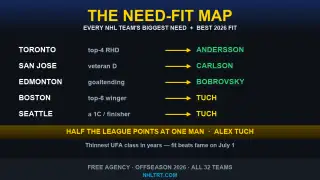
NHL 2026: Every Team's Biggest Need & Dream UFA Fit
A thin free-agent class makes 2026 about fit, not fame. The Need-Fit Map names all 32 teams' biggest hole and the realistic target who fills...
By Mike Johnson · 8 min read
Comments
Be the first to share your take.
Get NHL trade rumors in your inbox
One email per week, zero spam, verified rumors only.