Jason Robertson Contract 2026: Stars $1.4M Gap Decoded
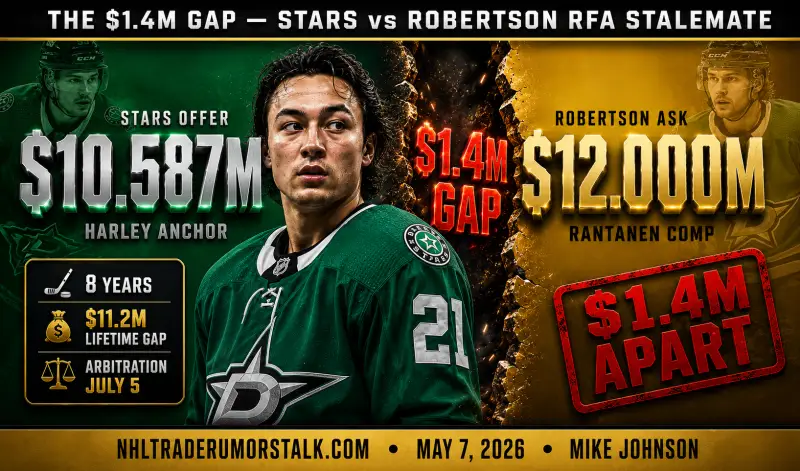
Jason Robertson asks $12M, Stars offered $10.587M. Inside the $1.4M Gap, the Harley Anchor, the Skater Tax, and Robertson arbitration leverage as Kaprizov $17M reset the winger market.
Live updates
No updates yet. Refreshing automatically.
For the first time since signing his current $7.75M deal in 2022, Jason Robertson is staring down a contract negotiation where Dallas holds $11M of cap space and the rest of the league knows it. The 2026-27 NHL salary cap leaping to $104M does not help. The $1.4M Gap between what Stars are offering ($10.587M, the Harley anchor) and what Robertson is asking ($12M, the Rantanen comp) just decided the entire 2026 RFA market, and the offer-sheet board with it. Per Jeff Marek on the DFO Rundown, the gap is real, the leverage is split, and the arbitration window in mid-July is the cliff nobody is talking about loud enough.
This page maps the gap. Why Stars opened at the Harley anchor. Why Robertson's agent Andy Scott points at Kaprizov's $17M reset. The arbitration leverage no one is talking about. And the four likely endgames as July 1 closes in.
The cluster reality check: my $11.7M Cliff article already had Robertson at the cliff edge of the offer-sheet compensation table. This is the Stars-side counter, the negotiating room view, the math that decides whether the Cliff threshold matters or not.
Key Takeaways
- The Gap is $1.4M, but the real gap might be $2M: Stars opened at Harley's $10.587M AAV, Robertson wants Rantanen's $12M. With Kaprizov's $17M deal resetting the winger market in September 2025, agent Andy Scott may push that ask higher.
- Robertson has arbitration rights: At 26 with six NHL seasons, Robertson can file for salary arbitration if a deal is not reached. That flips leverage the Stars' QO + match-offer-sheet strategy normally creates. The $1.4M Gap stops being a negotiation and becomes a clock.
- Stars' real wiggle room is $4.7M: Per The Hockey News' May 5 cap analysis, Dallas has $65.987M committed across seven contracts at $8M or higher. The remaining cap space barely covers depth + Robertson's qualifying offer.
- The Skater Tax is real: Marek says Dallas has been "burned before" giving long-term to non-skaters (Seguin's late-career, Klingberg's exit). That is why Stars will not go to $12M for 8 years without a fight.
- July 1 is not the deadline. Arbitration filing is. If no deal by mid-July, Robertson files. Arbitrator-set salary lands somewhere between the two numbers, but locks Stars to single-year AAV when they wanted long-term control.
Cap context update: The NHL/NHLPA confirmed the 2026-27 cap on May 6 at $104 million, which lifts the individual ceiling to $20.8 million for the first time. See the full 9-Digit Era audit covering how Robertson's $1.4M gap fits into the new market.
The Harley Anchor: Why Stars Opened at $10.587M
Look, the Stars' offer did not come from nowhere. The Harley Anchor, Thomas Harley's 8-year, $84.696M extension signed October 28, 2025 at $10.587M AAV, is the internal comp Jim Nill keeps reaching for. Per the league's release on the deal, Harley is 24, signed long-term, anchors the left side next to Heiskanen, and runs second-highest AAV on the roster behind Mikko Rantanen ($12M).
The internal logic writes itself. Stars do not want Robertson's AAV above Harley's. The moment Robertson clears the Harley Anchor, every comp downstream resets. Roope Hintz's next deal. Wyatt Johnston's second contract. Heiskanen's flex year. Crossing the anchor is not one contract, it is five. And Jim Nill knows it.
Robertson's response, per Jeff Marek on the DFO Rundown this week: he "does not want it" at the Harley number. Andy Scott has a different anchor in his briefcase: Mikko Rantanen's $12M AAV. The same agent represents both players, which is why the Rantanen comp is the most loaded number in the room. The same Harley Anchor logic is exactly why The $11.7M Cliff does not apply to Robertson directly, he is on a UFA-track negotiation, not a poach-track offer-sheet defense.
The Harley Anchor is not just a number. It is the ceiling Stars have decided to defend. Crossing it means redoing comps for the next five contracts on the roster. Robertson sees that. Andy Scott sees that. Both have a different anchor in mind.
The Kaprizov Ceiling: Why Robertson Sees $14M, Not $12M
On September 30, 2025, Kirill Kaprizov signed an 8-year, $136M extension with Minnesota. $17M AAV. The largest contract in NHL history per NHL.com's announcement, beating Draisaitl's $14M. That single signing reset the elite-winger market, and Robertson's agent Andy Scott (who also represents Mikko Rantanen) noticed.
The math is uncomfortable for Stars. Kaprizov posted 56 points (25 goals, 31 assists) in just 41 games during 2024-25 — missing the second half of the season due to injury — at a 1.37 PPG pace when healthy. Robertson posted 45 goals and 51 assists in 82 games during 2025-26 at a 1.17 PPG pace. Kaprizov is the higher-PPG healthy version of Robertson, two years older, and locked in at 16.35 percent of the $104M cap. Per Bill Guerin's announcement, Kaprizov's career PPG is 1.21 — the elite-winger benchmark Andy Scott will plant on the table.
Run that math on Robertson: at 16.35 percent he would land at $17M. At a 12 percent cap-share haircut he would land at $12.5M. Andy Scott's opening ask of $12M is not the ceiling, it is the floor. The Kaprizov reset gave him a new comp. My full UFA market read covers how this comp inflation cascades through the entire 2026 winger pool, but Robertson is the loudest example.
The Kaprizov Ceiling does not mean Robertson gets $17M. It means the conversation no longer ends at $12M. It opens at $12M. Andy Scott has the Kaprizov receipt sitting on the desk.
"The Kaprizov Ceiling did not change Robertson's value, it changed the conversation. Two months ago, $12M was a stretch. Today, $12M is a haircut. The market reset, and Andy Scott has the receipt."
Mike Johnson, Senior EditorThe Skater Tax: Marek Explains the Burned-Before Pattern
This is the part of the negotiation no one wants to say out loud, but it is why Stars are firm at the Harley Anchor. The Skater Tax. Per Jeff Marek on the DFO Rundown:
"Dallas has been burned before going long-term on players that are not great skaters. When it finally starts to go south for them, it goes south quickly... And I think that is one of the sensitivities."
Jeff Marek, DFO Rundown, May 6 2026The pattern Marek is referencing is Tyler Seguin's late-career skating decline. Seguin's 8-year deal at $9.85M became dead money in years 6 through 8 as his foot-speed broke down. John Klingberg exited Dallas under the same kind of skating-mobility cliff. Both are still on the cap sheet in some form, both serve as cautionary tales every time Nill negotiates a long-term contract with a player whose game depends on stick over feet.
Robertson's skating is an acknowledged weakness, not bottom-tier. He has scored at a 1.17 points-per-game pace this season. But the math worries Stars: an 8-year deal ages Robertson 27 to 34. Skating-dependent skill curves degrade faster than pure shooters who can post up at the net. The Skater Tax is a $1M to $2M AAV haircut Stars want to apply to compensate for that decline-risk.
Robertson's counter is simple: "I am a 96-point scorer. I am not paying the Skater Tax on a Seguin precedent that was not even me." Andy Scott's job is to argue the 96-point season is the proof The Skater Tax should not apply. Stars want the discount. Robertson wants to be treated like the producer he is, not the skater he is not.
The unspoken third party in every Robertson negotiation room is the Seguin contract. The Skater Tax is what Stars have decided to call the lesson they learned. Whether Robertson pays it is the negotiation.
The Arbitration Card: Hidden Leverage for Robertson
Here is the part Stars fans are not talking about loud enough. Jason Robertson, age 26 with six NHL seasons, has full arbitration rights as a Group 2 RFA. Per CBA Article 12, Group 2 RFAs with four or more pro seasons qualify. Robertson was drafted 2017 (39th overall) and made his pro debut in 2020-21, which puts him at six seasons easily eligible.
If no deal lands by the post-July 5 filing window, Robertson files. An arbitrator hears both sides. The arbitrator awards a number, usually between the two opening positions. The mechanic is simple but the consequences are not. Arbitration awards are 1-year or 2-year only, never 8 years. So Stars lose long-term cap planning the second the filing happens. Per The Hockey Writers' May 6 leverage analysis, Robertson has "significantly more leverage than in past negotiations."
Why this scares Stars: it locks them into 1-year cap planning when they wanted 8 years of certainty. Why it scares Robertson less: even a $13M one-year award lets him test UFA in 2027 at age 27, with the cap projected over $113M.
"It's a business on both sides. I'm optimistic, I hope. It's not like what it was when I was 10 years old, getting to the NHL, anymore. It's a business. I learned that four years ago. It's not my first time."
Jason Robertson, post-elimination presser, May 4 2026The likely play: arbitration filing is the bluff. Both sides prefer an 8-year deal. But filing forces Stars to move off the Harley Anchor. Andy Scott does not want to fire the gun. Jim Nill does not want to dodge it. If The $1.4M Gap does not close by mid-July, the gun comes out.
Stars Cap Wall: The True $4.7M Wiggle Room
You can read "Stars have $11M of cap space" in five aggregator articles. That number is a lie of omission. The true wiggle room, after committed contracts and depth needs, is $4.7M. Here is the math, sourced to The Hockey News' May 5 cap analysis.
| Contract | AAV | % of $104M Cap |
|---|---|---|
| Mikko Rantanen | $12.000M | 11.5% |
| Thomas Harley | $10.587M | 10.2% |
| Tyler Seguin | $9.850M | 9.5% |
| Roope Hintz | $8.450M | 8.1% |
| Miro Heiskanen | $8.450M | 8.1% |
| Wyatt Johnston | $8.400M | 8.1% |
| Jake Oettinger | $8.250M | 7.9% |
| TOTAL committed (top-7) | $65.987M | 63.4% |
The math the aggregators skip:
- Cap ceiling 2026-27: $104.0M
- Top-7 committed: $65.987M (63.4 percent of cap)
- Depth players (12 spots × ~$2M average): $24.0M
- Robertson qualifying offer minimum: $9.3M
- Total committed if Robertson takes QO: $99.3M
- True wiggle room: $4.7M
With $4.7M of breathing room, Stars cannot pay Robertson $12M and fill out the roster. Either The Skater Tax applies and Robertson takes the Harley number, or someone gets traded, or the rest of the depth runs on min-AAV ELC pieces. There is no fourth option. This is the same structural cap problem the Floor Squeeze is forcing on ten OTHER teams in reverse, except those teams need to spend, and Stars cannot.
Anchor Index: Where Robertson Should Land
Here is where Robertson sits relative to comparable 25-27 year old RFA-track wingers who recently signed long-term. The Anchor Index plots cap-share percent versus production. Robertson should be paid where the line meets his points-per-game, not where the Harley defender comp lives.
ANCHOR INDEX 2026
Production-weighted comps for 25-27 year old wingers signed long-term. Stars Harley anchor offer is roughly $2M low.
5 RFA Path Tiers: How Each Ends
Five paths. Five different futures. Here is how each ends, with probability weights:
| Path | AAV / Term | Probability | Outcome |
|---|---|---|---|
| 1. Qualifying Offer | $9.3M / 1 year | 5% | Robertson refuses, files arbitration |
| 2. Bridge Deal | $9.5M-$10.5M / 2-3 yr | 15% | Both sides reset, 2027-28 walk year |
| 3. Full 8-Year Deal | $11.5M-$12.5M / 8 yr | 50% | Cluster-aligned, the Cliff resolves |
| 4. Offer Sheet Match | $11.7M+ / 7 yr | 10% | Cliff threshold matched, Stars eat trouble |
| 5. Trade | n/a | 20% | Anaheim, Pittsburgh, or Toronto land him |
Path 1 (Qualifying Offer): Stars file the $9.3M QO to retain rights. Robertson refuses to sign it. Files for arbitration. Locks Stars into a 1-year award.
Path 2 (Bridge Deal): Both sides agree to a 2 or 3 year deal at $9.5M to $10.5M to delay the long-term commitment until cap is at $113.5M+ in 2027-28. Stars buy time. Robertson tests market closer to UFA at age 28.
Path 3 (Full 8-Year): Most likely. Both sides find $11.7M to $12M middle ground. Cluster-aligned with the $11.7M Cliff threshold. Stars cross the Harley Anchor by ~$1M. Robertson takes a slight haircut from the Rantanen comp.
Path 4 (Offer Sheet Match): A cap-rich rebuilder (Anaheim, Chicago) offers $11.7M to $12M. Stars match, eating the cap pain. Pittsburgh CANNOT attack because of the Pick Ownership rule per the cluster offer-sheet article.
Path 5 (Trade): Lazerus's scenario. Stars trade Robertson for ~3 high-value pieces (top-4 D + 1st + prospect). Anaheim and Pittsburgh are the loud names. Toronto is a dark horse if Auston Matthews walks, which would dovetail with the Maple Leafs subtraction spiral reset that has been brewing all season. The mid-market spend pattern that Calgary is running is the cleaner roadmap, but Dallas is contender-tier and cannot accept that math without a Cup window cost. The Four-First Problem the Blues hit with Robert Thomas is the cautionary tale Jim Nill rereads before any Robertson trade conversation.
Path Probability Index: Where The $1.4M Gap Actually Closes
Five paths, five different futures, but not equal odds. Here is my probability-weighted read on each outcome and how the cap math gets resolved before mid-July arbitration filings. Higher score equals more likely scenario.
PATH PROBABILITY INDEX
Probability score for each path Robertson's contract resolution can take before July 5 arbitration filing. Higher equals more likely.
Two Million Apart: The Verdict
Strip away the comps, the anchors, and the taxes. Two Million Apart. That is the real distance Stars and Robertson have to close between now and the arbitration filing window in mid-July. The Gap is $1.4M today. With Kaprizov's $17M ceiling pushing Andy Scott's ask up, it could widen to $2M before it closes.
Both sides want the same thing: Robertson in Dallas long-term. Both sides are scared of the same thing: arbitration's one-year cap-locked award. The compromise: $11.5M to $12M AAV on 8 years. Stars cross the Harley Anchor by $1M. Robertson takes a $500K haircut from the Rantanen comp. The Skater Tax is the wildcard. If Stars insist on a $1M decline-risk discount, Robertson files.
My pick: 8 years × $11.85M, signed by July 4 weekend. Stars cross the anchor. Robertson clears the Cliff threshold by $150K. Andy Scott uses Kaprizov as the off-ramp leverage but lands closer to Rantanen than the new ceiling. Two Million Apart becomes a $300K split-the-difference. The cluster pillar holds, and Stars' 2026-27 window stays open for one more Cup run.
Watch the arbitration filing window. If July 5 passes without a deal, Path 1 activates. Stars do not want that. Neither does Robertson. So the gap closes, either by $1M of Stars' restraint breaking or by $1M of Robertson's term-discount giving in. Either way, Two Million Apart does not survive July. The cluster cap math, including the Daily Cap Roster playoff pressure Stars are already feeling, makes a long-term deal the only sane path.
Companion read:
Robertson's contract structure won't fall under The July 1 Bonus Wall if signed after September 16, when the new 60% bonus cap takes effect.
Sources and Reporting
- NHL.com, Harley extension press release Oct 28, 2025
- NHL.com, Kaprizov record-breaking $17M extension Sept 30, 2025
- PuckPedia, Robertson contract page and AAV history
- Daily Faceoff Rundown, Marek "burned before" quote May 6 2026
- The Hockey News, Stars cap struggle parallel May 5 2026
- The Hockey Writers, Robertson arbitration leverage May 6 2026
- Yahoo Sports, Stars $11M cap math May 1 2026
- Heavy.com, Robertson sets RFA market May 2 2026
- ESPN, Kaprizov record contract analysis
- NHL.com Stars, Robertson negotiation history Sept 29, 2025
- Spotrac, 2026-27 Dallas Stars cap table
Frequently Asked Questions
What is the gap between Stars and Robertson?
The gap is $1.4M AAV. Dallas Stars opened at $10.587M (the Harley Anchor, matching defenseman Thomas Harley's 8-year extension AAV). Jason Robertson's agent Andy Scott is asking $12M (the Mikko Rantanen comp). Over an 8-year term, that gap totals $11.2M in lifetime contract value. Kaprizov's $17M reset in September 2025 may push Robertson's ask higher before the gap closes.
Does Robertson have arbitration rights?
Yes. Per CBA Article 12, Group 2 RFAs with four or more pro seasons qualify for salary arbitration. Robertson, age 26, was drafted in 2017 and made his pro debut in the 2020-21 season, giving him six pro seasons. If no contract is signed by the post-July 5 filing window, Robertson can file. The arbitrator awards a 1-year or 2-year deal, never long-term, which removes Stars' long-term cap planning option.
How much cap space do the Stars have for Robertson?
Per The Hockey News May 5 cap analysis, Stars have $65.987M committed across seven contracts at $8M or higher (Rantanen, Harley, Seguin, Hintz, Heiskanen, Johnston, Oettinger). After depth players ($24M for 12 spots) and Robertson's qualifying offer ($9.3M), true wiggle room is $4.7M against the $104M cap ceiling. Stars cannot pay Robertson $12M without trading another contract.
What qualifying offer does Robertson get?
Robertson's qualifying offer (QO) for 2026-27 lands at the minimum required to retain RFA rights, around $9.3M based on his current $7.75M salary structure. If Robertson signs the QO, he plays one year at $9.3M and becomes an unrestricted free agent in July 2027 at age 27. Stars typically issue the QO to preserve negotiating rights, with the long-term deal negotiated in parallel.
Why did Stars sign Harley first?
Stars signed Thomas Harley to an 8-year, $84.696M extension on October 28, 2025 specifically to set the internal cap comp before Robertson's negotiation opened. Harley's $10.587M AAV is the ceiling Stars want to defend. Crossing it for Robertson means re-doing comps for Hintz, Johnston, and Heiskanen's next deals. The Harley Anchor is a 5-contract chess move, not a 1-contract decision.
What contract is Robertson likely to sign?
My production-weighted projection: 8 years × $11.85M AAV ($94.8M total), signed by July 4 weekend. Stars cross the Harley Anchor by $1M. Robertson takes a $150K haircut from the Rantanen comp. Andy Scott uses the Kaprizov ceiling as off-ramp leverage but lands closer to Rantanen than the new $17M record. Probability: 50 percent on the 8-year deal, 20 percent on a trade, 15 percent on a bridge, 10 percent on offer sheet match, 5 percent on QO + arbitration filing.
Frequently Asked Questions
What is the gap between Stars and Robertson?
The gap is $1.4M AAV. Dallas Stars opened at $10.587M (the Harley Anchor, matching Thomas Harley's 8-year extension AAV). Robertson's agent Andy Scott is asking $12M (the Mikko Rantanen comp). Over an 8-year term, that gap totals $11.2M in lifetime contract value. Kaprizov's $17M reset in September 2025 may push Robertson's ask higher before the gap closes.
Does Robertson have arbitration rights?
Yes. Per CBA Article 12, Group 2 RFAs with four or more pro seasons qualify for salary arbitration. Robertson, age 26, was drafted in 2017 and made his pro debut in 2020-21, giving him six pro seasons. If no contract is signed by the post-July 5 filing window, Robertson can file. The arbitrator awards a 1-year or 2-year deal, never long-term, removing Stars' long-term cap planning option.
How much cap space do the Stars have for Robertson?
Per The Hockey News May 5 cap analysis, Stars have $65.987M committed across seven contracts at $8M or higher. After depth players ($24M for 12 spots) and Robertson's qualifying offer ($9.3M), true wiggle room is $4.7M against the $104M cap ceiling. Stars cannot pay Robertson $12M without trading another contract.
What is Robertson's qualifying offer?
Robertson's qualifying offer for 2026-27 lands around $9.3M based on his current $7.75M salary structure. If Robertson signs the QO, he plays one year at $9.3M and becomes an unrestricted free agent in July 2027 at age 27. Stars typically issue the QO to preserve negotiating rights, with the long-term deal negotiated in parallel.
Why did Stars sign Harley first?
Stars signed Thomas Harley to an 8-year, $84.696M extension on October 28, 2025 specifically to set the internal cap comp before Robertson's negotiation opened. Harley's $10.587M AAV is the ceiling Stars want to defend. Crossing it for Robertson means re-doing comps for Hintz, Johnston, and Heiskanen's next deals. The Harley Anchor is a 5-contract chess move, not a 1-contract decision.
What is Robertson's likely contract?
My production-weighted projection: 8 years times $11.85M AAV ($94.8M total), signed by July 4 weekend. Stars cross the Harley Anchor by $1M. Robertson takes a $150K haircut from the Rantanen comp. Probability: 50 percent on the 8-year deal, 20 percent on a trade, 15 percent on a bridge, 10 percent on offer sheet match, 5 percent on QO + arbitration filing.
Related Stories
NHL Goalie Free Agents 2026
The 2026 NHL goalie free-agent market has exactly one proven starter, Sergei Bobrovsky, 37, asking for $42 million. His partner Daniil Taras...
By Mike Johnson · 8 min read

NHL Free Agency 2026: Time & How to Watch
NHL free agency 2026 opens at noon ET on Wednesday, July 1. How to watch live on NHL Network and the trackers, who is actually available (Al...
By James Wright · 8 min read

Golden Knights Offseason Squeeze
Vegas reached Game 6 of the 2026 Cup Final, then handed itself a summer with about $4.6M in cap space to re-sign Pavel Dorofeyev, replace a...
By Mike Johnson · 9 min read
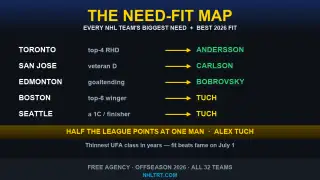
NHL 2026: Every Team's Biggest Need & Dream UFA Fit
A thin free-agent class makes 2026 about fit, not fame. The Need-Fit Map names all 32 teams' biggest hole and the realistic target who fills...
By Mike Johnson · 8 min read
Comments
Be the first to share your take.
Get NHL trade rumors in your inbox
One email per week, zero spam, verified rumors only.