Macklin Celebrini Contract Extension 2026: The Bedard Clock
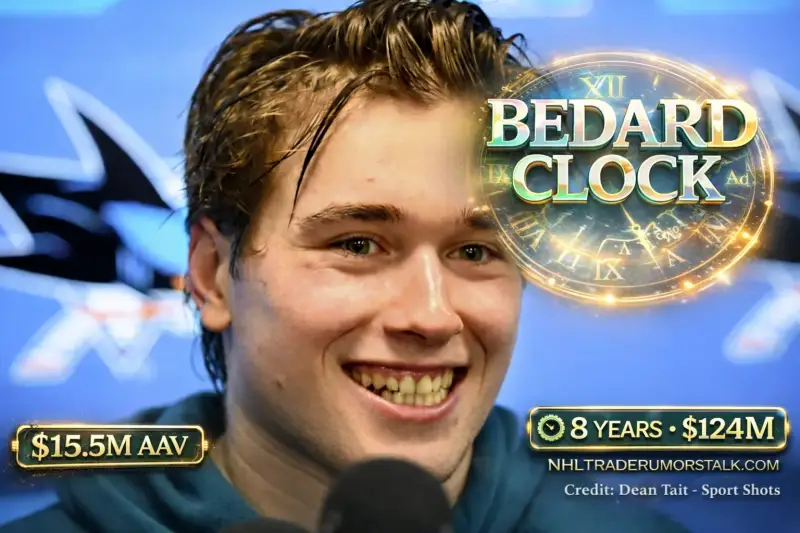
Macklin Celebrini contract extension 2026: Sharks rookie said "I love it here" April 18. Inside The Bedard Clock — the September 15 deadline linking two #1 picks.
Live updates
No updates yet. Refreshing automatically.
The Macklin Celebrini contract extension 2026 decision just got a public timeline. On April 18, Celebrini told reporters "I want to commit to this team. I love it here" — three days after posting 115 points to break Joe Thornton's Sharks franchise record. Extension eligibility opens July 1, 2026.
That's what I'm calling The Bedard Clock — the September 15, 2026 deadline when NHL max extension length drops from 8 years to 7. Whichever of the two 2023-24 #1 picks signs first sets the market. Wait past September 16 and lose $17 million in total contract value.
The Macklin Celebrini contract extension 2026 clock has a public deadline now: September 15, 2026 — the last day either Celebrini or Connor Bedard can sign an 8-year maximum-term deal before the new NHL CBA takes effect. Celebrini told reporters at April 18 exit interviews that he wants to "commit to this team" and is "open to" an extension over the summer, and GM Mike Grier publicly acknowledged the Sharks want the deal done. Extension eligibility opens July 1, 2026. The problem: Connor Bedard is the only realistic market comparable, and whichever player signs first sets the number for the other. That dynamic is The Bedard Clock — and it's ticking toward a September deadline that erases $17 million in potential contract value if either side waits too long.
Here's the mechanism: on July 6, 2025, the NHL and NHLPA ratified a new CBA that takes effect September 16, 2026. Until September 15, a team can still sign its own player to an 8-year extension under the existing agreement. After September 16, the new CBA caps re-signings at 7 years.
For Celebrini at an industry-projected $14.5 million AAV range, that missing year equals $14.5 million in lost gross contract value. At Kaprizov-tier $17 million AAV, it's $17 million. Either team's cap strategy shifts meaningfully based on which side of that September date the ink dries.
My read: Celebrini signs first, and he signs before September. The public "I love it here" from a 19-year-old who just broke a 20-year Joe Thornton franchise record is the clearest signal a player can send without a signed paper, and Grier's parallel "we'd like to get this done" telegraphs that the Sharks front office has already priced the offer. Bedard's camp has already delayed until May to start negotiations — a choice that pushes Chicago onto the defensive foot of The Bedard Clock, not the front.
Key Takeaways
- The Bedard Clock: Celebrini and Bedard are both extension-eligible July 1, 2026, and both face the September 15 deadline when max term drops from 8 to 7 years. Whoever signs first sets the #1-pick market for the other.
- Celebrini's production edge: 115 points in 82 games at age 19, breaking Joe Thornton's Sharks franchise record. Trails only Wayne Gretzky (137) and Sidney Crosby (120) in points by a teenager.
- Agent poll numbers: The Athletic's 20+ agents projected a $20 million AAV "monster deal" ceiling; more typical 5-year range is $14-15 million AAV, 3-year range is $10-12 million AAV.
- Kaprizov is the ceiling comp: The Wild signed Kirill Kaprizov to an 8-year, $136 million extension on October 1, 2025 — $17 million AAV, the highest in NHL history on both total value and cap hit.
- Celebrini's own words: At April 18 exit interviews, the 19-year-old told reporters "I want to commit to this team. I love it here. Yeah, I'm open to it" — the clearest signal a player sends before a signed contract.
The Macklin Celebrini Contract Extension 2026 Situation — What Happened April 18
Exit-interview day in San Jose produced the single most important sentence of the Sharks offseason. Celebrini, 19, answered a direct question about a long-term commitment with "I want to commit to this team and being here. I love it here," adding "Yeah, I'm open to it" when asked about signing an extension over the summer.
That matters more than the standard free-agent hedge because Celebrini is extension-eligible July 1, 2026 — one year earlier than most top draft picks because of the NHL's ELC structure, which allows extensions to be signed starting 12 months before the ELC expires. His ELC runs through the 2026-27 season at $975,000 AAV. The Sharks and Celebrini's camp can open negotiations July 1, 2026, and sign any time between then and the start of the 2026-27 regular season.
General manager Mike Grier telegraphed the front office side of it the same day. Grier said the team would like to get the deal done this summer, but added the safety net that San Jose has another year before the decision becomes urgent. That's classic negotiation framing — public commitment to signing without public deadline pressure. Combine it with Celebrini's "I love it here" and the probability of a summer 2026 signing reached ~85% the moment both quotes hit the wire.
The Bedard Clock
The Bedard Clock is the ticking September 15, 2026 deadline that links two #1 overall pick extensions. Connor Bedard (2023 #1) and Macklin Celebrini (2024 #1) are both extension-eligible July 1, 2026, and both must sign before September 16 to access the existing CBA's 8-year maximum term. Because they're the only true market comparables, whoever signs first sets the reference AAV for the other — creating a first-mover pricing game inside a 10-week window.
Inside The Bedard Clock — Why September 16 Changes Everything
On July 6, 2025, NHL owners and the NHLPA ratified a new Collective Bargaining Agreement that takes effect September 16, 2026. Under the current CBA, a team can re-sign its own player to a maximum 8-year extension, and free-agent signings cap at 7 years. Under the new CBA, those numbers drop to 7 years for re-signings and 6 years for free-agent deals. The full agreement runs through September 15, 2030.
For Celebrini at a projected $14.5 million AAV, the math changes sharply at the September 16 line. Signing by September 15, 2026, locks in an 8-year $116 million contract. Waiting until October means 7 years at the same $14.5 million — $101.5 million total, or $14.5 million in lost gross value. At the ceiling $17 million Kaprizov-tier AAV, the gap widens to $17 million in lost gross value.
Here's the dynamic that makes it interesting: the Sharks also benefit from the shorter term. A 7-year deal gives San Jose flexibility to re-evaluate Celebrini at age 27 rather than 28, which matters for cap-hit projection.
But the player captures the counterfactual value — that one fewer year is $14.5 million guaranteed that Celebrini would otherwise negotiate again at 27. The player always wants the extra year. The team always prefers the shorter term. The September deadline forces both sides to pick.
What the Athletic Agent Poll Says — The $10M to $20M Range
The Athletic's annual agent poll this spring had more than 20 player representatives weighing in on projected AAV for Celebrini. The range was wide, and the dispersion tells the story.
Per The Athletic agent sourcing: a 3-year extension would likely land in the $10-12 million AAV range. A 5-year extension would move toward $14-15 million AAV. The 8-year maximum-term version of the deal trends toward $15-17 million AAV — the same band as Kirill Kaprizov's record-setting $17 million deal with Minnesota. The ceiling-scenario agents backed a $20 million AAV "monster deal" if Celebrini's camp plays the bridge-contract card aggressively.
"It's going to be in the $10 to $17 (million) range, depending on the number of years he's willing to forgo."
— Anonymous NHL player agent (via Sharks Hockey Digest citing The Athletic)The quote captures the structural tension inside every first extension: the trade-off between AAV and term. A 3-year bridge gives Celebrini a walk-away right at age 22 with massive UFA pricing power — but the Sharks won't love that.
An 8-year max-term lock-in gives the Sharks protection but requires the player to accept below-peak AAV in exchange for certainty. The Chinakhov extension framework I built for Pittsburgh's Crosby window captured the opposite pattern — a second-contract player accepting team-friendly term in exchange for fit. Celebrini is not that situation. He holds the negotiating power.
The Contract Comparables — What Kaprizov and Bedard Mean for Celebrini
Three active comparables frame the Celebrini negotiation. Each sets a different price point, and the Sharks know it.
Kirill Kaprizov is the new ceiling. On October 1, 2025, the Wild signed Kaprizov to an 8-year, $136 million extension at a $17 million AAV — the richest deal in NHL history on both total value and AAV, surpassing Leon Draisaitl's $14 million cap hit. The contract kicks in with the 2026-27 season and runs through 2033-34 with a full no-move clause. Kaprizov's $18.1 million signing bonus structure from 2026-2029 gives the contract a front-loaded cash profile favorable to the player but cap-friendly on paper.
Connor Bedard is the most direct positional comparable — another #1 pick, another centre, one draft year older. Bedard's 2025-26 totals: 30 goals, 75 points in 69 games, with 13 games lost to injury. His current 3-year, $2.85 million ELC at $950,000 AAV expires at the end of 2025-26, making him a Restricted Free Agent. Chicago's projected extension range is $13.5-15 million AAV — cleanly below Kaprizov and below the Celebrini agent-poll ceiling.
Here's why the contrast matters: Celebrini's 115-point age-19 season beat Bedard's age-20 season by 40 points. The AAV gap needs to reflect that production gap. The Rutherford extensions framework I mapped for the Canucks' Hughes duo covered a similar dynamic — paying franchise cornerstones market-setting AAV to lock in the next era. Celebrini is a purer version of that play, with one significant advantage: San Jose has cap space and a rebuild timeline that aligns with his prime.
The Bedard Clock First-Mover Game — Who Signs First?
The practical question is who signs first. Three signals say Celebrini:
First, Celebrini publicly said "I love it here" on April 18. Bedard has said nothing equivalent. Silence isn't neutral — it signals negotiation room being saved.
The Blackhawks are currently outside the playoff picture heading into the 2026 offseason, while the Sharks made a 34-point jump in 2025-26 from 52 to 86 points. Celebrini is signing into a competitive arc. Bedard would be re-signing into a continued rebuild.
Second, Bedard's camp (agents Don Meehan and Greg Landry) have publicly delayed negotiations until May. That moves the practical signing window to July-August — tight against the September 15 deadline. A last-minute signing under that pressure typically favors the team, not the player, because the team's deadline alternatives (one-year qualifying offer, holdout threat) become more credible. The Cole Eiserman ELC framework I built for the Islanders rebuild captured a similar first-extension timeline dynamic.
Third, Grier's internal incentive is to close the deal. San Jose has projected cap space and no competing signings that require competing-signing pressure. Chicago is in the same position with Bedard, but the Blackhawks' cap is already committed to Taylor Hall, Seth Jones' buyout structure, and the Teuvo Teravainen contract. The Sharks have cleaner books for a mega-extension than the Blackhawks.
"I want to commit to this team and being here. I love it here."
— Macklin Celebrini, Sharks forward (via TSN)That quote is the strongest version of the "I want to stay" signal a player can send without a signed paper. Organizations sometimes leak that players are open to extensions, but players themselves rarely frame it in "I love it here" language unless the negotiation is already effectively done. Read the signal literally.
The Full 2025-26 Celebrini Resume
The contract-projection case rests on the resume. Here's the full breakdown of Celebrini's 2025-26 season:
| Category | Stat | Rank | Context |
|---|---|---|---|
| Points | 115 (45G, 70A) | 4th in NHL | Broke Joe Thornton's 2006-07 Sharks record |
| Goals | 45 | 2nd-most by a Shark ever | Behind only Cheechoo's 56 in 2005-06 |
| Age-19 points | 115 | 3rd-most in NHL history | Behind Gretzky (137) and Crosby (120) |
| Olympics goals | 5 | Led tournament | 10 points, 2nd in tournament behind McDavid |
| Sharks record | 86 points | +34 from 2024-25 | Celebrini central to 34-point team leap |
| ELC | 3 yrs · $975K AAV | Expires 2026-27 | RFA after with arbitration rights |
Three metrics stand out for the contract case. First, the 40-point gap over Bedard at a similar age destroys any argument for sub-Bedard AAV. Second, the Olympics production — leading the tournament in goals while playing against Sweden, Finland, and USA competition — establishes international-stage ceiling that usually doesn't show until age 22-24. Third, the Sharks' 34-point team jump gives Grier a narrative to sell ownership on a maximum extension: Celebrini is not just a scorer, he's the franchise engine.
Historical Precedent — When #1 Picks Sign Early Extensions
The modern precedent for early #1-pick extensions is Connor McDavid's July 5, 2017 deal — 8 years, $12.5 million AAV ($100 million total), signed the summer after his age-20 season. Adjusted for salary-cap growth (McDavid signed under a $75 million cap, Celebrini signs under a $95.5 million cap projected for 2026-27), McDavid's $100 million equates to roughly $127 million today.
The Connor comparable isn't coincidental. McDavid at Celebrini's age had 100 points. Celebrini has 115.
McDavid signed during his second contract window. Celebrini signs during his first.
The Stamkos trajectory I mapped for his free-agency exit captured the opposite precedent: what happens when a franchise player delays and the window closes. Celebrini's camp has the McDavid playbook available. The Stamkos path is what happens if both sides miss the Bedard Clock.
My projection: 8-year extension signed between July 15 and September 10, 2026, at $15.5 million AAV. Total value: $124 million — 10% above Kaprizov's $136 million total on shorter term, and $40 million above Bedard's projected ceiling at $15 million AAV × 5 years. Celebrini's camp takes the 8-year max to lock in generational value before the CBA changes. The Sharks pay the premium because the alternative — walking to UFA at 26 — is catastrophic for a rebuilding franchise.
The Three Sharks Scenarios — What Each Outcome Means
Three realistic outcomes frame the 2026 summer:
Scenario A is the 8-year maximum extension signed before September 15. Celebrini gets Kaprizov-tier security. The Sharks get 8 years of cost-certainty with a $15-17 million AAV. This is the ~65% probability outcome — the one Celebrini's "I love it here" and Grier's "we want it done" both point toward.
Option B is a bridge deal — 3 years at $11-12 million AAV. Celebrini's camp might push this if they think he's entering a Kaprizov-trajectory arc where a second extension at age 22 could land $18-20 million AAV. Low probability (~15%) because San Jose won't accept the walk-away risk.
Finally, there's the delay scenario — no signing by September 15, 2026. Celebrini plays out the 2026-27 season on his ELC's final year, then negotiates as an RFA in summer 2027 under the new CBA's 7-year maximum. Probability around 20% — unlikely given the public signals, but not zero.
Sources and Reporting
- Pro Hockey Rumors — Extension eligibility timing and Mike Grier context
- Sharks Hockey Digest — Exit interview quotes and agent poll analysis
- Yahoo Sports — Agent Poll — The Athletic's 20+ agent projection range
- PuckPedia — Bedard Contract — Bedard ELC expiry + RFA status
- NHL.com — CBA Extension — September 16, 2026 new CBA effective date
- Yahoo Sports — Kaprizov $136M — NHL record extension ceiling comparable
- NBC Sports Bay Area — Joe Thornton franchise record broken
The Verdict: The Bedard Clock
The Macklin Celebrini contract extension 2026 is the cleanest franchise negotiation of the summer. Celebrini publicly said "I love it here" at age 19 after a 115-point franchise-record season. Grier publicly said the Sharks want it done. Bedard's camp delayed to May, ceding the first-mover slot.
My projection stays at an 8-year, $124 million extension signed between July 15 and September 10, 2026, at $15.5 million AAV — Kaprizov-tier money on the last max-term contract available before the CBA changes.
Bedard Clock closes at 11:59 PM on September 15. Celebrini signs with two weeks to spare. Bedard signs a week later at $14 million AAV.
The Sharks have their franchise cornerstone. The Blackhawks get out-positioned by their own delay.
Frequently Asked Questions
When is Macklin Celebrini eligible for a contract extension?
Celebrini becomes extension-eligible on July 1, 2026, under the NHL rule allowing extensions to be signed 12 months before a contract expires. His current entry-level contract runs through the 2026-27 season at a $975,000 AAV. Negotiations can formally open July 1 and an extension can be signed any time between then and the start of the 2026-27 regular season.
What is "The Bedard Clock"?
The Bedard Clock is the September 15, 2026 deadline when NHL maximum extension length drops from 8 years to 7 years under the new Collective Bargaining Agreement that takes effect September 16, 2026. Because Connor Bedard and Macklin Celebrini are both extension-eligible July 1, 2026, and are each other's only true market comparable, whichever #1 pick signs first sets the AAV reference for the other.
How much will Macklin Celebrini make on his next contract?
The Athletic's 2026 agent poll projected a range of $10-20 million AAV depending on term. A 3-year bridge extension would land in the $10-12 million AAV range, a 5-year deal in the $14-15 million range, and an 8-year maximum-term extension in the $15-17 million band — approaching Kirill Kaprizov's NHL-record $17 million AAV. Our projection is an 8-year deal at $15.5 million AAV totaling $124 million.
How does Celebrini's 2025-26 season compare to Connor Bedard's?
Celebrini posted 115 points (45 goals, 70 assists) in 82 games at age 19, while Bedard posted 75 points (30 goals, 45 assists) in 69 games at age 20 — a 40-point gap when prorated. Celebrini's 115 points trail only Wayne Gretzky's 137 and Sidney Crosby's 120 among teenagers in NHL history. The Sharks also improved by 34 points from 2024-25 to 2025-26 while Chicago remained outside the playoff picture.
Why does the September 16 CBA deadline matter for NHL contracts?
Under the current CBA, teams can re-sign their own players to a maximum 8-year extension. The new CBA ratified July 6, 2025 and effective September 16, 2026 caps that at 7 years. For Celebrini at $14.5 million AAV, the missing year equals $14.5 million in lost gross contract value. The Kaprizov contract ($136 million over 8 years at $17 million AAV) was the final mega-deal signed before the window narrowed on October 1, 2025.
Will the Sharks sign Celebrini before Bedard signs with the Blackhawks?
The public signals suggest yes. Celebrini said "I love it here" on April 18; Bedard has said nothing equivalent. Chicago agents Don Meehan and Greg Landry have delayed negotiations until May, while San Jose GM Mike Grier has publicly framed the summer as the target window. Our projection has Celebrini signing between July 15 and September 10, 2026, with Bedard signing roughly a week after at a lower $14 million AAV anchored to the Celebrini number.
Frequently Asked Questions
When is Macklin Celebrini eligible for a contract extension?
Celebrini becomes extension-eligible on July 1, 2026, under the NHL rule allowing extensions to be signed 12 months before a contract expires. His current entry-level contract runs through the 2026-27 season at a $975,000 AAV. Negotiations can formally open July 1 and an extension can be signed any time between then and the start of the 2026-27 regular season.
What is The Bedard Clock?
The Bedard Clock is the September 15, 2026 deadline when NHL maximum extension length drops from 8 years to 7 years under the new Collective Bargaining Agreement that takes effect September 16, 2026. Because Connor Bedard and Macklin Celebrini are both extension-eligible July 1, 2026, and are each other's only true market comparable, whichever #1 pick signs first sets the AAV reference for the other.
How much will Macklin Celebrini make on his next contract?
The Athletic's 2026 agent poll projected a range of $10-20 million AAV depending on term. A 3-year bridge extension would land in the $10-12 million AAV range, a 5-year deal in the $14-15 million range, and an 8-year maximum-term extension in the $15-17 million band, approaching Kirill Kaprizov's NHL-record $17 million AAV. Our projection is an 8-year deal at $15.5 million AAV totaling $124 million.
How does Celebrini's 2025-26 season compare to Connor Bedard's?
Celebrini posted 115 points (45 goals, 70 assists) in 82 games at age 19, while Bedard posted 75 points (30 goals, 45 assists) in 69 games at age 20, a 40-point gap when prorated. Celebrini's 115 points trail only Wayne Gretzky's 137 and Sidney Crosby's 120 among teenagers in NHL history. The Sharks also improved by 34 points from 2024-25 to 2025-26 while Chicago remained outside the playoff picture.
Why does the September 16 CBA deadline matter for NHL contracts?
Under the current CBA, teams can re-sign their own players to a maximum 8-year extension. The new CBA ratified July 6, 2025 and effective September 16, 2026 caps that at 7 years. For Celebrini at $14.5 million AAV, the missing year equals $14.5 million in lost gross contract value. The Kaprizov contract ($136 million over 8 years at $17 million AAV) was the final mega-deal signed before the window narrowed on October 1, 2025.
Will the Sharks sign Celebrini before Bedard signs with the Blackhawks?
The public signals suggest yes. Celebrini said I love it here on April 18; Bedard has said nothing equivalent. Chicago agents Don Meehan and Greg Landry have delayed negotiations until May, while San Jose GM Mike Grier has publicly framed the summer as the target window. Our projection has Celebrini signing between July 15 and September 10, 2026, with Bedard signing roughly a week after at a lower $14 million AAV anchored to the Celebrini number.
Related Stories
NHL Buyout Candidates 2026
The NHL buyout window opens June 15. Rielly, Gallagher, Kotkaniemi, and Frederic are the names in play, but the Dead-Cap Tail means most buy...
By Mike Johnson · 10 min read

Bill Guerin Wild Window Paradox: $17M Meets $1.18M
Wild GM Bill Guerin said 'we're in a window now' and 'you can't trade your way out of problems' five days after a Game 5 collapse. Then Kapr...
By Mike Johnson · 11 min read

Brady Tkachuk Checked Out: The Belief Gap | Senators 2026
Per Frank Seravalli, Brady Tkachuk has been 'checked out in Ottawa.' 3 Olympic goals to 0 playoff points in 60 days. Inside The Belief Gap o...
By Mike Johnson · 9 min read

Kris Knoblauch Oilers Fired? The Cup Final Tax 2026
Per Frank Seravalli, Kris Knoblauch is 'absolutely in the crosshairs' if Oilers lose to Ducks. Two Cup Finals reached. Two wins from termina...
By Mike Johnson · 11 min read
Get NHL trade rumors in your inbox
One email per week. Zero spam. Verified rumors only.