Michkov Benching Justified? Flyers Pace Tax in Game 6
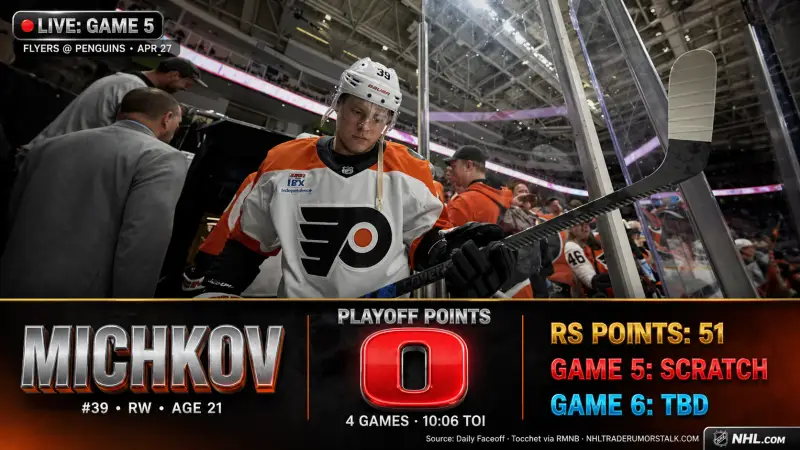
Matvei Michkov, 21, posted 51 points in the regular season and zero through four playoff games. Rick Tocchet sat him for Game 5. We break down the Pace Tax framework that decided it.
Live updates
No updates yet. Refreshing automatically.
Matvei Michkov is 21 years old, scored 20 goals and 51 points across the 2025-26 regular season, and put up exactly zero points in his first four playoff games against Pittsburgh. So when Rick Tocchet scratched him for Game 5 on April 27, the Flyers fan base split into two camps overnight. Tocchet's call was either the smartest move of the series or the dumbest one. There is no middle ground here. The Flyers lost that game 3-2, the series tightened to 3-2, and now Game 6 is back in Philadelphia on Wednesday night with the entire Michkov benching debate sitting in the front office's lap.
Was the Michkov benching justified? Honestly, on the merits, yes. He was averaging 10 minutes and 6 seconds of ice time per playoff game, second-lowest among Flyers forwards behind only Denver Barkey. He was producing nothing offensively. He was, per multiple league sources, a defensive liability against Pittsburgh's pressure forecheck. Alex Bump came in cold off four straight scratches, scored his first NHL playoff goal, threw hits, and gave Tocchet exactly the energy injection the lineup needed. That is the box-score story.
But here is the messy part. Michkov is the franchise asset. He is the reason the Flyers fan base started believing again. Sitting him in a closeout game is the kind of move that either ages like fine wine or blows up the front office in October. I am calling this whole thing the Pace Tax, and the bill is due Wednesday.
Key Takeaways
- The Pace Tax: Playoff hockey strips developmental skilled players of the regular-season margin they thrive on.
- Michkov line: 51 regular-season points (20G, 31A) crashed to 0 through 4 playoff games at 10:06 average TOI.
- Tocchet's call: Replaced Michkov with Alex Bump for Game 5; Bump scored his first NHL playoff goal in a 3-2 loss.
- Defensive context: Michkov plus/minus jumped from minus-18 as a rookie to zero in 2025-26, but his playoff defensive metrics collapsed against Pittsburgh's pressure.
- Game 6: Wednesday at 7:30 p.m. ET in Philadelphia. Series 3-2. The Pace Tax framework gets its real verdict.
What Actually Happened: The Game 5 Scratch
Tocchet announced the scratch Sunday in practice. The reasoning was about pace, energy, and a developmental check-in. Michkov had played four playoff games. He had recorded no points, no real chances, and his ice time kept shrinking. Through four games, the kid was basically watching the playoffs from the bench during third periods anyway.
And then there is Alex Bump. He had been a healthy scratch for the first four games of the series. He came in for Game 5 with fresh legs, energy, and a chip on his shoulder. He scored his first NHL playoff goal. He fired four shots on net. He threw hits. The Flyers lost the game, but Bump was not the reason. He was, if anything, the only reason the score line was 3-2 and not 4-1.
Tocchet's public framing was developmental, not punitive. The Penguins' own young player decisions on this exact roster show how a head coach's first playoff series with a skilled rookie usually goes one of two ways: either the kid breaks through, or the kid sits while the veterans close the deal. Michkov got the second version on Sunday.
"There's a lot of pace in the playoffs. It's OK to evaluate them every once in a while, give them a rest, whether it's Matvei, whether it's Bumper. That's the way to develop your players."
Rick Tocchet, head coach of the Philadelphia Flyers (via RMNB)That quote is the cleanest version of Tocchet's defense. The phrase that matters most is "a lot of pace." Translation: this Pittsburgh series is faster, more physical, and more punishing than anything Michkov saw in the regular season. The Pace Tax is real, and Tocchet decided his rookie was paying it in points and minus events the team could not afford anymore.
The Pace Tax, Defined
The Pace Tax
The structural cost playoff hockey imposes on developmental skill players. The same player who creates time and space against tired regular-season checking lines suddenly cannot get to spots, win second-effort puck battles, or absorb the speed of forecheck pressure when every shift is a 45-second sprint. The Pace Tax is paid in invisible turnovers, lost battles, and minus events that don't show up in the box score until they decide a series.
Michkov's case fits the Pace Tax pattern almost too cleanly. His regular-season game lives in slow-developing offensive zone cycles. He waits, scans, then strikes. That works in October when the third defensive pair is gassed by minute 50. It does not work in April when Kris Letang is shadowing him and the Penguins forecheck is collapsing on him before the puck reaches his stick.
His ice-time number tells the rest of the story. 10 minutes 6 seconds is not a top-six forward's deployment. It's not even a steady third-line role. It is "fourth-line check-in" minutes, and it had been trending lower since Game 1. Tocchet was already telegraphing the move. The Game 5 scratch just made it official. A similar TOI compression hit Matthew Knies in Toronto earlier this season, and the Leafs handled it with quieter line-juggling rather than a healthy scratch. Tocchet picked the louder option.
Why the Numbers Backed the Call
Let's run the math. Michkov posted 51 points in the regular season. That is roughly 0.62 points per game across an 82-game season, a sophomore step back from his 63-point, 80-game rookie year. His shooting percentage stayed in the 12-13 percent range, which is sustainable. His expected goals share at five-on-five (xGF percent: meaning the share of scoring chances his team generated when he was on ice) sat in the 47-49 range across the regular season, which is below the league average for skilled forwards but inside acceptable two-way territory.
The playoff drop-off was sharper than the surface stats suggest. Through four games, his ice time average of 10:06 was the second-lowest among Flyers forwards. He took zero shots that registered as high-danger chances. He was on the ice for two even-strength goals against. And his shifts were ending earlier and earlier as Pittsburgh's defensive pair started exploiting his neutral-zone hesitation.
And then there is the lineup math. The Flyers had Bump waiting. He was a healthy scratch for four straight games and was reportedly the best player in practice. The same kind of rookie-pipeline depth question hits every team during a playoff run, and Tocchet's job was to optimize for Game 5, not for Michkov's career arc.
| Stat | Regular Season 2025-26 | Playoffs (4 GP) | Trend |
|---|---|---|---|
| Goals | 20 | 0 | Cliff drop |
| Points | 51 | 0 | Cliff drop |
| TOI/Game | 17:30 (approx) | 10:06 | -7:24 collapse |
| Plus/Minus | 0 | negative | Pressure exposure |
| Lineup Status | Top-6 winger | Healthy scratch G5 | Demotion |
The Counter-Case: Why This Could Backfire
Now the other side. And this is the one that worries me.
Michkov is 21. He is the most skilled forward the Flyers have drafted in over a decade. The franchise has been building, in large part, around the promise of his eventual breakout. The same kind of skill premium that drives free-agent bidding wars also drives whether young stars feel valued by their head coach. Sitting him in Game 5 sends one of two messages: "we trust you to come back stronger" or "we don't trust you when it matters." Tocchet has framed it as the first. Some of the Russian hockey media is already framing it as the second.
And here is the rub. If the Flyers lose Game 6 and Game 7, the Michkov scratch becomes the lasting image of a series collapse. Internet hot takes will write themselves: "the coach who benched the franchise player and lost a 3-0 series." That is the Tocchet career risk in a single sentence.
Michkov Benching Audit
Three angles that matter when judging Tocchet's Game 5 call. Higher score equals stronger justification.
Game 6 Decision Matrix
Three coaching decision paths Tocchet faces for Wednesday night. Higher score equals higher probability of that scenario playing out.
The Insider Reaction: What League Sources Are Saying
Anthony Di Marco of Daily Faceoff broke down the league's view on Tuesday. The reaction from rival executives, per his reporting, was supportive of Tocchet's call. They cited Michkov's defensive struggles, his offensive disappearance, and the simple fact that 21-year-old skilled forwards typically need a developmental jolt at some point in their first deep playoff run.
"Michkov's struggle to keep up and produce offense (all while being somewhat of a liability defensively) made it hard to find a place for him in the lineup, according to sources."
Anthony Di Marco, Flyers insider (via Daily Faceoff)That defensive-liability framing is the part rival teams pay attention to. Skilled rookies who can't survive a playoff forecheck become trade-deadline targets two years later for a reason. The same arc hit Nils Hoglander in Vancouver when his offense couldn't paper over his defensive metrics. Michkov is not on that trajectory yet, but the playoff data point tells the front office something honest.
And here is what stands out to me from the Di Marco quote. The Flyers are still officially in a "rebuilding" frame, but they made the playoffs. That changes the math overnight. The kid who gets developmental ice time in October has to fight for ice time in April. Tocchet drew the line in Game 5. Whether he holds it for Game 6 is a different question.
What Game 6 Decides: and What Comes Next
Game 6 is Wednesday at 7:30 p.m. ET at Xfinity Mobile Arena. The series sits 3-2 Flyers. The decision tree on Michkov is binary. Tocchet either reinserts him, hoping the Game 5 scratch reset his game, or he keeps Bump in and asks Michkov to watch a closeout game from the press box. Both options carry weight.
My read on this: I think Michkov goes back in. The Flyers' offense looked thin in Game 5. They scored two goals. They needed three. Tocchet has been very public about the developmental angle, which is the diplomatic way of saying he wants Michkov ready for the next round. The Toronto subtraction-spiral pattern is a useful comp here. Once a star starts shrinking in playoff minutes, the long-term cost of keeping him benched is greater than the short-term cost of riding him through one bad series.
My specific prediction: Michkov returns for Game 6 in a third-line role at around 12-13 minutes of ice time. He gets one power-play shift but not first-unit deployment. The Flyers win 4-2 to close out the series. And the Pace Tax narrative becomes a footnote rather than a headline.
The flip side. If Tocchet sits him again and the Flyers lose, this becomes the most-discussed coaching decision of the entire 2026 first round. Hot-take Twitter will be unkind. The Flyers' front office will be on the phone with the head coach by Thursday morning. Because that is how these things work in this league. A young player's value is shaped by exactly these moments, and a Game 7 loss after a Michkov scratch reshapes the conversation around his trade value going into next summer too.
The Historical Precedent Worth Knowing
I have been watching this league for a long time, and the closest historical parallel that comes to mind is the 2007 Pittsburgh Penguins. Sidney Crosby was 19 in his first NHL playoff series. Michel Therrien gave him no special treatment. Crosby was held to five points across a five-game first-round loss to Ottawa. The Penguins lost. And then, the next season, Crosby came back and won a Cup the year after that. The lesson: skilled rookies who struggle in their first playoff series are not broken. They are recalibrating.
Michkov is not Crosby. Nobody is suggesting he is. But the Pace Tax framework applies to every skilled young winger who hits playoff hockey for the first time. Some pay it for one round. Some pay it for two. Almost none pay it for an entire career. The Flyers' job is to absorb the bill in 2026 and make sure the long-term asset is intact for the contract years that follow.
Sources and Reporting
- Daily Faceoff: Anthony Di Marco insider report on Michkov scratch reasoning
- RMNB: Tocchet quote and TOI averages
- Philadelphia Inquirer: Game 5 scratch confirmation and Bump insertion
- Broad Street Hockey: Full Tocchet press conference reasoning
- NHL.com: Game 5 preview and series context
- StatMuse: Michkov season production database
- NBC Sports Philadelphia: Pre-game lineup speculation
- Hockey Reference: Michkov career production record
- Yahoo Sports: Bump performance recap and Tocchet praise
The Verdict: The Pace Tax
The Michkov benching was justified on the math, defensible on the lineup math, and risky on the long-term math. Tocchet picked the call any veteran coach with a 3-1 series lead would have made. My final read: Michkov returns Wednesday at 12-13 minutes, the Flyers close out Pittsburgh in Game 6, and the Pace Tax becomes a story we look back on as the moment Tocchet showed his rookie what playoff accountability actually feels like. If Game 6 goes the other way, this entire conversation gets rewritten by Thursday morning. Either way, the bill is due Wednesday.
Frequently Asked Questions
Was Matvei Michkov benched in Game 5 of the 2026 NHL playoffs?
Yes. Coach Rick Tocchet made Matvei Michkov a healthy scratch for Game 5 of the Flyers-Penguins first-round playoff series on April 27, 2026. Alex Bump replaced him in the lineup and scored his first NHL playoff goal in a 3-2 Pittsburgh win at PPG Paints Arena. The series narrowed from 3-0 to 3-2 with the loss.
Why did the Flyers bench Matvei Michkov?
Tocchet cited playoff pace and developmental rest as the rationale. Michkov had recorded zero points in four playoff games while averaging just 10 minutes 6 seconds of ice time, second-lowest among Flyers forwards. Anthony Di Marco of Daily Faceoff reported Michkov's defensive liabilities combined with offensive struggles made it hard for the coaching staff to justify a top-six minutes role with the season on the line.
What were Matvei Michkov's 2025-26 regular season stats?
Michkov posted 20 goals and 51 points across the 2025-26 regular season as a 21-year-old. His plus/minus rating improved from minus-18 in his rookie year to even (zero) in 2025-26, the largest year-over-year defensive improvement among Flyers forwards. His sophomore production trailed his 63-point rookie season.
Will Michkov return for Game 6 against Pittsburgh?
Tocchet has not publicly committed to Michkov's Game 6 status. Per Anthony Di Marco of Daily Faceoff, the Flyers' offensive limitations make a reinsertion plausible, but the decision rests on whether Bump retains his lineup spot after his Game 5 goal. Game 6 is Wednesday at 7:30 p.m. ET at Xfinity Mobile Arena in Philadelphia.
Frequently Asked Questions
Was Matvei Michkov benched in Game 5 of the 2026 NHL playoffs?
Yes. Coach Rick Tocchet made Matvei Michkov a healthy scratch for Game 5 of the Flyers-Penguins first-round playoff series on April 27, 2026. Alex Bump replaced him in the lineup and scored his first NHL playoff goal in a 3-2 Pittsburgh win at PPG Paints Arena. The series narrowed from 3-0 to 3-2 with the loss.
Why did the Flyers bench Matvei Michkov?
Tocchet cited playoff pace and developmental rest as the rationale. Michkov had recorded zero points in four playoff games while averaging just 10 minutes 6 seconds of ice time, second-lowest among Flyers forwards. Anthony Di Marco of Daily Faceoff reported Michkov's defensive liabilities combined with offensive struggles made it hard for the coaching staff to justify a top-six minutes role with the season on the line.
What were Matvei Michkov's 2025-26 regular season stats?
Michkov posted 20 goals and 51 points across the 2025-26 regular season as a 21-year-old. His plus/minus rating improved from minus-18 in his rookie year to even (zero) in 2025-26, the largest year-over-year defensive improvement among Flyers forwards. His sophomore production trailed his 63-point rookie season.
Will Michkov return for Game 6 against Pittsburgh?
Tocchet has not publicly committed to Michkov's Game 6 status. Per Anthony Di Marco of Daily Faceoff, the Flyers' offensive limitations make a reinsertion plausible, but the decision rests on whether Bump retains his lineup spot after his Game 5 goal. Game 6 is Wednesday at 7:30 p.m. ET at Xfinity Mobile Arena in Philadelphia.
Related Stories

How Do Line Changes Work in Hockey?
A line change is hockey's strangest routine: you swap players while the puck is live, but only inside a five-foot pocket beside your own ben...
By Mike Johnson · 10 min read

What Is the Long Change in Hockey?
The long change is not jargon, it is bench geography. Teams switch ends each period but keep the same bench, so in the second period a tired...
By Mike Johnson · 9 min read
What Is a Delayed Penalty in Hockey?
A delayed penalty is not a penalty yet. It is the referee holding the whistle after a foul until the penalized team touches the puck, which...
By Mike Johnson · 9 min read
What Is a One-Timer in Hockey?
A one-timer reaches the net just 42% of the time, the worst of any shot, yet it is the most dangerous weapon in hockey and the shot Ovechkin...
By Mike Johnson · 11 min read
Comments
Be the first to share your take.
Get NHL trade rumors in your inbox
One email per week, zero spam, verified rumors only.