Morgan Rielly Trade 2026: The NMC Anchor Explained
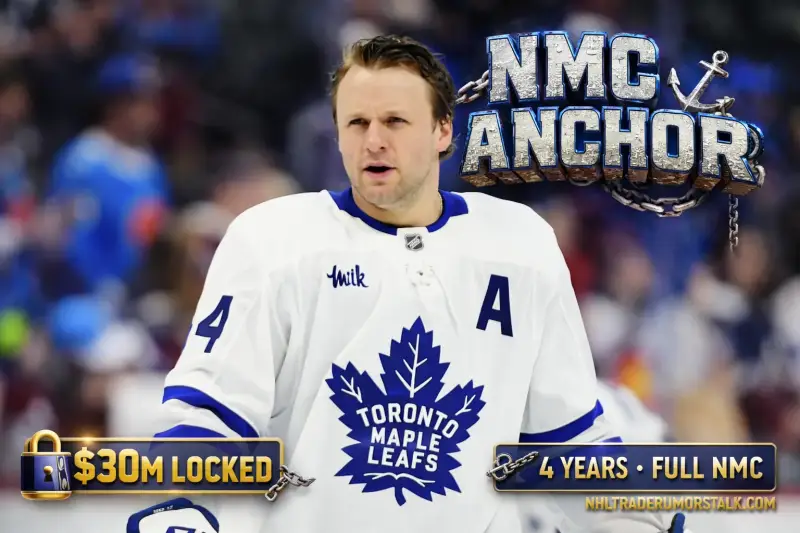
Morgan Rielly trade 2026 decision: $30M commitment + full NMC through 2029-30 = The NMC Anchor. Why the new Leafs GM has to call Rielly first.
Live updates
No updates yet. Refreshing automatically.
The Morgan Rielly trade 2026 question isn't "which team" — it's whether the new Maple Leafs GM can get past Rielly's full no-movement clause. Rielly holds four years and $30 million in remaining commitment at $7.5 million AAV, and he publicly told reporters "I want to stay" at exit interviews.
That's what I'm calling The NMC Anchor — the first decision the next Leafs GM (Gillis, Sundin, or otherwise) has to make before anything else in the offseason. Keep Rielly means $7.5M committed to a 32-year-old defenseman with a 49.0% xGF%. Trade him means getting him to waive a clause that gives him total control.
The Morgan Rielly trade 2026 decision is the single largest lever the new Toronto Maple Leafs general manager can pull, and it's the one they control least. Rielly, 32, holds a full no-movement clause at $7.5 million AAV through the 2029-30 season — four years and $30 million in remaining commitment that he alone can dictate. He publicly told reporters at the April locker-cleanout "I've always wanted to stay, I still wanna stay. I love playing here, I love being a Leaf," and Craig Berube reinforced that Rielly "can't think about being anywhere else." The new front office — reportedly narrowing to a Mike Gillis and Mats Sundin management structure after Brad Treliving's late-March firing — has not yet spoken to Rielly about his future. That conversation is the first call, and it's the anchor of everything else Toronto does this summer.
Here's the mechanism: an NMC gives a player veto power over any trade, waiver, or minor-league assignment. Rielly's clause runs through the entire remainder of his deal.
If Toronto wants to move him, Rielly has to approve the destination in writing. If Rielly refuses, the Leafs are stuck — they can neither trade him for value nor bury his cap hit. Every other Toronto roster move this offseason starts from that locked position: $7.5 million of cap space committed to a player whose xGF% dropped to 49.0% at 5-on-5 and whose power-play minutes have been reduced for a second consecutive season under Berube.
My read: the new GM's first phone call, before any internal evaluations or free-agent targeting, has to be Morgan Rielly. Not to demand a waiver — to build trust and honestly lay out the roadmap.
Rielly signed this deal under Kyle Dubas in October 2021. Shanahan's gone. Treliving's gone. Berube's under evaluation.
Institutional memory that courted Rielly no longer exists in the Leafs front office, and that's the conversation the new GM has to rebuild before any NMC discussion becomes possible.
Key Takeaways
- The NMC Anchor: Rielly's full no-movement clause through 2029-30 gives him total control over any trade. The new Leafs GM's first offseason call must be Rielly himself, not trade partners.
- The contract: 8 years, $60 million total signed October 29, 2021 under Kyle Dubas. $7.5M AAV through 2029-30 UFA year. Remaining commitment: $30 million over 4 years.
- Rielly's stated position: "I've always wanted to stay, I still wanna stay. I love playing here, I love being a Leaf" at April locker cleanout. Berube backed him publicly. That's the hardest kind of NMC to move.
- Production reality: 31 points in 54 games (7G, 24A) at age 32. 49.0% xGF% at 5-on-5. Power-play time reduced for second consecutive season under Berube, per The Athletic reporting.
- Market options: Vancouver, Edmonton, Seattle, and San Jose have been reported as rumored destinations. 50% retention + late pick compensation is the industry projected structure per Nick Kypreos.
The Morgan Rielly Trade 2026 Situation — What the NMC Actually Means
A full no-movement clause is the most powerful contract protection in professional hockey. It gives Rielly unilateral veto power over any trade, waiver, or minor-league assignment through the entire remainder of his contract. Toronto cannot send him anywhere — including to a rebuild-mode team, an affiliate, or even a cap-dump partner — without his written consent.
That matters for the 2026 offseason because Rielly's incentive structure is now radically different from the team's. The Leafs want cap flexibility; Rielly wants geographic stability.
Toronto wants a younger, faster blue line for Berube's forecheck-heavy system; Rielly wants to be the guy he signed up to be — the first-pair Cup-chase veteran. Those two things were aligned in 2021 when Kyle Dubas signed the deal. Four years later, they're not.
The actual trade mechanics under a full NMC look like this: Toronto provides Rielly's agent with a list of teams Rielly might accept. Rielly either opens negotiations with those teams or rejects the list entirely.
If he rejects, the Leafs either eat the contract or attempt to negotiate a modified NMC (partial list) in exchange for a bonus or extension consideration. That's rare. It's almost always easier to keep the player.
The NMC Anchor
The NMC Anchor is the roster-building constraint created when a full no-movement clause locks a veteran's cap hit in place while production declines. It forces every subsequent offseason decision — free-agent targeting, prospect runway, coach evaluation — to work around a fixed $7.5 million block of cap space the front office can't move without the player's explicit permission.
The 2025-26 Production Curve — Why This Year Triggered the Trade Talk
Rielly's 31 points in 54 games project to roughly 47 points across a full 82-game season. That's the lowest full-season pace of his career since 2017-18, and it arrives with his xGF% sitting at 49.0% — below the break-even line that separates positive-impact defensemen from neutral ones. His CF% (corsi-for, the raw shot-attempt measure) is 48.0%, meaning Toronto gets outshot when he's on the ice at 5-on-5.
His relative numbers salvage some of this — REL xGF% of +4.9 and REL CF% of +5.0 — meaning he's still better than Toronto's other defensive pairings, which says more about the Leafs' blue-line depth than about Rielly specifically. The harder data point is power-play usage. Rielly's man-advantage minutes have dropped for a second consecutive season under Berube, from his peak role as the first-unit quarterback to bottom-of-rotation minutes on unit two.
That decline is both a coaching verdict and a trade-value signal. The Bruce Cassidy Three-Year Closer framework I built earlier captured Toronto's broader coaching-evaluation cycle. If Berube isn't trusting Rielly with top-unit PP time, any trade destination is inheriting a defenseman whose offensive deployment has already been rationalized downward by his current coach — and that's information every GM interested in him already has.
The GM Situation — Why Gillis-Sundin Changes the Rielly Equation
Brad Treliving was fired at the end of March 2026. Brendan Shanahan exited the prior offseason. The Leafs have interviewed seven GM candidates, and the reported finalist structure is a Mike Gillis and Mats Sundin management pairing — Gillis as GM, Sundin as senior advisor or vice president.
That structural change matters to Rielly specifically. Kyle Dubas, the GM who signed Rielly's 8-year extension in October 2021, is in Pittsburgh. The institutional relationship that earned Rielly's trust doesn't exist in the Toronto front office anymore.
A Sundin-led management voice — franchise legend, 11-year captain, all-time Leafs points leader — could theoretically rebuild that trust faster than an outside hire. But Gillis is the decision-maker in that model, and Gillis has no prior relationship with Rielly.
"My desire to stay in Toronto is always going to be there."
— Morgan Rielly, Toronto Maple Leafs defenseman (via Yahoo Sports citing The Athletic)That quote is the single clearest signal Rielly can give without naming specific teams or vetoing specific lists. When a player with a full NMC says "my desire to stay is always going to be there" at exit interviews, they're telling the front office upfront: don't expect waivers on this list without a serious pitch. That raises the bar on whatever the new GM brings to the first meeting. The Nashville NMC framework I mapped for the Predators' rebuild captured the same trap from the team side — how an NMC blocks rebuild timelines even when the front office has a clear strategic need.
Three Realistic Trade Destinations — and One That Won't Work
Four teams have been reported as interested in Rielly at various points through 2025-26: Vancouver, Edmonton, Seattle, and San Jose. Not all four fit equally. Here's the industry-reported trade structure framework:
| Destination | Fit Grade | Retention | Projected Return |
|---|---|---|---|
| Vancouver Canucks | A (top fit) | 50% ($3.75M cap hit) | 2nd-round pick + mid-tier forward |
| Edmonton Oilers | B+ (Cup window) | 33% (~$5M cap hit) | 2nd-round pick + Mangiapane ballpark |
| Seattle Kraken | B (rebuild need) | 25-33% | 3rd-round pick + B-level prospect |
| San Jose Sharks | C (wrong stage) | 50%+ | Late pick only |
The Nick Kypreos projection is the industry anchor: "Retain 50 percent of $7.5 million, throw in a draft pick." Under that structure, Vancouver's the cleanest fit. Rielly is British Columbia-born (West Vancouver native), the Canucks have a defensive-core need, and at a 50% retained $3.75 million cap hit, he becomes a useful second-pair veteran rather than an inherited burden. The Canucks' own GM-search dynamic I covered earlier creates a parallel front-office opportunity — both teams building simultaneously under new management.
Here's why San Jose doesn't work: the Sharks are one season into a generational rebuild around Macklin Celebrini. Adding a 32-year-old veteran at even retained AAV doesn't fit the timeline — they'd be paying salary on a player unlikely to be on the roster when San Jose is competitive. Rielly would reject that destination anyway. Trade-fit analysis has to be bilateral on NMC moves, and San Jose fails on both directions.
Historical Precedent — The 2014 Toews-Style NMC Deal That Actually Worked
The cleanest precedent isn't a Leafs trade at all — it's Vancouver's 2014 Roberto Luongo deal back to Florida. Luongo held a full NMC at $5.33 million AAV with 10 years remaining.
Vancouver couldn't move him against his will, and Luongo only had one destination he'd approve: Florida, where his family lived. Vancouver's pricing power was zero. They accepted Jacob Markstrom and Shawn Matthias — a mid-tier return on what had been a franchise-cornerstone contract, because Luongo's destination veto meant there was no competitive market.
Rielly's situation compresses a similar dynamic. If he'll only waive for one team — and his Vancouver ties suggest he might — Toronto's negotiating footing collapses to whatever that team offers. The Dougie Hamilton retention-ladder framework I built for the Devils captured a similar dynamic on a different contract — the closer a player's NMC forces a single destination, the worse the return gets, regardless of on-ice value.
"I don't think he can think about being anywhere else. It would be hard for him to think about not being a Leaf."
— Craig Berube, Maple Leafs head coach (via Maple Leafs Hot Stove)Berube's framing is revealing. A head coach doesn't typically volunteer that a player "can't think about being anywhere else" unless the coach knows the player's NMC stance is hardening. That's a soft signal to the front office: Rielly's going to resist. Plan accordingly.
The Subtraction Spiral framework I built after the playoff exit captured the larger structural pattern — Toronto can't address the roster until the NMC anchor is addressed, and the NMC anchor can't be addressed until the new GM builds trust.
What Rielly's Locker-Room Value Does to the Math
The under-covered angle in this story is the dressing-room cost of moving Rielly. He's been a Leaf for 13 seasons, wears an "A," and is the longest-serving player on the roster. When the new GM walks in, he's looking at Auston Matthews, William Nylander, John Tavares, Mitch Marner's replacement — and Morgan Rielly as the senior voice of the room.
Matthew Knies made this point explicit at exit interviews. Asked about his own trade rumors, Knies said "I wouldn't want to look at it as a compliment. I'd look at it as a crappy thing. I don't want to leave this group of guys." The Matthew Knies trade deadline dynamic I covered earlier this year captured how the Leafs' young core views the dressing room as connected, and Rielly is the senior anchor of that connection.
That intangible matters more for the Leafs than for most teams because Toronto's 2026-27 roster has more new faces than veterans. Losing Rielly doesn't just cost a top-four defenseman — it costs the last institutional-memory voice in the room. The new GM has to weigh that against the $3.75M retained cap space they'd free up, and for a team trying to build a new coaching-GM-ownership structure, that's a harder trade than the raw cap math suggests.
What Happens Next — My Projection
My projection: Rielly stays. The new GM meets with him in early May, pitches the roadmap, and Rielly waives nothing because he doesn't have to. The Leafs eat the $7.5 million cap hit through 2027-28 at minimum, and by the time the contract enters its final two years (2028-29 and 2029-30), either Rielly agrees to waive for the final run or Toronto keeps him through UFA age 36.
The minority scenario — a 25% probability — is a Vancouver trade in June or July. That requires three things: Gillis-Sundin management gets hired, they meet with Rielly and present the rebuild honestly, Rielly accepts that a playoff-push extension elsewhere is preferable to a transitional role in Toronto. All three can happen. None of them are likely.
What stands out to me is how much of this decision is out of the Leafs' control. The Overcorrection Cycle framework I built for Toronto's GM search captured the larger governance pattern — Toronto keeps overcorrecting management, and each new regime inherits constraints the last regime built. The Rielly NMC is the biggest inherited constraint of all, and no new management structure removes it. The only thing that removes it is Rielly saying yes.
Sources and Reporting
- PuckPedia — Rielly Contract — $60M / 8yr / $7.5M AAV + full NMC through 2029-30 verification
- TSN — Rielly exit interview "longest-serving Leaf" context
- Maple Leafs Hot Stove — Gillis/Sundin management duo reporting
- Sportskeeda — Kypreos Projection — "Retain 50% + draft pick" industry framework
- NHL Trade Talk — Vancouver/Edmonton/Seattle destination analysis
- Hockey Buzz — April 2026 trade value breakdown
- Editor in Leaf — April 2026 exit interview complete transcript
- Wikipedia — Morgan Rielly — Career history + 2nd-highest scoring Leafs defenseman record
The Verdict: The NMC Anchor
Morgan Rielly trade 2026 decision isn't a trade question — it's a trust question. The new Leafs GM inherits a $30 million commitment through 2029-30, a 32-year-old defenseman at 49.0% xGF% with declining power-play usage, and a full no-movement clause that gives Rielly complete destination control.
Rielly said the words every player says when he wants to stay: "I love being a Leaf." Berube reinforced it. My projection stays at a 75% probability Rielly remains in Toronto through at least 2027-28, with the minority scenario being a Vancouver trade at 50% retention and a 2027 second-round pick return.
NMC Anchor holds because the new management team doesn't have the relational capital to dislodge it. That's not a Toronto weakness. It's the structural reality of a clause Kyle Dubas signed four years ago.
Frequently Asked Questions
Can the Maple Leafs trade Morgan Rielly?
Only with Rielly's written consent. He holds a full no-movement clause through the 2029-30 season that gives him complete veto power over any trade, waiver, or minor-league assignment. The Maple Leafs cannot move him to any team — including as a cap-dump or in a waiver wire assignment — without his explicit approval. His NMC was negotiated as part of the 8-year, $60 million extension signed with then-GM Kyle Dubas on October 29, 2021.
What is Morgan Rielly's contract?
Rielly is signed to an 8-year, $60 million contract at a $7.5 million AAV that runs through the 2029-30 season, after which he becomes an Unrestricted Free Agent at age 36. Four years and $30 million remain on the deal as of the 2026 offseason. The contract includes a full no-movement clause through its entire duration and was signed under former GM Kyle Dubas on October 29, 2021, before Dubas was fired and took over as Pittsburgh Penguins President of Hockey Operations.
Who are the rumored Morgan Rielly trade destinations?
Four teams have been linked: Vancouver Canucks (considered the frontrunner due to Rielly's British Columbia roots and Vancouver's defensive need), Edmonton Oilers (Cup-window fit), Seattle Kraken (rebuild defensive role), and San Jose Sharks (rumored but a poor fit given the Sharks' rebuild timeline). Chicago has also been mentioned as peripheral interest. The actual destination is controlled entirely by Rielly's NMC approval.
What are Morgan Rielly's 2025-26 stats?
Rielly posted 31 points (7 goals, 24 assists) in 54 games. His 5-on-5 expected goals share (xGF%) sits at 49.0%, with his corsi-for percentage (CF%) at 48.0%. He became the second-highest scoring defenseman in Toronto Maple Leafs franchise history on November 11, 2025, with an assist in a 5-3 loss to the Boston Bruins. His power-play time has been reduced for a second consecutive season under head coach Craig Berube.
Who is the new Toronto Maple Leafs general manager?
As of April 2026, the Maple Leafs do not have a permanent general manager. Brad Treliving was fired at the end of March 2026, and the team has interviewed seven candidates. Reports suggest Mike Gillis is the leading candidate for the GM role, with Mats Sundin being discussed as a senior advisor or vice president in a paired management structure. Brendan Shanahan departed the team presidency the prior offseason.
Why does Morgan Rielly's NMC matter for the Leafs offseason?
Because every other Maple Leafs roster decision this offseason has to work around Rielly's locked $7.5 million cap hit. Toronto cannot free that money via trade, buyout (the NMC blocks buyout eligibility without waiver), or minor-league assignment. Free-agent targeting, prospect runway, and coaching evaluation all compound from whatever the Rielly outcome is. That's why the new GM's first conversation in the offseason must be with Rielly himself — not with trade partners.
Frequently Asked Questions
Can the Maple Leafs trade Morgan Rielly?
Only with Rielly's written consent. He holds a full no-movement clause through the 2029-30 season that gives him complete veto power over any trade, waiver, or minor-league assignment. The Maple Leafs cannot move him to any team, including as a cap-dump or in a waiver wire assignment, without his explicit approval. His NMC was negotiated as part of the 8-year, $60 million extension signed with then-GM Kyle Dubas on October 29, 2021.
What is Morgan Rielly's contract?
Rielly is signed to an 8-year, $60 million contract at a $7.5 million AAV that runs through the 2029-30 season, after which he becomes an Unrestricted Free Agent at age 36. Four years and $30 million remain on the deal as of the 2026 offseason. The contract includes a full no-movement clause through its entire duration and was signed under former GM Kyle Dubas on October 29, 2021, before Dubas was fired and took over as Pittsburgh Penguins President of Hockey Operations.
Who are the rumored Morgan Rielly trade destinations?
Four teams have been linked: Vancouver Canucks (considered the frontrunner due to Rielly's British Columbia roots and Vancouver's defensive need), Edmonton Oilers (Cup-window fit), Seattle Kraken (rebuild defensive role), and San Jose Sharks (rumored but a poor fit given the Sharks' rebuild timeline). Chicago has also been mentioned as peripheral interest. The actual destination is controlled entirely by Rielly's NMC approval.
What are Morgan Rielly's 2025-26 stats?
Rielly posted 31 points (7 goals, 24 assists) in 54 games. His 5-on-5 expected goals share (xGF%) sits at 49.0%, with his corsi-for percentage (CF%) at 48.0%. He became the second-highest scoring defenseman in Toronto Maple Leafs franchise history on November 11, 2025, with an assist in a 5-3 loss to the Boston Bruins. His power-play time has been reduced for a second consecutive season under head coach Craig Berube.
Who is the new Toronto Maple Leafs general manager?
As of April 2026, the Maple Leafs do not have a permanent general manager. Brad Treliving was fired at the end of March 2026, and the team has interviewed seven candidates. Reports suggest Mike Gillis is the leading candidate for the GM role, with Mats Sundin being discussed as a senior advisor or vice president in a paired management structure. Brendan Shanahan departed the team presidency the prior offseason.
Why does Morgan Rielly's NMC matter for the Leafs offseason?
Because every other Maple Leafs roster decision this offseason has to work around Rielly's locked $7.5 million cap hit. Toronto cannot free that money via trade, buyout (the NMC blocks buyout eligibility without waiver), or minor-league assignment. Free-agent targeting, prospect runway, and coaching evaluation all compound from whatever the Rielly outcome is. That's why the new GM's first conversation in the offseason must be with Rielly himself, not with trade partners.
Related Stories

Darnell Nurse Trade: 4 Suitors
Edmonton wants Darnell Nurse's $9.25M off the books, but a buyout saves barely $1.53M and his no-move clause hands him the pen. The Bonus Sh...
By Mike Johnson · 12 min read
Darren Raddysh Free Agent 2026: 4 Teams
Darren Raddysh's 70-point breakout turned his $975K cap hit into a four-team bidding war. The Athletic linked him to Philadelphia, San Jose,...
By Mike Johnson · 13 min read
Bobby McMann Free Agent 2026 Destinations: 4 Teams Linked
Bobby McMann's career-high 29 goals just turned a $1.35M cap hit into Sharangovich-tier money. The Athletic locked him to 4 teams (Detroit,...
By Mike Johnson · 10 min read
Hellebuyck Trade Rumors 2026: The Vulture Watch Begins
David Pagnotta says vultures circle Hellebuyck after a .902 save percentage and exit-interview frustration. Three destinations make cap sens...
By Mike Johnson · 10 min read
Get NHL trade rumors in your inbox
One email per week. Zero spam. Verified rumors only.