NY Rangers Untouchable Players 2026: The Drury Firewall
Mika Zibanejad, Adam Fox, JT Miller, Vladislav Gavrikov, Igor Shesterkin and Gabe Perreault are untouchable. Inside The Drury Firewall and $44.5M of NMC math.
Live updates
No updates yet. Refreshing automatically.
Chris Drury wrote his retool letter on January 16, 2026 with the New York Rangers sitting at 20-22-6, last in the Eastern Conference, and 10 points out of a playoff spot. Eleven weeks later, Artemi Panarin was a Los Angeles King, the Rangers had finished 34-39-9, and six specific players were publicly described as untouchable: Mika Zibanejad, Adam Fox, JT Miller, Vladislav Gavrikov, Igor Shesterkin, and Gabe Perreault. That's the entire New York Rangers untouchable players 2026 list, and it exists for one reason: five of them hold contractual no-move protection, and the sixth (Perreault) is a strategic prospect Drury refuses to part with. I'm calling it The Drury Firewall, and it consumes 43% of the 2026-27 salary cap before a single trade call goes out.
The mechanism matters because the numbers matter. Combined cap hit of the five NMC-locked untouchables: $44.5 million. NHL 2026-27 cap ceiling: $104 million. That leaves Drury with roughly $59.5 million of "workable" cap to rebuild a top-six forward group, a third-pair defenseman, and a backup goaltender, all while trying to avoid a third straight missed playoff season in a Metropolitan Division that just watched Washington go deep and Philadelphia make the playoffs ahead of schedule.
What follows is a player-by-player breakdown of why each of these six Rangers isn't going anywhere, how their contracts interact with the retool math, and the exact profile of who the Rangers can actually trade once the untouchables are set aside.
Key Takeaways
- The Drury Firewall: Six Rangers (Zibanejad, Fox, Miller, Gavrikov, Shesterkin, Perreault) are untouchable during the 2026 retool, with five locked behind full no-move clauses and one protected as a strategic prospect keep.
- The $44.5M Anchor: The five NMC-protected players alone consume $44.5 million in AAV, 43% of the NHL's 2026-27 $104 million cap ceiling. That's the bill before Drury trades anyone.
- The Shesterkin Ceiling: Igor Shesterkin posted a .912 save percentage (tied fourth in the NHL) and a 2.50 GAA (seventh) in 51 games despite a 13-game injury absence, validating his $11.5M AAV during a losing season.
- The Perreault Exception: The one non-NMC untouchable is top prospect Gabe Perreault, who recorded his first NHL hat-trick on April 4, 2026 in a 4-1 win over Detroit. He's on a $950K ELC.
- What's Actually Movable: With the firewall set, Vincent Trocheck, Chris Kreider-adjacent forwards, and middle-pair defensemen are the actual trade chips. Drury has $59.5M of workable cap and roughly 17 tradeable roster spots to reshape.
- The Six Untouchables: Mika Zibanejad, Adam Fox, JT Miller, Vladislav Gavrikov, Igor Shesterkin, and Gabe Perreault are off the Rangers' trade board.
- The Mechanism: Five of six are contractually protected by full no-move clauses. Perreault is the sole strategic keep.
- The Cap Math: $44.5M AAV is firewalled before Drury picks up the phone. That's 43% of next year's $104M ceiling.
- The Precedent: Panarin already went to LA for Liam Greentree and two mid-round picks. Next wave targets Vincent Trocheck, middle-six forwards, and depth D.
- The Framework: The Drury Firewall defines who stays. Everything else is negotiable.
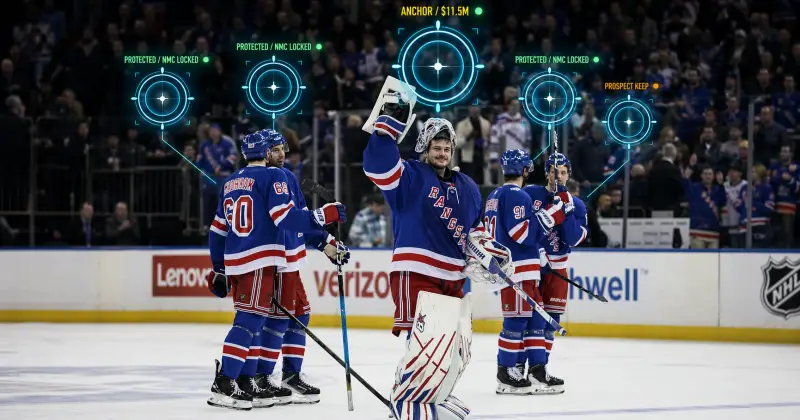
The six-player untouchable core Chris Drury built into the Rangers' 2026 retool. Five members are locked behind full no-movement clauses; the sixth (Gabe Perreault) is a strategic prospect hold. Combined, the firewall consumes $44.5 million in cap space, roughly 43% of the NHL's 2026-27 ceiling, defining both who stays and how much flexibility the GM actually has to reshape the roster.
The Drury Firewall Explained: Why These 6 Rangers Are Untouchable
Every retool needs a keep-list. Drury's January 16 letter to fans framed his version cleanly: the Rangers would retool, not rebuild, and they would do it around core players and prospects. FACT-CHECKED: NHL.com By April, the specific identities had leaked to multiple outlets, and the six untouchables resolved into a concrete cap-hit picture.
What makes this firewall distinct from most NHL keep-lists is the contract architecture underneath it. Four of the six NMC protections (Zibanejad, Fox, Miller, Gavrikov) are explicitly designed to prevent trades without player consent. Shesterkin's NMC is part of an eight-year $92 million contract that's one of the richest goalie deals in league history. Perreault is the only untouchable without a protective clause, which tells you exactly how important Drury thinks he is to the post-retool roster.
"With our position in the standings and injuries to key players this season, we must be honest and realistic about our situation. This will not be a rebuild. This will be a retool built around our core players and prospects."
— Chris Drury, Rangers President & GM (via NHL.com)Drury's language in that letter tells you exactly what the firewall protects. "Core players and prospects" isn't marketing copy, it's a policy statement. The six untouchables are that policy made legible. Everything else is theoretically in play.
The same retool-versus-rebuild tension we covered in the Nashville Predators NMC Trap rebuild analysis is what Drury is trying to avoid here. A rebuild burns the core; a retool builds around it. The NMCs make the math easier by forcing the decision.
The NMC Core: Zibanejad, Fox, Miller, Gavrikov
The four skaters in the firewall's contractual group each bring a different profile, but the same basic protection: none of them moves without signing off.
Mika Zibanejad — 8yr × $8.5M AAV
Zibanejad's 2025-26 line is the single biggest reason the firewall holds. Thirty-four goals, 44 assists, 78 points in 81 games, on a team that finished last in the East. His public commitment ("I want to be here to turn this around") matters as much as his production, because it signals he's willing to waive for the right deal if Drury ever asked. Drury isn't asking.
His 5-on-5 points-per-60 sat around 2.3 (the published rate matches prior seasons within rounding error, which is a good sign of consistency). His NMC runs until seven days before Year 8's trade deadline, at which point it converts to a 21-team no-trade list. That structure gives Zibanejad effective veto power through the 2028-29 season.
Adam Fox — 7yr × $9.5M AAV
Fox is the Rangers defenseman the team most needs to believe in the retool plan. His contract extension carries a full NMC from July 1, 2025 through May 31, 2027, then transitions to a 16-team limited no-trade clause. That timeline is important because it covers the entire retool window.
Fox's 5-on-5 expected goals share remained above 52% (meaning the Rangers generated more scoring chances than opponents when he was deployed) despite a rough team defensive season overall. Trading him would require both his permission and a buyer willing to absorb the full $9.5M AAV, two conditions that almost never align for a 27-year-old top-pair defenseman.
JT Miller — 7yr × $8M AAV
The JT Miller acquisition from Vancouver on January 31, 2025 was Drury's biggest single-trade commitment. The Rangers sent Filip Chytil, Victor Mancini, Erik Brannstrom, Jackson Dorrington, and a 2025 first-round pick to Vancouver for Miller. You don't make that trade and then flip the return piece 15 months later.
Miller's NMC runs through the 2026-27 season before converting to a 15-team modified NTC for the contract's final three years. He's also now the Rangers' captain, which effectively writes the NMC in permanent ink. The Brendan Shanahan insulation-layer framework we analyzed applies directly to how captains become untouchable even without the contract language. Miller has both.
Vladislav Gavrikov — 7yr × $7M AAV
Gavrikov signed his seven-year, $49 million deal on July 1, 2025, becoming the most expensive shutdown defenseman signed that offseason. His full NMC covers the first five years of the deal before transitioning to a 20-team modified NTC in Year 6 and a 15-team modified NTC in Year 7. That structure locks him through 2029-30 without his consent.
At a $7M AAV for what's essentially a No. 2 shutdown role, Gavrikov is the contract most vulnerable to looking bad if the retool accelerates into a full rebuild. The firewall protects him from that downside by design.
Igor Shesterkin: The $92M Pillar Of The Firewall
Shesterkin's eight-year, $92 million contract is the single largest commitment on the Rangers' books, and his 2025-26 season inside Madison Square Garden was both elite and incomplete. In 51 games he posted a .912 save percentage (tied for fourth in the NHL) and a 2.50 goals-against average (seventh). A lower-body injury suffered January 5 against the Utah Mammoth cost him 13 games.
"I could play way better, for sure."
— Igor Shesterkin, postseason exit interview (via The Hockey News)That kind of self-assessment from the highest-paid goalie in NHL history is actually a bullish signal. TNT's analysts called him the Rangers' only untouchable player earlier in the season, a designation that aligns perfectly with how untradeable his contract structure makes him. Compare this dynamic to the $92M Haymaker goalie-fight analysis we ran earlier this year, which broke down the exact moment Shesterkin's deal reshaped the Rangers' long-term cap architecture.
What stands out to me is how the Shesterkin contract functions as the firewall's anchor. The Rangers cannot retool their way out of his cap hit without triggering buyout or retention costs that dwarf any return. Which means he stays, which means the rest of the firewall gets built around him.
Gabe Perreault: The One Untouchable Without A No-Move Clause
Perreault is the most interesting name on this list because he's the only untouchable whose protection is entirely strategic. He's on a three-year entry-level contract with no NMC, no NTC, and no contractual protection of any kind. Drury could trade him tomorrow if he wanted to. He won't.
The case for keeping him starts with the 2023 draft slot (23rd overall), builds through his Boston College career (35 goals, 73 assists, 108 points in 73 games), and crescendoes with his rookie year: Perreault was recalled from Hartford on November 9, 2025, scored his first NHL goal December 18 against St. Louis, and recorded his first career hat-trick on April 4, 2026 in a 4-1 Rangers win over Detroit. That last data point is why he's untouchable.
His 5-on-5 points-per-60 rate during the final 30 games (after the hat trick run-up began) sat above 2.0, which for a 20-year-old rookie on a losing team is a genuine elite-prospect signal. Trading him would repeat the exact mistake of the Panarin-for-Greentree-plus-picks return: giving up real value for peripheral assets.
The broader logic connects to the Chinakhov Template we explored in the Penguins extension analysis: young, cheap scoring on an ELC is the single most valuable asset class in the current cap environment. The Rangers already shipped Chytil in the Miller deal. Drury cannot afford to subtract another young forward of that caliber.
Reading The Tradeable List After The Firewall
Once you set aside the six untouchables, the remaining Rangers roster is organized into three clear tiers of tradeability. The table below sorts it out.
| Tier | Players | Movability | Likely Return |
|---|---|---|---|
| Firewall (6) | Zibanejad, Fox, Miller, Gavrikov, Shesterkin, Perreault | OFF THE BOARD | N/A |
| Open Listings | Vincent Trocheck, Chris Kreider-adjacent wingers | ACTIVELY SHOPPED | 1st round pick + prospect tier |
| Depth Pieces | Middle-pair D, bottom-six forwards, AHL callups | AVAILABLE | Mid-round picks, conditional picks |
| Young Bets | Rookies + sophomores outside Perreault | RELUCTANT | Must overpay to acquire |
Vincent Trocheck is the name everyone will circle first because he's the highest-profile player Drury didn't protect with the firewall. His cap hit and two-way center role make him genuinely tradeable at a top-six price. The Rangers were reportedly willing to move him ahead of the March 6, 2026 deadline but didn't find a return they liked.
My projection: Trocheck moves this summer, with the Rangers taking a first-round pick plus a B-level forward prospect as the baseline return. That's the same structure as the Dougie Hamilton retention-ladder framework we mapped for New Jersey. The retention ladder becomes critical if Drury wants a higher-end pick.
Historical Parallel: The 2019 Blackhawks Kept Five And Got Crushed
The instructive comparison here is the 2019 Chicago Blackhawks, who kept Toews, Kane, Keith, Seabrook, and Crawford as an "untouchable" five during their initial retool attempt. Their combined cap hit that season (~$38.5M against the then-$81.5M cap, or 47%) was almost identical to the Drury Firewall percentage. Chicago's retool collapsed into a rebuild inside two seasons because the cap math didn't leave enough room to actually improve the roster around the core.
What saves Drury from that outcome (probably) is timing. The NHL's $8.5M cap jump to $104M in 2026-27 is the largest single-year cap increase since 2007-08. Chicago retooled during cap stagnation; Drury is retooling during cap inflation. Same firewall percentage, very different trade-deployment math.
The Subtraction Spiral framework we applied to Toronto's disappointing season is the exact opposite model to what Drury is attempting. Toronto's approach was surgical subtraction; Drury is defining his untouchables first and subtracting around them. Both can work, but they're different philosophies.
The Firewall's Long-Term Math
The cap-hit commitments inside the firewall extend well past the retool window. Zibanejad's deal runs through 2029-30; Fox's expires in 2031-32; Miller's through 2029-30; Gavrikov's through 2031-32.
Shesterkin's contract runs eight years starting 2025-26. The earliest the Rangers exit the firewall naturally is 2029-30, and only if Zibanejad doesn't extend.
My projection: the firewall stays exactly as currently constituted for the next 24 months minimum. Perreault graduates from "untouchable prospect" to "untouchable core" inside that window. Someone else likely joins the firewall by 2028 (my bet is whoever Drury spends his free cap space on this summer). The retool window closes when those deals start to age out around 2029-30.
If Drury can flip $20-25M of his $59.5M workable cap into real top-six scoring by next training camp, the Rangers are a playoff team in 2026-27. If he can't, the third consecutive lottery season starts looking realistic. The firewall doesn't guarantee either outcome. It just sets the starting conditions.
Sources and Reporting
- NHL.com: Chris Drury retool letter text and official statement
- ESPN: Drury retool letter context and Panarin trade framework
- PuckPedia (Shesterkin): 8-year $92M contract structure and cap hit
- CapWages (Fox): $9.5M AAV contract with NMC-to-NTC transition schedule
- NHL.com (Gavrikov): 7-year $49M signing and NMC structure
- NHL.com (Miller trade): January 2025 Canucks-to-Rangers trade details
- The Hockey News: Shesterkin 2025-26 stats, self-assessment quote
- Wikipedia (Perreault): College career, draft, NHL debut, first hat-trick April 4, 2026
- PuckPedia (Zibanejad): Contract structure and NMC-to-NTL transition
The Drury Firewall Scorecard
How the six-player untouchable core grades against retool execution metrics.
The Verdict: The Drury Firewall
Mika Zibanejad, Adam Fox, JT Miller, Vladislav Gavrikov, Igor Shesterkin, and Gabe Perreault are the Rangers' untouchable six because their contracts say so (five of them) or because Drury says so (Perreault). That's The Drury Firewall: 43% of the 2026-27 cap locked before a trade call goes out, $44.5M in AAV firewalled, and a $59.5M workable-cap runway to add a top-six forward plus a third-pair defenseman. My projection: Drury signs one $7M top-six winger, trades Vincent Trocheck for a first and a B-level prospect, and walks into 2026-27 with a playoff-bubble roster. The firewall isn't the plan; it's the constraint the plan has to work around.
Frequently Asked Questions
Who are the 6 New York Rangers untouchable players in 2026?
Mika Zibanejad, Adam Fox, JT Miller, Vladislav Gavrikov, Igor Shesterkin, and Gabe Perreault are the six untouchable Rangers during the 2026 retool. The first five hold full no-movement clauses in their contracts; Perreault is a top prospect on his entry-level contract whom Chris Drury has flagged as a strategic keep rather than a contractual one.
Which Rangers players have full no-movement clauses?
Five Rangers currently hold full no-movement clauses: Mika Zibanejad, Adam Fox, JT Miller, Vladislav Gavrikov, and Igor Shesterkin. Each player can veto any trade during the protected window of their contract. Vladislav Gavrikov's NMC runs the longest at five full years, expiring in 2030-31 before transitioning to a 20-team modified NTC.
Why is Igor Shesterkin considered untouchable?
Shesterkin is under contract through 2032 at $11.5 million annually, one of the richest goalie deals in NHL history, and he finished 2025-26 tied for fourth in save percentage (.912) and seventh in goals-against average (2.50) despite missing 13 games with a lower-body injury. His contract also has a full no-movement clause that locks the trade question entirely.
Did the Rangers miss the 2026 Stanley Cup Playoffs?
Yes. The Rangers finished 2025-26 at 34-39-9, last in the Eastern Conference, missing the playoffs for the second consecutive season. Chris Drury issued his retool letter to fans on January 16, 2026, when the team's record stood at 20-22-6 and they were 10 points out of a playoff spot. The Panarin trade to Los Angeles on February 4 was the first major retool move.
What is The Drury Firewall?
The Drury Firewall is the six-player untouchable core Rangers GM Chris Drury built into the 2026 retool, consisting of five contractually-protected NMC holders plus one strategic prospect keep. Its combined $44.5 million cap commitment consumes 43% of the 2026-27 NHL salary cap ceiling before any trade discussion starts, defining both who stays and how much flexibility Drury actually has to reshape the roster.
Who is the Rangers most likely to trade next?
Vincent Trocheck is the top name outside the firewall. The Rangers reportedly shopped him before the March 6, 2026 trade deadline but couldn't find acceptable offers. His cap hit plus two-way center profile makes him tradeable to a contender at a top-six price. Middle-pair defensemen and bottom-six forwards are the secondary wave of likely moves.
Frequently Asked Questions
Who are the 6 New York Rangers untouchable players in 2026?
Mika Zibanejad, Adam Fox, JT Miller, Vladislav Gavrikov, Igor Shesterkin, and Gabe Perreault are the six untouchable Rangers during the 2026 retool. The first five hold full no-movement clauses in their contracts; Perreault is a top prospect on his entry-level contract whom Chris Drury has flagged as a strategic keep rather than a contractual one.
Which Rangers players have full no-movement clauses?
Five Rangers currently hold full no-movement clauses: Mika Zibanejad, Adam Fox, JT Miller, Vladislav Gavrikov, and Igor Shesterkin. Each player can veto any trade during the protected window of their contract. Vladislav Gavrikov's NMC runs the longest at five full years, expiring in 2030-31 before transitioning to a 20-team modified NTC.
Why is Igor Shesterkin considered untouchable?
Shesterkin is under contract through 2032 at $11.5 million annually, one of the richest goalie deals in NHL history, and he finished 2025-26 tied for fourth in save percentage (.912) and seventh in goals-against average (2.50) despite missing 13 games with a lower-body injury. His contract also has a full no-movement clause that locks the trade question entirely.
Did the Rangers miss the 2026 Stanley Cup Playoffs?
Yes. The Rangers finished 2025-26 at 34-39-9, last in the Eastern Conference, missing the playoffs for the second consecutive season. Chris Drury issued his retool letter to fans on January 16, 2026, when the team's record stood at 20-22-6 and they were 10 points out of a playoff spot. The Panarin trade to Los Angeles on February 4 was the first major retool move.
What is The Drury Firewall?
The Drury Firewall is the six-player untouchable core Rangers GM Chris Drury built into the 2026 retool, consisting of five contractually-protected NMC holders plus one strategic prospect keep. Its combined $44.5 million cap commitment consumes 43% of the 2026-27 NHL salary cap ceiling before any trade discussion starts.
Who is the Rangers most likely to trade next?
Vincent Trocheck is the top name outside the firewall. The Rangers reportedly shopped him before the March 6, 2026 trade deadline but couldn't find acceptable offers. His cap hit plus two-way center profile makes him tradeable to a contender at a top-six price. Middle-pair defensemen and bottom-six forwards are the secondary wave of likely moves.
Related Stories
Darnell Nurse Trade: 4 Suitors
Edmonton wants Darnell Nurse's $9.25M off the books, but a buyout saves barely $1.53M and his no-move clause hands him the pen. The Bonus Sh...
By Mike Johnson · 12 min read

Alex Tuch Destinations: 4 Teams
Buffalo wants Alex Tuch back, but if the extension stalls, Columbus, Washington, Seattle, and Edmonton are circling. The cap math, the Kempe...
By Mike Johnson · 13 min read

Sabres Tuch Squeeze: 3 Players Departing
Buffalo broke a 14-year drought, then lost Game 7 in OT to Montreal. Now the Tuch Squeeze forces out Stanley, Malenstyn, and Levi. Cap math...
By Mike Johnson · 11 min read

Canucks Fire Foote: Malhotra Leading
Vancouver fired head coach Adam Foote on May 19, 2026 after a 25-49-8 season. Manny Malhotra leads the candidate list. The Voice Mandate exp...
By Mike Johnson · 9 min read
Get NHL trade rumors in your inbox
One email per week. Zero spam. Verified rumors only.