Ovechkin Retirement Decision 2026: Two-Rookie Hook
Alex Ovechkin 32 goals at 40 plus Hutson and Protas rookie emergence equals a return in 2026-27. The Two-Rookie Hook retention story explained.
Live updates
No updates yet. Refreshing automatically.
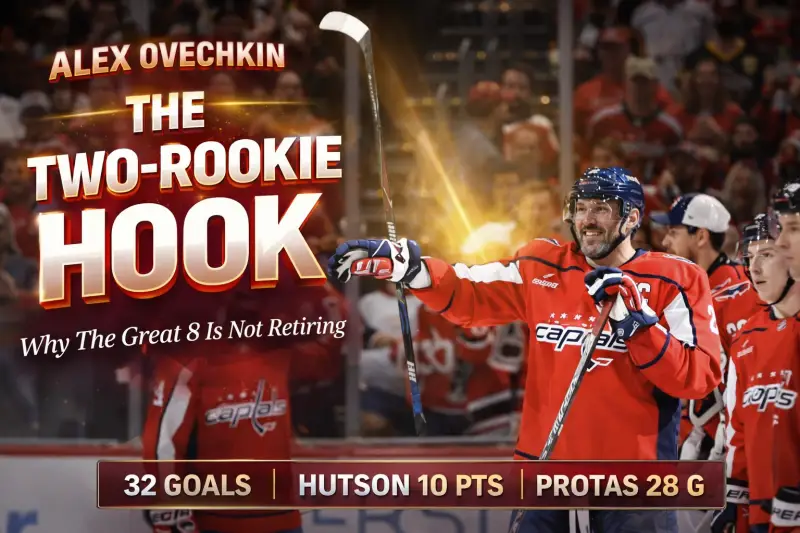
Ovechkin is not retiring. Friedman named two reasons: rookie defenseman Cole Hutson (10 pts / 14 games) and winger Ilya Protas (4 pts / 4 games). Expected outcome: 1-year × $4.5M base + $3M bonuses, signed between June 8–15, 2026. Season 22 focuses on mentoring both rookies through Washington's next competitive window.
Alex Ovechkin finished his age-40 season with 32 goals and 64 points in all 82 games, then told reporters he is "pretty sure it's not my last game." The Ovechkin retirement decision 2026 is no longer about whether a 40-year-old can still score. It is about whether two 19-year-olds are enough reason to come back. Sportsnet's Elliotte Friedman reported April 18 that the Washington Capitals captain is weighing a return specifically because of Cole Hutson (10 points in 14 NHL games) and Ilya Protas (4 points in 4 games). A rookie pairing that has convinced Ovechkin the franchise is not finished rebuilding around him. I'm calling this The Two-Rookie Hook: the most specific organizational retention reason any 40-year-old superstar has cited in modern NHL history.
Here's the mechanism: Ovechkin's 5-year, $47.5 million contract ($9.5M AAV) officially expires July 1, 2026, making him a UFA. Washington missed the playoffs at 43-30-9. Five points short — in the first season where everyone assumed the retirement decision was inevitable.
What changed is the final six weeks. Hutson made his NHL debut March 18, scored in that game, and the Capitals went 10-3-1 with him on the blueline. Protas arrived from AHL Hershey on April 6 after scoring 28 goals (the most ever by a teenager for Hershey) and immediately put up a 3-point game in Pittsburgh on April 13. The first teenager to do that for Washington since Scott Stevens in March 1984.
This article breaks down what Friedman said, what Hutson and Protas actually showed in their brief NHL windows, and why the Ovechkin retirement decision 2026 now leans toward one more year at a reduced cap hit. My read: Ovechkin signs a 1-year, $4-5M deal by June 15 and plays his 22nd season specifically to develop these two rookies alongside him.
Key Takeaways
- The Two-Rookie Hook: Friedman explicitly named Cole Hutson and Ilya Protas as the two players who make Ovechkin's return more likely than retirement.
- Ovechkin's direct quote: "I'm pretty sure it's not my last game"; as clean a signal as a 40-year-old UFA can offer without signing paperwork.
- Hutson's impact: 10 points in 14 NHL games as a 19-year-old defenseman, plus Capitals went 10-3-1 when he played. First defenseman ever to lead the IIHF World Juniors in points.
- Protas's arrival: 62 points in 66 AHL games (28G, the most by a teenager in Hershey history) — then 3-point NHL game in his third career outing.
- My projection: 1 year x $4-5M AAV on a bonus-heavy structure. Signed by June 15, 2026. Ovechkin plays season 22 specifically to mentor both rookies.
The Two-Rookie Hook — Retention Scorecard
Scored against Friedman report (April 18), direct Ovechkin quote (April 14), and 5 corroborating data points below.
Why Friedman Named Hutson and Protas Specifically
Friedman's 32 Thoughts segment on Ovechkin didn't hedge. The insider listed exactly two reasons — not three, not a general "roster depth" argument — two specific 19-year-olds who came up in the final 14 games and convinced the veteran captain the rebuild isn't over.
"Two of the reasons I think he's considering returning are Cole Hutson (10 points in 14 games) and Ilya Protas (four points in four games)."
— Elliotte Friedman, Sportsnet 32 Thoughts (via NHL Trade Rumors)That specificity matters. Friedman has reported on every aging Capitals decision since 2014, and he doesn't typically name prospects as retirement-decision factors unless the player himself has mentioned them.
Read Friedman's framing as Ovechkin's camp telegraphing the reasoning to the league. After hitting 1,000 combined goals and owning the Gretzky record chase in March 2026, Ovechkin's next career question became what, exactly, he'd come back to. Hutson and Protas answer that.
Washington owner Ted Leonsis publicly called the playoff miss "disappointing" at the April 17 season-ending press conference but praised young player development. That's the organizational alignment Ovechkin reportedly needed — an ownership group saying Hutson and Protas are central to the next window, not cap dumps after his exit. Similar to how the Penguins extended Yegor Chinakhov to match the Crosby window, Washington is using its prospect pipeline to prove its competitive runway to its franchise player.
Cole Hutson's 14-Game Audition: What the Numbers Say
Hutson's run from March 18 to the end of the season is the cleanest rookie audition the Capitals defense has produced in a decade. Selected 43rd overall in the 2024 NHL Draft, he signed his entry-level contract on March 15, debuted three days later against Ottawa, and scored an empty-net power-play goal in a 4-1 Washington win.
The counting stats: 10 points in 14 NHL games (by Friedman's count) or 12 games by NHL.com tracking — either way, a 19-year-old defenseman producing at a 58-70 point full-season pace. That's first-pairing production, not bottom-pair sheltered.
The underlying context is better. Hutson averaged 16:24 of ice time in his debut, took 5 shot attempts, and played 2:00 on the power play — deployment usually reserved for veterans. His 21 shots on goal and 13 hits over 12 tracked games signal a defenseman who initiates offense AND finishes checks. His -4 rating tells you the team wasn't perfect around him, but the Capitals still went 10-3-1 during his stint — that's 21 points in 14 games from a playoff-bubble team.
The Two-Rookie Hook
A retention framework where a veteran superstar's return decision is driven by specific emerging rookies whose arc intersects the veteran's remaining competitive years. The Ovechkin-Hutson-Protas version is the cleanest modern example: three-year age window (40, 19, 19) where the veteran mentors the rookies through their second contract.
Hutson's wider credential is the 2025 IIHF World Junior Championship, where he became the first defenseman ever to lead the tournament in points (11 in 7 games) while Team USA won gold. That's a historically rare combination — a 19-year-old defenseman with proven international offensive production AND a 14-game NHL audition that produced at a top-pair scoring rate.
Ilya Protas's AHL-to-NHL Acceleration
Protas took the longer developmental route. Drafted in the third round of 2024, he spent 2025-26 in AHL Hershey and did what only three players in franchise history had ever done — score 28 goals as a teenager. His 62 points in 66 AHL games, including 10 power-play goals, made the 2025-26 AHL All-Rookie Team.
The NHL conversion happened fast. Recalled April 6, Protas debuted against Toronto, and his third career game (April 13 at Pittsburgh) produced 1 goal and 2 assists for a 3-point night — the first teenager to post a 3-point game in a Capitals uniform since Scott Stevens did it on March 1, 1984. That's 42-year gap context for how rare teenage offensive production is in Washington.
His 4 points in 4 games project to a 0.67 points-per-game (PPG) pace — which is borderline top-six production for a 19-year-old wing learning the NHL in April playoff-bubble games. The ice time was conservative (around 14 minutes per game) but the per-minute rate was significant — roughly 1.8 points per 60 at even strength across his 4-game sample.
"I'm pretty sure it's not my last game."
— Alex Ovechkin, April 14 season finale (via TSN)Ovechkin said that quote after the Capitals' season finale against Columbus — a game where he recorded an assist on Jakob Chychrun's power-play winner. The language is as close to a return confirmation as a UFA captain gives publicly without an actual contract. When a 40-year-old sees his 19-year-old prospects producing in April and says "pretty sure it's not my last game" in the same week, the decision has already been made internally.
How the Two-Rookie Hook Compares to Historical Retention Plays
The closest modern parallel is Jaromir Jagr's 2011-13 Philadelphia/Dallas/Boston/New Jersey run, where the 41-year-old kept playing because he was helping develop Claude Giroux, Jamie Benn, and eventually Adam Henrique. But Jagr's case was transactional — he took 1-year deals to float between contenders. The Ovechkin version is organizational. He's staying in Washington because of Washington's young players specifically.
Here's how the production comparison looks between Ovechkin's age-40 season and the age-40 benchmarks he's chasing:
| Player | Age-40 Season | Goals | Points |
|---|---|---|---|
| Gordie Howe | 1968-69 (DET) | 44 | 103 |
| Johnny Bucyk | 1975-76 (BOS) | 36 | 83 |
| Teemu Selänne | 2010-11 (ANA) | 31 | 80 |
| Alex Ovechkin | 2025-26 (WSH) | 32 | 64 |
Ovechkin is the fourth player ever to score 30+ goals at age 40 or older. That production floor is why the Capitals and the player himself are both still having return conversations. Compare that to Steven Stamkos weighing his exit clause at age 36. That is a player weighing teams. Ovechkin is weighing whether to keep going at all.
The Capitals' Cap Math for a One-Year Ovechkin Extension
Here's where the business side sharpens the decision. Washington enters 2026-27 with the 8th-most projected cap room in the NHL, but with a $2.97 million cap overage carried over from 2025-26 performance bonuses eating into that room immediately. GM Chris Patrick's task: structure an Ovechkin extension that doesn't block the Hutson/Protas development track.
My projection: 1 year × $4-5M base AAV plus $3M in performance bonuses tied to games played, goal thresholds, and playoff appearance. That's roughly half his current $9.5M cap hit — the kind of pay cut Sergei Bobrovsky took in Florida at age 37 for the same "finish the run with a young core" reasoning.
Why bonus structure matters: if Ovechkin hits all triggers, the extension pays him fairly. If his health limits him or the Caps miss playoffs again, the base $4M stays cheap.
Hutson is on his 3-year ELC starting 2026-27 at $925K cap hit. Protas's ELC (already signed through 2027-28) is similar. Together, the three key pieces consume about 9-10% of a projected $104M cap — well below franchise-killing territory.
Why Retirement Was Never the Primary Scenario Anyway
Reading between the lines: Ovechkin's camp has signaled "not retiring" publicly since the 1,000-goal chase ended in March. The narrative question was always what his return looks like, not whether one happens. The Two-Rookie Hook simply answers the follow-up question — what makes a 22nd season worth playing?
The dressing room signals support this. Rookie defenseman Hutson already told Capitals media he grew up watching Ovechkin highlights. Protas told reporters after his first NHL game that playing on the same ice as Ovechkin "didn't feel real." That mutual respect creates the mentor-mentee dynamic that makes Ovechkin's retention genuinely productive, not ceremonial.
Compare to the Bruce Cassidy Three-Year Closer framework in Toronto — that's a team investing in a coach to close a 3-year championship window. Washington's version uses the veteran captain for the same timeline. Ovechkin staying 2026-27 gives the Capitals three full Hutson/Protas development seasons before the next veteran-exit conversation.
What Comes Next: Timeline + Contract Window
My projected sequence between now and July 1, 2026:
Ovechkin takes a short family break, returns to D.C. for organizational meetings mid-May. GM Chris Patrick and owner Ted Leonsis make a formal 1-year extension offer by June 1. Negotiations center on bonus structure, not base AAV. Ovechkin's camp wants performance triggers, Washington wants a clean cap hit for roster flexibility.
Deal gets announced between June 8-15, before the June 28 UFA interview window opens. Structure: 1 year × $4.5M base + $3M in bonuses tied to games played (60/70), goals (20/30), and playoff appearance. Total compensation: $4.5M-$7.5M range depending on outcomes.
The 2026-27 season opens with Ovechkin on the top line, Hutson on the second defensive pair, and Protas rotating into the top-nine forward group. What stands out to me: this is the first veteran-retention story in five years where the veteran isn't taking the discount for ceremonial purposes. He is taking it because he genuinely believes the rookies change the team's ceiling. Similar to the Cole Eiserman ELC dynamic on Long Island, these Capitals rookies come in cheap and hungry; exactly the supporting cast an aging star needs.
What I'd bet against: A two-year extension. Ovechkin's health, rest needs, and the 84-game schedule expansion all argue against term. One year at a time is the structure that fits every party: the player, the GM, the organization, and the cap sheet.
The Two-Rookie Hook Holds
Ovechkin returns for season 22. Contract: 1 year × $4.5M base + $3M in bonuses tied to games, goals, and playoff appearance. Announced June 8–15, 2026.
Hutson and Protas are the named reasons — the cleanest, most specific retention hook any 40-year-old has offered since Gordie Howe played season 25 in 1979.
Sources and Reporting
- Sportsnet 32 Thoughts — Friedman weekly NHL column archive
- NHL.com Capitals — Team hub for roster, stats, and schedule context
- NHL.com — Capitals playoff elimination, 43-30-9 record context
- NHL.com — Cole Hutson NHL EDGE debut stats
- Hershey Bears — Ilya Protas AHL All-Rookie Team + 28-goal season
- RMNB — Protas 3-point game April 13, first teenager since Stevens 1984
- PuckPedia — Ovechkin contract: 5yr × $9.5M, expires July 1, 2026
- ESPN — Hutson next-wave prospect analysis
- The Hockey News — Gordie Howe age-40 record context (44G, 103P)
The Verdict: The Two-Rookie Hook
Ovechkin returns. I'm projecting 1 year × $4.5M + $3M bonuses, announced June 8-15, 2026. The Two-Rookie Hook is the cleanest modern retention story in the NHL — a 40-year-old captain staying specifically because two 19-year-olds (a defenseman who led the World Juniors, a winger who set Hershey's teenage goal record) just proved they're real pieces of Washington's next competitive window.
Friedman's report isn't a guess — it's the formal leak. My bet: By the time training camp opens in September, the Ovechkin retirement decision 2026 will read as the most obvious non-retirement in superstar NHL history.
Frequently Asked Questions
Is Alex Ovechkin retiring after the 2025-26 season?
No, based on his April 14 comments and Friedman's April 18 report, Ovechkin is leaning toward returning for a 22nd NHL season. He told media "I'm pretty sure it's not my last game" after the season finale against Columbus. His $9.5 million contract expires July 1, 2026, making him a UFA, but Capitals GM Chris Patrick has publicly stated Washington will re-sign him at whatever terms Ovechkin wants.
Who are Cole Hutson and Ilya Protas?
Both are 19-year-old 2024 NHL Draft picks by Washington. Hutson (2nd round, 43rd overall) is an offensive-minded left-handed defenseman who debuted March 18, 2026. Protas (3rd round) is a winger and the younger brother of current Capitals forward Aliaksei Protas. He played 2025-26 with AHL Hershey before his April 6 NHL recall and is the first teenager to record a 3-point game in a Capitals jersey since Scott Stevens in 1984.
How much will Ovechkin's 2026-27 contract be worth?
Expect between $4.5 million and $7.5 million in total compensation on a one-year deal. Industry projections point to a $4-5 million base AAV plus bonuses tied to games played, goal thresholds, and playoff appearance; roughly half his current $9.5 million cap hit. The bonus structure protects Washington if his health limits appearances while rewarding Ovechkin if he matches his age-40 pace. No term beyond one year is expected.
Why did the Capitals miss the playoffs in 2025-26?
Washington finished 43-30-9 (95 points), three points behind Philadelphia for the final Eastern wild card spot. Special teams were the biggest issue — the penalty kill ranked in the NHL's bottom third for most of the season. Head coach Spencer Carbery's first playoff miss came in a season where Ovechkin played all 82 games at age 40, a remarkable durability feat that made him the fifth player in NHL history to achieve it.
Who holds the most goals at age 40 in NHL history?
Gordie Howe holds the record with 44 goals at age 40 during the 1968-69 season with Detroit. Only 40-year-old to reach 40 goals. Howe also added 59 assists for 103 points that year, the only 100-point season of his career. Ovechkin's 32 goals in 2025-26 make him the fourth player ever to score 30+ goals at age 40 or older, joining Howe, Johnny Bucyk (36 goals, 1975-76), and Teemu Selänne (31, 2010-11).
Frequently Asked Questions
Is Alex Ovechkin retiring after the 2025-26 season?
No, based on his April 14 comments and Friedman April 18 report, Ovechkin is leaning toward returning for a 22nd NHL season. He told media I am pretty sure it is not my last game after the season finale against Columbus. His $9.5 million contract expires July 1, 2026, making him a UFA, but Capitals GM Chris Patrick has publicly stated Washington will re-sign him at whatever terms Ovechkin wants.
Who are Cole Hutson and Ilya Protas?
Both are 19-year-old 2024 NHL Draft picks by Washington. Hutson (2nd round, 43rd overall) is an offensive-minded left-handed defenseman who debuted March 18, 2026. Protas (3rd round) is a winger and the younger brother of current Capitals forward Aliaksei Protas. He played 2025-26 with AHL Hershey before his April 6 NHL recall and is the first teenager to record a 3-point game in a Capitals jersey since Scott Stevens in 1984.
How much will Ovechkin 2026-27 contract be worth?
Expect between $4.5 million and $7.5 million in total compensation on a one-year deal. Industry projections point to a $4-5 million base AAV plus bonuses tied to games played, goal thresholds, and playoff appearance — roughly half his current $9.5 million cap hit. The bonus structure protects Washington if his health limits appearances while rewarding Ovechkin if he matches his age-40 pace. No term beyond one year is expected.
Why did the Capitals miss the playoffs in 2025-26?
Washington finished 43-30-9 (95 points), three points behind Philadelphia for the final Eastern wild card spot. Special teams were the biggest issue — the penalty kill ranked in the NHL bottom third for most of the season. Head coach Spencer Carbery first playoff miss came in a season where Ovechkin played all 82 games at age 40, a remarkable durability feat that made him the fifth player in NHL history to achieve it.
Who holds the most goals at age 40 in NHL history?
Gordie Howe holds the record with 44 goals at age 40 during the 1968-69 season with Detroit — the only 40-year-old to reach 40 goals. Howe also added 59 assists for 103 points that year, the only 100-point season of his career. Ovechkin 32 goals in 2025-26 make him the fourth player ever to score 30+ goals at age 40 or older, joining Howe, Johnny Bucyk (36 goals, 1975-76), and Teemu Selanne (31, 2010-11).
Related Stories
Darnell Nurse Trade: 4 Suitors
Edmonton wants Darnell Nurse's $9.25M off the books, but a buyout saves barely $1.53M and his no-move clause hands him the pen. The Bonus Sh...
By Mike Johnson · 12 min read
Darren Raddysh Free Agent 2026: 4 Teams
Darren Raddysh's 70-point breakout turned his $975K cap hit into a four-team bidding war. The Athletic linked him to Philadelphia, San Jose,...
By Mike Johnson · 13 min read
Bobby McMann Free Agent 2026 Destinations: 4 Teams Linked
Bobby McMann's career-high 29 goals just turned a $1.35M cap hit into Sharangovich-tier money. The Athletic locked him to 4 teams (Detroit,...
By Mike Johnson · 10 min read
Hellebuyck Trade Rumors 2026: The Vulture Watch Begins
Connor Hellebuyck is still under contract — but rivals circle as Winnipeg's window narrows.
By Sarah Chen · 1 min read
Get NHL trade rumors in your inbox
One email per week. Zero spam. Verified rumors only.