Jordan Binnington Trade Destinations 2026: Flag-Jersey Split
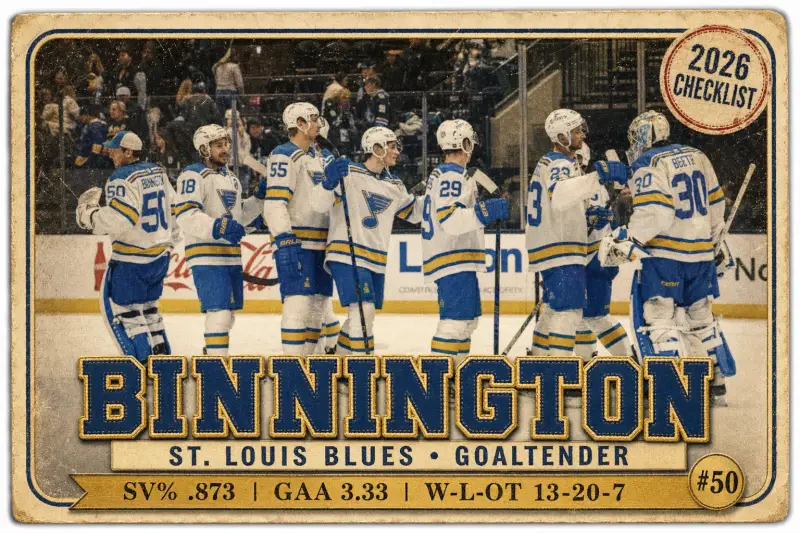
Jordan Binnington posted a .873 for the Blues and a .907 for Canada in the same 12-month window. With his no-trade clause shrinking July 1, four teams are lined up. Inside The Flag-Jersey Split and where he actually lands.
Live updates
No updates yet. Refreshing automatically.
- 1.The split: Binnington posted .907 for Canada at 4 Nations and .873 for the Blues in the same 12 months. A 34-point SV% gap between flag and club.
- 2.The replacement: Joel Hofer (25) posted .909 SV% with 6 shutouts. From Nov 29 onward .921 SV% (3rd in NHL). Blues have their starter.
- 3.The window: NTC shrinks from 14-team to 10-team block on July 1, 2026. Four new destinations open overnight.
- 4.The call: Edmonton for a 2027 2nd + B-level prospect, Blues retain $1M. Pittsburgh rumor is analytically wrong (Skinner+Silovs already set).
Jordan Binnington posted a .873 save percentage in 2025-26, the worst mark of his 9-year NHL career, and according to David Pagnotta, it's the reason the Stanley Cup champion is "more likely than ever" to be moved this offseason. The Blues' preferred answer, 25-year-old Joel Hofer, went 24-13-5 behind a .909 save percentage with six shutouts. Jordan Binnington trade destinations in 2026 are no longer a rumor cycle. They're a countdown to July 1.
Pagnotta laid out the exact trade setup in his April 22 update for The Fourth Period. Binnington has one year left at $6 million. The Blues have their young starter in place. Goalie-needy teams are already on the phone.
Here's the part that makes this summer different from every other Binnington trade cycle. The same goalie who posted a .873 behind the Blues also posted a .907 for Canada at the 2025 4 Nations Face-Off, including the gold-medal-clinching overtime win against the United States. That's The Flag-Jersey Split. One jersey he dominated in, one he struggled in, same 12-month window.
Key Takeaways
- The Flag-Jersey Split: Binnington posted a .907 for Canada and .873 for the Blues in the same 12-month window. That 34-point SV% gap is both the sales pitch and the warning label.
- The Timeline: Binnington's no-trade clause shrinks from 14-team to 10-team on July 1, 2026. That move adds four potential destinations overnight.
- The Alternative: Joel Hofer went 24-13-5 with .909 SV% and 6 shutouts at age 25. From November 29 onward he posted .921 (3rd in the NHL).
- The Price Tag: One year left at $6M AAV. Blues have $20M+ projected cap space and 3 first-round picks this offseason.
- The Destination Grid: Edmonton, Pittsburgh, Florida, Carolina all have goalie questions. Only two are clean fits once NTC and Cup math are accounted for.
The Pagnotta Report: Why This Summer Is Different
Pagnotta's full trade-setup quote on The Fourth Period was specific, not speculative:
"The one guy that looks more likely than ever to get moved this off-season is Jordan Binnington. They really like (goalie Joel) Hofer, Binner's got another year, final year, of his contract. There are going to be teams looking at goaltending this summer, and they will be talking to St. Louis about Jordan Binnington."
— David Pagnotta, The Fourth Period (via NHL Trade Rumors)Read it carefully. Pagnotta's not reporting interest. He's reporting intent. The Blues have already decided Hofer is the starter. Binnington's not losing a competition, he's being packaged for a market.
Why summer over deadline? Three reasons. First, Binnington's NTC relaxes July 1, opening more destinations. Second, goalie trade markets heat up at the draft, not in February, because contending teams don't swap starters mid-run. Third, Doug Armstrong hands the day-to-day GM job to Alexander Steen on July 1, and this is Armstrong's last chance to clear the books before he moves to President of Hockey Operations.
Binnington himself acknowledged the upcoming talks at his exit interview. When asked about his future, he kept it short:
"I think for me, I'm a competitive goaltender, right? I love St. Louis."
— Jordan Binnington, Blues exit interview April 2026 (via The Hockey News)That's diplomatic-speak for "I know what's coming." He followed it up with "I think 'Steener' and I are going to have some conversations," meaning the incoming GM will have the final say on where Binnington lands. The 10-team NTC gives Binnington a voice, not a veto.
The Flag-Jersey Split: Two Save Percentages, One Goalie
The Flag-Jersey Split
The dramatic performance gap a player shows between two jerseys inside the same 12-month window, where international or alt-role deployment unlocks a level his day-job never accesses. Acquiring teams have to decide which version they're buying, the flag version that delivered in the biggest moments, or the club version whose numbers are career-worst.
Binnington's February 2025 at the 4 Nations Face-Off was a full career in four games. His final line: 3-1-0, .907 save percentage, 2.37 goals-against average, including a 31-save performance in a 3-2 overtime win over the United States for the gold medal.
The NHL EDGE tracking made the performance specifically clear. Binnington stopped 29 of 32 high-danger chances for a .906 high-danger save percentage, second only to Connor Hellebuyck's .931 for the U.S. His stop on Auston Matthews's point-blank overtime attempt carried a Predicted Goal Rate of 18.78 percent. That's the kind of save that wins gold medals.
Four months later, the regular-season version arrived. Binnington's 2025-26 Blues season finished 13-20-7 with a .873 save percentage and 3.33 goals-against average across 41 appearances. That's a 34-point SV% drop between flag and club. No goalie of Binnington's caliber has ever delivered that gap inside one season.
What stands out to me: the flag-version skill set didn't disappear. He still makes the impossible save. What broke down was the volume consistency, the 33-shot nights where he needs to stop 30 in a 4-3 grind. The Blues' team defense collapsed around him, and Hofer got hotter. Acquiring teams have to decide if fresh scenery plus Cup-and-gold-medal pedigree returns Binnington to his flag ceiling, or if the club numbers are the new baseline.
Destination Grid: Four Teams, Four Fits, One Rejection
Four teams have been publicly connected to Binnington. Here's how each destination actually stacks up on goalie need, cap fit, NTC clearance, and asset package:
| Team | Goalie Need | Cap / NTC Fit | Fit Score |
|---|---|---|---|
| Edmonton Oilers | Jarry .863 SV% since arriving; McDavid window urgency | Cap tight but doable; NTC likely clears | 8/10 |
| Carolina Hurricanes | Andersen UFA after 2025-26; Bussi emerging | $29M+ cap room 2026-27; NTC clears | 7/10 |
| Florida Panthers | Bobrovsky UFA; contract talks "pretty bad" | Cap tight; Bob re-sign may happen first | 6/10 |
| Pittsburgh Penguins | Skinner + Silovs tandem already set | Cap room exists; NTC likely clears | 3/10 (REJECT) |
Pittsburgh is where I have to stop and actually say no. Kyle Dubas just acquired Stuart Skinner in the December Jarry-for-Skinner swap and has Arturs Silovs as his secondary option. Adding Binnington at $6M would mean $11M+ committed to goaltending for a team that's also deciding what to do with Sidney Crosby and Evgeni Malkin in their age-39 seasons. That's a cap allocation mismatch.
Pittsburgh doesn't need a starter. They need either a backup or nothing. Binnington is a starter at $6M. The Penguins linking has been speculative, not substantive.
Binnington Trade Likelihood
Grading the three realistic landing spots across fit, assets, and market pressure.
The 14-to-10 Window: How Binnington's NTC Opens Summer 2026
This is the part most articles skip. Binnington's no-trade clause isn't a full block. It's a modified no-trade that shrinks each year of his contract. Right now it's a 14-team block. On July 1, 2026, it becomes a 10-team block for his final contract year.
Four more teams are added to his tradable list overnight. Some of those are almost certainly contenders he'd welcome, Edmonton, Carolina, Florida among them. Others are where he has veto power, likely Detroit, Philadelphia, and a couple of rebuild teams he wouldn't want to resuscitate.
That's why summer timing matters more than deadline timing. The Blues can't force him to Pittsburgh or Detroit if his 14-team block includes them now. Once it relaxes to 10, the pool of willing partners widens, and the market pressure on returning assets rises. Armstrong has waited 12 months for this window specifically.
Compare the mechanics to Nashville's NMC-heavy rebuild where Juuse Saros's full clause has trapped the Predators. Binnington's structure is cleaner, modified not full, shrinking not static, with one contract year left. That's why he's moveable and Saros isn't.
What The Return Looks Like (And Why Dubas-Template Teams Will Call First)
Here's my projection for the package Armstrong and Steen will chase. A first-round pick is the ceiling ask, and given Binnington's club numbers, they're not getting it. My baseline: a 2027 second-round pick, a mid-tier prospect (B-level defenseman or forward), and potentially a conditional pick that upgrades based on Binnington's playoff starts with the acquiring team.
The Dubas template from the Chinakhov trade is the model: acquire a disgruntled or underperforming player at a discount by taking on a manageable cap hit and sending mid-round picks. Edmonton can absolutely run this template. So can any team that believes the 4 Nations version is accessible with the right team defense in front of him.
What St. Louis avoids is the retention trap. The Blues have been burned by the four-first-round-pick asking price on Robert Thomas. On Binnington, asking for more than realistic return just freezes the market. Armstrong's smart enough to take fair value and move on.
Blues cap implications: moving $6M off the books combined with Kyrou's potential trade value in the same offseason gives Steen roughly $30M in flexibility heading into free agency. That's a full reset, not a retool.
The one scenario I'm watching: what if Bobrovsky and Florida settle on a two-year extension? That removes the Panthers from the market, Carolina re-signs Andersen, and suddenly the Binnington market collapses to just Edmonton. If that happens, the return drops to a third-round pick and a prospect. Armstrong would pivot to retention (up to 50%) to salvage value.
Sources and Reporting
- NHL Trade Rumors (Pagnotta): original "more likely than ever" quote and destination list
- Pro Hockey Rumors: March trade-lean confirmation and goalie market context
- PuckPedia (Binnington): contract, NTC structure year-by-year
- NHL EDGE (4 Nations): high-danger save data and PGR metrics
- ESPN (Binnington 2025-26): final season stat line
- NHL.com Blues (Hofer stats): Hofer's 24-13-5, .909 SV%, Nov 29 onward .921
- St. Louis Sports Central: Blues offseason cap space, pick inventory, Steen transition
- The Hockey News: Binnington exit-interview quotes
- Daily Faceoff: summer-vs-deadline market logic
The Verdict: The Flag-Jersey Split
Binnington gets moved. My call: Edmonton, on or around July 1, for a 2027 second-round pick plus a B-level prospect, with St. Louis retaining $1 million of the $6M cap hit to close the deal. That lands Binnington behind a Stuart-Skinner-free roster where he's the undisputed starter for one Cup-window year next to Connor McDavid and Leon Draisaitl.
What that team's buying is The Flag-Jersey Split gamble. Hoping the .907 goalie under a red maple leaf shows up again when the Oilers logo needs him in April. My read: with a better defense in front of him than the Blues provided, he closes the gap to roughly .895. That's not elite. That's good enough to win Cup games.
Frequently Asked Questions
Where is Jordan Binnington most likely to be traded in 2026?
Edmonton is the most likely destination based on urgency and fit. The Oilers are stuck with Tristan Jarry's .863 save percentage, Connor McDavid is entering a contract year, and GM Stan Bowman has mid-round picks and prospects to offer. Carolina is a distant second if Frederik Andersen leaves in free agency.
How much is left on Jordan Binnington's contract?
Binnington has one year remaining on his 6-year, $36 million contract signed in 2023. His 2026-27 cap hit is $6 million AAV. He also carries a modified no-trade clause that shrinks from a 14-team block to a 10-team block on July 1, 2026, the last year of the deal.
Why do the Blues want to trade Binnington?
The Blues have 25-year-old Joel Hofer ready to take over the starter role. Hofer posted a .909 save percentage with 6 shutouts in 46 games. His post-November 29 stretch included a .921 save percentage, the 3rd-best in the NHL. Cost-controlled youth behind $6M of veteran salary is an asset reallocation the Blues can no longer delay.
Did Binnington really play better for Canada than for the Blues?
Yes, and the statistical gap is striking. At the 2025 4 Nations Face-Off he posted a .907 save percentage across 4 games and won the tournament. For the 2025-26 Blues season he posted a .873 save percentage across 41 games. The 34-point SV% swing happened inside the same 12-month window with identical goalie equipment and preparation.
What would St. Louis get back in a Binnington trade?
Realistic return projection: a 2027 second-round pick plus a B-level prospect. With up to $1 million in cap retention, the Blues could potentially extract a conditional first that upgrades if Binnington reaches the Conference Finals with his new team. Armstrong and Steen reportedly prioritize asset liquidity over maximum-value stalling.
Frequently Asked Questions
Where is Jordan Binnington most likely to be traded in 2026?
Edmonton is the most likely destination based on urgency and fit. The Oilers are stuck with Tristan Jarry's .863 save percentage, Connor McDavid is entering a contract year, and GM Stan Bowman has mid-round picks and prospects to offer. Carolina is a distant second if Frederik Andersen leaves in free agency.
How much is left on Jordan Binnington's contract?
Binnington has one year remaining on his 6-year, $36 million contract signed in 2023. His 2026-27 cap hit is $6 million AAV. He also carries a modified no-trade clause that shrinks from a 14-team block to a 10-team block on July 1, 2026, the last year of the deal.
Why do the Blues want to trade Binnington?
The Blues have 25-year-old Joel Hofer ready to take over the starter role. Hofer posted a .909 save percentage with 6 shutouts in 46 games. His post-November 29 stretch included a .921 save percentage, the 3rd-best in the NHL. Cost-controlled youth behind $6M of veteran salary is an asset reallocation the Blues can no longer delay.
Did Binnington really play better for Canada than for the Blues?
Yes, and the statistical gap is striking. At the 2025 4 Nations Face-Off he posted a .907 save percentage across 4 games and won the tournament. For the 2025-26 Blues season he posted a .873 save percentage across 41 games. The 34-point SV% swing happened inside the same 12-month window with identical goalie equipment and preparation.
What would St. Louis get back in a Binnington trade?
Realistic return projection: a 2027 second-round pick plus a B-level prospect. With up to $1 million in cap retention, the Blues could potentially extract a conditional first that upgrades if Binnington reaches the Conference Finals with his new team. Armstrong and Steen reportedly prioritize asset liquidity over maximum-value stalling.
Related Stories
Darnell Nurse Trade: 4 Suitors
Edmonton wants Darnell Nurse's $9.25M off the books, but a buyout saves barely $1.53M and his no-move clause hands him the pen. The Bonus Sh...
By Mike Johnson · 12 min read
Darren Raddysh Free Agent 2026: 4 Teams
Darren Raddysh's 70-point breakout turned his $975K cap hit into a four-team bidding war. The Athletic linked him to Philadelphia, San Jose,...
By Mike Johnson · 13 min read
Bobby McMann Free Agent 2026 Destinations: 4 Teams Linked
Bobby McMann's career-high 29 goals just turned a $1.35M cap hit into Sharangovich-tier money. The Athletic locked him to 4 teams (Detroit,...
By Mike Johnson · 10 min read
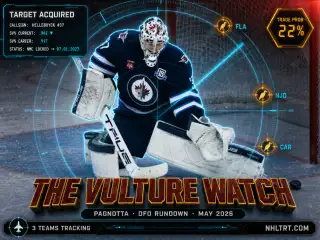
Hellebuyck Trade Rumors 2026: The Vulture Watch Begins
David Pagnotta says vultures circle Hellebuyck after a .902 save percentage and exit-interview frustration. Three destinations make cap sens...
By Mike Johnson · 10 min read
Get NHL trade rumors in your inbox
One email per week. Zero spam. Verified rumors only.