Don Waddell 2026 Trade Deadline: The Miscalculation
Pittsburgh clinched the playoffs April 9 with 36 post-trade points from Yegor Chinakhov. Columbus missed by 6 points with 10 from Danton Heinen. Inside The Waddell Miscalculation, the trade that flipped the 2026 Metro standings.

Live updates
No updates yet. Refreshing automatically.
- 1.The trade: Columbus GM Don Waddell sent Yegor Chinakhov to Pittsburgh on December 29, 2025 for Danton Heinen, a 2026 2nd-round pick, and a 2027 3rd-round pick.
- 2.The gap: Chinakhov scored 36 points in 43 Pittsburgh games. Heinen scored 10 in 44 NHL games, then went to AHL Cleveland.
- 3.The cost: Pittsburgh clinched the playoffs April 9. Columbus missed by 6 points. Waddell's 6th straight non-playoff summer.
- 4.What's next: Dubas almost certainly extends Chinakhov (RFA, $2.1M). Projected 4 years at roughly $5.5M AAV.
Pittsburgh clinched its first playoff berth since 2021-22 on April 9, 2026, and Columbus GM Don Waddell watched the proof that his December 29 trade broke the wrong way. Four months after Waddell shipped Yegor Chinakhov to the Penguins for Danton Heinen and two draft picks, one of those assets has 36 points and a first-round date with the Flyers. The other has 10 points and finished the season in the AHL with the Cleveland Monsters.
That's the Don Waddell trade deadline 2026 retrospective in two sentences. It's also a 30-point production gap inside a near-identical post-trade window, and it's about to cost the Blue Jackets a second-round pick they won't recoup for years.
This is what I'm calling The Waddell Miscalculation. Not the trade process. The trade thesis itself.
Key Takeaways
- The Waddell Miscalculation: Columbus traded Chinakhov for Heinen plus a 2026 2nd and 2027 3rd on December 29, 2025. The Penguins clinched the playoffs April 9. The Blue Jackets missed by 6 points.
- Production Gap: Chinakhov: 18G-18A-36 points in 43 Pittsburgh games. Heinen: 6G-4A-10 points in 44 NHL games before Columbus sent him to AHL Cleveland.
- Career Highs: Chinakhov finished 2025-26 with 21G-21A-42 points, both goal and assist career bests under Penguins coach Dan Muse.
- CBJ Collapse: Columbus went 2-7-1 in their final 10 games, falling from 2nd in the Metro to 11th in the East. Final record: 40-30-12, 92 points, their first 90+ point season without a playoff berth.
- What Comes Next: Chinakhov is RFA this summer at $2.1M. Dubas almost certainly extends. Columbus is now 6 seasons without a playoff series.
The December 29 Trade: What Actually Happened
Waddell made the call before the All-Star break and before the Blue Jackets' 14-2-1 hot streak. At the time, Columbus sat outside the wild-card picture. Chinakhov had asked for a trade in July 2025. He'd stated his reasons publicly.
"I had some misunderstandings with the coach during the season. Now I would be glad to have a trade."
— Yegor Chinakhov, July 2025 (via NHL Trade Rumors)That quote matters because it tells you everything about the position Waddell thought he was trading from. Chinakhov wasn't productive under Dean Evason or Rick Bowness. He'd scored 6 points in 29 games before the swap. Waddell treated him like a depreciating asset and swung a deal for an established veteran plus picks.
Here's what Columbus got back, according to the official team release:
"This trade provides us with additional draft capital over the next two years and a good two-way player in Danton Heinen that will add to our organizational depth at the forward position."
— Don Waddell, Columbus GM, December 29, 2025 (via NHL.com Blue Jackets)Read that statement again. "Additional draft capital" and "organizational depth" are the exact words a GM uses when the player coming back is the second-tier piece. Waddell wasn't claiming Heinen would push Columbus into the playoffs. He was describing a consolation return.
The miscalculation was valuing Chinakhov as a bottom-six drag instead of a deployment problem. Similar reasoning to what we've seen in Toronto's overcorrection cycle, where the evaluation of the player never updated to account for a coaching or role change.
Chinakhov's Dan Muse Unlock: 0.84 Points Per Game
Pittsburgh didn't trade for Chinakhov blindly. Kyle Dubas reportedly wouldn't have acquired him without coach Dan Muse already signing off on a specific ice-time plan. That plan worked immediately.
Chinakhov's post-trade production line:
- 43 games played
- 18 goals, 18 assists, 36 points
- 0.84 points per game (a 4x improvement over his Columbus rate of 0.21)
- March 2026 alone: 8 points, averaging 18:13 of ice time per game
- 21G-21A-42 points regular-season total, career highs in both goals and assists
What stands out to me is the ice time. In Columbus, Chinakhov was drifting between lines and getting spot duty. In Pittsburgh, Muse slotted him beside skilled forwards with offensive zone starts and power-play looks. The 18:13 March TOI is middle-six heavy, and it unlocked his wrist shot, the same shot scouts flagged coming out of the 2020 draft when Columbus took him 21st overall.
Production at Chinakhov's Pittsburgh rate projects to roughly 69 points over a full 82-game season. For context, that's top-six winger money on the open market. The Penguins are getting that production on a $2.1 million cap hit. When Dubas extends him in June, which he almost certainly will, the restricted free-agent math gives Pittsburgh the upper hand in negotiations.
For deeper context on how this fits Dubas's broader asset strategy, see the Chinakhov extension math inside the Crosby window. The short version: Pittsburgh bought high-ceiling production at mid-tier cost, and the 2026 2nd and 2027 3rd were a fair tax to pay.
What The Waddell Miscalculation Actually Cost
The Waddell Miscalculation
A GM evaluation error where a disgruntled-but-talented young player gets traded as a depreciating asset rather than a deployment problem. The error compounds when the return is a flat-line veteran plus mid-round picks, because the production gap widens every night the new team wins and every night the old team loses by a goal.
Columbus missed the 2026 playoffs by 6 points. That number matters because it's fewer than Chinakhov's 36 post-trade points and far more than Heinen's 10. In a hypothetical world where Waddell keeps Chinakhov, even accounting for the coaching-fit issues that might have capped him below Pittsburgh's 0.84 PPG output, the gap between a 15-point second-half and a 6-point one would almost certainly have pushed Columbus past Detroit or Philadelphia.
Heinen's NHL numbers tell the second half of the story. 10 points in 44 games with a 2.25 million-dollar cap hit. Then a demotion to AHL Cleveland, where he actually produced better at 18 points in 13 games, proof the tools were there, but the NHL fit in Columbus wasn't. Heinen's contract runs through next season with $2.25M against the cap.
That's the "organizational depth" Waddell referenced. Columbus also got a 2026 2nd-round pick (originally from St. Louis) and a 2027 3rd-round pick (originally from Washington). Draft picks are assets, but they're 2-4 years away from producing NHL games. By the time either pick matures, the Penguins will have gotten two full seasons of top-six production from Chinakhov on an RFA-controlled deal.
The collapse made it worse. Columbus went 2-7-1 over their final 10 games, falling from 2nd in the Metropolitan Division to 11th in the Eastern Conference. Adding Conor Garland on March 6 for a 3rd-round 2026 pick and a 2nd-round 2028 pick didn't save them. Garland's career 49 points per 82 games played is useful, but it couldn't replace the second-line scoring Chinakhov was producing in Pittsburgh.
Asset Ledger: Penguins vs Blue Jackets Net Exchange
The clearest way to see The Waddell Miscalculation is in a head-to-head asset table. Here's what each team got back through April 2026:
| Asset Moved | Pittsburgh Got | Columbus Got | Net Value Verdict |
|---|---|---|---|
| Player (top-6 forward) | Chinakhov: 36 pts in 43 GP | Heinen: 10 pts in 44 GP (then AHL) | Pittsburgh +26 points |
| Cap Hit 2025-26 | $2.1M (Chinakhov) | $2.25M (Heinen) | Pittsburgh saves $150K |
| Contract Term | RFA this summer (Pens hold rights) | 1 year left at $2.25M | Pittsburgh has control |
| Draft Capital | Sent 2026 2nd + 2027 3rd | Got 2026 2nd + 2027 3rd | Columbus +2 picks (4yr wait) |
| Playoff Result | 1st berth since 2021-22 | 6th straight miss (92 pts) | Pittsburgh advances |
Draft picks matter, but they're lottery tickets on players who may not reach the NHL for three to four years. Chinakhov is producing first-line offense right now, on a cap-controlled contract, on a team that just beat out Columbus for the final Eastern Conference playoff spot.
Waddell Trade Grade
Grading Waddell's December 29 Chinakhov-for-Heinen-plus-picks trade across three dimensions.
What Columbus Does Next (And What Dubas Does With Chinakhov)
Columbus now enters a sixth consecutive offseason without a playoff round. Waddell's challenge is that the Blue Jackets finished with 92 points, their fifth-highest total in franchise history, yet still missed the postseason. That's a weird kind of rebuild purgatory, too good to tank and not good enough to win in May.
My projection on Columbus's direction: Waddell retools without blowing it up. He's already shown he prefers "players with term" over rental gambles. Expect him to target a second-line forward with 2-3 years of cost certainty this summer. Boone Jenner's return to full health matters. So does whatever happens with Conor Garland, who has one year left before UFA.
The parallel for Waddell is what we saw inside Nashville's NMC-heavy rebuild trap. Teams that cling to mid-career veterans while their young talent ages into RFA years tend to stall. Columbus needs to avoid that pattern.
Pittsburgh's path is clearer. Chinakhov's restricted free agency this summer gives Dubas maximum cost control. My call: a 4-year extension at roughly $5.5M AAV, which would lock up an emerging top-six winger through the tail end of the Crosby window and into the early post-Crosby era. That's the Chinakhov Template that Dubas was searching for when he made the trade.
The broader takeaway is about how you evaluate disgruntled young talent. Chinakhov had asked out. He had a reputation as difficult. Those are the exact players who produce trade-value discounts. Teams like the Canucks after firing Allvin have to learn to distinguish between players who can't play and players whose deployment doesn't fit. Pittsburgh nailed that distinction. Columbus missed it.
The 2026 playoffs reveal the full cost of getting that wrong. Chinakhov's skating in games that matter. Heinen's in Cleveland. Waddell's preparing for his sixth straight non-playoff summer while Dubas gets to extend a 0.84 PPG winger on an RFA contract.
Sources and Reporting
- NHL.com (Blue Jackets official): December 29 trade announcement and Waddell statement
- NHL.com (Penguins official): trade acquisition details and draft pick terms
- NHL.com playoff clinch recap: April 9 game details, Crosby/Malkin milestones
- Wikipedia (2025-26 Columbus Blue Jackets season): final record, standings, elimination date
- Daily Faceoff: Dubas acquisition grade and production context
- Puck Reporter: Chinakhov March 8-point month, 18:13 TOI average
- PuckPedia (Heinen): contract details, AHL Cleveland stats
- CBS Sports (Heinen): 2025-26 NHL totals (6G-4A in 44 GP)
- Union and Blue: CBJ 2-7-1 late collapse analysis
The Verdict: The Waddell Miscalculation
Pittsburgh won this trade the moment Dan Muse deployed Chinakhov in the top six with power-play time. Columbus didn't lose because of the picks they got, they lost because the thesis was wrong. Waddell priced a disgruntled 24-year-old winger as a depreciating asset when he was actually a deployment problem.
My final read: Chinakhov signs a 4-year, $22M extension with the Penguins this summer, Columbus enters year seven of the post-Nash rebuild with no Cup series since 2014, and the 2026 2nd-round pick St. Louis sent becomes a footnote. The Waddell Miscalculation isn't a process failure. It's a pure evaluation error, and the 26-point production gap is the receipt.
Frequently Asked Questions
Why did the Blue Jackets trade Yegor Chinakhov to the Penguins?
Chinakhov had requested a trade in July 2025, citing "misunderstandings with the coach." GM Don Waddell traded him December 29, 2025 to Pittsburgh for Danton Heinen, a 2026 second-round pick, and a 2027 third-round pick. Columbus head coach Dean Evason was fired in November 2025 and replaced by Rick Bowness, but Chinakhov's role didn't expand enough to keep him.
What did Pittsburgh give up for Chinakhov?
The Penguins traded Danton Heinen, a 2026 second-round draft pick (originally from St. Louis), and a 2027 third-round draft pick (originally from Washington). Kyle Dubas had accumulated both picks in earlier trades, meaning Pittsburgh didn't move a single pick from its own original stock.
Did Danton Heinen play in the NHL after the trade?
Yes, but briefly. Heinen played 33 games with Columbus after the trade, producing 10 points (combined with his pre-trade Pens totals for 6G-4A-10 points across 44 NHL games). Columbus then assigned him to the AHL's Cleveland Monsters, where he posted 18 points in 13 games. His contract runs through 2026-27 at $2.25 million AAV.
How many points did Chinakhov score with the Penguins?
Chinakhov recorded 36 points (18 goals, 18 assists) in 43 games after the December 29, 2025 trade. His full 2025-26 regular-season totals (21 goals and 21 assists for 42 points) set career highs in both categories. In March 2026 alone, he posted 8 points while averaging 18:13 of ice time per game under head coach Dan Muse.
When did Pittsburgh clinch the 2026 Stanley Cup Playoffs?
The Penguins clinched their first playoff berth since 2021-22 on April 9, 2026, with a 5-2 win over the New Jersey Devils. Sidney Crosby and Evgeni Malkin became the first teammates in NHL history to record 60-plus points in the same season while both age 38 or older. Pittsburgh drew the Philadelphia Flyers in the Eastern Conference First Round.
Frequently Asked Questions
Why did the Blue Jackets trade Yegor Chinakhov to the Penguins?
Chinakhov had requested a trade in July 2025, citing 'misunderstandings with the coach.' GM Don Waddell traded him December 29, 2025 to Pittsburgh for Danton Heinen, a 2026 second-round pick, and a 2027 third-round pick. Columbus head coach Dean Evason was fired in November 2025 and replaced by Rick Bowness, but Chinakhov's role didn't expand enough to keep him.
What did Pittsburgh give up for Chinakhov?
The Penguins traded Danton Heinen, a 2026 second-round draft pick (originally from St. Louis), and a 2027 third-round draft pick (originally from Washington). Kyle Dubas had accumulated both picks in earlier trades, meaning Pittsburgh didn't move a single pick from its own original stock.
Did Danton Heinen play in the NHL after the trade?
Yes, but briefly. Heinen played 33 games with Columbus after the trade, producing 10 points (combined with his pre-trade Pens totals for 6G-4A-10 points across 44 NHL games). Columbus then assigned him to the AHL's Cleveland Monsters, where he posted 18 points in 13 games. His contract runs through 2026-27 at $2.25 million AAV.
How many points did Chinakhov score with the Penguins?
Chinakhov recorded 36 points (18 goals, 18 assists) in 43 games after the December 29, 2025 trade. His full 2025-26 regular-season totals (21 goals and 21 assists for 42 points) set career highs in both categories. In March 2026 alone, he posted 8 points while averaging 18:13 of ice time per game under head coach Dan Muse.
When did Pittsburgh clinch the 2026 Stanley Cup Playoffs?
The Penguins clinched their first playoff berth since 2021-22 on April 9, 2026, with a 5-2 win over the New Jersey Devils. Sidney Crosby and Evgeni Malkin became the first teammates in NHL history to record 60-plus points in the same season while both age 38 or older. Pittsburgh drew the Philadelphia Flyers in the Eastern Conference First Round.
Related Stories

Darnell Nurse Trade: 4 Suitors
Edmonton wants Darnell Nurse's $9.25M off the books, but a buyout saves barely $1.53M and his no-move clause hands him the pen. The Bonus Sh...
By Mike Johnson · 12 min read
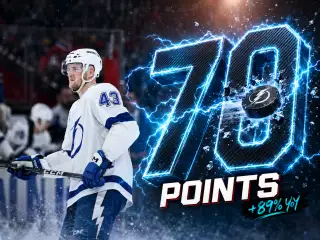
Darren Raddysh Free Agent 2026: 4 Teams
Darren Raddysh's 70-point breakout turned his $975K cap hit into a four-team bidding war. The Athletic linked him to Philadelphia, San Jose,...
By Mike Johnson · 13 min read
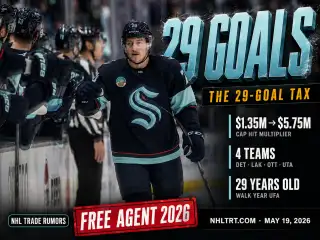
Bobby McMann Free Agent 2026 Destinations: 4 Teams Linked
Bobby McMann's career-high 29 goals just turned a $1.35M cap hit into Sharangovich-tier money. The Athletic locked him to 4 teams (Detroit,...
By Mike Johnson · 10 min read

Hellebuyck Trade Rumors 2026: The Vulture Watch Begins
David Pagnotta says vultures circle Hellebuyck after a .902 save percentage and exit-interview frustration. Three destinations make cap sens...
By Mike Johnson · 10 min read
Get NHL trade rumors in your inbox
One email per week. Zero spam. Verified rumors only.