Porter Martone Scouting Report: Flyers Rookie Playoff Debut 2026
Porter Martone scouting report 2026: 19-year-old Flyers rookie scored playoff GWG 21 days after ELC signing, breaking Simon Gagne 26-year record.
Live updates
No updates yet. Refreshing automatically.
The Porter Martone scouting report 2026 writes itself now. Twenty-one days after signing a $2.9 million entry-level contract with Philadelphia, the 19-year-old scored the game-winning goal in his playoff debut at 17:23 of the third period on April 18, breaking Simon Gagne's 26-year-old Flyers record as the youngest player to score in a postseason debut.
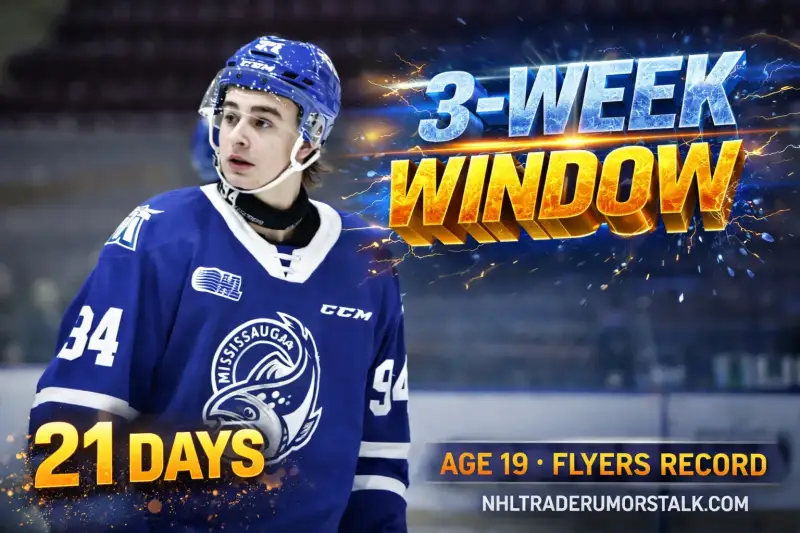
That's what I'm calling The 3-Week Window — the shortest path from pen on paper to postseason hero in modern Flyers history. He's 10 NHL games into his career. He already owns a franchise record and a playoff game-winner. Game 2 is tonight at PPG Paints Arena.
The Porter Martone scouting report 2026 turned into a franchise record in 21 days. On April 18, 2026, the 19-year-old rookie scored the game-winning goal at 17:23 of the third period — a wrist shot past Stuart Skinner with 2:37 remaining — to lift the Philadelphia Flyers to a 3-2 Game 1 victory over the Pittsburgh Penguins at PPG Paints Arena. Martone (19 years, 174 days) is now the youngest Flyer ever to score in a postseason debut, breaking Simon Gagne's 26-year-old record of 20 years, 44 days set in Game 1 of the 2000 Eastern Conference Quarterfinals. He's also the first teenager to score in an NHL playoff debut since Andrei Svechnikov did it in 2019.
Here's the mechanism: General manager Daniel Briere signed Martone to a 3-year, $2.9 million entry-level contract with a $966,667 AAV on March 29, 2026, right after Michigan State's NCAA Tournament run ended. Martone made his NHL debut on March 31 against Washington and scored his first NHL goal on April 5 — an overtime power-play winner against Boston, the first Flyer ever to score his first NHL goal in OT.
Thirteen days later, he scored a playoff game-winner against the Penguins. Ten games into his NHL career, one playoff game, one game-winner — and a 26-year franchise record broken.
My read: the usual caution around teenage rookies — the adjustment curve, the depth-line minutes, the "give him a year in the AHL" script — doesn't apply to this player. Martone was the sixth overall pick of the 2025 NHL Draft for a reason.
He scored 50 points in 35 games as a Big Ten freshman at Michigan State — the second-most goals ever by a Spartan rookie, behind only Rod Brind'Amour's 27 in 1988-89. He was the College Hockey News Rookie of the Year. The 3-Week Window isn't luck — it's a 19-year-old who spent two seasons dominating lower leagues finally being handed NHL minutes at exactly the moment they mattered.
Key Takeaways
- The 3-Week Window: Martone signed his 3-year, $2.9M ELC on March 29 and scored a playoff game-winner on April 18. Twenty-one days. The shortest Flyers bench-to-banner arc of the modern era.
- Record broken: At 19 years, 174 days, Martone is the youngest Flyer ever to score in a playoff debut. He bested Simon Gagne's mark of 20 years, 44 days that stood from the 2000 Eastern Conference Quarterfinals.
- First teen since Svechnikov: Martone is the first teenager to score in an NHL playoff debut since Andrei Svechnikov did it for Carolina in 2019 — a seven-year gap.
- Draft resume: Sixth overall pick in the 2025 NHL Draft. OHL captain of Brampton with 98 points. Michigan State freshman with 50 points in 35 games (25G, 25A). CHN Rookie of the Year. Second-most goals by a Spartan rookie ever.
- What's next: Game 2 is tonight (April 20) at 7 PM ET at PPG Paints Arena on ESPN/NBCSP/SN-PITT. The Flyers lead the Eastern Conference Quarterfinals 1-0.
The Porter Martone Scouting Report — What He Actually Is
Central Scouting had Martone sixth among North American skaters entering the 2025 NHL Draft, and the Flyers took him at sixth overall. The draft profile is unusual — Martone measures 6 feet 3 inches and 214 pounds with a right-handed shot playing right wing, which is the position and profile every NHL GM has chased for two decades. Power forwards who can actually make plays are hockey's rarest asset.
What Martone actually is: a playmaker wearing a power forward's body. His hockey sense and vision — constantly scanning the ice, reading teammates' tendencies, projecting plays before they unfold — is the scouting community's consensus strength. He has a heavy, accurate shot with a deceptive quick release, and his toe-drag and shoot motion beats goalies off the rush. He's hard to knock off the puck, wins battles on the boards, and doesn't avoid the dirty areas.
Game 1 was the scouting report in miniature. He skated around the circle, found open ice, picked his spot, and sniped a wrist shot past Skinner from the high slot — the kind of shot that separates top-six NHL forwards from third-line grinders. Konecny's assist was a simple feed. The goal was all Martone.
The 3-Week Window
The 3-Week Window is the 21-day span between Martone's ELC signing (March 29, 2026) and his playoff debut game-winning goal (April 18, 2026). It captures the compressed timeline of an elite prospect moving from amateur to franchise-record holder — the shortest path from pen on paper to postseason hero in modern Flyers history.
12-Element Scouting Card — The Complete Bio
The full profile for a player who went from Michigan State freshman to Flyers franchise record-holder in under a month:
| Element | Detail |
|---|---|
| Born | October 26, 2006 (Peterborough, Ontario) |
| Age | 19 years, 174 days (Game 1 debut) |
| Size | 6 ft 3 in / 214 lb |
| Position / Shot | Right Wing / Right |
| Draft | #6 overall, 2025 NHL Draft (Philadelphia Flyers) |
| OHL Career | 178 GP · 89 G · 115 A · 204 PTS (Sarnia / Mississauga / Brampton) |
| OHL 2024-25 | 57 GP · 37 G · 61 A · 98 PTS · Brampton Steelheads Captain |
| NCAA 2025-26 | 35 GP · 25 G · 25 A · 50 PTS · Michigan State (CHN Rookie of Year) |
| NHL Debut | March 31, 2026 vs Washington Capitals |
| First NHL Goal | April 5, 2026 · OT power play vs Boston (first Flyer ever) |
| Contract | 3 yrs · $2.9M total · $966,667 AAV · Expires 2027-28 · RFA |
| U18 Record | 17 points (surpassed Connor Bedard's Canadian U18 record) |
Two elements on that card deserve extra weight. First, the second-most goals by a Michigan State rookie ever (25) trail only Rod Brind'Amour's 27 from 1988-89 — Brind'Amour finished his career with 452 NHL goals. Second, the Canadian U18 scoring record at 17 points broke a mark held by Connor Bedard, who entered the NHL as the most-hyped Canadian prospect since Crosby. Those two data points are the reason Martone went sixth overall despite a skating question mark.
Inside The 3-Week Window — March 29 to April 18
Walk the timeline. Michigan State's NCAA Tournament run ended on March 28. The next day, Briere announced the ELC at a 3-year, $966,667 AAV — standard top-10 pick structure, with roughly $2.9 million in total value through 2027-28.
Philadelphia had a cap-space need and a clear runway. Martone had a one-week adjustment period, played his first NHL game on March 31, and by April 5 was scoring 5-on-3 overtime winners against Boston.
Martone himself framed the week after Game 1 in comments to NHL.com: his acknowledgment of how quickly it all happened was grounded in how much the veteran group carried him in. The Chinakhov trajectory through Pittsburgh's Crosby window captured a similar pattern for another young Eastern Conference forward — drafted mid-first-round, handed real minutes early, rewarded a veteran team that needed secondary scoring.
"Coming in here, I think the older guys have done a great job with not just me, but all the other guys on the team, kind of teaching us the ropes."
— Porter Martone, Philadelphia Flyers rookie (via NHL.com)That quote matters because it reveals the Flyers' internal coaching dynamic. Veterans Konecny, Foerster, and Sanheim reached out to Martone shortly after his ELC signing — a detail the organization leaked because it frames Philadelphia as a functional player-development environment, not the chaotic rebuild the team looked like two seasons ago.
Second half of that post-game answer was the tell. Martone's own "It's my 10th NHL game. It's pretty special" line — zero braggadocio, just awareness of what he was stepping into.
Most 19-year-olds don't get handed playoff ice time on a team that needs offense. Martone got it, and he used it.
Rick Tocchet's Verdict — "He's Got a Hell of a Hockey IQ"
The head coach framing matters because it tells you how much rope the rookie is getting. Rick Tocchet — who took over the Flyers bench this season and has a well-documented preference for earned minutes over talent deployment — has been public about Martone from the jump.
"You can just tell he's a hockey player. He loves the game. He's got a hell of a hockey IQ."
— Rick Tocchet, Philadelphia Flyers head coach (via The Hockey News)Tocchet's public praise for a 19-year-old is unusual. Coaches typically hedge — "we'll see how he develops" or "still some things to work on." Tocchet skipped the hedge. That tells you Martone's deployment in Game 1 wasn't experimental; it was earned.
The Cole Eiserman ELC framework I built for the Islanders rebuild covered the opposite pattern — where an elite prospect signs but gets protected minutes. Martone's deployment is the inverted version: immediate trust, real stakes, and the kid scores a playoff game-winner.
Advanced Metrics — What Ten Games Actually Show
Ten NHL games is a small sample, but some underlying numbers are already signaling something. Martone's NCAA goals-per-game rate at Michigan State was 0.71 — second in all of college hockey. His points-per-game rate of 1.43 was fourth in the NCAA across all ages and divisions.
Production like that from a 19-year-old freshman, against 22- and 23-year-olds, projects cleanly to NHL top-six usage. The skating questions scouts flagged pre-draft remain real — explosiveness isn't elite — but he compensates with puck-protection, hockey sense, and a release that demands defensive attention.
The Game 1 goal itself is a small-sample micro-study in why the draft capital was justified. Konecny's assist came from a broken play; Martone located the open space, adjusted his stick lie, and released a shot with a quick toe-drag element that Skinner couldn't track. That's a top-line NHL sequence from a player with 10 NHL games on his résumé.
Historical Precedent — When Teen Playoff Scorers Break Records
The most relevant comparison isn't another Flyers prospect — it's Andrei Svechnikov's 2019 Carolina debut. Svechnikov, drafted second overall in 2018, was a 19-year-old when he scored in his first NHL playoff game for the Hurricanes. He went on to become a 30-goal scorer and eventually signed an eight-year, $62 million extension. The trajectory from teenage playoff scorer to franchise cornerstone is real in the modern NHL — the bar just requires the player to translate early moments into sustained production.
Inside the Flyers organization, Simon Gagne's 2000 trajectory is the direct internal parallel. Gagne scored in his playoff debut at 20 years, 44 days — a mark that stood for 26 seasons. He went on to be a 40-goal scorer, made All-Star games, and centered (with Brind'Amour) the best Flyers offensive line of the 2000s.
The Stamkos trajectory I mapped for his free-agency exit captured a similar framework in reverse — what it takes to become a 40-goal-per-year guy, and what it costs when the window closes. Martone's window is just opening.
Game 2 Tonight — What to Expect
Game 2 drops at 7 PM ET at PPG Paints Arena on ESPN, NBCSP, and SN-PITT. The Penguins will adjust — Skinner saw the goal and will study the release, and Pittsburgh's defense will either double-check Martone on the rush or leave Konecny open instead. Both options have tradeoffs.
My projection: Martone gets 13-16 minutes of 5-on-5 plus first-unit power play time, and the Flyers win 3-1 or 4-2 on the back of better goaltending and a Konecny-Foerster-Martone line combination that has been their most productive five-on-five group since the trade deadline. The coached-out adjustment for Martone isn't hiding him — Tocchet's deployment pattern doesn't work that way. The adjustment is letting him loose a shift earlier per period.
Pittsburgh's counter is Crosby-Rust-Rakell. That's a top line that beats Philadelphia on talent, but not one that beats them on the mental compression of a 2-0 series hole. If the Flyers get Game 2, this series becomes about Philadelphia's depth — and depth is what Martone represents. The complete 2026 playoff bracket and schedule guide I built earlier has the full series TV schedule for anyone tracking the bracket-long arc.
What Martone's Ceiling Actually Looks Like
The 12-element scouting card has two ceiling indicators that should matter to Flyers fans. First, the goals-per-game rate (0.71 in college, trending toward 0.30+ in the pros by Year 2) suggests a 25-30 NHL goal baseline by the 2027-28 season. Second, the combination of size (6-3, 214) and right-handed shot at RW fills a positional scarcity the Flyers have needed since the 2010s.
Projecting realistically: Martone's Year 3 line looks like 60-70 points, 25-30 goals, and 250-plus hits. That's not star-level; it's elite second-line production at a $966,667 cap hit — the most valuable contract structure in the NHL. When the ELC expires in 2027-28, Martone will be a 21-year-old RFA with two NHL seasons of top-six production and a franchise record to his name. The McMann contract-projection framework I built for the Kraken applies directly: the next deal probably lands in the $7-8.5 million AAV range on a six-year term, with Martone becoming the second franchise-tenured winger next to Konecny.
But that's three seasons away. For now, the story is simpler.
Bottom line — the 3-Week Window closed a 26-year franchise record. Game 2 is tonight. And the Porter Martone scouting report is about to get its first real test: do it again.
Sources and Reporting
- Flyers.NHL.com — Martone ELC Announcement — Contract signing details from March 29, 2026
- PuckPedia — Martone Contract — 3-year / $2.9M / $966,667 AAV confirmation
- Wikipedia — Porter Martone — Career stats, birthdate, U18 record, draft history
- Elite Prospects — OHL career totals and Michigan State season stats
- TSN — ELC announcement and transition context
- Broad Street Hockey — Game 1 analytical breakdown and shot description
The Verdict: The 3-Week Window
The Porter Martone scouting report 2026 is now a franchise record and a playoff game-winner — in 21 days. Central Scouting's sixth-overall projection held up through Michigan State's NCAA Tournament run, through March 29 to April 18, and through a wrist shot past Stuart Skinner that broke a record Simon Gagne set in 2000.
This 3-Week Window is the cleanest prospect-to-playoff-hero arc in modern Flyers history. Game 2 is tonight. My projection: Martone gets his second playoff point, the Flyers take a 2-0 series lead, and the Porter Martone conversation stops being about the debut and starts being about the ceiling.
Frequently Asked Questions
Who is Porter Martone?
Porter Martone is a 19-year-old Philadelphia Flyers right winger drafted sixth overall in the 2025 NHL Entry Draft. Born October 26, 2006, in Peterborough, Ontario, he stands 6 feet 3 inches, 214 pounds, and shoots right. He captained the OHL's Brampton Steelheads before spending 2025-26 at Michigan State, where he was named College Hockey News Rookie of the Year with 50 points in 35 games.
What did Porter Martone do in Game 1 against the Penguins?
Martone scored the game-winning goal at 17:23 of the third period on a wrist shot past Stuart Skinner, assisted by Travis Konecny. Final score was 3-2 Flyers. At 19 years, 174 days, he became the youngest player in Flyers history to score in a postseason debut — breaking Simon Gagne's 26-year-old franchise record of 20 years, 44 days from Game 1 of the 2000 Eastern Conference Quarterfinals.
What is Porter Martone's contract?
Martone signed a 3-year, $2.9 million entry-level contract with a $966,667 AAV on March 29, 2026, announced by general manager Daniel Briere. The deal runs through the 2027-28 season, after which Martone becomes a Restricted Free Agent at age 21. The ELC structure includes standard top-10 pick performance bonuses.
When is Game 2 of the Flyers-Penguins series?
Game 2 is Monday, April 20, 2026, at 7 PM ET at PPG Paints Arena in Pittsburgh, televised on ESPN, NBC Sports Philadelphia, and Sportsnet Pittsburgh. The Flyers lead the best-of-seven Eastern Conference Quarterfinal series 1-0 after their 3-2 Game 1 victory. Game 3 shifts to Philadelphia's Wells Fargo Center on Wednesday, April 22.
Is Porter Martone the youngest NHL player to score in a playoff debut?
No — Martone is the youngest Flyer, but not the youngest NHL player. He is the first teenager to score in an NHL playoff debut since Andrei Svechnikov did it for the Carolina Hurricanes in 2019, a seven-year gap. Svechnikov went on to become a 30-goal scorer and sign an eight-year, $62 million extension with Carolina in 2021.
What were Porter Martone's college hockey stats?
At Michigan State in 2025-26, Martone posted 50 points (25 goals, 25 assists) in 35 games. His 25 goals were the second-most ever by a Spartan rookie, trailing only Rod Brind'Amour's 27 in 1988-89. He finished second in the NCAA in goals-per-game (0.71) and fourth in points-per-game (1.43), earning All-Big Ten First Team honors and College Hockey News Rookie of the Year.
Frequently Asked Questions
Who is Porter Martone?
Porter Martone is a 19-year-old Philadelphia Flyers right winger drafted sixth overall in the 2025 NHL Entry Draft. Born October 26, 2006, in Peterborough, Ontario, he stands 6 feet 3 inches, 214 pounds, and shoots right. He captained the OHL's Brampton Steelheads before spending 2025-26 at Michigan State, where he was named College Hockey News Rookie of the Year with 50 points in 35 games.
What did Porter Martone do in Game 1 against the Penguins?
Martone scored the game-winning goal at 17:23 of the third period on a wrist shot past Stuart Skinner, assisted by Travis Konecny. Final score was 3-2 Flyers. At 19 years, 174 days, he became the youngest player in Flyers history to score in a postseason debut, breaking Simon Gagne's 26-year-old franchise record of 20 years, 44 days from Game 1 of the 2000 Eastern Conference Quarterfinals.
What is Porter Martone's contract?
Martone signed a 3-year, $2.9 million entry-level contract with a $966,667 AAV on March 29, 2026, announced by general manager Daniel Briere. The deal runs through the 2027-28 season, after which Martone becomes a Restricted Free Agent at age 21. The ELC structure includes standard top-10 pick performance bonuses.
When is Game 2 of the Flyers-Penguins series?
Game 2 is Monday, April 20, 2026, at 7 PM ET at PPG Paints Arena in Pittsburgh, televised on ESPN, NBC Sports Philadelphia, and Sportsnet Pittsburgh. The Flyers lead the best-of-seven Eastern Conference Quarterfinal series 1-0 after their 3-2 Game 1 victory. Game 3 shifts to Philadelphia's Wells Fargo Center on Wednesday, April 22.
Is Porter Martone the youngest NHL player to score in a playoff debut?
No, Martone is the youngest Flyer, but not the youngest NHL player. He is, however, the first teenager to score in an NHL playoff debut since Andrei Svechnikov did it for the Carolina Hurricanes in 2019, a seven-year gap. Svechnikov went on to become a 30-goal scorer and sign an eight-year, $62 million extension with Carolina in 2021.
What were Porter Martone's college hockey stats?
At Michigan State in 2025-26, Martone posted 50 points (25 goals, 25 assists) in 35 games. His 25 goals were the second-most ever by a Spartan rookie, trailing only Rod Brind'Amour's 27 in 1988-89. He finished second in the NCAA in goals-per-game (0.71) and fourth in points-per-game (1.43), earning All-Big Ten First Team honors and College Hockey News Rookie of the Year.
Related Stories
NHL Buyout Candidates 2026
The NHL buyout window opens June 15. Rielly, Gallagher, Kotkaniemi, and Frederic are the names in play, but the Dead-Cap Tail means most buy...
By Mike Johnson · 10 min read

Bill Guerin Wild Window Paradox: $17M Meets $1.18M
Wild GM Bill Guerin said 'we're in a window now' and 'you can't trade your way out of problems' five days after a Game 5 collapse. Then Kapr...
By Mike Johnson · 11 min read

Brady Tkachuk Checked Out: The Belief Gap | Senators 2026
Per Frank Seravalli, Brady Tkachuk has been 'checked out in Ottawa.' 3 Olympic goals to 0 playoff points in 60 days. Inside The Belief Gap o...
By Mike Johnson · 9 min read

Kris Knoblauch Oilers Fired? The Cup Final Tax 2026
Per Frank Seravalli, Kris Knoblauch is 'absolutely in the crosshairs' if Oilers lose to Ducks. Two Cup Finals reached. Two wins from termina...
By Mike Johnson · 11 min read
Get NHL trade rumors in your inbox
One email per week. Zero spam. Verified rumors only.