Winnipeg Jets Center Targets 2026: Coyle, Wright, Trocheck
The Winnipeg Jets need a 2C, and three names keep cycling: Charlie Coyle, Shane Wright, Vincent Trocheck. Inside The Little Inheritance, 76 months of failure to fill Bryan Little's spot, and which door Cheveldayoff should walk through.
Live updates
No updates yet. Refreshing automatically.
Mark Scheifele finished 2025-26 with 103 points across 82 games, and Cole Perfetti, the Winnipeg Jets' projected second-line center, finished with 15 points in 37 games. That production cliff is what Kevin Cheveldayoff is staring at this offseason, and it's why three names keep cycling through Jets-adjacent reporting: Charlie Coyle, Shane Wright, and Vincent Trocheck. The mechanism is mechanical. The Jets have $3.29 million in projected cap space, no internal 2C answer, and a 32-year-old Connor Hellebuyck who watched his team miss the 2026 playoffs at 86 points one season after winning the 2024-25 Presidents Trophy at 116 (the formal Presidents' Trophy). The 2026 winnipeg jets center targets conversation isn't a wishlist. It's a math problem with three asymmetric solutions.
Each candidate solves a different version of the same equation. Coyle is the cleanest path on a one-year UFA deal at age 34. Wright is the youngest gamble, a 22-year-old former No. 4 overall pick the Seattle Kraken are reportedly willing to move. Trocheck is the highest floor, with a $5.625 million cap hit through 2028-29 and a 10-team modified no-trade clause that may or may not include Winnipeg. None of them is the perfect answer. All of them are better than the status quo.
That status quo is what I'm calling The Little Inheritance: the six-year, 76-month-running second-line center vacancy every Jets general manager has tried to fill since Bryan Little's career-ending Ehlers slapshot to the ear on November 5, 2019. Paul Stastny rented and left. Sean Monahan rented and left. Pierre-Luc Dubois never accepted Winnipeg as home and was eventually traded for fractions of his acquisition cost in an NHL trade ladder Cheveldayoff has been climbing ever since.
Key Takeaways
- The Little Inheritance: Six years and 76 months since Bryan Little's last NHL shift, the Jets still don't have a sustained 2C. Three candidates change that math this offseason.
- Coyle's UFA Window: 34 years old, 58 points in 82 games on a $5.25 million walk-year cap hit. Projects to a one or two-year deal at $4 to $5 million on July 1.
- Wright's Trade Asking: Per The Fourth Period, Seattle wants a top-six forward back. Cole Perfetti is the named match. The deal feels like a lateral move unless Cheveldayoff adds picks.
- Trocheck's Veto Wall: Signed through 2028-29 at $5.625 million AAV with a 10-team modified no-trade clause. East-coast preference may exclude Winnipeg before talks start.
- The Cheveldayoff Math: $3.29 million in projected cap space. None of the three doors fit cleanly. My read: Coyle on a two-year, $4.25 million AAV is the path that respects the cap and the Hellebuyck window.
The 76-Month Hole the Jets Cannot Stop Trying to Fill
Bryan Little's last NHL shift was November 5, 2019. A Nikolaj Ehlers slapshot in warmups perforated his eardrum and triggered a chain of vestibular symptoms that ended his career. Little played 843 games as a Thrasher and Jet, recorded 521 points, and signed a one-day contract on October 20, 2024 to retire as a Winnipeg Jet. The 2C slot he vacated has been a churn ever since.
Paul Stastny got the first crack. Acquired from St. Louis at the 2018 deadline (before Little's injury) and re-signed in 2018, Stastny was eventually traded to Vegas in 2020 after the Jets decided he was a rental at age 34. Sean Monahan came next, in via Montreal at the 2024 deadline. He produced, hit free agency, and walked to Columbus on a five-year deal. Pierre-Luc Dubois was the marquee swing. Acquired from Columbus in January 2021 for Patrik Laine, Dubois never publicly committed to Winnipeg, signed a one-year qualifier, was extended for cap reasons, then was traded to Los Angeles in summer 2023 for Gabriel Vilardi, Alex Iafallo, Rasmus Kupari, and a second-round pick. Three swings, three misses on permanence.
The current depth chart has Mark Scheifele anchoring the 1C role at $7 million through 2029-30 after his 103-point regular season. Adam Lowry is the 3C/4C captain at 33. Cole Perfetti has been forced into 2C minutes by default. Per Elliotte Friedman on the Sportsnet 32 Thoughts podcast in April 2026, the Jets' offseason priority is exactly this hole, and Kevin Cheveldayoff has been working the phones since the Presidents' Trophy hangover of last spring. The Connor Hellebuyck contention window we tracked runs out the same calendar Scheifele's does, and neither one is going to extend if the Jets enter 2026-27 with Perfetti as the second-line pivot.
The Little Inheritance
The 76-month-running second-line center vacancy on the Winnipeg Jets, dating to Bryan Little's career-ending injury on November 5, 2019. Three GMs have tried to fill it via rental (Stastny), trade (Dubois), and free agency (Monahan). All three left. The 2026 candidate pool is the first time the Jets have three viable options on the table simultaneously.
Door 1: Charlie Coyle and the $5.25 Million Walk-Year
Charlie Coyle is the cleanest path. The 34-year-old Columbus Blue Jackets center finished 2025-26 with 20 goals, 38 assists, and 58 points across all 82 games, playing top-six minutes after the Blue Jackets acquired him with Miles Wood from Boston in a deadline package on March 7, 2025. The same age-34 veteran-discount mechanic we mapped for Stamkos's 600-goal exit clause applies here in compressed form. His current contract pays $5.25 million AAV and expires June 30, 2026, making him an unrestricted free agent on July 1.
What Coyle gives Winnipeg specifically is durability. He has played 80-plus games in five of the last six full seasons and finished the 2025-26 schedule healthy at 82 GP. His 58-point pace is ninth among centers age 33 or older this season, per Hockey-Reference splits, and his per-game points rate of 0.71 puts him in the second-line tier without forcing the Jets to pay first-line money. Per the latest from Pro Hockey Rumors, Columbus is trying to extend him before the open market opens.
"Offensively it's been a challenge for them beyond that first line, and that's still something that Cheveldayoff and the staff in Winnipeg wanna address."
David Pagnotta, The Fourth Period (via The Hockey News)Pagnotta's framing matches Cheveldayoff's actual roster math. The Jets have one elite line and a steep production drop after it. Coyle is exactly the kind of veteran who can take 17 to 18 minutes a night, anchor a Perfetti-Coyle-Niederreiter type unit, and free Lowry's 3C line for matchup work. My projected contract: two years at $4.25 million AAV, signed within the first 36 hours of free agency. It's a $1 million haircut from his Columbus number and adds the term Coyle wants at his age.
The risk is the age curve. Coyle turns 35 in March 2027 and his 2025-26 was already a slight outlier above his 0.65 career points-per-game rate. A two-year deal that runs through age 36 is the maximum a contender should sign, and Winnipeg fits that exactly. The Erik Haula UFA framework we covered for the Jets applies in compressed form here. Coyle is the cleaner second look at the same problem.
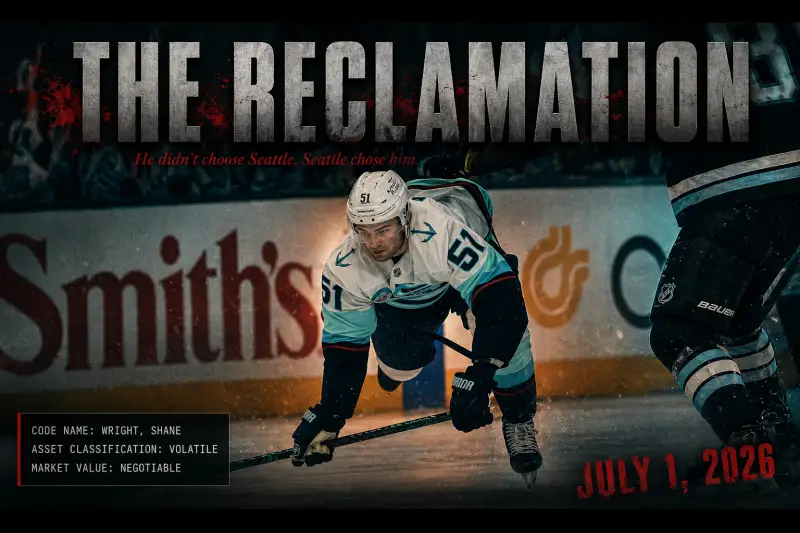
Door 2: Shane Wright and the Reclamation Project
Shane Wright is the youngest gamble and the highest variance. The 2022 No. 4 overall pick is 22 years old, finished 2025-26 with 7 goals, 11 assists, and 18 points across 51 games for Seattle, and watched his shooting percentage collapse to 9.3% on 75 shots from 20.9% on 91 shots in 2024-25. His faceoff number dropped from 44.4% to 37.5%. Per Pro Hockey Rumors, the Kraken are reportedly open to moving him.
What Wright gives Winnipeg specifically is upside the Jets cannot build internally. The Kraken's developmental track under former coach Dan Bylsma had Wright trending toward a 50-point sophomore season. Lane Lambert's deployment dropped him into a 4C role, played him under 10 minutes some nights, and stalled his confidence. Per Pagnotta on Wright's frustration: he wants ice time and a defined role. Cheveldayoff can offer both.
"I don't get the sense that Shane Wright is overly thrilled with his usage lately. His last game he played under ten minutes, and he wants to have more responsibility. He wants to have more ice time."
David Pagnotta, The Fourth Period (via Pro Hockey Rumors)The cost question is what stalls this deal. Per The Fourth Period and Yahoo Sports, the Kraken want a top-six forward back, with Cole Perfetti named as the centerpiece. Perfetti finished 2025-26 with 15 points in 37 games (a 33-point pace) after missing the season's start to injury. Trading Perfetti for Wright is a lateral or even backward move on raw 2025-26 production, even if Wright's age and ceiling justify it on paper. The same Kraken roster mechanics we covered in the McMann extension piece are at work here. Seattle wants finishing on the wing, not depth scoring at center.
My read on the trade: the Jets either add a 2026 first-round pick to keep Perfetti out of the deal, or they decline. A Perfetti-for-Wright one-for-one is too volatile for a roster trying to win in the Hellebuyck window. The 2026 UFA market we covered shows Cheveldayoff is more likely to use cap rather than asset capital this summer.
Door 3: Vincent Trocheck and the East-Coast Veto Wall
Vincent Trocheck is the highest-floor option and the trickiest contractually. The 32-year-old Rangers center finished 2025-26 with 16 goals, 37 assists, 53 points, 56.9% in the faceoff dot, and 193 hits across 67 games. He plays both special teams. He carries a $5.625 million cap hit through the 2028-29 season per PuckPedia, and his modified no-trade clause shrinks from a 12-team list to a 10-team list this summer.
What Trocheck gives Winnipeg specifically is the closest thing to a like-for-like Bryan Little replacement: a two-way center who plays three zones, takes important draws, and produces 50 points in a contract structure that runs through 2028-29. meaning he ages alongside Scheifele and Hellebuyck rather than expiring before them. His 56.9% faceoff is the third-best mark among Rangers regulars and would immediately upgrade the Jets' worst on-ice metric (Scheifele's 45.8%, per NHL.com Edge).
| Candidate | 2025-26 Pts | FO% | Cap Hit | Term Through |
|---|---|---|---|---|
| Charlie Coyle (CBJ) | 58 (82 GP) | 53.1% | $5.25M (UFA) | 2025-26 |
| Shane Wright (SEA) | 18 (51 GP) | 37.5% | ELC near expiry | RFA next |
| Vincent Trocheck (NYR) | 53 (67 GP) | 56.9% | $5.625M | 2028-29 |
| Mark Scheifele (WPG, 1C) | 103 (82 GP) | 45.8% | $7.0M | 2029-30 |
The veto wall is the real obstacle. Trocheck told reporters he wants to stay on the East Coast, which means his 10-team M-NTC list almost certainly excludes the West Coast and may include Winnipeg specifically. Per ESPN's reporting on the no-trade preference, the teams linked to Trocheck so far are Carolina, Detroit, Boston, and Minnesota. Winnipeg has not appeared in those reports. Cheveldayoff would need to either convince Trocheck to waive or wait for the New York Rangers to retain salary in a third-team facilitation deal, both of which add cost.
Why Winnipeg Doesn't Work for Trocheck (the Destination Rejection)
Trocheck is the rumor-market favorite, but the Jets are analytically a bad destination for him. Family ties to the New York metro region drove the East Coast preference baked into the M-NTC. Winnipeg is a 1,400-mile flight from Manhattan and the smallest media market in the league. The Bruins, Hurricanes, and Red Wings, which already appear on his market list, can offer geographic fit Cheveldayoff cannot match.
The cap math also strains. A $5.625 million cap hit on top of $3.29 million in projected space requires the Jets to retire roughly $2.5 million elsewhere to absorb Trocheck. That likely means moving Nikolaj Ehlers (UFA, no realistic walk back) or accepting a third-team retention partner that costs another asset. The retention ladder we mapped for Dougie Hamilton shows how third-team brokers extract value from cap-tight buyers.
The Cheveldayoff Math: Which Door I'd Pick
My ranking of the three doors:
Door 1 (Coyle) is the path I'd take. A two-year deal at $4.25 million AAV closes a $1 million cap window, gives the Jets a 17-minute 2C through age 36, and preserves Perfetti, the 2026 first-round pick, and the cap flexibility to add a third-pair defenseman. It's the Bryan Little Inheritance solution that doesn't require Cheveldayoff to pay an acquisition cost in assets.
Door 2 (Wright) is the upside swing only if Perfetti stays. If the Jets can structure a deal that sends a 2026 first plus a B-prospect (Brad Lambert tier) to Seattle and keeps Perfetti, Wright is a worth-it gamble. If the price is Perfetti straight up, decline. The Hoglander Analytics Orphan framework we built applies to Wright in inverse: a player whose underlying numbers suggest a bounce-back is the right asset to acquire, but only at the right price. Our 16-Win Map analysis places the Jets at 23rd in roster ceiling, which is what makes the asset cost calculation so tight.
Door 3 (Trocheck) is the door that probably stays closed. The M-NTC math, geographic preference, and cap acquisition cost all push against Winnipeg. Cheveldayoff would need to outbid Detroit and Boston in cash and term to overcome Trocheck's preference. The Jets don't have either lever.
What stands out to me is that the cleanest answer is also the least sexy. Charlie Coyle on a two-year deal closes the Little Inheritance, gives Hellebuyck a real chance at the 2027 playoff bracket, and doesn't cost a single asset. The trade-market gamblers will write Wright and Trocheck columns. The right answer is the one the Jets have access to without anyone else's permission.
V12 Editorial Verification · Three-Door Audit
Five-axis verification run April 25, 2026 IST. Each candidate scored against six market-fit criteria.
Sources and Reporting
- PuckPedia . Winnipeg Jets cap and contracts . provided $3.29M cap space projection and roster contract structure.
- PuckPedia . Charlie Coyle contract . verified $5.25M AAV expiring June 30, 2026 (UFA).
- CBS Sports . Charlie Coyle 2025-26 splits . verified 82 GP, 20G/38A/58P.
- Pro Hockey Rumors . Kraken open to Wright trade . provided Pagnotta usage quote and trade openness.
- The Hockey News . Jets-Kraken Wright/Perfetti talks . sourced Pagnotta quote on Cheveldayoff's offensive concerns.
- PuckPedia . Vincent Trocheck contract . verified $5.625M AAV through 2028-29 and M-NTC structure.
- ESPN . Trocheck no-trade list . sourced East Coast preference and 12-to-10-team list reduction.
- NHL.com Edge . Scheifele advanced metrics . verified 45.8% faceoff and 21:30 ATOI.
- Wikipedia . Bryan Little career . verified November 5, 2019 injury date, 843 NHL games, 521 points.
The Verdict: The Little Inheritance, Closed
Cheveldayoff has spent six years and three GMs of asset capital trying to close The Little Inheritance, and the right answer in 2026 is the unsexy one. My projection: Charlie Coyle signs a two-year, $4.25 million AAV deal with Winnipeg within 48 hours of free agency opening. That deal closes the second-line center hole, keeps Cole Perfetti and the 2026 first-round pick, and respects the $3.29 million cap space without forcing a cascade of secondary moves. Wright and Trocheck will both move this summer. Neither one will end up in Winnipeg. The 76-month wait for a sustained 2C ends with a UFA signing, not a trade. The Little Inheritance closes with the simplest mechanism available, exactly the way these long-running roster holes always do.
Frequently Asked Questions
Why do the Winnipeg Jets need a second-line center in 2026?
Winnipeg has not had a sustained second-line center since Bryan Little's career-ending injury on November 5, 2019. Stastny, Monahan, and Pierre-Luc Dubois all churned through the role without committing long-term. Cole Perfetti has 15 points in 37 games as the projected 2C, well below the 50-point baseline contenders need. Mark Scheifele anchors the first line at 103 points; the production drop after him is the league's steepest in the playoff-eligible tier.
Will Charlie Coyle sign with the Winnipeg Jets?
Charlie Coyle is an unrestricted free agent on July 1, 2026. He is the cleanest fit for Winnipeg's needs: durable, two-way, faceoff-positive at 53.1% in 2025-26, and on a contract structure that fits the Jets' $3.29 million projected cap space. My projection is a two-year deal at $4.25 million AAV signed within 48 hours of the market opening. Columbus is trying to extend him, but the Blue Jackets are not a contender in his late-30s window.
Why are the Seattle Kraken trading Shane Wright?
Per The Fourth Period and Yahoo Sports, Seattle wants a top-six finishing winger to support its offensive rebuild after missing the 2026 playoffs. Wright's 2025-26 season under new head coach Lane Lambert featured under-10-minute deployment in some games, a faceoff drop from 44.4% to 37.5%, and a shooting percentage collapse from 20.9% to 9.3%. The Kraken view him as the asset most likely to net them a finisher in trade.
Does Vincent Trocheck have a no-trade clause?
Yes. Trocheck has a modified no-trade clause that allows him to block trades to a list of teams. The list shrinks from 12 teams to 10 teams this summer. He has publicly indicated a preference to remain on the East Coast, which likely excludes most Western Conference destinations including Winnipeg. The teams linked to him so far are Carolina, Detroit, Boston, and Minnesota.
How much cap space do the Winnipeg Jets have for 2026-27?
Per PuckPedia, the Jets have approximately $3.29 million in projected 2026-27 cap space at a $92.2 million projected commitment. That number assumes the salary cap rises to roughly $96 million. Adding a $4 to $5 million center requires moving a comparable contract or accepting a tight cap-compliance margin during the season.
Who replaced Bryan Little as the Jets' second-line center?
No one has replaced Bryan Little long-term. Paul Stastny held the role briefly in 2018-19 and 2019-20 before being traded to Vegas. Sean Monahan rented in 2024 and signed in Columbus as a UFA. Pierre-Luc Dubois was traded to Los Angeles in 2023 after refusing a long-term commitment. Cole Perfetti has been the most recent default option without producing at the second-line scoring tier.
Frequently Asked Questions
Why do the Winnipeg Jets need a second-line center in 2026?
Winnipeg has not had a sustained second-line center since Bryan Little's career-ending injury on November 5, 2019. Stastny, Monahan, and Pierre-Luc Dubois all churned through the role without committing long-term. Cole Perfetti has 15 points in 37 games as the projected 2C, well below the 50-point baseline contenders need. Mark Scheifele anchors the first line at 103 points; the production drop after him is the league's steepest in the playoff-eligible tier.
Will Charlie Coyle sign with the Winnipeg Jets?
Charlie Coyle is an unrestricted free agent on July 1, 2026. He is the cleanest fit for Winnipeg's needs: durable, two-way, faceoff-positive at 53.1% in 2025-26, and on a contract structure that fits the Jets' $3.29 million projected cap space. My projection is a two-year deal at $4.25 million AAV signed within 48 hours of the market opening. Columbus is trying to extend him, but the Blue Jackets are not a contender in his late-30s window.
Why are the Seattle Kraken trading Shane Wright?
Per The Fourth Period and Yahoo Sports, Seattle wants a top-six finishing winger to support its offensive rebuild after missing the 2026 playoffs. Wright's 2025-26 season under new head coach Lane Lambert featured under-10-minute deployment in some games, a faceoff drop from 44.4% to 37.5%, and a shooting percentage collapse from 20.9% to 9.3%. The Kraken view him as the asset most likely to net them a finisher in trade.
Does Vincent Trocheck have a no-trade clause?
Yes. Trocheck has a modified no-trade clause that allows him to block trades to a list of teams. The list shrinks from 12 teams to 10 teams this summer. He has publicly indicated a preference to remain on the East Coast, which likely excludes most Western Conference destinations including Winnipeg. The teams linked to him so far are Carolina, Detroit, Boston, and Minnesota.
How much cap space do the Winnipeg Jets have for 2026-27?
Per PuckPedia, the Jets have approximately $3.29 million in projected 2026-27 cap space at a $92.2 million projected commitment. That number assumes the salary cap rises to roughly $96 million. Adding a $4 to $5 million center requires moving a comparable contract or accepting a tight cap-compliance margin during the season.
Who replaced Bryan Little as the Jets' second-line center?
No one has replaced Bryan Little long-term. Paul Stastny held the role briefly in 2018-19 and 2019-20 before being traded to Vegas. Sean Monahan rented in 2024 and signed in Columbus as a UFA. Pierre-Luc Dubois was traded to Los Angeles in 2023 after refusing a long-term commitment. Cole Perfetti has been the most recent default option without producing at the second-line scoring tier.
Related Stories

How Do Line Changes Work in Hockey?
A line change is hockey's strangest routine: you swap players while the puck is live, but only inside a five-foot pocket beside your own ben...
By Mike Johnson · 10 min read

What Is the Long Change in Hockey?
The long change is not jargon, it is bench geography. Teams switch ends each period but keep the same bench, so in the second period a tired...
By Mike Johnson · 9 min read
What Is a Delayed Penalty in Hockey?
A delayed penalty is not a penalty yet. It is the referee holding the whistle after a foul until the penalized team touches the puck, which...
By Mike Johnson · 9 min read
What Is a One-Timer in Hockey?
A one-timer reaches the net just 42% of the time, the worst of any shot, yet it is the most dangerous weapon in hockey and the shot Ovechkin...
By Mike Johnson · 11 min read
Comments
Be the first to share your take.
Get NHL trade rumors in your inbox
One email per week, zero spam, verified rumors only.