Flyers Center Trade 2026: The Pivot Asymmetry
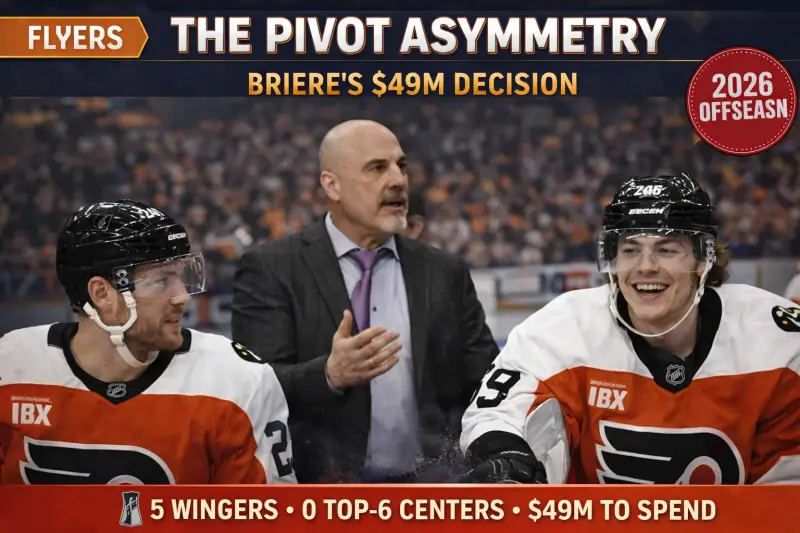
Philadelphia has 5 top-6 wingers and zero proven top-6 centers - The Pivot Asymmetry defines the Flyers' entire 2026 offseason. Robert Thomas vs Shane Wright vs Matty Beniers: which target actually solves the 1C problem, what it costs, and why Briere's $49M cap space was built for this exact moment.
Live updates
No updates yet. Refreshing automatically.
Danny Briere will walk into the 2026 NHL offseason with $49 million in projected cap space, 8 draft picks across the first 3 rounds of 2026 and 2027, and a single unsolved problem that's followed the Philadelphia Flyers for 6 straight seasons — they have 5 top-6 wingers and zero proven top-6 centers. That structural imbalance defines the entire Flyers center trade 2026 offseason, and I'm calling it The Pivot Asymmetry — because the Flyers' most abundant roster asset (scoring wingers) solves for their scarcest one (top-line pivots) only if Briere converts the surplus into a genuine 1C. The two names driving every Flyers rumor since February are Robert Thomas of St. Louis and Shane Wright of Seattle, per Daily Faceoff's offseason reporting.
Philadelphia made the playoffs on April 13 for the first time since 2020, but the roster that got them there still leans almost entirely on the wings. Tyson Foerster, Travis Konecny, Matvei Michkov, Porter Martone, and Owen Tippett give the Flyers top-6 wing depth few teams in the East can match. What they don't give the Flyers is a player who can drive a line from the middle.
Key Takeaways
- The Pivot Asymmetry: Philadelphia has 5 legitimate top-6 wingers and 0 top-6 centers — a roster-construction problem Briere has $49M and 8 early-round picks to solve this summer.
- Robert Thomas is the expensive solution: 22 goals, 39 assists, 61 points in 63 games (0.97 PPG) at age 26, signed through 2030-31 at $8.125M AAV — reported price tag is 4 first-round picks plus a core player.
- Shane Wright is the reclamation play: 2024-25 = 44 points; 2025-26 = 26 points in 72 games. Friedman thinks Seattle moves him "for the right offensive stud or young player."
- Matty Beniers is the ghost option: 7-year $50M deal at $7.143M looks immovable unless Seattle signals a full rebuild — and Kraken GM Francis has done the opposite.
- Cap context matters: The salary cap rises to $104 million in 2026-27, giving Briere real spending room that last year's Flyers regime didn't have.
The Pivot Asymmetry: Why Briere's 2026 Offseason Lives and Dies at Center
Sean Couturier turned 33 during the season and carries a $7.75 million cap hit through 2029-30, with the last 4 years of that deal likely to look brutal on the books. Christian Dvorak — re-signed to a 5-year, $25.75 million extension on January 6, 2026 per ESPN's reporting — is a reliable 3C at $5.15 million AAV, but his 25 points (9G, 16A) in 39 games is a 3C production line, not a 2C one. The internal pipeline of Jett Luchanko, Jack Berglund, and Jack Nesbitt is genuine — Nesbitt in particular is what Briere called "a solid NHL center for a long time" — but none are ready for a top-6 role in October 2026.
Briere's own quotes from the February trade deadline laid out the framework clearly. He told reporters the Flyers were "absolutely looking for centers" but "not looking for rentals," and he was "listening on Konecny, Tippett, Couturier, and Ristolainen" as trade currency. The Flyers ultimately didn't land a center at the 2026 deadline, claiming Luke Glendening off waivers as a 4C stopgap instead. That's what sets up July as the real inflection point.
The Pivot Asymmetry
When a team's most abundant roster asset (in this case, scoring wingers) cannot solve its most critical roster gap (top-line center) without converting one into the other. The Flyers carry 5 top-6 wingers but 0 proven top-6 centers — the asymmetry defines their entire offseason priority list.
The cap math is genuinely good news. Philadelphia projects to $49 million in cap space heading into July, which is 3rd-most in the NHL. The salary cap itself jumps to $104 million in 2026-27, an $8.5 million increase that effectively gives every contending team a "free" top-6 forward in buying power. Briere can spend or swing a trade without gutting the core.
The limiting factor isn't what Philadelphia can afford — it's what the market demands. That's the same dynamic Toronto's GM search has wrestled with all offseason, where financial capacity and trade-market realities pull in different directions.
Robert Thomas: The Expensive Solution That Actually Solves the Problem
Robert Thomas is the best available center name because he's the only one who moves Philadelphia from "contender" to "Cup threat" in a single trade. His 2025-26 line reads 22 goals, 39 assists, 61 points in 63 games — a 0.97 points-per-game pace that would've been the Flyers' team lead by 15 points. He's signed through 2030-31 at $8.125 million, 26 years old, and plays the center-ice puck-distribution role Philadelphia hasn't had since prime Claude Giroux.
The price is the problem. I broke down the four-first-round-pick barrier on Thomas earlier this offseason, and nothing has softened. Per multiple reports, St. Louis is starting conversations at four first-round picks, one top-end prospect, and a roster player — and that's the opening price, not the closing one.
Philadelphia has the draft capital to overpay without flinching. The Flyers hold 8 selections across the first 3 rounds of the 2026 and 2027 drafts combined, plus a wing surplus that Doug Armstrong's Blues front office would almost certainly accept in place of one of the first-round picks. My projection: a realistic Thomas package is Tippett + 2 first-rounders (2026 + 2028) + a top prospect (Alex Bump or Denver Barkey) + a conditional 2nd. That's expensive — it's also how you actually win a playoff round.
"I still think Wright for the right offensive stud or young player that they really like."
— Elliotte Friedman, 32 Thoughts Podcast (via NHL Rumors)Friedman's framing matters because it sets the floor for Wright's market. The "right offensive stud or young player" language implies Seattle won't be swayed by pure pick capital — they want a roster piece back. Philadelphia's wing surplus makes them one of the only contending teams who can offer that without breaking its lineup.
Shane Wright: The Reclamation Play That Could Backfire
Shane Wright was the 4th overall pick in the 2022 draft — the same draft Juraj Slafkovsky went 1st — and his arc has been defined by the gap between expectation and reality. His 2024-25 season produced 19 goals and 44 points in 79 games, a number Seattle fans pointed to as proof that the Wright project was finally clicking. His 2025-26 regression is severe: 11 goals, 26 points in 72 games — a 41% points-per-game drop with no obvious injury explanation.
Analytically, Wright's problem isn't shooting luck. His 8.4% shooting percentage is below his career average, but his 46.3% expected goals share (xGF%) at 5-on-5 — meaning Seattle generated fewer scoring chances than opponents when he was on ice — is the actual red flag. Good young centers who keep their xGF% above 50% eventually produce; centers trending in the wrong direction at 22 years old often don't find it.
That said, Wright is cheap. He has one year remaining on his entry-level contract, which makes any acquiring team an RFA negotiation away from either a bridge deal or a bet-on-yourself 1-year tender. The Flyers could slot Wright as their 2C behind Couturier at a combined cap hit under $10 million for 2026-27 — and if Couturier's next injury opens the 1C slot, Wright becomes the experiment that pays off.
This is the kind of reclamation move Calgary's Saddledome Exit Strategy has telegraphed all offseason, similar to how Jordan Kyrou's offseason trade value conversation has played out in St. Louis — turning an underperforming first-rounder into a change-of-scenery reset.
| Target | Age | 2025-26 Stats | Cap Hit | Projected Cost |
|---|---|---|---|---|
| Robert Thomas | 26 | 22G-39A-61P (0.97 PPG) | $8.125M thru 2030-31 | 4 firsts + prospect + Tippett |
| Shane Wright | 22 | 11G-15A-26P (0.36 PPG) | ELC, RFA in 2026 | 1 first + top prospect |
| Matty Beniers | 23 | 20G-28A-48P (0.61 PPG) | $7.143M thru 2030-31 | Not realistically available |
| Sean Couturier (internal) | 33 | Injury-managed 2C | $7.75M thru 2029-30 | Already rostered |
The Matty Beniers Question Seattle Won't Answer
Every piece written about Flyers center targets mentions Matty Beniers as the dream scenario, and every piece has to immediately concede that Beniers probably isn't available. His 20 goals, 28 assists, 48 points in 79 games (0.61 PPG) is a legitimate 2C line at age 23, and his 7-year $50 million extension at $7.143 million AAV is the exact kind of middle-tier deal contending teams happily absorb. The catch is Seattle GM Ron Francis told reporters publicly that the Kraken aren't rebuilding — they're retooling.
Here's why Beniers to Philadelphia doesn't work as a trade target: Seattle spent the 2026 deadline moving out expiring veterans (Yanni Gourde, Brandon Tanev, Oliver Bjorkstrand), not core young centers. Francis explicitly said "We're roughly at $20 million or so in cap space available" — the profile of a team buying, not tearing down. Moving Beniers would signal a full rebuild Seattle hasn't committed to, and Francis isn't going to burn the franchise center who was drafted 2nd overall just three years ago. The same organizational logic Steve Yzerman used in Detroit's Architect's Ceiling offseason applies here — good GMs don't trade cornerstones just because a bidder calls.
My read: Beniers is a 2028 conversation, not a 2026 one. If Seattle misses the playoffs for a third consecutive year and Francis's seat gets warm, Beniers becomes trade-eligible. In the 2026 offseason, pushing a serious offer to Seattle for Beniers is how you get laughed off the phone. Don't waste the Tippett currency on a call that won't get picked up.
What the Flyers Can Actually Pay (Cap + Assets Breakdown)
The financial picture is the cleanest it's been in Briere's tenure. Flyers cap structure for summer 2026 looks like this: $49 million projected space, $104 million league cap, zero dead money coming off the books beyond Kevin Hayes and Scott Laughton retention (a combined $6.83 million). Briere can absorb Thomas's $8.125 million AAV without creating a future cap problem — the Thomas contract expires the same summer Couturier's does, giving Philadelphia full flexibility in 2030.
Philadelphia's draft capital reads like a rebuilding team's inventory, not a contender's. The Flyers hold 3 first-round picks across the next 2 drafts, 3 second-rounders, and 2 third-rounders — 8 selections in the first 3 rounds of 2026 and 2027 combined. Add in a wing surplus that includes Tippett (1 year left at $6.2M) plus prospects Porter Martone and Alex Bump, and Briere has arguably the league's deepest trade chest among playoff teams.
What stands out to me is how specifically Briere built this offseason. He didn't spend the rising NHL salary cap room on extensions — he kept it open for a swing. He didn't trade picks at the 2026 deadline — he banked them for summer spending power.
The Dvorak extension is the clearest tell. Re-signing him to a 5-year deal locks in his 3C slot through 2030-31, which only makes sense if Briere expects to land a real 1C above him. Every move has been pointed at this offseason — similar to how the Matthew Knies trade-deadline discipline reshaped Toronto's summer flexibility.
"His game is tailored perfectly for a 2C or 3C role, and he's going to be a solid center in the NHL for a long time."
— Danny Briere, Flyers GM, on prospect Jack Nesbitt (via Philadelphia Inquirer)That Briere quote matters because it implicitly admits the Nesbitt path is a 2C path, not a 1C one. Briere isn't waiting on Nesbitt to become Crosby — he's building around Nesbitt eventually filling the middle of the lineup while someone else carries it. That someone has to come from outside the organization.
Historical Precedent: When the 2011 Flyers Solved the Same Problem
This isn't Philadelphia's first center-shortage summer. In June 2011, Paul Holmgren traded Jeff Carter and Mike Richards on the same day — Carter to Columbus for Jakub Voracek and the 8th overall pick (which became Sean Couturier), Richards to Los Angeles for Wayne Simmonds and Brayden Schenn. The Flyers had committed to both centers long-term, realized they'd drafted themselves into a 2C-2C roster with no real 1C, and reset the entire middle of the lineup in a single weekend.
The parallel isn't perfect — Briere doesn't need to gut the roster to solve this — but the decision framework is identical. In 2011, Holmgren realized he had two good-but-not-great centers and no clear 1C. In 2026, Briere has one aging center, one reliable 3C, and three developing prospects, and still no 1C. The only way out is the same: acquire the piece from outside.
The historical lesson cuts both ways. The 2011-12 Flyers made the playoffs and won a round the season after that reset, but the long-term consequences of trading Carter and Richards haunted Philadelphia for a decade. Every 1C acquisition has a cost that lives past the acquiring season. Briere should study the 2011 moves not just for what to do, but for what to not overpay.
The Verdict: The Pivot Asymmetry
My call: Philadelphia lands Robert Thomas by August 15, and the package costs a 2026 first-round pick, Owen Tippett, top prospect Alex Bump, and a conditional 2028 first that becomes unprotected if Thomas re-signs with the Flyers past 2030-31. That's 2 first-round picks, a top-6 winger, and a top prospect — exactly the four-asset framework the Blues have been quoting since February, with Tippett's cap-friendly $6.2 million slotting into St. Louis's wing depth chart. The Pivot Asymmetry gets solved not by picking between Thomas and Wright — it gets solved by Briere committing to the expensive player who actually moves the needle in a playoff series.
If Briere can't pry Thomas loose, Wright at 1 first-round pick and a mid-tier prospect becomes the fallback — and a reasonable one at age 22. But fallbacks are how playoff teams become play-in teams. The Flyers have spent 6 years accumulating the asset base for exactly this moment. This is the moment.
Sources and Reporting
- Daily Faceoff — original offseason center-target framework and target list
- ESPN — Christian Dvorak 5-year, $25.75M extension details
- PuckPedia — Robert Thomas — contract terms, AAV, term
- PuckPedia — Matty Beniers — contract terms and cap structure
- NHL Rumors — Elliotte Friedman 32 Thoughts Wright trade-value framing
- Philadelphia Inquirer — Briere on Nesbitt, Luchanko, and prospect depth
- 97.5 The Fanatic — 2026 deadline analysis and Glendening claim context
- CapWages — Philadelphia Flyers — team cap structure and 2026-27 projection
Frequently Asked Questions
Will the Flyers trade for Robert Thomas in 2026?
Robert Thomas is the top realistic target for a Flyers center trade 2026 package, with a reported asking price of 4 first-round picks plus a top prospect and a roster player. St. Louis GM Doug Armstrong is evaluating whether to commit to a full rebuild after trading Jordan Kyrou earlier this offseason. Philadelphia has the 3rd-most draft capital among playoff teams, giving them genuine bargaining power to match the Blues' price if Briere commits to overpaying.
How much cap space do the Philadelphia Flyers have for the 2026-27 offseason?
The Flyers project to $49 million in 2026-27 cap space against a league ceiling rising to $104 million. Kevin Hayes and Scott Laughton retention clearing ($6.83 million combined) and the Cam Atkinson buyout finishing contribute to the highest cap flexibility Philadelphia has had since 2014. Briere specifically preserved this space at the trade deadline by not taking on salary.
Could Matty Beniers be traded to the Flyers?
Matty Beniers is technically tradeable but not realistically available. Seattle GM Ron Francis said the Kraken have '$20 million or so in cap space' heading into the offseason, signaling a retool rather than a rebuild. Francis moved out aging veterans Gourde, Tanev, and Bjorkstrand at the 2026 deadline while keeping core young centers. A Beniers trade would require Seattle to pivot to a full rebuild they haven't committed to.
Who are the Philadelphia Flyers' top center prospects?
The three center prospects in the Flyers' pipeline are Jett Luchanko (drafted 12th overall in 2024), Jack Nesbitt (2025 first-round pick), and Jack Berglund (2024 2nd round, Sweden). Berglund won gold with Team Sweden at the 2026 World Junior Championship and Briere called him the best player in the tournament. Nesbitt is projected as a 2C/3C, not a 1C, which is why Philadelphia still needs to acquire from outside.
What did Elliotte Friedman say about Shane Wright's trade value?
On the 32 Thoughts podcast in late February 2026, Friedman said: 'I still think Wright for the right offensive stud, or young player.' The framing specifically excludes pure draft-pick offers and implies Seattle wants roster pieces in return. Philadelphia's wing surplus - Tippett, Martone, or prospects Alex Bump and Denver Barkey - matches that Kraken ask more cleanly than most contending teams can.
Related Stories

Darnell Nurse Trade: 4 Suitors
Edmonton wants Darnell Nurse's $9.25M off the books, but a buyout saves barely $1.53M and his no-move clause hands him the pen. The Bonus Sh...
By Mike Johnson · 12 min read
Darren Raddysh Free Agent 2026: 4 Teams
Darren Raddysh's 70-point breakout turned his $975K cap hit into a four-team bidding war. The Athletic linked him to Philadelphia, San Jose,...
By Mike Johnson · 13 min read
Bobby McMann Free Agent 2026 Destinations: 4 Teams Linked
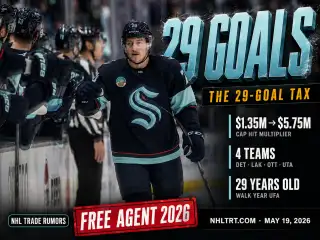
Bobby McMann's career-high 29 goals just turned a $1.35M cap hit into Sharangovich-tier money. The Athletic locked him to 4 teams (Detroit,...
By Mike Johnson · 10 min read
Hellebuyck Trade Rumors 2026: The Vulture Watch Begins
Connor Hellebuyck is still under contract — but rivals circle as Winnipeg's window narrows.
By Sarah Chen · 1 min read
Get NHL trade rumors in your inbox
One email per week. Zero spam. Verified rumors only.