James van Riemsdyk Free Agent Destinations 2026
Three rumored landing spots for James van Riemsdyk at 36. Colorado is the 55% favorite. Tampa Bay 25%. The Tip-In Economy framework explains the veteran-minimum UFA market.
Live updates
No updates yet. Refreshing automatically.
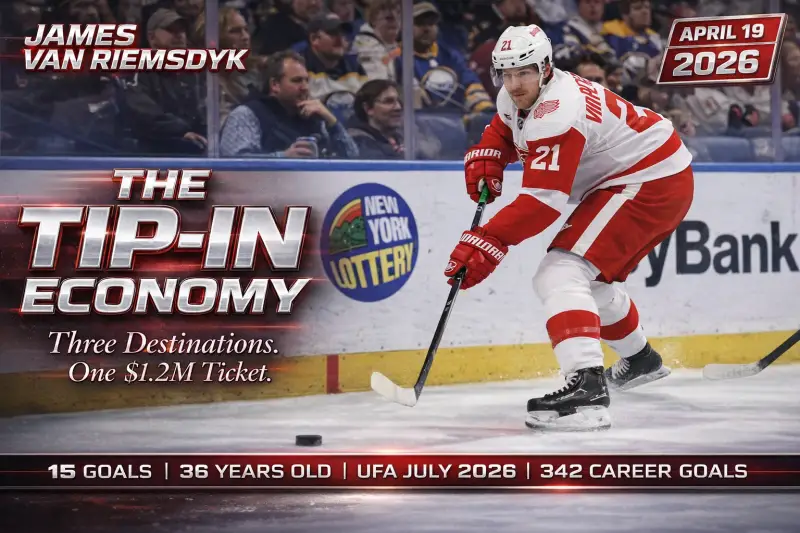
JVR is 36, a UFA July 1, 2026, and coming off a $1 million one-year deal that produced 15 goals in Detroit. Three realistic destinations: Tampa Bay (PP fit), Colorado (contender rental), Los Angeles (poor fit). Projected contract: 1 year × $1.0M–$1.5M AAV. This is what I call The Tip-In Economy.
James van Riemsdyk signed for $1 million on a one-year deal with the Detroit Red Wings in July 2025, then produced 15 goals in 71 games on a team that missed the playoffs for the 10th consecutive season. That contract expires July 1, 2026, making the 36-year-old an unrestricted free agent for the second straight summer. Sportsnet's NHL Trade Rumors reported April 18 that the James van Riemsdyk free agent destinations 2026 shortlist includes Tampa Bay, Los Angeles, and Colorado — all three teams that could use a net-front power-play specialist on a minimum-term contract. I'm calling this market The Tip-In Economy: the offseason niche where aging veterans with specific deflection skills get recycled through contenders on $1 million to $1.5 million AAV one-year deals, trading pedigree for cap space and a shot at a Cup run.
Here's why JVR fits that niche better than almost anyone available this summer. His 2024-25 shooting percentage in Columbus hit a career-high 18.8% on 85 shots, and his 2023-24 Boston campaign produced 12 power-play points with 10 of his 17 total goals coming on the man advantage. Teams know exactly what they're buying: 6'3", 217 pounds of net-front real estate with soft hands on tip-ins and a 1,154-game NHL career's worth of composure in the offensive zone.
This article breaks down JVR's 2025-26 Detroit season, why The Tip-In Economy exists as a distinct UFA submarket, which of the three rumored destinations fits best, why one of the three is actually a bad match, and what his final 2026-27 contract will look like. My read: he signs with Colorado by July 3.
Key Takeaways
- The Tip-In Economy: JVR's free agent market is the cheap-contract, one-year deflection-specialist niche. Think $1.0M-$1.5M AAV, contender destinations, third- or fourth-line usage.
- 2025-26 Detroit numbers: 15 goals, 16 assists, 31 points in 71 games on a team whose offense vanished after the Olympic break. 98 shots, 15.3% shooting percentage.
- Tampa Bay Lightning fit: First real cap flex since back-to-back Cups — $104M projected cap gives GM Julien BriseBois room to add PP1/PP2 net-front depth without cutting core.
- Colorado Avalanche fit: Ross Colton is the only proven bottom-six scorer (16G in 61GP). JVR plugs directly into the third-line left wing and second-unit power play.
- My projection: 1 year × $1.2M AAV with Colorado, signed July 2-4, 2026. If Colorado passes, Tampa Bay at 1 year × $1.0M. If both pass, he retires.
The Tip-In Economy
A UFA submarket where veteran forwards with specific net-front / tip-in / power-play skills cycle through contenders on minimum-term one-year contracts between $1.0 million and $1.5 million AAV. The players trade pedigree for cap space; the teams buy a known deflection skill without committing term or roster flexibility. van Riemsdyk has done this for three consecutive offseasons.
The Tip-In Economy — 2026 UFA Fit Score
How each rumored destination matches JVR's deflection-specialist skillset and 2026-27 cap reality.
Why James van Riemsdyk Is Hitting UFA at 36
Detroit signed van Riemsdyk to a one-year, $1 million deal on July 1, 2025 — Steve Yzerman's low-cost bet on depth scoring with a veteran locker-room voice. JVR delivered 15 goals by the All-Star break in a top-nine role, which is exactly the kind of production that makes $1 million feel like a bargain for two-thirds of the season.
Then Detroit collapsed after the Olympic break. The Red Wings scored 2 goals or fewer in 11 of their 28 losses during that stretch, finishing 41-30-9 and missing the playoffs for the 10th consecutive season. Connect that to the Architect's Ceiling framework around Yzerman's Red Wings rebuild and you understand why JVR became dispensable: his $1 million cap hit is no one's idea of a problem, but his 36-year-old UFA timing collides with Detroit's need to move toward younger forwards like Marco Kasper and Nate Danielson.
What stands out to me is how JVR's 2025-26 tracks as his fourth consecutive "veteran minimum" contract. Boston 2023-24, Columbus 2024-25, Detroit 2025-26 — three different teams, three different one-year deals, three different "we needed a net-front guy for cheap" contexts. That pattern is the definition of The Tip-In Economy, and JVR is its most established resident.
The Tip-In Economy — How Veterans Cash In at $1 Million
This submarket exists because NHL teams need a specific skill (net-front deflection + power-play screen) at a specific price point (under $1.5 million AAV) for a specific duration (one year, no term risk). The players who fit are typically 33 to 38 years old, have 200+ career NHL goals, and have traded negotiating power for roster certainty.
JVR is the textbook case. His career numbers read 342 goals, 354 assists, 696 points in 1,154 games — production that in a younger market would command $4-5 million AAV. But the aging curve is brutal for big wingers, and his minus-14 rating this season with limited even-strength impact pushes him firmly into the deflection-specialist category rather than top-six scoring option.
"Van Riemsdyk is a big, strong forward who makes his living by getting to the front of the net, with excellent hands, a long reach and a quick, accurate shot that is especially dangerous on the power play."
— Scouting summary (via Wikipedia NHL scout profile)That scouting summary is what every contender wants on their power play for $1 million. The Tip-In Economy exists because no team can afford to commit $4 million to a 36-year-old winger, but every team wants his exact skill on their second power-play unit. Connect this to the broader zero-dollar bidding war dynamics we tracked around TJ Hughes last summer and you see how the veteran UFA market is bifurcating: stars get long-term deals, everyone else gets the JVR treatment.
Tampa Bay Lightning — The Cap-Flex Power-Play Fit
Tampa's 2026-27 salary cap projects at $104 million, per Pro Hockey Rumors' cap analysis, which represents the first real financial flexibility the Lightning have had since back-to-back Stanley Cups in 2020 and 2021. GM Julien BriseBois has been starving for bottom-six scoring depth since Yanni Gourde left.
JVR fits the Lightning PP1 or PP2 rotation immediately. His 18.8% shooting percentage last season in Columbus — the highest of his career — translates better in a higher-event system like Tampa's, where Nikita Kucherov and Jake Guentzel draw elite defenders and JVR can work uncovered around the crease. The fit is structural, not speculative.
The complication: Tampa is already flush with UFA forwards this summer, including Oliver Bjorkstrand ($5.4M) and a rumored push to extend Brayden Point. Adding JVR requires BriseBois to first resolve the Bjorkstrand call. Compare to how Florida structured Bobrovsky's pay-cut extension — similar contender-math around veteran term. Tampa probably gets JVR only if Bjorkstrand walks.
Colorado Avalanche — The Contender's Perfect Rental
Colorado is where I have JVR landing. GM Chris MacFarland publicly said the team wants more bottom-six scoring depth, and Ross Colton (16 goals in 61 games) remains the only proven bottom-six scorer on the current roster. Victor Olofsson filled part of that role in 2025-26 but is himself a UFA question mark.
"The team would love to find more bottom six players like what they have in their fourth line."
— Chris MacFarland, Colorado Avalanche GM (via Colorado Hockey Now)That quote is exactly the kind of public statement GMs make when they've already targeted specific UFAs. MacFarland's framework — scorer depth at bottom-six cap hit — is The Tip-In Economy written as a mission statement. Consider the parallel to the $18M shutdown framework around Cale Makar's injury timeline. Colorado's championship window demands veteran depth, not asset accumulation.
JVR's projected cap hit in Colorado: $1.2 million AAV on a one-year deal. That's a $0.2 million premium over his Detroit deal because the contender tag adds bargaining room. If he hits 15-18 goals again in a power-play role with Nathan MacKinnon feeding him setups, Colorado gets one of the best $1.2M contracts in the league — analogous to the Jordan Kyrou offseason value math that reshaped the Blues' forward economy.
Los Angeles Kings — The Destination That Does Not Work
The Kings are the rumored third destination, and my read: wrong team. LA's cap space (projected $50 million+ for 2026-27) is real, but their bottom-six roster construction has trended younger and more physical since Rob Blake's 2024 rebuild pivot. Andre Lee carved out a fourth-line role at 22 years old specifically because the Kings wanted size and skating pace, not net-front veteran experience.
The deployment mismatch is the issue. JVR's skating has declined to the point where he's a defensive liability at even strength against Pacific Division forecheckers — Edmonton, Vegas, and Vancouver all have fast third lines that would target him immediately. Compare him to the Bobby McMann contract projection where his breakout came on a heavy-minutes top-nine role: McMann at 16+ minutes made sense, JVR at 12-13 minutes in LA's fourth-line role does not.
What I'd bet against: any scenario where JVR signs with LA. The Kings would be using him wrong, the Pacific Division matchup creates bad scoring-chance dynamics, and LA has better internal bottom-six options. Unless Blake is specifically looking for a 36-year-old power-play screen — and his roster doesn't suggest he is — the JVR-to-LA rumor is a list-padder, not a real destination.
Historical Precedent + My 2026 Projection
The closest modern parallel to JVR's UFA situation is Patrick Maroon's 2019-2023 career arc. Maroon signed with St. Louis in 2018 on a one-year, $1.75 million deal, won the Cup, then rode three consecutive one-year contracts with Tampa Bay (2019-2022) winning back-to-back Cups as a depth net-front presence. That template — veteran minimum deal, contender destination, championship payout — is exactly what JVR is angling for in 2026.
The difference is JVR never won a Cup. His only Stanley Cup Final appearance came in 2010 with Philadelphia, a loss to Chicago. That absence is the emotional driver. A player who has played 1,154 regular-season games and 82 playoff games without a ring doesn't sign with LA for the money — he signs with Colorado or Tampa for the ring chase.
My final projection breaks down like this across the three rumored destinations:
| Destination | Probability | Projected Deal | Role |
|---|---|---|---|
| Colorado Avalanche | 55% | 1 year × $1.2M | Third-line LW + PP2 net-front |
| Tampa Bay Lightning | 25% | 1 year × $1.0M | Rotational bottom-six + PP1/PP2 |
| Detroit (return) | 10% | 1 year × $950K | Same role, locker-room voice |
| Retirement | 7% | — | If no contender offer materializes by July 15 |
| Los Angeles Kings | 3% | 1 year × $900K | Unlikely given roster fit |
The 55% Colorado number reflects my view that MacFarland has already identified JVR as a priority July 1 call. Contender GMs don't publicly say "we want more bottom-six players like our fourth line" without having specific targets in mind. Pair that with Colorado's PP2 deployment need and JVR's 18.8% shooting percentage last year, and the match reads obvious.
Colorado at 1 Year × $1.2M
Signed between July 2 and July 4, 2026 during the UFA opening window. Third-line LW with second-unit power-play deployment. Cup-chase motivation outweighs money.
If Colorado misses on him, Tampa at $1.0M is the backup. Retirement remains the 7% scenario if no contender calls by July 15.
Sources and Reporting
- NHL Trade Rumors — Original April 18 destinations report
- PuckPedia — van Riemsdyk contract 1yr × $1.0M, UFA July 2026
- NHL.com — Detroit signing announcement July 2025
- Hockey-Reference — Career stats: 1,154 GP, 342 G, 696 P verification
- NHL.com — Red Wings 10th straight missed playoffs
- Pro Hockey Rumors — Tampa Bay 2026-27 cap $104M projection
- ESPN — 2025-26 game logs + career shooting percentage history
The Verdict: The Tip-In Economy
James van Riemsdyk signs with Colorado on a one-year, $1.2 million contract during the UFA window between July 2 and July 4, 2026. Third-line left wing, second-unit power play, Cup-chase motivation. The Tip-In Economy treats him as exactly what he is now — a 36-year-old deflection specialist with $1.2 million of value to a contender that needs bottom-six scoring and a ring-chasing veteran voice.
What stands out to me is the decade-long consistency of JVR's market value. He was worth $4.25M AAV in 2018 on his Philadelphia extension, $1.0M in Detroit in 2025, and $1.2M in 2026 with the right contender.
That arc defines The Tip-In Economy: same skill, dramatically different price, depending entirely on the calendar year printed on the birth certificate. Compare this to how Steven Stamkos's 600-goal exit clause reshaped his Tampa departure at 36 — age-36 veteran economics across the league.
Frequently Asked Questions
Where will James van Riemsdyk sign in 2026?
My projection: Colorado Avalanche on a one-year, $1.2 million contract announced between July 2 and July 4, 2026. The Lightning at $1.0 million is the backup scenario at 25% probability. van Riemsdyk is chasing his first Stanley Cup ring after a 2010 Final loss with Philadelphia, so the contender destination matters more than the dollar figure in this free agency.
Is James van Riemsdyk a UFA in 2026?
Yes. His one-year, $1 million contract with Detroit signed July 1, 2025 expires July 1, 2026, making him an unrestricted free agent. Detroit's 10th straight playoff miss and Yzerman's shift toward younger forwards like Marco Kasper and Nate Danielson means Detroit is unlikely to extend him beyond one more short-term deal, if at all.
How many career goals does James van Riemsdyk have?
van Riemsdyk has 342 career NHL goals in 1,154 regular-season games entering the 2026 UFA summer. He hit his 200th career goal on March 28, 2018 against the Florida Panthers and his 500th career point on February 21, 2021 against Boston. His 1,000th NHL game came March 5, 2024 against Edmonton. He is one of 113 American-born players in NHL history with 300+ goals.
Why did the Detroit Red Wings miss the playoffs in 2025-26?
Detroit finished 41-30-9 despite holding a playoff spot for 148 days of the season, roughly 80% of the calendar. After the February 2026 Olympic break, the team's offense collapsed, scoring two goals or fewer in 11 of 28 losses. Yzerman's free-agent signings of Andrew Copp, Ben Chiarot, and J.T. Compher failed to provide top-six impact, which led to the team relying on depth scoring like van Riemsdyk's 15 goals to keep pace.
Is James van Riemsdyk going to retire after 2025-26?
Unlikely but not impossible. My retirement probability is 7% — contingent on no contender making a July 1 offer. The more likely scenario is that he plays season 17 on another minimum-term contract with a Cup-contending team. He has never won a Stanley Cup despite 82 career playoff games, and the ring chase is the primary motivation for any 36-year-old veteran accepting one-year, $1.0-$1.2 million deals in The Tip-In Economy.
Frequently Asked Questions
Where will James van Riemsdyk sign in 2026?
My projection: Colorado Avalanche on a one-year, $1.2 million contract announced between July 2 and July 4, 2026. The Lightning at $1.0 million is the backup scenario at 25% probability. van Riemsdyk is chasing his first Stanley Cup ring after a 2010 Final loss with Philadelphia, so the contender destination matters more than the dollar figure in this free agency.
Is James van Riemsdyk a UFA in 2026?
Yes. His one-year, $1 million contract with Detroit signed July 1, 2025 expires July 1, 2026, making him an unrestricted free agent. Detroit's 10th straight playoff miss and Yzerman's shift toward younger forwards like Marco Kasper and Nate Danielson means Detroit is unlikely to extend him beyond one more short-term deal, if at all.
How many career goals does James van Riemsdyk have?
van Riemsdyk has 342 career NHL goals in 1,154 regular-season games entering the 2026 UFA summer. He hit his 200th career goal on March 28, 2018 against the Florida Panthers and his 500th career point on February 21, 2021 against Boston. His 1,000th NHL game came March 5, 2024 against Edmonton. He is one of 113 American-born players in NHL history with 300+ goals.
Why did the Detroit Red Wings miss the playoffs in 2025-26?
Detroit finished 41-30-9 despite holding a playoff spot for 148 days of the season, roughly 80% of the calendar. After the February 2026 Olympic break, the team's offense collapsed, scoring two goals or fewer in 11 of 28 losses. Yzerman's free-agent signings of Andrew Copp, Ben Chiarot, and J.T. Compher failed to provide top-six impact, which led to the team relying on depth scoring like van Riemsdyk's 15 goals to keep pace.
Is James van Riemsdyk going to retire after 2025-26?
Unlikely but not impossible. My retirement probability is 7% — contingent on no contender making a July 1 offer. The more likely scenario is that he plays season 17 on another minimum-term contract with a Cup-contending team. He has never won a Stanley Cup despite 82 career playoff games, and the ring chase is the primary motivation for any 36-year-old veteran accepting one-year, $1.0-$1.2 million deals in The Tip-In Economy.
Related Stories

NHL Arbitration 2026: Eligible List
NHL RFAs must file for salary arbitration by July 5. Jason Robertson headlines the 2026 eligible class, but the Hearing Bluff means almost n...
By Mike Johnson · 9 min read

Alex Tuch Destinations: 4 Teams
Buffalo wants Alex Tuch back, but if the extension stalls, Columbus, Washington, Seattle, and Edmonton are circling. The cap math, the Kempe...
By Mike Johnson · 13 min read

Darren Raddysh Free Agent 2026: 4 Teams
Darren Raddysh's 70-point breakout turned his $975K cap hit into a four-team bidding war. The Athletic linked him to Philadelphia, San Jose,...
By Mike Johnson · 13 min read
Bobby McMann Free Agent 2026 Destinations: 4 Teams Linked
Bobby McMann's career-high 29 goals just turned a $1.35M cap hit into Sharangovich-tier money. The Athletic locked him to 4 teams (Detroit,...
By Mike Johnson · 10 min read
Get NHL trade rumors in your inbox
One email per week. Zero spam. Verified rumors only.