NHL $20.8M Salary Cap Ceiling 2026-27: The 9-Digit Era
The NHL salary cap rises to $104M in 2026-27, lifting the maximum individual contract to $20.8 million — the first time above $20M in cap era history. Inside the 9-Digit Era and which stars cross next.
Live updates
No updates yet. Refreshing automatically.
The NHL salary cap rises to $104 million in 2026-27, and the 20 percent individual-player rule lifts the maximum allowed cap hit to $20.8 million for the first time in league history. The NHL $20.8M salary cap ceiling 2026-27 isn't just a record number, it is the structural trigger for hockey's 9-Digit Era, the moment elite contracts cross $100 million total value as a baseline expectation rather than a generational outlier.
That figure comes straight from the NHL/NHLPA confirmation on May 6, with the cap jumping a record $8.5 million from $95.5 million the year prior, per ESPN. The new cap floor sits at $76.9 million and the cap midpoint at $90.4 million. Kirill Kaprizov already sits as the league's top earner at $17 million annual cap hit on his 8-year, $136 million extension that activates next season. The math leaves $3.8 million of fresh headroom for the next nine-digit signature.
Now look at what nobody is putting on the front page. Eight contracts in NHL history have crossed $100 million total value, and the cap space opening this summer almost guarantees that count grows fast. Connor McDavid's UFA year arrives in 2028. Auston Matthews hits the same window. Leon Draisaitl already owns the second-largest deal ever signed. The collective bargaining agreement rule that has held individual salaries to 20 percent of the league cap since 2005 just rewrote what "highest paid" means.
Key Takeaways
- Cap Lift: The 2026-27 NHL salary cap rises to $104 million, an $8.5 million jump and the largest single-year increase since the cap era began in 2005.
- The 9-Digit Era: The new $20.8 million individual ceiling (20 percent of $104M) makes $100 million total contracts the next baseline for elite players, not the exception.
- Kaprizov Sets the Floor: Kirill Kaprizov's $17 million AAV on 8 years and $136 million total is currently the highest in NHL history, and it leaves $3.8 million of additional headroom for the next deal.
- UFA Wave Incoming: Connor McDavid (2028), Auston Matthews (2028), and Leon Draisaitl all sit on contracts that align with the cap ceiling either now or by their next negotiation.
- Eight Already Crossed: Only eight contracts in NHL history have totaled $100 million or more. Five of those have happened in the past five years.
Companion read: While stars cross $20M into the 9-Digit Era, The Saros Tax shows the goalie middle market's albatross side.
How $20.8M Became the NHL's New Ceiling
The NHL salary cap works on a percentage rule that has barely changed in 20 years. No single player can carry a cap hit greater than 20 percent of the league cap at the time the contract is signed. When the cap was $39 million in the 2005-06 inaugural season, that meant a $7.8 million individual maximum. When the cap hit $95.5 million in 2025-26, the ceiling sat at $19.1 million.
Now the cap jumps to $104 million for 2026-27, per the NHL/NHLPA joint announcement on May 6, and the math goes 0.20 × $104M = $20.8M. The figure is locked. It is the largest cap hit any single player can carry on a deal signed during the upcoming window. Per ESPN's reporting, this is the largest year-over-year cap increase ever recorded in the cap era.
The catch is that the 20 percent rule is set at the time of signing, not the time of execution. If a player signs an extension during 2026-27 at $20.8 million AAV and the cap rises to $113.5 million the following season (per the announced 2027-28 projection), that contract still carries forward at $20.8M. The $20.8 million ceiling is real, ironclad, and almost certainly going to be tested.
Compare the salary cap mechanics on Cale Makar's $18 million-equivalent shutdown analysis for how teams already model worst-case star-cap absences. The framework is the same: the higher the AAV, the more brutal the consequences when something breaks.
The $17M Wall and How Kaprizov Just Set It
Kirill Kaprizov set the current ceiling at the end of September 2025 when he signed an 8-year, $136 million extension with the Minnesota Wild. The deal carries an annual cap hit of $17 million, which Daily Faceoff confirmed makes him the highest-paid player in NHL history by AAV.
"This historic contract has significant implications for other star players. The major impact will be on Connor McDavid, whose AAV should eclipse that of Kaprizov."
Daily Faceoff, on the Kaprizov extension
Kaprizov's deal activates with the 2026-27 season, the same year the cap hits $104 million. That timing is not a coincidence. It shows you exactly how stars and agents synchronize signing windows with cap movement. Igor Shesterkin's $92 million haymaker already followed this pattern at the goalie position. Star agents wait for cap clarity, then strike at the ceiling.
What stands out, though, is the room left between Kaprizov and the new max. He's at $17M. The cap allows $20.8M. That's a $3.8 million gap, or about 22 percent more upside on an annual basis. For an 8-year max-term deal, that translates to $30.4 million in potential additional total value over a Kaprizov-shaped contract. McDavid's representatives would have read the same math the moment Friedman's reporting hit Wednesday night.
The Five Contracts Most Likely to Cross $20M
Here's the breakdown of the five active contracts that sit closest to crossing the new $20.8 million ceiling. AAV verified via Puckpedia, CapWages, and ESPN reporting on each deal.
| Player | Team | Current AAV | UFA / Next Signing |
|---|---|---|---|
| Kirill Kaprizov | Minnesota | $17.0M | 2034 UFA (locked) |
| Leon Draisaitl | Edmonton | $14.0M | 2033 UFA (locked) |
| Jack Eichel | Vegas | $13.5M | 2034 UFA (locked) |
| Auston Matthews | Toronto | $13.25M | 2028 UFA (open) |
| Connor McDavid | Edmonton | $12.5M | 2028 UFA (open) |
Note on rankings: Top 5 by current cap hit (per RMNB May 6, 2026) is Kaprizov, Draisaitl, Eichel, Matthews, and Nathan MacKinnon at $12.6M. McDavid sits sixth at $12.5M but is included above due to his 2028 UFA window leverage, which functionally puts him ahead of MacKinnon (locked through 2030-31) in $20M ceiling-cross probability.
Two of those five names are open windows. The other three are locked into long-term deals already, which means their actual cap hits stay where they sit unless a future restructuring triggers. So the candidates for actually crossing $20.8M are McDavid and Matthews. Both finish their current contracts in summer 2028. Both get to negotiate against a cap that will likely sit at $113.5 million by then.
McDavid took an unusually team-friendly 2-year, $25 million extension last October ($12.5M AAV), which Edmonton sources framed as McDavid prioritizing flexibility over maximizing the bag, per NHL.com. The decision flips on him in 2028. One unnamed agent told Heavy.com bluntly: "I think he's going to get $20 (million AAV)." That's the bar McDavid set for himself the day he turned down a max extension last fall.
Matthews is the other live story. Per Daily Faceoff reporting, the Maple Leafs forward has been described as "unsure if he'll be back with team in 2026-27." His $13.25 million AAV expires summer 2028, and the Leafs have to either extend at the new ceiling or risk losing the franchise center on July 1, 2028. McDavid's playoff injury context shows what's at stake when a max-AAV star misses time, which is exactly what Toronto would face in any post-injury Matthews extension talk.
Why Draisaitl, Eichel, and Kaprizov Stay Locked
The other three on the contract list don't get to revisit terms anytime soon. Leon Draisaitl signed an 8-year, $112 million extension in September 2024 with a full NMC (no-movement clause) and an AAV of $14 million, per the official Oilers release. The deal expires after the 2032-33 season. Draisaitl's not crossing $20M because he's not signing again until he's 38.
Jack Eichel agreed to an 8-year, $108 million extension with Vegas on October 8, 2025, at $13.5 million AAV, per ESPN. That deal also runs through 2033-34. Eichel locked in before the cap-jump confirmation, which means he left potential money on the table. Vancouver's $112M Hughes extension push follows similar timing logic, just on the other side of the negotiation table.
Kaprizov, similarly, locked in for 8 years through 2033-34. His $17 million AAV will look like a bargain by 2030 when the cap is well past $120 million, but that's the trade-off. Long-term security at today's ceiling beats waiting for tomorrow's higher ceiling and risking injury or decline.
The 9-Digit Club: All 8 Members Ranked
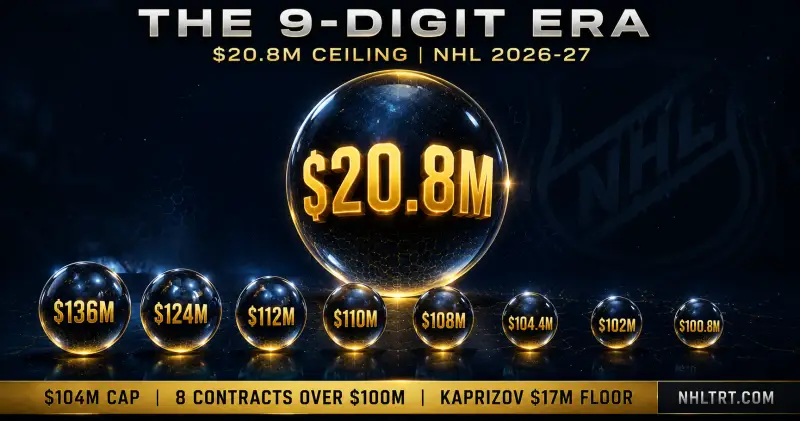
Only eight contracts in NHL history have crossed $100 million in total value. Half of them happened in the last five years. Source: The Hockey News and the published contract terms via Puckpedia.
| Rank | Player | Total Value | Year Signed |
|---|---|---|---|
| 1 | Kirill Kaprizov | $136M | 2025 |
| 2 | Alex Ovechkin* | $124M | 2008 |
| 3 | Leon Draisaitl | $112M | 2024 |
| 4 | Shea Weber | $110M | 2012 |
| 5 | Jack Eichel | $108M | 2025 |
| 6 | Sidney Crosby | $104.4M | 2012 |
| 7 | Ilya Kovalchuk** | $100M | 2010 |
| 8 | Nathan MacKinnon | $100.8M | 2022 |
* Ovechkin's 13yr/$124M deal expired at the end of the 2025-26 season. He is currently signed to a 5yr/$47.5M extension at $9.5M AAV (signed July 27, 2021). The $124M total remains the historical benchmark for the league's first 9-digit deal.
** Kovalchuk originally signed a 17yr/$102M deal with the Devils on July 19, 2010, which the NHL voided as cap circumvention on July 21, 2010. He re-signed a 15yr/$100M deal in September 2010 (later voided when he left for the KHL in 2013).
Ovechkin's 2008 deal was the league's first $100 million contract, per ESPN. It took 17 years for Kaprizov's $136M to take the all-time record off it. The pace then collapsed. Five of these eight contracts were signed since 2020, including three in the past 12 months alone (Kaprizov, Eichel, Draisaitl).
"Kaprizov's deal is the largest in NHL history by total value, surpassing Alex Ovechkin's $124 million Capitals deal that had held the record for 17 years."
Daily Faceoff, on the Kaprizov $136M extension
That Daily Faceoff line captures exactly what's happening now in reverse. The Ovechkin deal felt like a one-off — the kind of contract a generational franchise icon talks his owner into. Kaprizov, Eichel, and Draisaitl signing into the same total-value range within an 18-month window proves the 9-Digit Era moved from singular to standard. Compare to Bobrovsky's pay-cut extension with Florida — even discount deals for elite veterans now scale relative to ceilings that did not exist five years ago.
The 9-Digit Era Audit
$20.8M CEILING — WHO BREAKS IT FIRST
Combined score: contract timing + market position + agent leverage + team cap room. Higher = more likely to be the first $20M+ AAV signature.
CAP ERA TIMELINE
How the maximum allowed individual salary has tracked the NHL salary cap rise since the 2005 CBA installed the 20 percent rule. Each milestone shows cap, max, and a defining contract from that window.
What Comes Next: The 2027-28 $113.5M Cap
The NHL/NHLPA confirmed cap projections through 2027-28: $104 million next year, then $113.5 million the year after. That second jump pushes the individual ceiling to roughly $22.7 million by the time McDavid and Matthews actually need to ink new deals. They aren't competing for $20.8 million money. They're competing for what comes next.
So where does this go from here? Three quick predictions for the next 30 months:
- By July 1, 2026, somebody signs at $19M+ AAV. The cap clarity arrived May 6. Star agents have been waiting for it. Watch for an offer-sheet wave at the high end too — see extension projection mechanics for how mid-tier deals already compress upward.
- McDavid signs at $21-22M AAV in summer 2028. The two-year bridge deal he took makes no other sense. Edmonton either pays the rate or watches him walk on July 1, 2028.
- Matthews tests UFA. Toronto's recent disappointing season and the McDavid comparable will push Matthews to either secure $20M+ in Toronto or take it from a Western contender. The Stamkos exit-clause precedent shows what happens when a franchise center gets to choose his market.
That's the path. Not because the 9-Digit Era predicts it but because the cap math forces it. Every previous cap inflection point produced a wave of new top-of-market deals. The 2013 lockout gave us Crosby's $104.4M. The 2022 cap recovery gave us MacKinnon's $100.8M. This 2026 jump is bigger than both.
Companion read:
The 9-Digit Era contracts that build The July 1 Bonus Wall will be the last to use 80%+ bonus structures before the new CBA's 60% cap kicks in September 16, 2026.
Companion read:
While stars cross $20M ceilings, Toronto's 8.5% Ticket shows the rookie-max side of the same cap economy: $950K hit on top of $22.24M projected Toronto cap space.
Sources and Reporting
- NHL.com: Official 2026-27 cap announcement: $104M cap, $20.8M individual max, $76.9M floor
- ESPN: NHL salary cap to increase to $104 million: $8.5M record year-over-year jump confirmation
- The Hockey News: NHL max individual salary surpasses $20 million: First time above $20M in cap era
- Daily Faceoff: Kaprizov highest-paid NHL player ever: $17M AAV / $136M total deal mechanics
- Puckpedia: McDavid contract data: 2yr/$25M extension, UFA 2028
- ESPN: Draisaitl $112M extension: 8yr/$14M AAV verified
- ESPN: Eichel $108M extension: 8yr/$13.5M AAV signed October 2025
- The Hockey News: Richest contracts in NHL history: Top 8 contracts $100M+ ranked source
- CapWages: NHL CBA 2025 changes: 20% rule and CBA mechanics reference
The Verdict: The 9-Digit Era
The NHL just made $20.8 million the most expensive number in hockey, and Kirill Kaprizov's $17 million AAV looks like the floor of an era rather than the ceiling of one. McDavid took a deliberate two-year bridge in October to position himself against this exact cap window. Matthews owns a mirror version of that bet running through 2028.
The 9-Digit Era arrives in two waves. Wave one was Kaprizov, Eichel, and Draisaitl all crossing $100M total value within an 18-month sprint. Wave two starts on July 1, 2026, the moment teams can sign players at the new $20.8 million ceiling, and crests in summer 2028 when the McDavid and Matthews extensions go to market. By then the cap will be $113.5 million. The ceiling moves with it.
Hockey just changed its monetary scale. Kaprizov set the ceiling at $17M. McDavid takes it past $20M. The 9-Digit Era is the new floor.
Frequently Asked Questions
What is the maximum individual NHL player salary in 2026-27?
The maximum individual NHL cap hit for 2026-27 is $20.8 million, which represents 20 percent of the new $104 million salary cap upper limit announced May 6 by the NHL and NHLPA. This is the first time the maximum allowed individual salary has exceeded $20 million in the salary cap era, which began in 2005-06 with a $7.8 million ceiling. The 20 percent rule has remained constant for 21 years.
Who currently has the highest cap hit in the NHL?
Kirill Kaprizov of the Minnesota Wild owns the highest AAV in NHL history at $17 million per year. He signed an 8-year, $136 million extension on September 30, 2025 that activates with the 2026-27 season and runs through 2033-34. The contract also became the largest total value deal in NHL history, surpassing Alex Ovechkin's $124 million Capitals deal that had held the record for 17 years.
How many NHL contracts have crossed $100 million in total value?
Eight NHL contracts have totaled $100 million or more across the entire history of the league. In order: Kirill Kaprizov ($136M), Alex Ovechkin ($124M), Leon Draisaitl ($112M), Shea Weber ($110M), Jack Eichel ($108M), Sidney Crosby ($104.4M), Ilya Kovalchuk ($102M), and Nathan MacKinnon ($100.8M). Five of these eight deals were signed since 2020.
Will Connor McDavid sign for $20 million or more?
Multiple agents who spoke to Heavy.com after Kaprizov's deal projected McDavid will eclipse $20 million AAV when his current 2-year, $25 million bridge extension expires in summer 2028. McDavid took the short-term deal at $12.5 million AAV specifically to negotiate against the rising cap, with one anonymous agent stating: "I think he's going to get $20 (million AAV)." By 2028, the projected NHL cap will be $113.5 million.
Why does the NHL limit individual salaries to 20 percent of the cap?
The 20 percent individual cap rule has existed since the 2005-06 NHL season, the first year of the modern salary cap. It was negotiated into the CBA to maintain competitive balance by preventing any single team from concentrating too much spending power on one player. The rule applies at the time of signing, meaning a contract locks in based on the cap value that year and cannot be retroactively challenged when caps rise in future seasons.
Frequently Asked Questions
What is the maximum individual NHL player salary in 2026-27?
The maximum individual NHL cap hit for 2026-27 is $20.8 million, which represents 20 percent of the new $104 million salary cap upper limit announced May 6 by the NHL and NHLPA. This is the first time the maximum allowed individual salary has exceeded $20 million in the salary cap era, which began in 2005-06 with a $7.8 million ceiling. The 20 percent rule has remained constant for 21 years.
Who currently has the highest cap hit in the NHL?
Kirill Kaprizov of the Minnesota Wild owns the highest AAV in NHL history at $17 million per year. He signed an 8-year, $136 million extension on September 30, 2025 that activates with the 2026-27 season and runs through 2033-34. The contract also became the largest total value deal in NHL history, surpassing Alex Ovechkin's $124 million Capitals deal that had held the record for 17 years.
How many NHL contracts have crossed $100 million in total value?
Eight NHL contracts have totaled $100 million or more across the entire history of the league. In order: Kirill Kaprizov ($136M), Alex Ovechkin ($124M), Leon Draisaitl ($112M), Shea Weber ($110M), Jack Eichel ($108M), Sidney Crosby ($104.4M), Ilya Kovalchuk ($102M), and Nathan MacKinnon ($100.8M). Five of these eight deals were signed since 2020.
Will Connor McDavid sign for $20 million or more?
Multiple agents who spoke to Heavy.com after Kaprizov's deal projected McDavid will eclipse $20 million AAV when his current 2-year, $25 million bridge extension expires in summer 2028. McDavid took the short-term deal at $12.5 million AAV specifically to negotiate against the rising cap, with one anonymous agent stating: "I think he's going to get $20 (million AAV)." By 2028, the projected NHL cap will be $113.5 million.
Why does the NHL limit individual salaries to 20 percent of the cap?
The 20 percent individual cap rule has existed since the 2005-06 NHL season, the first year of the modern salary cap. It was negotiated into the CBA to maintain competitive balance by preventing any single team from concentrating too much spending power on one player. The rule applies at the time of signing, meaning a contract locks in based on the cap value that year and cannot be retroactively challenged when caps rise in future seasons.
Related Stories
How Much Will Gavin McKenna Make?
How much will Gavin McKenna make? The No. 1 pick already earns a reported ~$700K in college NIL, but the NHL entry-level system caps his bas...
By Mike Johnson · 8 min read

NHL Waivers Explained: The 24-Hour Window
NHL waivers explained: the 24-hour noon-to-noon ET claim window, why the worst team in the league claims first, the age-and-games exemption...
By Mike Johnson · 8 min read

NHL Entry-Level Slide Rule: The 9-Game Window
NHL entry-level slide rule explained: CBA Article 9.1(d), the 10-game cutoff (playoffs included), the September-to-December age trap, what s...
By Mike Johnson · 8 min read

Cale Makar Contract Extension 2026
Cale Makar can sign a Colorado extension on July 1, 2026, but the new CBA cuts the re-sign max from eight years to seven on September 16, so...
By James Wright · 8 min read
Comments
Be the first to share your take.
Get NHL trade rumors in your inbox
One email per week, zero spam, verified rumors only.