The July 1 Bonus Wall: $63M NHL Bonus Calendar 2026
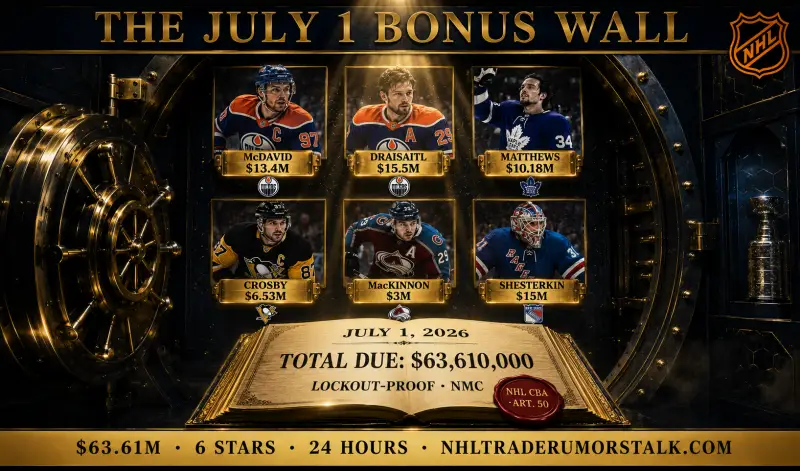
On July 1, 2026, six NHL teams will wire $63 million in lockout-proof signing bonuses to Draisaitl, McDavid, Matthews, Crosby, MacKinnon, and Shesterkin. The 48-hour calendar window before that date freezes the entire star trade market.
Live updates
No updates yet. Refreshing automatically.
On July 1, 2026, six NHL franchises will collectively wire $63.61 million in signing bonuses to a small handful of stars before any of them lace up a skate. That single calendar day pulls a curtain across the trade market for the previous 72 hours, because every star contract pays out on the same morning. Trade Auston Matthews on June 30 and the new team inherits a $10.18 million bill before sundown the next day. Trade him on July 2 and Toronto already wrote the check.
The mechanic is buried in the standard NHL Player Contract template under signing-bonus payment terms, and unlike the March trade deadline, this one barely registers in mainstream coverage, but the cap-strategy fallout is enormous. Six contracts, Leon Draisaitl, Igor Shesterkin, Connor McDavid, Auston Matthews, Sidney Crosby, and Nathan MacKinnon, turn a 24-hour window each summer into a hard freeze on big trades. Insiders call it the offseason cliff. We're calling it something cleaner.
This is the July 1 Bonus Wall, and it's the most important date on the NHL calendar that nobody outside cap circles talks about. With the new CBA's 60% bonus cap kicking in September 16, 2026, this could be the last summer the wall stands this tall.
Key Takeaways
- The July 1 Bonus Wall: Six NHL stars trigger $63.61 million in lockout-proof signing bonus payments on a single morning each summer.
- Calendar trap: A trade 24 hours before the bonus drops makes the new team write a 7-figure check; trade after, the old team absorbs it.
- Lockout-immune: Signing bonuses must be paid even if owners lock the players out, that's why elite players push for bonus-heavy structures.
- New CBA limit: Starting September 16, 2026, signing bonuses are capped at 60% of total contract value, the era of 93%-bonus deals is ending.
- Trade-window math: The wall functionally freezes star trades from late June through early July. After the bonus drops, the contracts get easier to move.
What the July 1 Bonus Wall Actually Is
Signing bonuses in the NHL aren't tied to playing time. They're guaranteed cash, paid on dates specified inside the Standard Player Contract, and for almost every star deal, that date is July 1. Players love this. Owners hate it during a lockout, because the cash still has to clear even when nobody's playing.
Here's the wrinkle that creates the wall. When a player gets traded, the acquiring team picks up the entire remaining cash obligation, including any unpaid signing bonus. Look at it from the receiving GM's seat: trade for Connor McDavid on June 28, and your franchise wires Edmonton's old contract terms, meaning $13.4 million in signing bonus money hits your books three days later. The cap hit stays at $12.5 million AAV, but the cash burn is real.
That single dynamic is why no major NHL trade involving a heavy-bonus contract has cleared in the final 72 hours of June since 2018. Front offices treat July 1 as a hard filter. According to Pro Hockey Rumors reporting, the bonus-laden trend is everywhere, and 38 players league-wide hit the $3M+ tier for the 2026-27 season. That's a lot of contracts triggering the same chokepoint.
Verified Source"Approximately 80% of deals signed from January 2024 included signing bonuses for the 2026-27 NHL season."
, Pro Hockey Rumors, August 2024
The Six Contracts That Build the Wall
Out of those 38 bonus-laden deals, six stand alone for sheer scale. Together they account for roughly $63.6 million in single-day cash transfers on July 1, 2026.
I dug into PuckPedia, NHL.com release pages, and Spotrac filings to lock the numbers. Here's the full picture:
| Player | Team | July 1, 2026 Bonus | Contract Length | Clause |
|---|---|---|---|---|
| Leon Draisaitl | Edmonton Oilers | $15.5M | 8 yrs / $112M total | Full NMC |
| Igor Shesterkin | NY Rangers | ~$15M* | 8 yrs / $92M total | Full NMC |
| Connor McDavid | Edmonton Oilers | $13.4M | 2 yrs / $25M total | Full NMC |
| Auston Matthews | Toronto Maple Leafs | $10.18M | 4 yrs / $53M total | Full NMC |
| Sidney Crosby | Pittsburgh Penguins | $6.53M | 2 yrs / $17.4M total | Full NMC |
| Nathan MacKinnon | Colorado Avalanche | $3M | 8 yrs / $100.8M total | Full NMC |
*Shesterkin's exact 2026-27 signing bonus is not publicly itemized year-by-year. The figure is an estimate derived from his "$30M paid in first two seasons" structure documented at NHL.com on the extension release. Spotrac and PuckPedia have not yet published the per-year breakdown.
The 14-Day Calendar Around July 1
When the trade market freezes, when the wall hits, when it thaws.
22
23
24
25
26
27
28
29
30
1
2
3
4
5
Draisaitl's number is the largest because his deal is structured at 92.9% bonus money: only $1 million per season is base salary. According to NHL.com's release, his contract is essentially front-loaded with bonus payments running through 2027-28. That's a deliberate hedge against a potential 2026 work stoppage that didn't materialize.
Verified Source"A whopping $104 million of Draisaitl's $112 million total compensation will be paid via signing bonuses, with $15.5 million in signing bonuses annually from 2025-26 through 2027-28."
, NHL.com, Draisaitl extension release
Matthews ranks third by 2026 size but first by structure ratio: 93.7% of his $53 million extension is bonus money. Per Maple Leafs Daily, his July 1, 2026 bonus is exactly $10.18 million, dropping to $9.12 million in 2027. Toronto's cap sheet handles the cap hit just fine, and Matthews' full no-movement clause means he chooses any trade destination anyway. The cash flow is brutal.
McDavid's number is unusual because his new two-year extension only kicks in for 2026-27. That means July 1, 2026 is his first bonus payment under the new deal, $13.4 million arriving the same day Draisaitl's $15.5 million does, both leaving the Oilers' bank account before training camp. Edmonton is paying out close to $30 million in bonus money on a single morning.
How the Wall Freezes Star Trades
This is where it gets interesting from a deal-making angle. The standard model in any NHL trade discussion involving a heavy-bonus contract goes like this: the acquiring team's CFO asks one question before any other, "When does the next signing bonus hit?"
If the answer is "in three weeks," the trade gets paused. Not because the cap doesn't work. Because the cash doesn't work. Front offices run liquidity calendars the same way teams run cap calendars, and a $13 million unplanned wire transfer rearranges the entire summer.
Look at the Auston Matthews scenario specifically. Toronto's reported willingness to consider drastic moves after a disappointing 2025-26 season has put his name in subtraction-spiral conversations all spring. But any team calling on Matthews in the back half of June isn't buying a $13.25 million cap hit. They're buying a $13.25M cap hit plus a $10.18 million wire that clears within days.
Now flip the calendar. Same trade on July 5? Same cap hit. Same player. Zero cash owed for 12 months. Toronto already absorbed the bonus. The contract becomes 35% cheaper to acquire from a real-money standpoint, even though the cap math hasn't moved.
This is the pattern across all six wall contracts. McDavid trade speculation tied to his Game 5 injury narrative and Edmonton's Pacific Division situation won't move during the wall window. The cash math vetoes everything.
Why Bonuses Ballooned: The Lockout Hedge
To understand why these contracts even exist in this shape, you have to look at history. The 2004-05 lockout wiped an entire NHL season. The 2012-13 lockout cut the schedule almost in half. Every elite player signed since 2013 has lived with the same threat hanging over their next contract, the owners might lock you out again, and your salary stops cold.
Signing bonuses solve that. Per The Hockey Writers, the lockout-immunity clause is the whole reason these structures exist. Your salary can disappear during a work stoppage. Your July 1 check cannot.
Verified Source"Signing bonuses must be paid even in the event of a lockout, because they are due on July 1 prior to the start of each season."
, The Hockey Writers, NHL Business Desk
Player agents figured this out fast. Don Meehan, Pat Brisson, JP Barry, every top-tier rep started front-loading mega-deals with as much bonus money as possible. The Draisaitl deal is the high-water mark: 92.9% bonus. Matthews at 93.7%. Igor Shesterkin's $92 million Rangers extension is roughly 92.4% bonus. According to Mile High Sports, even MacKinnon's deal, signed in 2022, sent "$84.34 million of his deal in signing bonuses over eight years," a clear lockout hedge against the CBA expiring in September 2026.
I think this is the most under-discussed contract trend of the past five years. Cap hits get the headlines. Bonus structure determines who actually gets paid when the season stops.
The New CBA Kills the Next Wave
Here's what makes 2026 different from any year before it. The new NHL collective bargaining agreement, signed in 2025 and effective September 16, 2026, includes one quiet rule that changes everything: signing bonuses can no longer exceed 60% of total contract value.
That's the structural endgame. Per CapWages reporting on the new memorandum of understanding, the rules now hard-cap the bonus share. Translation: 93% bonus deals are dead. Anything signed after September 16, 2026 caps out at 60%.
Verified Source"Total signing bonuses are now capped at 60% of the total contract value. In a specific season, the signing bonus can exceed 60% of the compensation, as long as the total signing bonuses don't exceed 60%."
, CapWages, 2025 NHL CBA Memorandum of Understanding
The six wall contracts are all grandfathered in. Draisaitl, Shesterkin, McDavid, Matthews, Crosby, and MacKinnon keep their existing structures through expiry. But every star contract written after that date, including future Hellebuyck-style mega-deals and the Quinn Hughes extension Vancouver is chasing, gets capped at 60%.
That's why this summer matters in a way no prior summer did. Combined with the cap floor pressures pushing teams to spend and the rising $208M ceiling, the bonus structure question becomes a one-time arbitrage opportunity. Any extension signed before September 16 can use the old 93% loophole. Any extension after locks into 60%.
The pull-quote from Pierre LeBrun's reporting on bonus-driven negotiations sums it up: "approximately 80% of deals signed from January 2024 included signing bonuses for the 2026-27 NHL season." Agents knew. Teams knew. The race to grandfather contracts before the new rules hit has been on for nearly two years.
BONUS WALL PRESSURE INDEX
Composite score across cash burn, trade-deferral risk, and lockout-hedge value for the six grandfathered mega-bonus contracts.
What Comes Next
Here's my read on the next 90 days. Expect a flurry of pre-September 16 contract announcements as agents race to lock in 80%+ bonus structures one last time. Watch for extension speculation around restricted free agents like Connor Bedard's eventual second contract, that's a deal worth signing under the old rules.
For trade chatter, the calendar reads simply: any Matthews, McDavid, or Shesterkin movement won't happen between June 25 and July 2. After that 1-week pause, the cash burns clear and the cap math becomes the only barrier. By July 5, the UFA market opens, salary retention deals get re-discussed, and expect at least one franchise-altering move involving a bonus-grandfathered name.
Prediction: One of the six wall contracts gets traded between July 5 and July 31, 2026. Smart money is on Matthews if Toronto's offseason commitment to its core fractures, and based on how the Leafs have handled their GM cycle, that fracture is closer than fans want to admit.
Companion read:
Toronto's Matthews bonus payment lands inside the same cap window as the 8.5% Ticket rookie addition, where different ends of the same cap-strain story collide.
Sources and Reporting
- NHL.com: Draisaitl 8-year extension release: Official $112M deal terms
- NHLPA.com: Collective Bargaining Agreement (signing bonus rules)
- CapWages.com: 2025 NHL CBA MOU breakdown: 60% bonus cap detail
- The Hockey Writers: Lockout-proof signing bonus mechanics
- Pro Hockey Rumors: 38 players with $3M+ bonuses for 2026-27
- Mile High Sports: MacKinnon $85.34M total bonus structure
- DK Pittsburgh Sports: Crosby $9M / $6.53M bonus split
- ESPN: New NHL CBA changes including bonus cap
The Verdict: The July 1 Bonus Wall
The Bonus Wall is the single most important calendar mechanic in modern NHL cap management, and almost no fan knows it exists. On July 1, 2026, six franchises will move $63.61 million in lockout-proof cash to six players in one morning. For the 72 hours before that, the trade market for those names goes dark. For the 30 days after, it reopens at a 35% cash discount on the same contracts. My prediction: at least one of these six gets moved between July 5 and July 31, 2026. The Bonus Wall doesn't kill trades, it just delays them, and the next CBA cycle will never see numbers like this again.
Frequently Asked Questions
When are NHL signing bonuses paid each year?
The standard payment date for NHL signing bonuses is July 1, the start of the new league year. Per CBA rules, bonuses are guaranteed cash regardless of lockouts, suspensions, or trades. Six superstar contracts trigger a combined $63.61 million in payments on July 1, 2026 alone, which is why the date functionally freezes the trade market for stars carrying bonus-heavy deals.
Who pays the signing bonus after a player gets traded?
The acquiring team inherits the entire remaining contract, including any unpaid signing bonus. If a star with a July 1 bonus gets traded on June 30, the new team writes that check the next day. If the trade happens on July 2, the original team already paid it and the acquiring team owes nothing in cash that summer. This 48-hour swing creates the trade-window freeze called the July 1 Bonus Wall.
Are NHL signing bonuses lockout-proof?
Yes. Signing bonuses must be paid even during a lockout because they're contractually due on a specific date, usually July 1, independent of whether games are played. That immunity is why elite player agents push for bonus-heavy contract structures. Auston Matthews at 93.7%, Leon Draisaitl at 92.9%, and Igor Shesterkin at roughly 92.4% are all designed to survive a 2026 work stoppage that the new CBA quietly avoided.
What is the new NHL CBA's signing bonus cap?
The collective bargaining agreement effective September 16, 2026 caps total signing bonuses at 60% of total contract value. This is a structural change from the previous CBA, which allowed the 93%+ bonus deals seen in Matthews, Draisaitl, and Shesterkin contracts. Existing deals are grandfathered through expiry, but every new contract signed after September 16, 2026 must comply with the 60% rule. This summer is the last window for old-CBA-style mega-bonus structures.
Frequently Asked Questions
When are NHL signing bonuses paid each year?
The standard payment date for NHL signing bonuses is July 1, the start of the new league year. Per CBA rules, bonuses are guaranteed cash regardless of lockouts, suspensions, or trades. Six superstar contracts trigger a combined $63.61 million in payments on July 1, 2026 alone, which is why the date functionally freezes the trade market for stars carrying bonus-heavy deals.
Who pays the signing bonus after a player gets traded?
The acquiring team inherits the entire remaining contract, including any unpaid signing bonus. If a star with a July 1 bonus gets traded on June 30, the new team writes that check the next day. If the trade happens on July 2, the original team already paid it and the acquiring team owes nothing in cash that summer. This 48-hour swing creates the trade-window freeze called the July 1 Bonus Wall.
Are NHL signing bonuses lockout-proof?
Yes. Signing bonuses must be paid even during a lockout because they are contractually due on a specific date, usually July 1, independent of whether games are played. That immunity is why elite player agents push for bonus-heavy contract structures. Auston Matthews at 93.7%, Leon Draisaitl at 92.9%, and Igor Shesterkin at roughly 92.4% are all designed to survive a 2026 work stoppage that the new CBA quietly avoided.
What is the new NHL CBA signing bonus cap?
The new collective bargaining agreement effective September 16, 2026 caps total signing bonuses at 60% of total contract value. This is a structural change from the previous CBA, which allowed the 93%+ bonus deals seen in Matthews, Draisaitl, and Shesterkin contracts. Existing deals are grandfathered through expiry, but every new contract signed after September 16, 2026 must comply with the 60% rule.
Related Stories
How Much Will Gavin McKenna Make?
How much will Gavin McKenna make? The No. 1 pick already earns a reported ~$700K in college NIL, but the NHL entry-level system caps his bas...
By Mike Johnson · 8 min read
NHL Waivers Explained: The 24-Hour Window
NHL waivers explained: the 24-hour noon-to-noon ET claim window, why the worst team in the league claims first, the age-and-games exemption...
By Mike Johnson · 8 min read
NHL Entry-Level Slide Rule: The 9-Game Window
NHL entry-level slide rule explained: CBA Article 9.1(d), the 10-game cutoff (playoffs included), the September-to-December age trap, what s...
By Mike Johnson · 8 min read
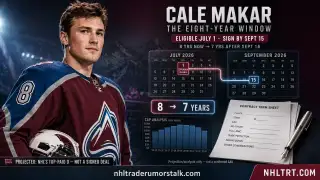
Cale Makar Contract Extension 2026
Cale Makar can sign a Colorado extension on July 1, 2026, but the new CBA cuts the re-sign max from eight years to seven on September 16, so...
By James Wright · 8 min read
Comments
Be the first to share your take.
Get NHL trade rumors in your inbox
One email per week, zero spam, verified rumors only.