Maple Leafs Andersson Trade Offer 2026: Counter-Offer Gap
The Maple Leafs Andersson trade offer 2026 is finally public: Treliving offered Ben Danford plus a pick. Conroy countered with two firsts plus Easton Cowan. Inside the Counter-Offer Gap that killed the deal.
Live updates
No updates yet. Refreshing automatically.
The Maple Leafs Andersson trade offer 2026 is finally public: Brad Treliving pitched prospect Ben Danford plus at least one pick. Craig Conroy countered with two first-round picks and Easton Cowan. Toronto walked.
The gap between those two offers is what I'm calling the Counter-Offer Gap — a structural asset-quality mismatch so wide the deal was dead before it reached paper. Understanding why matters because Mike Gillis and Mats Sundin inherit the same Calgary phone line this summer, and Huberdeau at 50 percent retained is the sequel.
According to TSN's Darren Dreger, the Maple Leafs Andersson trade offer 2026 finally has a specific shape: Brad Treliving pitched prospect Ben Danford plus at least one draft pick for Rasmus Andersson at the 2026 deadline. Craig Conroy countered with two first-round picks plus Easton Cowan — and Toronto refused. That rejected framework is what I'm calling the Counter-Offer Gap, the structural distance between what a buyer puts on the table and what a seller demands, which usually determines whether a deal is possible or functionally dead on arrival.
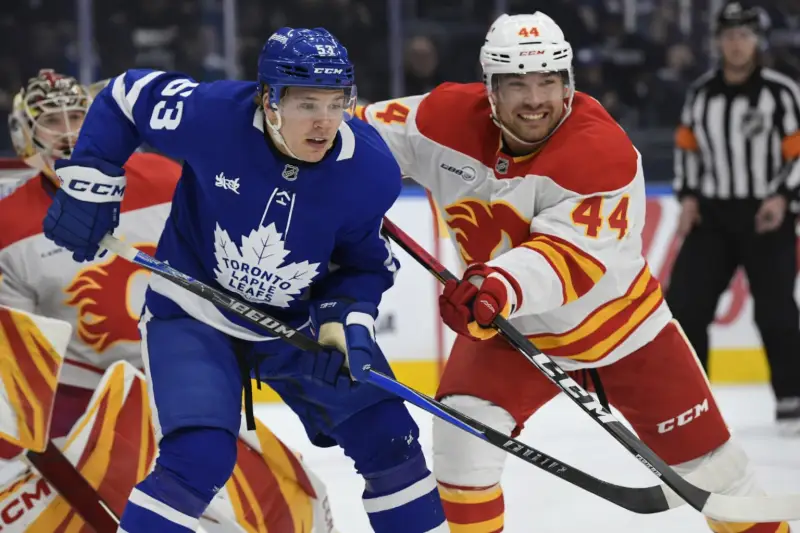
Here's the mechanism: Danford was Toronto's 2024 first-round pick (31st overall), a 6'2" right-shot defenseman still playing in the OHL with the Oshawa Generals at age 20. Zero NHL games. Cowan, by contrast, was Calgary's demand — Toronto's top prospect who had already graduated to 60 NHL games with 25 points as a 21-year-old rookie. The gap between "untested prospect" and "graduated NHL player plus two firsts" wasn't a negotiation — it was Calgary saying no by asking for something Toronto would never trade.
My read: this rejected offer tells you more about both organizations than the Vegas trade that actually closed. Treliving understood Andersson's rental status capped the return. Conroy understood his rebuilt-Saddledome architecture needed NHL-ready assets, not pipeline depth.
My earlier breakdown of the Asking Price Delta explains what Calgary ultimately settled for with Vegas (Whitecloud, Wiebe, 2027 first, conditional 2028 second) — and none of those pieces maps cleanly onto what Toronto could offer.
Key Takeaways
- The Counter-Offer Gap: Toronto offered Ben Danford (2024 first-rounder, 0 NHL games) plus a pick. Calgary demanded two firsts plus Easton Cowan (25 NHL points as a rookie). The asset-quality mismatch made the deal impossible.
- Dreger's reveal: TSN's Darren Dreger reported the exact rejected terms: "I believe the Flames wanted two 1sts and Easton Cowan for Rasmus Andersson." That single sentence confirms a specific offer that had been reported only in fragments before now.
- Andersson's market context: A 29-year-old defenseman on an expiring $4.55 million contract with no extension possible mid-season created a rental pricing ceiling that Calgary's counter-demand ignored completely.
- The Cowan refusal: Toronto's unwillingness to move Cowan for a rental was their strategic line. Cowan went on to score 9 goals and 16 assists in 60 NHL games — validating the refusal across a full rookie season.
- Gillis and Sundin inherit the phone line: Calgary will push Jonathan Huberdeau at 50 percent retention this summer ($5.25M effective cap hit on a top-six winger). That same asset-value calculus returns with new Toronto decision-makers.
The Maple Leafs Andersson Trade Offer 2026 — What Treliving Actually Proposed
Toronto's package was more modest than most competitors assumed heading into the deadline. Per Dreger's reporting, Treliving's offer centered on Ben Danford — the 31st overall pick from the 2024 NHL Draft — plus at least one draft pick. That's it.
No NHL roster player. No multi-first structure. One prospect plus a pick for a top-pair defender on an expiring contract with 50 percent retention available.
Danford was a specific choice, not random inclusion. The 6'2", 192-pound right-shot defenseman from Belleville carries first-round pedigree (31st overall, 2024), posted 33 points in 64 OHL games with a plus-27 rating last season, and earned OHL Third Team All-Star honors this year as captain of the Oshawa Generals with 5 goals and 20 assists in 61 games.
The problem wasn't Danford himself. Calgary wasn't shopping for a developmental project — Conroy needed NHL-graduated talent to fit the rebuild-retool hybrid I broke down in the Saddledome Exit Strategy piece. Danford was the wrong asset profile for the moment.
Why the Counter-Offer Gap Was Always Too Wide
Calgary's counter wasn't incremental. Two first-round picks plus Easton Cowan represented a fundamentally different asset class than Toronto's proposal. Cowan wasn't just another prospect — he was the 2023 first-round pick (28th overall) who had won 2025 Memorial Cup MVP, graduated to 60 NHL games in 2025-26, and posted 25 points as a rookie. Calgary was asking for a player, not a pipeline piece.
The Counter-Offer Gap
The Counter-Offer Gap is the structural distance between a buyer's opening trade offer and the seller's counter-demand. Small gaps signal an active negotiation. Large gaps — especially when the asset classes don't match (prospect vs NHL player, picks vs roster depth) — signal the deal is functionally dead on arrival. Reading the gap correctly is how GMs decide whether to keep talking or move on.
"I believe the Flames wanted two 1sts and Easton Cowan for Rasmus Andersson."
— Darren Dreger, TSN Insider (via NHL Trade Rumors)That quote matters because it confirms the gap was asymmetric by design. Calgary didn't counter Toronto's offer with an incrementally larger ask — they countered with a categorically different ask. Cowan's Memorial Cup MVP trophy, his NHL graduation, and his 21-year-old age all pushed him into an asset tier Danford won't reach for at least two more seasons. Similar to the Matthew Knies deadline calculus I mapped earlier, Toronto's organizational line was clear: unproven prospects and picks are available, but graduated NHL players with term are protected.
Ben Danford vs Easton Cowan — Why Calgary Demanded the Older Prospect
Here's the asset comparison table that explains the mismatch better than any narrative:
| Metric | Ben Danford (Offered) | Easton Cowan (Demanded) |
|---|---|---|
| Draft position | 31st overall, 2024 | 28th overall, 2023 |
| Current age | 20 | 21 |
| Primary league 2025-26 | OHL (Oshawa Generals) | NHL (Toronto Maple Leafs) |
| NHL games played | 0 | 60 |
| Signature accomplishment | OHL Third Team All-Star | 2025 Memorial Cup MVP |
| Position value | RHD stay-at-home | Top-six winger projection |
Every row in that table favors Cowan. He's a year older in the same draft class, graduated to the NHL while Danford is still captaining an OHL team, and carries a Memorial Cup MVP trophy that Danford's 2024 run to the OHL final with Oshawa couldn't match. From Calgary's perspective, asking for Cowan wasn't greedy — it was consistent with what they got from Vegas (Zach Whitecloud, an NHL defenseman plus picks). They needed graduated assets to restock.
What stands out: Calgary's demand pattern was identical across both partners. They asked Toronto for NHL-ready Cowan and got rejected. They asked Vegas for NHL-ready Whitecloud and got the deal. Toronto's equivalent (Cowan) was too valuable to surrender for a rental.
What This Tells Us About Gillis and Sundin's Incoming Leafs Philosophy
Brad Treliving was fired on March 30, 2026. The Maple Leafs are reportedly close to hiring a Mike Gillis and Mats Sundin management duo to lead the front office, per Sportsnet's Elliotte Friedman and confirmation from Daily Faceoff. The Andersson non-trade becomes an important philosophical test case for whoever walks into that building next.
Treliving passed on the deal because moving a graduated NHL rookie for a rental violated his asset-preservation instincts. The Subtraction Spiral I wrote about last month captured Toronto's broader 2025-26 season problem — veteran departures without equivalent replacements. Adding to that problem by shipping Cowan for a two-month rental would have compounded the structural issue the team is already trying to escape.
Gillis brings a specific philosophy from his Vancouver years: analytics-native roster construction with a preference for younger, cost-controlled assets. Sundin brings institutional memory and player-relations credibility. Together, they arrive at an organization that just said no to a Cowan-for-rental trade — which is exactly the kind of discipline Gillis built Vancouver on before the 2014 firing.
"Mike Gillis signed Mats Sundin with the Vancouver Canucks back in 2008."
— Daily Faceoff analysis (via Daily Faceoff)That single historical fact is why the partnership concept makes sense. Gillis and Sundin already have a trust-based professional relationship going back 18 years, which shortcuts the usual GM-president integration friction. The Overcorrection Cycle risk I flagged in my Maple Leafs GM search piece applies directly here — hiring two executives who already know each other's philosophies reduces the learning-curve risk that doomed the previous regime's first-year decisions.
Huberdeau at 50 Percent Retained — The Summer Sequel to Watch
Calgary and Toronto aren't done talking. According to multiple reports, the Flames will spend the summer trying to move Jonathan Huberdeau, whose $10.5 million cap hit runs through 2030-31 as one of the highest-priced forward contracts in the league. At 50 percent retention, Huberdeau's effective cap hit drops to $5.25 million — a more movable number for a top-six winger on a team that needs right-wing help for Auston Matthews.
This is the summer sequel to the Andersson rejection. Nick Robertson's likely exit this summer combined with the Leafs' acknowledged need for top-six wing production makes Huberdeau a structurally plausible target — but only at the right retention percentage and the right asset price. If Calgary demands Cowan or Danford in any Huberdeau package, Gillis and Sundin will hang up the phone the same way Treliving did.
My projection: Calgary moves Huberdeau to a team other than Toronto by August 1, accepting a second-round pick plus minor-league depth at 50 percent retention. The Bobrovsky pay-cut precedent applies to high-AAV veterans who become movable once the retention math works. If Toronto does end up as the destination, it'll require Calgary to drop their asking price further than Huberdeau's market value currently suggests.
Sources and Reporting
- Hockey Patrol — Confirmation of Toronto-Calgary Andersson trade frustration
- Heavy.com — Ben Danford as Toronto's offered prospect in the Andersson negotiation
- NHL.com — Ben Danford Draft Profile — 31st overall 2024, defensive-zone reliability
- The Leafs Nation — Cowan 2025-26 rookie season stats and NHL role
- PuckPedia — Andersson contract — $27.3M total, $4.55M AAV, UFA July 2026, 50% retained by Calgary
- Maple Leafs Hot Stove — Gillis and Sundin reported partnership management role
- PuckPedia — Huberdeau contract — $84M / 8yr / $10.5M AAV through 2030-31
- Wikipedia — Ben Danford — Full draft, OHL career, and prospect profile
The Verdict: The Counter-Offer Gap
The Maple Leafs Andersson trade offer 2026 looks in retrospect like a market-efficient rejection. Treliving offered what the asset profile justified — a first-round prospect plus a pick for a rental UFA. Conroy countered with an asset class Toronto couldn't match without gutting its prospect pipeline.
That wasn't bad negotiation — it was two teams with mismatched valuations walking away cleanly. My projection: Gillis and Sundin will run the same analysis on Huberdeau at 50 percent retention this summer, and if Calgary's ask includes Cowan or Danford, Toronto will walk a second time. The Counter-Offer Gap is how smart teams avoid bad trades.
Frequently Asked Questions
What did the Maple Leafs offer for Rasmus Andersson?
Toronto offered Ben Danford, their 2024 first-round pick (31st overall), plus at least one draft pick in exchange for Rasmus Andersson. TSN's Darren Dreger confirmed the package structure, which centered on the 20-year-old OHL defenseman currently captaining the Oshawa Generals. No NHL roster player was included in the Toronto proposal.
Why did Calgary reject the Maple Leafs offer?
Calgary's GM Craig Conroy counter-demanded two first-round picks plus top prospect Easton Cowan instead. The Flames wanted NHL-graduated or near-graduated assets to fit their retool timeline, not a pure prospect-pipeline addition. Toronto refused because Cowan was viewed as an untouchable developmental asset who ultimately posted 25 points as a 2025-26 rookie.
Who is Ben Danford?
Ben Danford is a 20-year-old right-shot defenseman from Belleville, Ontario, drafted 31st overall by Toronto in 2024. He's 6'2", 192 pounds and currently captains the Oshawa Generals in the OHL. His 2025-26 season included 5 goals and 20 assists in 61 games and earned him OHL Third Team All-Star honors. He has zero NHL games played as of the 2026 deadline.
Did the Leafs trade for Rasmus Andersson?
No. Andersson was traded to the Vegas Golden Knights on January 18, 2026 for Zach Whitecloud, prospect Abram Wiebe, a 2027 first-round pick, and a conditional 2028 second-round pick. Calgary retained 50 percent of Andersson's $4.55 million cap hit in the transaction. Andersson becomes an unrestricted free agent on July 1, 2026.
Will the Leafs pursue Jonathan Huberdeau this summer?
Reports indicate Calgary will actively shop Huberdeau in summer 2026 at potential 50 percent salary retention, which would drop his effective cap hit to $5.25 million. Toronto's acknowledged need for a top-six right-wing alongside Auston Matthews makes them a logical destination, but the new Gillis-Sundin regime will apply the same asset-valuation discipline that doomed the Andersson deal before closing any package.
Frequently Asked Questions
What did the Maple Leafs offer for Rasmus Andersson?
Toronto offered Ben Danford, their 2024 first-round pick (31st overall), plus at least one draft pick in exchange for Rasmus Andersson. TSN's Darren Dreger confirmed the package structure, which centered on the 20-year-old OHL defenseman currently captaining the Oshawa Generals. No NHL roster player was included in the Toronto proposal.
Why did Calgary reject the Maple Leafs offer?
Calgary's GM Craig Conroy counter-demanded two first-round picks plus top prospect Easton Cowan instead. The Flames wanted NHL-graduated or near-graduated assets to fit their retool timeline, not a pure prospect-pipeline addition. Toronto refused because Cowan was viewed as an untouchable developmental asset who ultimately posted 25 points as a 2025-26 rookie.
Who is Ben Danford?
Ben Danford is a 20-year-old right-shot defenseman from Belleville, Ontario, drafted 31st overall by Toronto in 2024. He's 6'2", 192 pounds and currently captains the Oshawa Generals in the OHL. His 2025-26 season included 5 goals and 20 assists in 61 games and earned him OHL Third Team All-Star honors. He has zero NHL games played as of the 2026 deadline.
Did the Leafs trade for Rasmus Andersson?
No. Andersson was traded to the Vegas Golden Knights on January 18, 2026 for Zach Whitecloud, prospect Abram Wiebe, a 2027 first-round pick, and a conditional 2028 second-round pick. Calgary retained 50 percent of Andersson's $4.55 million cap hit in the transaction. Andersson becomes an unrestricted free agent on July 1, 2026.
Will the Leafs pursue Jonathan Huberdeau this summer?
Reports indicate Calgary will actively shop Huberdeau in summer 2026 at potential 50 percent salary retention, which would drop his effective cap hit to $5.25 million. Toronto's acknowledged need for a top-six right-wing alongside Auston Matthews makes them a logical destination, but the new Gillis-Sundin regime will apply the same asset-valuation discipline that doomed the Andersson deal before closing any package.
Related Stories

Darnell Nurse Trade: 4 Suitors
Edmonton wants Darnell Nurse's $9.25M off the books, but a buyout saves barely $1.53M and his no-move clause hands him the pen. The Bonus Sh...
By Mike Johnson · 12 min read

Darren Raddysh Free Agent 2026: 4 Teams
Darren Raddysh's 70-point breakout turned his $975K cap hit into a four-team bidding war. The Athletic linked him to Philadelphia, San Jose,...
By Mike Johnson · 13 min read
Bobby McMann Free Agent 2026 Destinations: 4 Teams Linked
Bobby McMann's career-high 29 goals just turned a $1.35M cap hit into Sharangovich-tier money. The Athletic locked him to 4 teams (Detroit,...
By Mike Johnson · 10 min read
Hellebuyck Trade Rumors 2026: The Vulture Watch Begins
Connor Hellebuyck is still under contract — but rivals circle as Winnipeg's window narrows.
By Sarah Chen · 1 min read
Get NHL trade rumors in your inbox
One email per week. Zero spam. Verified rumors only.